So the first company that I believe meets this dynamic of an attractive buy today is Meta.
Contexto
"So the first company that I believe meets this dynamic of an attractive buy today is Meta. It's been one of my top picks in 2026 and it doesn't change today."
The last of the big tech that I believe is uniquely ideal right now is Microsoft.
Contexto
"The last of the big tech that I believe is uniquely ideal right now is Microsoft... And if it is, this will prove to be an ideal time to buy."
Now, the next two that I'll mention that I believe are particularly attractive buys today are two that I've recently added to the portfolio. Both Uber and Door Dash.
Now, the next two that I'll mention that I believe are particularly attractive buys today are two that I've recently added to the portfolio. Both Uber and Door Dash.
I believe Copart represents a very interesting company to look at.
Contexto
"...there's other companies that I believe are worth looking at today. For example, Copart... I believe Copart represents a very interesting company to look at."
...the only use of time is how do I buy more Bitcoin? But take all your money, buy Bitcoin, then take all your time, figure out how to borrow more money to buy more Bitcoin.
Contexto
Michael Saylor quote: "...the only use of time is how do I buy more Bitcoin? ... take all your money, buy Bitcoin..."
No, we're always buying. Uh Bitcoin is always a good investment. We're always buying.
Contexto
Michael Saylor quote: "No, we're always buying. Uh Bitcoin is always a good investment. We're always buying."
Transcrição Completa
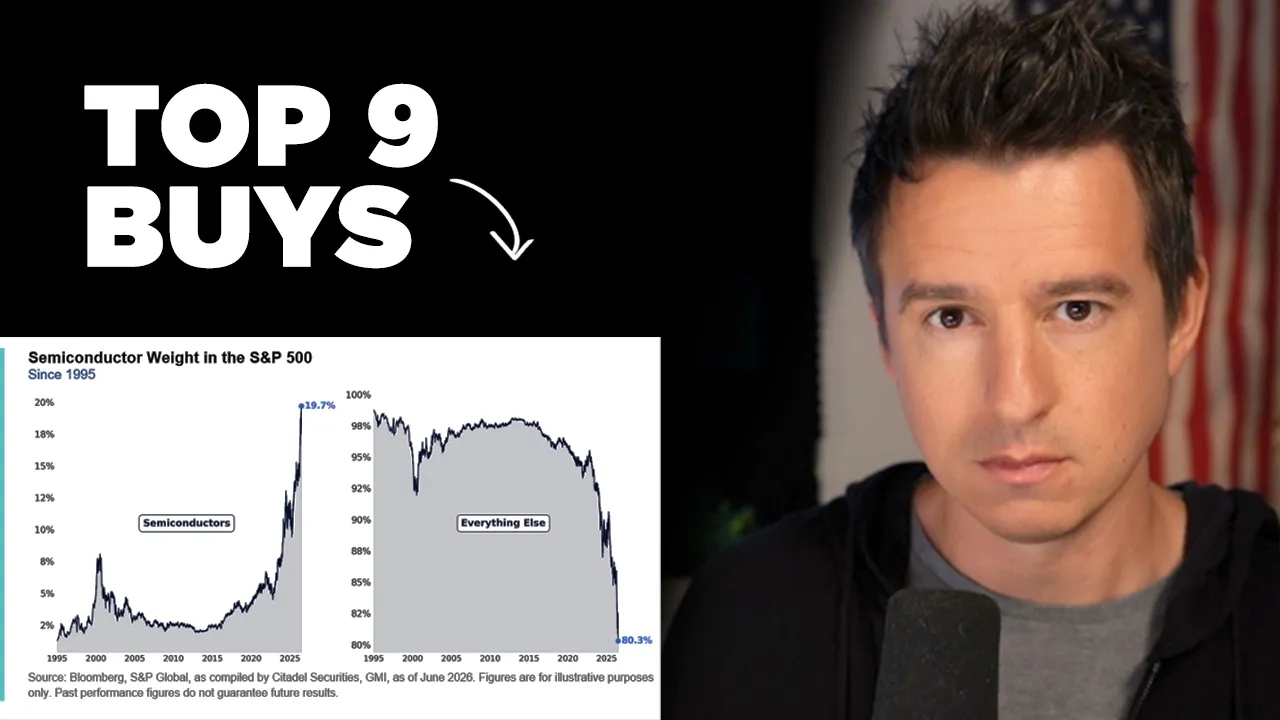
Today on the Joseph Carlson show, we're going to be going over nine stocks to buy in July. With the market racing up, led by semiconductor stocks. You know the drill. It's the same group of companies going up every single day. These are the Micron Technologies, the ASMLs, the companies that have been leading this market in 2026. But I have a group of nine stocks that I believe have been left behind. These are all extremely high-quality companies and they're now trading at attractive valuations. and I'll be laying out the case of why I believe each one of them is a buy in July. Now, of course, we have other news to get to. For example, Tom Lee is on CNBC today laying out his case of why he believes July will be a strong month in the market. Big tech companies are now flipping on that narrative of AI wiping out all your jobs. And then in this week's fail of the week, we have Micro Strategies Michael Sailor, the crazy Bitcoin guy. He's once again demolished his own company's stock. It's down 80% and we'll be discussing in the fail of the week. So, we have a ton to get to in this episode. And just a reminder, if you haven't already, try out qual.com. This website I own 100%. I created it from the ground up and I built it specifically for investors. It has all the charts, the graphs, the earnings calendars, DCF, watch lists, all of that good stuff. Plus, you have exclusive content. We have Qualrum Studio with high quality, extensive deep dives into different companies, portfolio updates, as well as new content coming out every single week. So, if you want to try that out, you can do so with a free trial at qualim.com. Now, we start things off today by looking at nine companies that I believe are excellent quality and they're particularly good buys today. Now, when I look at companies, I'm looking for compounding machines, extremely highquality, durable earnings growth companies. I'm not looking for just a timely trade, one that I can flip over a 3-month period. These are stocks that you can buy into as large concentrated positions and hold for multi-year periods and make significant gains over a long period of time. In fact, if I do my analysis correctly, these are companies that you could theoretically hold forever, hopefully for multiple decades. So, if I break this into two parts, I have the long-term part of the company. That's the moat, the duration, the earnings growth, the margins of the company. I need that to go up over long periods of time. I need the company to become more financially prosperous over time, the moat to get wider, and for it to make more and more money every single year. That is the long-term thing that I'm looking for. In the short term, I'm looking for valuation. So, I want to buy these great companies when they offer very attractive prices. Finding that mixture where you get both a great company and you get it at a very attractive price is difficult, but it happens. Again, that combination doesn't happen often, but it's happening right now for a very specific reason. This chart illustrates the dynamic being played out here and the opportunity within. When we look at this, this is the semiconductor weight in the S&P 500 since 1995. Now I want to zoom in here. We have this side which is the semiconductors. So this is semiconductors as a percentage of the S&P 500 or the waiting of semiconductors in the S&P 500. You can see that in 1995 it was roughly 1%. Then it went up to 2%. Then it went all the way up to around 8%. So right there we're at around 8%. Of course the dot bubble burst. Semiconductors went way down as investors sold out as a percentage of the S&P 500. Now, don't be confused. This is not just Semiconductor's share price going up and down. This is as a percentage of the rest of the market. So, it actually went down as a percentage of the S&P 500. And then all throughout around this time period from 2005 to around uh 2020, it never made up over 5%. In fact, most of the time it was right around 2% here. Very small amount of the S&P 500. We've never had a a big portion of the S&P 500 be semiconductors. But then you can see what happened in 2020. It started to trend up a little bit. Nothing crazy. People were relating it back here to being like the dot bubble levels, but it started to go up a lot more. When you really look at how dramatic semiconductors have climbed as a percentage of this market, it's staggering. The visuals really illustrate it here. It went from 8% up to 12%. This was uh back in 2024. So we're at 12%. And then in another year, just one more year, semiconductors climbed up to 19.7%. So today, it's around 20% of the S&P 500. Now, that should be shocking to nobody because when we look at the market, it's going up every day, but it's only going up because of semiconductors. We've looked at another illustration that shows that all the returns this year, literally all of them are driven by semiconductors. and then a tiny portion driven by energy companies because of semiconductors. So all the alpha all the positive gains this year are from semistocks. So it's driven up in terms of gains in the market and the S&P 500 and the QQQ and it's built a massive portion of the S&P 500 now up to 20% which is unprecedented. Now there's valid arguments of why semi stocks are doing well right now. Of course these companies have an influx of demand. They are being priced with scarcity pricing. It's as if everybody wants these products all at the same time and there's not enough of them. So when supply is far below demand, the prices go up dramatically. And companies like Micron and many others have jacked up their prices 10 times causing incredible margins and earnings in the short term. So you may look at this and say, "Well, Joseph, that's justified." And that's true. It could be justified for a time, but historically semiconductor stocks have been far more volatile. They're considered cyclical. They have influxes of scarcity pricing, demand which eventually stabilize and then they get diminished. Over time, we should see something similar here. You can say that there's different structural changes and maybe it's not quite as cyclical this time, but it's difficult to argue that there's no more cyclicality in semi stocks. Plus, what we're seeing now with the rise in semis like we saw in 2000 is an immense amount of momentum in these companies. People are simply buying semistocks because other people are buying semistocks. It is the Tik Tok trader. Just buy whatever is going up. Well, a lot of people are following that advice. Semi stocks are going up. More people are buying them. Therefore, making them go up even further. Even Bloomberg has written about this that the strategy of simply buying whatever is going up is the winning strategy today. It's being driven in large part by momentum factors. So, while we look at semi stocks and the massive success, I don't want to say that none of this is justified or that I'm bearish on semis going forward. That's not the claim that I'm making. But I do believe that there is momentum in semis that the valuations are being moved up dramatically. And I think that there's opportunities that are far more attractive elsewhere in the market. You could actually see the same dynamic during 2000. For example, many people reference how internet stocks were overvalued in 2000. That's the obvious fact. All the internet companies, the tech companies, right, they went up to insane valuations. We had companies that just had a website with really no business model trading at huge market caps and valuations. And that's what caused the bubble. Everybody knows that. But what most people miss is that if you went outside of the internet stocks, the most popular, the ones with the most momentum, the ones with the most excitement, if you looked anywhere outside of those companies, the rest of the market was overall a fantastic buy. You could have bought numerous companies that were not internet stocks and you would have done really well. Consumer staples did great from 2000. They went up 35%. Utilities also did great. We had healthcare companies and small cap companies doing great. There's many railroads and there's companies like Monster Energy that did fantastic starting from the year 2000. The only place that you didn't want to be during that time period was the place that everyone wanted to be during that time period. The stocks that continued going up because people kept buying them. The dot bubble internet stocks. Those were the specific ones you wanted to avoid. If you're concerned about a market that continues to raise up, pushing the valuations of the most hyped companies up more and more every single day, there's more than one option than getting out of the market. The other option is to simply look at what else is being left behind cuz just like in 2000, those in some cases are the best deals. And I believe it will be similar today. The other part of this equation, the semiconductor waiting is that as this percentage of semiconductors goes up to 20%. We have everything else and everything else is going down as a percentage of the S&P 500 from nearly 98% down to now just 80%. So semiconductors have eaten away the market share, the waiting of the S&P 500 to a huge extent. The only way for the S&P 500 to give up this much share in waiting from everything else to just semiconductor stocks is for a lot of money to move quickly. And remember that in the short term, the market is mostly a reallocation game. Money moves from everywhere else to fund all these semiconductor buys. So I believe this dynamic of investors pulling money out of everywhere indiscriminately and throwing it into semiconductors creates a unique situation to the benefit of investors that are willing to go against the pack today and that is this everything else category. This creates a fertile hunting ground for investors looking for the highest quality companies at the lowest valuations today. And I believe the ones that are the most reasonable to highlight today are the big tech companies. Big tech companies are growing faster than ever. Their headcount is stabilizing. Their earnings growth are growing. Their revenue is accelerating. Yet, the stock prices are at multi-year lows. And that is because of the narrative of their capex spend. Investors are concerned about this. Well, most investors, Bill Aman is one of the ones who's not concerned about this capex investment. And I agree with Bill Aman here. >> They're businesses that we've admired for a long time, but they were never cheap enough for us. We at least we missed the opportunities when they had moments of cheapness. Mhm. >> Um but I think the market has reacted very negatively to the very large uh capital expenditures that these companies have committed to you know in the approaching you know many hundreds of billions of dollars and I guess investors are concerned about are they going to earn adequate returns on these investments and I would say we don't share that concern at all. one the kind of valuations of the companies have come down significantly and that meanwhile their growth rates are accelerating and that's what really creates an opportunity and we you know we we have confidence in the management teams here when they say that we're earning you know very very attractive returns on these investments it it makes sense to us I mean >> so Bill Aman's not worried about the capex spend I'm not worried about it and in fact I wouldn't describe myself as not worried about it I would describe myself as excited about it whenever a company has influx demand so much that they customers lining out the door that they have to build more product to fulfill on that customer demand. I consider that a good thing. If you have so many customers that you need to build more locations as a restaurant, that's a good thing. In this case, while investors are still skeptical, we can even see leading data showing that these big tech companies are doing quite well with AI already. For example, this chart shows that the biggest AI spenders are accelerating profits and moderating headcount. Meaning that profits are going up while headcount is staying the same or in many cases going down. That's operating leverage. We can see this with Google. Google has the adjusted EBIT going up every single quarter, every year while the headcount stays the same. When you map this out with EBIT per employee in 2022 was $393,000 per employee. Then in 2023, it's 488. 2024 it's 6 uh 613 2025 676 this is per employee so the amount of EBIT per employee is going up double in just uh four years and then it's expected to rise all throughout 2026 2027 and 2028 we can see the same dynamic with Microsoft we see the EBIT going up by billions every single year we have the headcount going down slightly over the long term we have the EBIT per employee going from 389,000 up to past 1 million In Met is no exception. In fact, Met is actually increasing its EBIT per employee at a faster kager than either of these companies so far, faster than Microsoft or Google. It's growing its EBIT every single year very fast. And the headcount's actually going down. So, the adjusted EBIT per employee is going from 389,000 up to a projected 1.78 million. We have Amazon. Amazon has a ton of employees because they have their huge logistics business. But you see the same trend here. The headcount in Amazon's case is remaining the same. But even keeping this headcount the same is a big win for Amazon because their revenue continues to grow. So the adjusted EBIT per employee is going from 8,000 to 24 and then in 2028 it's expected to rise to 112,000 at a faster ker than any of these companies. So the first company that I believe meets this dynamic of an attractive buy today is Meta. It's been one of my top picks in 2026 and it doesn't change today. I still think that Meta is a unique combination of very fast growth, high operating leverage, an incredibly strong financial business for its core business, and its growth paths are very attractive. When we look at Meta, it also trades at an 18 times forward PE. That gives you a lot of wiggle room with the valuation. In the short term, the valuation could always go lower. Investors can sell out of Meta while they go into different things, but long term, this sets up for a very attractive buy. Met has already shown an incredible amount of optionality with their compute spend that they're doing. For example, semi analysis just published this article saying that they have so many different options of what they can do with it. First of all, they have their frontier AI model. Meta has not given up on training frontier models. The bulk of incremental capacity still goes to Meta super intelligent labs which we think the team is currently excited about their progress. Meta is building an ecosystem of products. They want to have a flagship model and they're working towards that and there's a report saying that they're getting closer. They say number two, we have the core system of meta. We believe Meta thinks they can scale up ad recommendation systems by over 10x in complexity to accelerate revenue growth that requires both inference and training compute for their Rexis models. So Meta believes that they can improve their ad recommendation system by over 10x. Third, they say that we believe Meta is in final talks with anthropic to get access to private instance of Claude. This would be akin to bedrock foundry or vertex from the hyperscalers. There are multiple use cases for meta ranging from internal usage to building the premier sales and marketing SAS powered by Frontier AI agents. We expect Meta to launch a token as a service endpoint and increasingly move up the stack. People from Meta have already talked about releasing their AI API so other companies can actually externally use what they're building. And then finally, there's the optionality of becoming a NeoCloud business. We expect Meta to strike a few SpaceX type deals. Elon is a sales genius and he created a brand new marketing segment. Large-scale ondemand compute at a huge pricing premium. We think Meta wants in, but selectively. After all, just a couple hundred MWs can already drive 10 billion a year in revenue. We expect a $10 billion anthropic deal to kick off the flywheel. Essentially, the meta bull case is that the capex is doing exactly what Mark Zuckerberg said he wanted it to do. create a superpower for Meta. Make it so that not only can they enhance their core business with ads, but they can build their own flagship AI model. They can license it, they can do whatever they want with an API and allow other people to use it, as well as they can simply just rent out extra compute capacity in a Starlink like deal. All of that equates to a very attractive company, an interesting one that again is selling at an 184p. Next up is an easy one. We also have Amazon. Amazon's a bit different than Meta because it doesn't face any of the same type of risks. Amazon has the benefit of already having their massive logistics system, already having the two-day delivery, having the Prime membership. Uh, and then on top of that, we have AWS, which I believe going forward will grow at an accelerated pace. There is so much demand for their products. Amazon is spending more on capex than anyone at this point, and all of it is going online and being immediately monetized. I believe that Amazon this month is another unique deal. The last of the big tech that I believe is uniquely ideal right now is Microsoft. It continues to trade below $400 per share. That puts Microsoft at below a 24p ratio. If we look at the current valuation and compare it to its history, this can inform us of what type of situation Microsoft's in. Microsoft typically trades around this range around a 30 plus PE ratio on a trailing basis. Usually between a 30 and a 38. And that's not even the highest it has traded. has traded up to almost a 40 trailing PE just in 2024. So just last year. Then we have this here. You can see this coincide with the chart that I showed at the beginning that everything else including Microsoft is being sold to fund semiconductor stocks. Since Microsoft is not a semi stock, it's being thrown out with the rest of them. Microsoft's valuation has plummeted to a 5-year low now trading at the 23. The lowest point that we got in the 2022 sell-off, this was the big tech sell-off when you could have bought Microsoft for as cheap as possible, was a 23 trailing PE. That's right where we are today. Now, of course, this is backwards looking. The future may be different for Microsoft. But even the analyst projections are that it's going to grow earnings per share at a high teens rate. We don't see the Microsoft Office suite losing any actual market share today. It looks like even in the future, Microsoft will be just fine. And if it is, this will prove to be an ideal time to buy. So I believe Meta, Amazon, and Microsoft are all uniquely good buys in July, and I think it will be proven out in the next 3 years. There's no guarantees with any of this. Investing always takes on risk. That's why we buy more than one company. But I see a lot of good fundamental reasons of why these stocks are attractive buys today. The next one that I would mention is Netflix. Netflix is trading down again today. It's down to $75.83 per share. It's actually given up a lot of gains recently. It's down 15% this year. And then if we look over the long term, if we zoom out a bit, Netflix is down around 40% from its highs. The stock now trades at valuations that are relatively tame. This is a 224 PE ratio today based on 2027's earnings per share estimates right now. It's trading at a 20. I believe these earnings per share estimates are actually low. So I think the stock is actually below a 20 PE ratio based on the true earnings that I'll put up. So, in my analysis, Netflix is rather cheap today. And there's a couple reasons why. One of them that I believe is the most valid reason of why Netflix stock is trading down is that Netflix simply hasn't had a big hit in a while. I have the service. I'm a Netflix subscriber. I've had it for over 10 years. But when I look at Netflix, usually every year, every 3 to 6 months, they have some type of big hit, right? You have the Stranger Things, you have Squid Game, you have K-pop Demon Hunters. uh you have something that comes out of the woodworks. You don't even know what it may be. It might be Tiger King. Remember that one? It can be anything, but usually there's like a really big hit that comes out for Netflix. And in 2026, there really hasn't been one. If I'm being honest, I watched the service and it's been rather flat for the past 6 months. So, investors are looking at this scratching their head saying that Netflix hasn't come out with any big hits. And then you have HBO coming out with like The House of the Dragon. You have Apple TV uh coming out with a lot of good stuff. Apple TV has some really highbrow, entertaining, really well done shows and it makes you become a bit more concerned about Netflix. In fact, one of the problems with Netflix, of course, is continually coming out with great content. They have an issue now, as Bloomberg notes, that Netflix viewers routinely abandon shows after the first season. Netflix is struggling to get viewers to stick with its shows for more than a season. One Piece, for example, one of Netflix's most watched shows in 2023, lost more than 30% of its audience for the second season. Two seasons or season two of Beef, rather, suffered a drop of more than 70%. And The Night Agent shed 50% of its audience for the second season and another 35% for its third season. Adding insult to injury, the latest season of Avatar: The Last Airbender, one of Netflix's most watched titles in 2024, suffered a drop of more than 60% over week 1. That doesn't bode well for the rest of the month. Now, apparently Netflix themselves is aware of this and they're very concerned about it and they're doing a lot to study it and find out what is the root factors behind this. They say the sharp drop in viewers is a major source of concern for the company, which has been studying its data to figure out why this is happening. Now, I have my own thoughts of why this is happening. In fact, I think some of them are fairly obvious. For example, we can go through some of these shows, and some of them have very specific reasons. They mention Beef here, which had a fantastic season 1. If you haven't seen it, it's well worth watching. But Beef is an anthology. Season 1 is completely different than season 2. It doesn't have any of the same actors, the same story. There's no continuity whatsoever. So, this one, I believe, is totally unreasonable to include here. the the show is nothing like itself in season 1 and season 2. It's just the same name. And then we have other shows, many of which have come out multiple years later. And I believe that's a root cause of the problem here. Some of these shows you're waiting 2 years if you're lucky to get a second season. In many cases, it's like 3 to 5 years. With the amount of content that comes out every single day, trying to wait 3 to four years for a new season of a show, it may as well just be an eternity. You watch a show and then it comes out with a new season. You're thinking, "What even happened in the first season? I can't even remember it." Compare that to shows like Breaking Bad, which came out with a new season almost every single year. Not quite, but almost every single year they had a new season. And the new seasons had tons of episodes at full length, 45 minutes. So, this was a ton of content every single year. You could actually remember the storyline as you were watching it. And the show continued to gain popularity all throughout the seasons. and it was the most popular in season 5. Breaking Bad is a great example of this solution to these problems. An example of a Netflix series that has done this, at least to a good extent, is Ozark. Remember that one with Jason Baitman? It has a bit of a Breaking Bad fill. It's all about drugs and he's an accountant that does money laundering. It's a great series. I think it's worth watching. But this was one that it came out with seasons pretty consistently throughout. every single season led up with continuity to the other one and it gained in viewership every season until the finale. It was one of the biggest hits on Netflix. Netflix can do this correctly. They've shown it before with some of their their shows, but in so many cases, Netflix makes the mistake of first of all just cancing a lot of shows. So, people don't want to get invested when they know that there's a 50% chance the next season will be cancelled. Uh, in some cases, Netflix has literally canled seasons on huge cliffhers. The Santa Clarita diet, for example, this series went on for three seasons. It ended the third season on a giant cliffhanger leading up to the next season and then it was cancelled. How much respect do you have for your members to have a giant cliffhanger for a series that's been on for three seasons and then you cancel it? These are the problems that people have trusting Netflix with a fulllength series. Apple's doing this differently. Apple finishes every series. It doesn't matter if it has like five viewers or a million. They finish every single series that they start. They never cancel them. So, people know when they're watching an Apple series that it's going to be finished thoroughly. And Netflix can improve on this. They can finish out more of their series, even if the viewership is struggling in the short term. They can not end series on huge cliffhers before cancing them, especially. And they can come out with series far quicker, record them upfront, multiple seasons, more episodes of the same shows, and would fix a lot of these issues. Now, I believe that Netflix is a type of company to learn from mistakes. It adapts quickly. They look at all the data and they come up with long-term solutions. So, I expect to see some of these things be implemented over time. But finally, when we look at Netflix stock, this has never been a good company to bet against. Every time investors have beaten down Netflix and said that it's the end for this company, it's continued to grow. Netflix is expected to grow its earnings per share quickly, its revenue quickly, it's expected to have operating margins go up. And then the last point I'll make on this stock is that Netflix is a company that is being sold with the rest of the stock market indiscriminately. That is happening. The comparable that I'll give is to Spotify. I've made this comparison before, but it's hard to explain why Netflix and Spotify trade almost identically if all the problems of the stock going down are fundamental. If it's all because of hit series or whatever earnings growth projection you make for Netflix, why is Spotify stock trading in lock step with Netflix? It's because a lot of this has to do with market dynamics of people pulling money out of everywhere else and putting it in semiconductors. Now, the next two that I'll mention that I believe are particularly attractive buys today are two that I've recently added to the portfolio. Both Uber and Door Dash. Both of these companies specialize in different categories. Uber of course is the ride sharing king today. They have the massive network. They have all the advantages to keep this network even amongst the competition of AV competitors. Uber stock price went as high as $100 per share. At that point I was thinking h it's probably not the best to buy and then it traded all the way back down to $70 per share. And this gives us an opportunity. As we look at Whimo, Tesla, Zuks, and all these other competitors to Uber, they do face competition, but just to highlight the scale and size difference, Whimo's doing 500,000 trips per week, and Uber is doing 3.64 billion trips per quarter. To put that in perspective, Uber does 570 times plus the trips that Whimo does. Over 570 times. Uh, that's a lot more. Now, Whimo, of course, can try to chip away at this, but the lead for Uber I consider insurmountable at this point. It is a massive aggregator of demand. They continue to grow all throughout the world. Door Dash is another one where the stock price went up to $281 per share. It traded down to 150. That's where I bought in on the company. It's traded back up a little bit now to 190. So, when I look at these companies, I have my portfolio today, which by the way, it cracked a million dollars in the passive income portfolio. So, that's fun to see. But when we look at these two positions, Door Dash has moved up a little bit. Uber is still flattish going back from the red to the green. And by the way, this holding right here, Mobility Global, is a spin-off from S&P Global. I've not decided to sell it yet. I'm going to be holding on to this one for a little bit. But when we look at Door Dash and Uber, these are two companies that I'm excited about because they're both early in their growth path. They both suffered extensive sell-offs throughout this market dynamic. And then there's other companies that I believe are worth looking at today. For example, Copart is a company that has a very solid emote, a solid business model, but this one has been crushed in this market. It was trading at $62 per share. Now, it's all the way down to 28%. So, it's down over 50% from its highs. I believe Copart represents a very interesting company to look at. It's one that I'm fascinated by the business model. They work with unique real estate insurance companies and their own software. They have an incredibly strong balance sheet, and they'll still grow over the long term. So that's one that I'm interested in as well. We also have Constellation Software. It's basically a company that does serial acquisitions of vertically integrated software. It's selling off of course because of the market dynamics in general as well as the distaste for any company that has anything to do with software. Constellation remains a very high-quality company and I do not believe that Claude is going to replace or even really damage the huge majority of software that they own. This selloff is likely overdone with this one as well. The last one that I'll mention is Mastercard. Another obvious one here. It's been left behind in this market. It's down from its highs. It was trading at $600 per share. Now it's at 530. Mastercard at a 254 PE 23 based off 2027's earnings is an attractive valuation on a very high quality company. So I believe all of these are very interesting companies. I've added to many positions in my portfolio. I've built out and bolstered up a lot of these holdings so that when this trade finally happens, when the market cools off of semiconductors a little and refocuses elsewhere for a time, I'll be well situated for that. In the meantime, I have a couple companies that have done well in this market. Google's one of them and ASML is another one that continues to go up any day the semiconductor trade goes up. But I'm building up the rest of my portfolio for when this trade happens. Now, as we jump into some news here, we have Tom Lee explaining why he believes this month will be particularly good in the market. It's going to be a strong July. >> Uh yeah, I mean July, we're going to get Q2 earnings, >> right? >> And uh in the first quarter, earnings came in way better than expected. And so the market's PE is actually lower now than it was in January by one point, one full turn. And I think second quarter earnings are going to surprise to the upside again. So the market's going to get cheaper again. and that means there's room for PE to expand. So I think July is going to be a stronger month for stocks. >> Now that's a very straightforward thesis. He says that last quarter earnings came in better than expected. This quarter, which is this month, they're going to report earnings and it should come in very strong. Earnings should continue to grow, which means that the stock market will either get cheaper or stock prices will move up to adjust for the new earnings growth. One of those has to happen. And since stocks are already somewhat cheap, he believes that it's more likely that in July stock prices move up. So I don't have any disagreement with this fundamentally. All I would say is that it's a very short timeline to predict. I don't know if this will all happen in July, but it it very well could. Now, the other piece of news that is worth highlighting here is this massive sentiment shift and thought shift from all the big tech leaders. Big tech has suddenly flipped on the AI jobs wipeout scenario. A year ago, the message from many business leaders was that AI was going to wipe out jobs. For the past month or so, tech CEOs have been striking a more optimistic tone. In late May, OpenAI Chief Executive Sam Alman, who has long predicted that AI will lead to seismic shifts in workforce, said during a conference, quote, "We've been roughly right on the technological predictions and pretty wrong on the social and economic implications." The anthropic CEO Dario Amade who warned in May 2025 that artificial intelligence could eliminate half of entry-level jobs a year later highlighted more positive scenarios for AI adopting businesses. Quote, "They can do the same thing with less resources and that leads to things like layoffs or they can do more with the same amount of resources, but that requires creativity." Now, I've said this for a very long period of time. AI is not going to cause a situation where nobody can find a job. It's just not going to happen. The doom and gloom that these people share is completely unfounded. When you have a product that makes people more productive, it makes the person more valuable. As long as people need to do anything with AI, which they still very well need to do long into the future, you'll have more and more people being hired because of this not fired. But now, finally, we're starting to see the leaders themselves, the promoters of this doom and gloom change their stance. Now, moving on, we get to the fail of the week, which is Micro Strategies Michael Sailor. If we look at Micro Strategy as a company, you can see that this company stock price is down around 80% from the highs. So, it's trading upwards of $450 plus dollars. Now, if we look at it today, it is down to $98. And this all happened in just a couple of years with Bitcoin declining. It goes down 30 40%. Micro Strategy was basically a levered play on Bitcoin and so it it fell a more dramatic amount. Now, Michael Sailor is unique in that he's one of the only individuals ever to have done this twice in a public company. For example, this wasn't random chance, and the fact that he's done this twice in a row also isn't random. The way that he runs his company is destined for failure. Sailor has trained investors to believe Strategy's model of acquiring bitcoins would work so long as the market value the company at a premium to the value of a Bitcoin holding. Now the problem is that this entire strategy ran on the assumption that Micro Strategy would always trade at a premium to Bitcoin. When the metric began showing the market was valuing strategy at a discount to the value of its bitcoins, the roll-up strategy was starting to come undone. And roll-ups typically don't work well in reverse. So basically his entire company depended on always trading at a premium to Bitcoin. And as soon as that reversed, as soon as he started trading at a discount, everything just started to unravel. Now, the stock price is down around 78% from its highs. Any investor that's bought Micro Strategy recently, of course, has been completely destroyed. Now, you may wonder why anybody would have invested in this in the first place. Well, there's a lot of believers in Bitcoin. And if they believe they can get into Bitcoin and have even better returns in Bitcoin itself, some people are drawn to that. There's also the fact that Michael Sailor himself is very confident and very outspoken and very definitive with everything he says about Bitcoin. >> If I told you I know how it all ends, right? Once you know how it all ends, that that the only use of time is how do I buy more Bitcoin? But take all your money, buy Bitcoin, then take all your time, figure out how to borrow more money to buy more Bitcoin. then take all your time and figure out what you can sell to buy Bitcoin. And if you absolutely love the thing that you're that you don't want to sell it, go mortgage your house and buy Bitcoin with it. And if you've got a business that you love because your family works for the business, it's in your family for 37 years and you can't bear to sell it, mortgage it, finance it, and convert the proceeds into the hardest money on earth, which is Bitcoin. So what I would say is use all your time to acquire Bitcoin, finance entities and weaker currencies to buy Bitcoin or educate yourself on why this makes sense if you're not sure. And then educate everybody around you. You know, if you're working for a company that's got a $100 million in the treasury, you ought to convince the CEO and the board of directors to convert the treasury to Bitcoin. That's the most accreative thing you can do. That'd be worth billions to them. This is his whole mo basically do everything you can, sell everything, leverage everything to buy as much Bitcoin as you can. That's what he's done with Micro Strategy is simply taken equity, sold it to buy Bitcoin and over and over again. He also is instructing others to do the same. Sell your house, sell every safe asset, everything that you need to try to buy Bitcoin. More speculative asset, but he doesn't call it speculative. He says that he knows how it's going to end. He also knows that this entire thing is reliant on other people buying Bitcoin. Bitcoin has no earnings per share to speak of. It has no fundamentals, no free cash flow. It's all dependent on other investors valuing it at even more than you paid for it. So, he's saying to become a religious zealot, proceliting Bitcoin, sharing it with your your businesses, getting them to invest their balance sheet in Bitcoin from lesser assets and lesser currencies. You got to share the good message to buy Bitcoin to make Michael Sailor's holding go up. He's tried to do the same thing. He tried to instruct Berkshire Hathaway with Warren Buffett to invest their huge balance sheet that's currently in US treasuries into Bitcoin instead. That 32 uh 320 billion that is destroying $ 32 billion a year. They are destroying $3 billion a month in capital because they're they're generating a 3% after tax yield at best and the cost capital is 15%. So take 12% negative real yield on that. That is the cost. Multiply 30 325 billion times 12%. That's what the shareholders are paying right now for that. Since he's suggested to Buffett to invest the entire balance in Bitcoin, Bitcoin has fallen by 30%. It would have been looked at as one of the worst decisions Buffett would ever have made to follow Michael Sailor's advice. Michael Sailor continues to preach his advice that everybody needs to buy Bitcoin and do everything you can and invest all the balance sheets of all of America's companies into Bitcoin. And when he's questioned by anyone with any simple question, in many cases, he'll act extremely defensively, even rude to the interviewer. >> No, no. The the question I'm trying to get to though is like with in 25 like you launching the preferreds, which I think are a really interesting product, does that change the the playbook for all these other companies and how do they now compete against you? Now you have the preferreds as well. >> I I again I take issue with your question. It's an ignorant, insulting, myopic question. Why do you why do you frame things that way? We're not competing with each other. That's like saying, well, you know, like I heard my neighbor bought Bitcoin and I bought Bitcoin. There's not enough room for both of us to buy Bitcoin. We're competing with each other now. What's my what's my ne my neighbor's got to buy another crypto asset. Like we're not competing with each other Danny. Like that that's that's the ignorant part of the question, right? That's what I take issue with. What you have if you're a hotel company in Japan >> Mhm. >> you're competing with other hotel companies in Japan. And the decision to buy Bitcoin is just a decision to improve the quality of your company. It's like saying, "How many companies can have electricity?" I heard 200 companies have electricity, but there's one company that uses a lot of it. So, do the other companies have to change their strategy? Dude, like you think they had the same strategy? It's a it's a it's a silly question and and it's a it's a myopic, ignorant, toxic framing of a question and the result is you c you know, you come to some ignorant conclusion. Okay, >> there's room for 400 million companies to buy Bitcoin, Danny. >> Mhm. >> Do insurance companies? >> He hasn't stopped once. This just keeps going. The interviewer hasn't said a thing. He's on his where what are we at now? Almost twominute rant. And of course, this question was totally reasonable. Micro strategy, even if they're not hiring people and competing directly for business, if you buy micro sailors preferred, that's money going that place and not other places. those other places are competing for you for each incremental dollar. Michael Sailor has also gone on the air multiple times to say that they're never selling. They're never going to sell Bitcoin. They're only ever buyers forever and ever and ever. We're buying quite a lot actually and we'll we'll actually report our next buys on Monday morning. I think people will be pleasantly surprised. In fact, we've been accelerating our purchases. >> Are you ever not buying, Michael? >> No, we're always buying. Uh Bitcoin is always a good investment. We're always buying. We always think it's a great deal. But then when it came out to Micro Strategy selling, this is what he has to say in response to that. >> Yeah. Well, the point is I said to, by the way, I said to you, never sell your Bitcoin. I never said that the company wouldn't sell his Bitcoin. >> So, he flips on his own advice and now he's having to backpedal dramatically because of it. So, as we look at the epic collapse of Micro Strategy with the stock down 80% from its highs, we can only conclude that this was entirely inevitable. That's it for this episode. Hope you enjoy your day. Have a good one.

Comentários 0
Entre para participar da discussão.
EntrarAinda não há comentários. Seja o primeiro a compartilhar sua opinião!