- Video return
- +47.74%
- Calls
- 2
- Buy / Sell
- 2 0
- Published
Recommendations
Entry is the asset's closing price on the publication date. Current is the last close on record.
-
Entry $1,569.94 01 Jul 2026Current $2,499.93 25 Aug 2026Result +$929.99
I ended up taking the trade on both Ethereum and on Bitcoin. I took a long
Context “I ended up taking the trade on both Ethereum and on Bitcoin. I took a long and if we bring this out to the 15minute chart, you can actually go ahead and see the positive price action.”
-
Entry $58,550.75 01 Jul 2026Current $78,497.00 26 Aug 2026Result +$19,946.25
I ended up taking the trade on both Ethereum and on Bitcoin. I took a long
Context “I ended up taking the trade on both Ethereum and on Bitcoin. I took a long and if we bring this out to the 15minute chart, you can actually go ahead and see the positive price action.”
Full Transcript
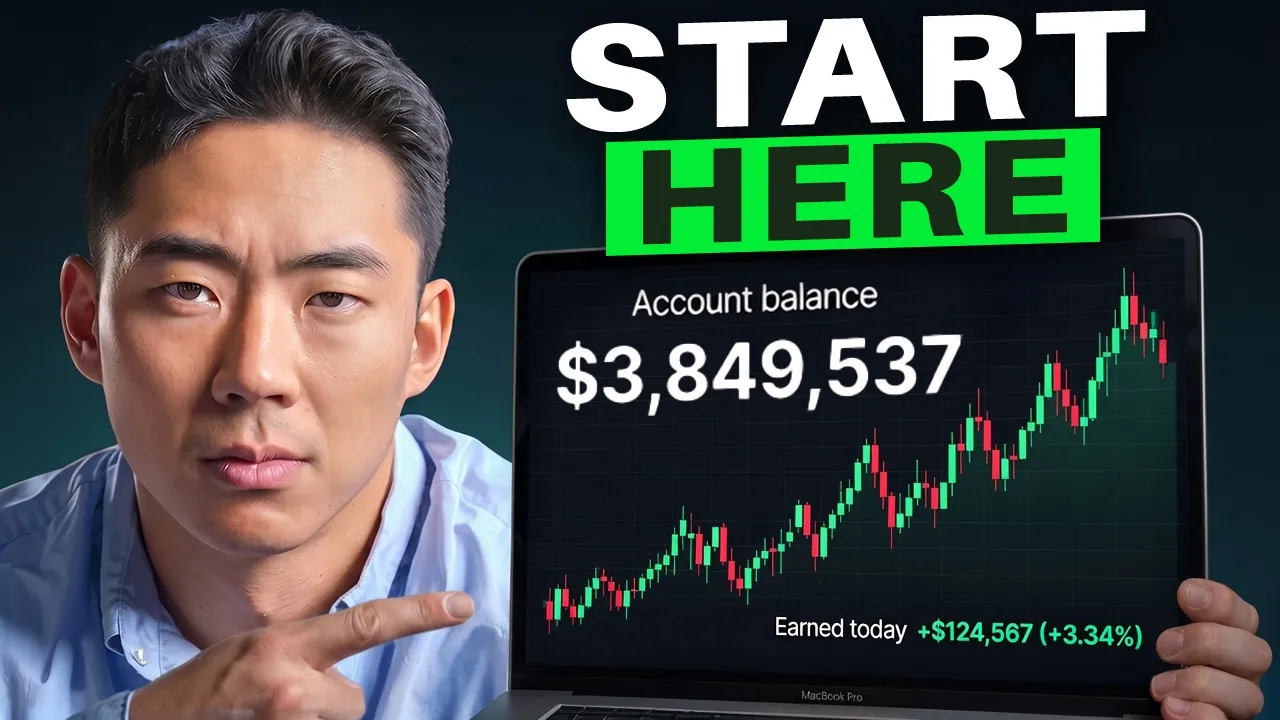
So, a few years ago, if you really wanted an edge in trading, you pretty much needed expensive research subscriptions, years of screen time, or an actual professional trading desk. Today, one person with a laptop and the right AI tools can do things that not too long ago would have taken an entire team to pull off. And yet, most traders right now are still stuck watching random YouTube videos, buying course after course, hopping from one strategy to the next, and wondering why they still can't make any money. Now, you've probably heard of the stat before that around 90% of traders lose money. And depending on which study you pull, that exact number moves around a bit, but the reality stays the same, which is that the overwhelming majority of people who get into trading never actually become consistently profitable. Now, I personally don't think that's because trading is impossible. And I don't think it's because most people aren't smart enough to figure it out. The way I see it, it's because most people are still learning how to trade the exact same way it's been taught for the last couple of decades. So, in this video, I'm going to break down why so many traders even fail before they get a real shot at succeeding. From there, I'm going to show you what I would do differently, the exact skills I would focus on first, the mistakes I would go out of my way to avoid, and how I would actually build an edge, and how I would use AI to seriously speed up the learning curve. On top of that, towards the end of the video, I'm going to also pull back the curtain to show you my actual trading workflow. I'll then show you how I research for opportunities, how I prep before I even take a trade, and how I use these tools in a real behindthescenes example that I filmed just for you guys, so you can see exactly how all of this comes together in real life. So, think about how most people get into this. Maybe you saw someone on YouTube flashing their profits. Maybe you saw a trader on Tik Tok throwing up a P&L screenshot. Or maybe you bought a course that promised to hand you some winning strategy. Now, none of those are necessarily bad on their own. But here's the real problem, guys. Most people spent all of their time learning how to place trades long before they ever realize how the market actually works. These are the same people that memorize candlesticks, indicators, and patterns. They learn support and resistance and then they learn different systems, but then they still fail and they still have no real idea why price is even moving in that direction in the first place. So, what I've seen is that we have pretty much now a new generation, a whole army of traders who can spot a bull flag in 2 seconds, but have no clue what's actually driving liquidity. These are the same people who only look at the charts and they don't acknowledge what catalysts matter or what risks are sitting right around the corner waiting to wipe them out. Because the point I want to make here is this. If I really had to start over in 2026 or 2027, I really don't believe it's high ROI to go spend years memorizing every indicator, every pattern under the sun, constantly hopping from this to that, trying to figure out what's going to work or hunting for that next secret setup, thinking that there's a secret sauce to all this. And it's kind of like that whole Kung Fu Panda moment where Po opens up the secret scroll to unlock unlimited powers and he finds out it's actually just a reflection of himself. Trading is kind of like that. and I'll reveal to you exactly how that works. With that said, the big takeaway though before we get into it is that I truly believe that putting your focus on understanding how markets actually work and building real systems is what's going to give you the strongest edge and the best foundation to beat the pretty brutal odds that every new trader is up against. So, for those who don't know me, over the last few years, I've traded a 7igure portfolio. I even grew one of my accounts from roughly $3,000 to over $600,000 in just a matter of months. But honestly, that's not even the part of the story that I think is the most valuable for you. Because what actually matters are all the mistakes that I learned along the way. All the losses that I had, all the setbacks, because all those moments are now things that I can share to you to help you grow in your journey and pretty much speedrun the ways to become a profitable trader. Look, I mean, even in my worst moments, there was definitely a point. I even thought all of day trading was just straight up gambling. It was pretty much a big scam. But once I got the simple fundamentals down, which I'm going to share with you in this video, I realized that the problem wasn't with the industry. The problem was with me. So the reason I share all of this with you in today's video is to help someone to avoid all those mistakes, to give you some hope in this industry. Because if I really knew now what I knew back then, I really believe that I would have gotten so much farther than where I'm at today. So before we even get into the solution, we first need to understand why is it that so many traders end up losing in the first place? Why does day trading have such a bad stigma to it? As I mentioned in the beginning of the video, the data that most people lose money in trading is pretty consistent. Let's start with this study from Brazil where researchers tracked every single person who started day trading on one of the biggest futures markets in the entire world. And out of everyone who stuck with it for more than 300 days, 97% of them lost money. Now, only about 1% ended up making more than their country's minimum wage. And it wasn't even just Brazil either. Taiwan ran their own study. They looked at 15 years of data and they found that less than 1% of them were able to turn a real consistent profit. Now, naturally, you might hear about a number like that and then just assume, all right, why would I even participate in this game if this is that hard? I would even be asking myself questions like, is the market really rigged? I've heard that claim a lot. Or I'd even ask myself, is it just that people are too emotional and maybe all of them were just following a wrong system? And I think there's a lot of truth in all those statements. So upon doing more research, I found this one really interesting take. When it comes to the study done in Brazil, all the people that kept day trading, the ones that were grinding day in and day out, losing from year after year, it never changed. If they kept losing in the beginning, they kept losing at the end. What this here tells me is that the problem was never really about effort or even about luck. And I don't think it was about screen time either because they were spending a lot of time trading. The problem, I believe, came from the approach itself. And the way I see it, most traders lose money because of four specific things, and they pretty much all come back to learning this game in the wrong order. So, the first problem why most people are losing money when it comes to trading is this. Most people learn how to place trades before they even learn how markets actually work. I've been through this pattern. You get excited. You see the 12-year-old driving a Lamborghini in Miami. Then you're like, "All right, if he's doing this, I definitely deserve to do this." You open up account. You deposit some money. You watch some YouTube videos. Before you know it, you're taking trades. You think you know what you're doing. You see support and resistance. You think you're the new ICT master of the entire world. And then it takes only a few weeks for you to then realize this ain't working. This is because, like I said, a lot of people get into trading the exact opposite way. They never take time to actually understand how liquidity moves. They look at their lines and charts thinking that's what predicts the future, but they don't bother to spend any time learning what real market drivers are. and especially most importantly knowing why price moves the way it does. So then you can build conviction and take a high probability setup from there. Now the second problem and this is a big one and it's that most traders who get into trading have no unique identifiable edge. If there's anything I've learned about trading is that you have to understand this. Trading is still a very PvP game. I like thinking about it in Call of Duty or some kind of skill-based matchmaking game where you know you're going up against other people. But in this case, this is not skill-based matchmaking. This means if you just started for the very first time, you're going up against the guy who's been trading in these markets for the last 30 years with a bigger payroll with a quant team behind him. And to me, it's like Hazabula trying to square up against Mike Tyson in a legitimate fight. When you don't have an edge, you don't even understand the basis of your own system, the likelihood that you're going to win consistently over time is pretty low. The third reason why most new traders lose money is simply because of information overload. Today we got all this social media. We got Twitter, Instagram, Stock Twits, Reddit, we got the news, we got podcasts, newsletters, you name it. The list goes on and on. And the problem isn't that there's a lack of information like how it used to be maybe back in the day. But the problem is now there's way too much information. So instead of getting any kind of clarity, most people end up drowning in noise and stuck in complete analysis paralysis. And that's only going to keep getting harder. And then last but not least, the fourth problem that most traders have is that there is no real feedback loop. The average trader who gets into the game only care about when they win. After that, they move on to the next. There's no reflection. There's no learning in the process. And really, those are the moments where if you lose, you're supposed to learn from them. And that's how you prevent making those same mistakes in the future. But most people don't care to do that. They don't have the time. They don't have the energy or they just have convinced themselves that there's no point in doing so. You ever open a trade and then completely forget what you did? Well, a month later, a year later, two years later, the best traders in the world remember their biggest mistakes. The worst traders in the world don't even remember what they did yesterday. There's a study here where two professors tracked over 60,000 households and found that the ones who traded the most earned around 11% a year, while the overall market did about 18% in returns. It turns out the people who are most active, the ones constantly jumping in and out of trades, actually ended up with the worst returns out of everyone. Now, this is where I want to introduce to you the new way. This is what I call the way of the modern trader. And the best way I can explain the difference is with a simple analogy. Think about the old way of learning how to trade. Kind of like you're trying to drive across the country, but you're using just a pencil and a paper map. Yes, you could technically get to your destination, but it's inefficient. You might end up at the wrong place. But why would you do that when nowadays we have GPS, Apple Maps, Google Maps, ways, whatever you use, and it gets you there quicker, less stress, and more accurately. I believe that's how the trading industry is right now. The old way of trading is still very mechanical. It requires a lot of learning. It requires for you to control your emotions and meditate 20 times per day and then maybe you will be able to win some trades. In today's day and age, guys, I'm really all about working smarter than harder. And with the use of AI and all the tools that exist today, I believe most traders who aren't able to make a profit or just getting into this game are just a framework away from being able to put something actionable and increasing the likelihood that you don't get wrecked. Now, this doesn't mean that the old way will never work. It does work for some people, but I just prefer the new way, which is easier, and in my opinion, I think it's more effective. So, here's why I believe this modern approach gives you such a big advantage. The old way of learning how to trade was taking care of the basics, which is important, but it missed one of the most crucial things. I've already dropped this nugget a few times, but it's the idea of understanding what moves the market. This comes down to the fact that you could have the cleanest A+ setup in the world and it's not going to matter one bit if you have no idea what Trump is about to post that pumps or dumps the whole market. It doesn't matter if your indicator is going off like crazy when literally that setup is moving for you and you have no idea that there's an announcement coming out where liquidity is going to start moving in a different direction. The best traders in the world all use this format where they start to understand global rotation. They understand what's going on outside of trading and then use trading as a tool to position themselves accordingly for the upside in the case that the scenario plays out. What I've learned over the years and after seeing a lot of traders who've had success, they really understand these three core elements. Number one, the new modern trader understands the broader market conditions, meaning if we're risk, they'll know that or if we're riskoff, they will understand that. Number two, the modern trader really understands the general direction of liquidity. This means they know where the money is actually flowing. And number three, the modern trader knows how to price in news announcements and major events and then is able to find undervalued aid symmetry to take position in. Now, in the past, trading with this kind of edge required a lot more time. It required you to have access or to even pay for subscriptions like the Bloomberg terminal. That nowadays costs at least $25,000. But now, because of AI, we've pretty much democratized all of the tools that you need. So everyday retail traders have the same kind of skill and firepower that we didn't have years ago. So how do you do this? Well, that's what we're going to go over next. In this, I'm going to go over the step-by-step seven phase framework. So phase one is to actually learn how markets work. This directly solves that first problem of learning setups before you understand anything underneath them, before you ever place a single trade. This is where you focus on understanding liquidity, catalyst, narrative, and market structure. Yes, you can just look at the charts and say, "Ah, this looks good." But if you're able to understand the underlying thesis on what's going on in the broader market, that is the missing piece, which gives you the true edge. Phase two is then to pick your battlefield. This solves the problem of trying to trade everything absolutely at once. Nowadays, we got access to trade anything we want. So people get stuck between trading crypto, trading the index fund, trading the Russell versus the NASDAQ, or even trading options or even other equities like forex, currencies, commodities. And I know it's tempting to want to trade all of them, but you need to pick one, and you have to first master one before you get into other assets. Personally for me, my battlefield has been crypto futures. And I'll get into the why on that a little bit later. But just understand phase two is really important because a lot of you guys are spreading yourself way too thin across every market. And one of the best ways to just make consistently in the market is to not always be all over the place. You want to focus on one asset class. Understand and build that pattern recognition skill and master that. I've seen so many people go from Forex to then crypto to stocks and before you know it, you're pretty much mid at everything. After that, you have phase three. And this is the one that I've seen most beginners skip all the time. And this is true risk management. Now guys, poor risk management is the single biggest account killer. This is what blows people up. This is where people end up quitting trading, not because they're done learning and they don't want to try anymore. It's because they literally don't have the firepower to do so. So this is where you focus on your position sizing, how much you're actually risking per trade, and above everything else, capital preservation. Risk management is also one of the things that separates like a new amateur trader from a true professional. Professionals will focus on their downside first before they ever start dreaming about what upside they can make. So, if you take nothing away from this video, here's the one lesson. All right, protect your capital because this is what keeps you in the game long enough to actually get good. Phase 4 is now where you build an edge. When it comes to risk management, there's an old way of doing it and there's a new way. I'll share with you that new way in this video. It's a lot easier. You don't actually have to do any kind of thinking. You'd be surprised at how good AI is now. And this solves a problem of you being completely identical to every other trader out there. I grew up playing rugby for the last 12 years. There's a lot of skills that you can have. Every player has their own edge. I know that I wasn't gifted to be able to run the fastest. I wasn't gifted in being the tallest or the strongest either. That means I had to build my edge somewhere else. I built it through being tough. I was quick to the rucks. I was able to steal the ball and I got technical. I really learned my form. This means although I wasn't fast, I could learn how to juke. And this means even though I wasn't the biggest, I could learn the best foreign tackling. All of that eventually gave me a division one offer to play rugby in the States. And it's what allowed me to be on the teams that won multiple national championships growing up. When it comes to trading, very similar stuff, but your edge can come from a bunch of different places. It can come from understanding news better, understanding deep research, understanding AI powered workflows, or it could simply just be your raw speed or your ability to process information faster, or you being emotionless. There's a lot of different ways to build your edge, and I'm going to teach you how you can actually discover that in this video. Phase five then is to create your own working research system. This here is the direct answer to one of the problems I mentioned, which was information overload. So, instead of drowning in a hundred different news sources, and getting stuck on your timeline and just feeling gassed by midday before you actually take a trade, I'm going to go over how you can actually build a system for discovering opportunities, tracking catalysts, following narratives, and most importantly, filtering all of the signal out from the noise. Basics is then learning how to properly journal and improve. This solves a problem I mentioned earlier, which is having no feedback loop very soon. And we're going to have AI agents coming out and doing trades for us. You still need to know how to be a good operator. Jarvis still needed Tony Stark. Well, until he turned into Ultron, but Tony Stark was a great operator and the AI helped him. You cannot expect AI to make all this money for you. It's not going to happen. In this phase, you're going to get better. You're going to get smarter. And every single trade that you take, whether it's a stop-loss that becomes a loss or if it's a win, you use that as a data point, which then helps you to improve and continue to get better. So it separates you from all the people that end up losing money and stuck in that loop forever. Last but not least, the seventh phase here is to scale slowly. This here solves the classic problem of blowing up right after a little bit of early success, which is what most people also run into. Sometimes I think it's actually a blessing for you to lose money trading earlier on. That way you learn the lesson. You don't oversize too fast and you can grow in a steady way. All right, so the next question here is then how do we do this? because this is where AI comes into all of it. AI actually touches every single solution, every way a modern trader becomes a modern trader. Going back into that seven-phase list, when you're in the first phase of learning how markets work, AI becomes like a tutor that can break down concepts like liquidity or market structure until it finally clicks. Look, think about it. When it comes to day trading, the only resources you really have are either on YouTube or someone's course or curriculum, or you happen to get lucky and you actually have a mentor in the space. But with AI now, you can actually learn from a personal tutor on whatever question you might have. So if you have to break down concepts like market structure or how liquidity actually works, I've noticed that AI is really good in being able to teach you so that it sticks. When you're doing your research, it works like an analyst that pulls together everything on a catalyst or a narrative in a fraction of the time it used to take. when you're journaling and reviewing your trades, this ends up then becoming your own personal coach or mentor that helps you to spot the patterns in your own decisions. So, the tool that I personally use for all of this guys, it is Perplexity, which also happens to be the sponsor of today's video. Now, look, the research and the learning that really still is just half of it, the part that genuinely changed the game for me and what actually helped me to become a better trader over the last few months is that you can now build your own custom trading tools with it. And I want to show you guys one here instead of just talking about it. All right. So, what you're looking at here is a full ICT terminal that I built myself using perplexity computer. What it does is it pulls up a live chart and automatically marks out all the stuff that specific traders use. So, ICT, which stands for inner circle traders, use priceactionbased trading. They look at FVGs, fair value gaps, liquidity pools, order blocks. This and smart money concepts, maybe another trading strategy that you've heard of, all pretty much do a very similar thing. These strategies are looking at where liquidity is sitting and it helps you to gain an edge. Now, a lot of people are following these principles. I do think it works. I do think it can be profitable, but I do think the difficulty level of this is extremely high. This is where you can now use AI to help you create concepts, generate trades automatically, do the hardest thing when it comes to being an ICT or smart money concept trader first, and it gives you an entry, a stop, a target, and the exact risk-to-reward ratio in every single setup. Having all of these concepts mapped out like this has genuinely helped me spot more potential setups and given me way more time to read what the market is doing. My strategy when it comes to trading simply relies on market structure. It also involves me really understanding the broader liquidity and how the market is moving in any significant events coming up so I can place my trades. And look, no matter what your strategy is, the whole point that I want you to walk away with is that the modern trader in this generation, in this era, isn't sitting there asking AI to magically predict what the market's going to do next. AI is never going to get good enough to do that. But for those who are able to use AI to process information faster to actually build the exact tools that you need and to help you get smarter, quicker, more confident, and then to even manage your risk on top of that, I think is some of the best high value ROI things you can do using AI today that most traders are still not adapting to. So, if you want to build your own version of this tool or really any tool that fits the way you personally like to trade, I'll have a link for this down below in the description. Now, in just a minute, I'm also going to go through a behindthescene in real life workflow on me going through how I use this strategy. So, this right here is the part of the video that I think is actually the most valuable. This is me taking you through a true day in my life, a real workflow from just a few days ago on how I personally approach a trade from start to finish. So, the first thing I do every single day, I'll check the broad market conditions. From there, I look at the direction of liquidity and where the money is flowing. Then, I go through my research process. I check catalyst and headlines for that day and for that week. And this is where I start to build conviction. If I have no conviction, I'm not going to want to trade. Why enter something that you don't believe in? Once I do see something that's worth taking, this is how I prep for the trade. And this is how I actually go through that whole seven phase modern trading framework that I talked about earlier. I'll look up the trade and then I'll use some kind of AI tool. For this instance, perplexity. I'll have it tell me the risk management, how I would size, and where I can go from there. All right, guys. So, all of that is pretty straightforward. It's not flashy. There's no like secret sauce that you got to pay for. This is just a real repeatable process built on understanding the market first, manage my risk second, and then using AI to accelerate and speed up what is going on. Over the last few days, I ended up taking that trade. We hit the weekend. Today is the start to a new Monday. Now, I'm going to open up my futures trading portfolio here. And literally since Friday, guys, when I went through that, I'm up $10,000 on this account. And let me show you what trades are actually open. All right, this isn't no fake demo trading account. This is a real account funded by myself. I took this trade on Arrow at 33 cents. It's at 43 cents today. It's up $5,800. I entered a short on oil here when we got news here that the warrant I ran was coming to a close. This was in the green by a couple hundred earlier. I still have the trade open. I'm going to leave it open for a little bit longer, but I ended up taking the trade on both Ethereum and on Bitcoin. I took a long and if we bring this out to the 15minute chart, you can actually go ahead and see the positive price action. I had my stop loss in there. And really, guys, this has been amazing. So, let me go into my account analysis just to show you guys what has happened. Today's P&L is $10,400. P&L in the last 7 days is $14,000. P&L in the last 30 days, $22,131. But you guys can see I started this portfolio out at $20,000. I'm currently up uh 24 close to $25,000 now. And at the time of filming this video, I just had one of my best trading days. I'm up about $10,400 following this system. You can see just the P&L here. And then on top of that, I've been posting every single one of my alerts, what I'm watching, the different setups inside of my Discord. So, I have full screenshots, receipts, not just myself, but actually my community of 30,000 people in my server who can attest to this. All right, so you got a broad level overview of those seven phases. You saw me put it into action. I am up on that and you could see that in this video here today. But how does this all really work? What is the step by step on this, Brian? Where do I get started? And how do I become this new generation of a modern trader that knows how to utilize AI? So in order to learn how broader market works, there's no way to speedrun this, but you have to just spend time understanding proper terms and definitions. The way the markets work in this modern day is through global liquidity, which is affected by bonds. Look into Ray Dalio's principle video. I think Andre Jick does a really good job explaining the whole bond market. And you have to keep up with the news. I was never really a news person. I thought it was just too much going on. But when I started to have Bloomberg up on the screen and I could dive deeper into conversations or then expand upon different questions or CEOs that were getting interviewed, that's when I started to get a much better understanding. Now, a lot of this stuff sounds very mechanical and manual, and it is. And if you don't have a degree in finance or economics, I think that's completely fine, too, cuz I never did either. But I do post about this and I share these things in our community. Would help is if you were to at least read something consistently every single day. The old way of doing this was reading the newspaper. Times have changed. People now read newsletters, podcasts, different alternative forms to digest information. Whatever it is, you have to make sure that you are downloading, you are getting information, and you're getting it from a credible source. This is where AI also helps. Again, I think you can use a variety of different platforms, but Perplexity does have their own finance dashboard tab. You could trade different assets. You can see why some of them might be moving up or down, and you could see the latest news. You guys can choose whatever you want to use, but to me, I like just keeping everything in one place. But as I get into trading more and more, and as I become a better investor, it's so important for me to understand first how the broader world of money works, how civilizations have formed, what the world's currency is going to look like, where the liquidity, where money is going to start flowing next, and then what impacts that. What impacts the market today is going to be very different from what impacts the market tomorrow. So things could change but in its current moment the AI trade the AI bubble narrative I think that's going to go on for many many years and something that people are going to debate constantly. I believe anything regarding war will also impact markets. Inflation interest rate cuts that also impacts markets a ton. And if you want to go a bit more macro earnings expectations when a company actually makes or loses expected amounts of revenue. These are the variety of factors that will help you as a trader to understand why certain things may go up or not. One big tip I want to mention is that you don't always have to participate in a trade. Half the time I'm looking for just a higher conviction setup and then I pull the trigger. This is where AI can actually look at your most recent trades if you've been interacting with it and it can give you an objective answer. All right, risk management. This one's the easiest one. Whenever you're trying to place a trade, all you have to do is pull up your trading view, your charts, and all I do is I screenshot it and I throw it into the AI and I just ask it from there. I mean, my AI is conditioned to not even have any prompt after that. It knows what I'm asking for when I send in the chart for you guys. You can put in how much money you're starting with, what a responsible level to size into it might be, and it could give you your stop-loss and your take-profit levels. All right, phase four, building a real edge. How can you do this? How can you identify what your real edge is? If you're not super introspective, not that confident, you feel like you got zero edge at all, you just have to keep getting reps in. Your edge gets developed over time and it'll become even more obvious based on what trades you're able to win or lose. Now, if you're too busy doing everything else, you're definitely not going to find an edge. These are really for the people who are committed, who actually want to become better traders or investors. For me, my edge is just understanding narratives. I can usually spot a narrative. I can usually become overly bullish on something, which sometimes can work against me. But I also have more of like a ADHD brain where I really get tunnel visioned into things that excite me. To your average person, that might not seem like an edge, but it really is. Your ability to tunnel vision, get excited, and learn new concepts or see how different narratives can play out based on the vision of how things move. These are all things that make me unique and that have helped me to make millions of dollars investing as someone who never worked at Wall Street or grew up learning finance. So, for you personally, you got to look at data points. Where have you gotten things right in the market? How did you find that? If your skill is just finding good YouTube channels and listening to them, hey, that could be your edge, too. It doesn't always have to be something so crazy. You don't need to be like this quant trader that's able to see math on license plate numbers and random things. You can be very unique in some very odd market. One of my best friends turned his $3,000 options portfolio on Robin Hood. I posted this on my Instagram. He grew it to now $30,000 in just a few weeks. and his strategy has just been buying super out of the money options, like super cheap contracts, scalping that within a single day. And yes, it's very high risk, but he cashed out $25,000 of that. It's now sitting in his account, and he continues to make money every single day. The whole point I want to make is you don't have to follow that exact strategy. It's not going to work for everyone. It's not going to work all the time either. But there is hope in the market. If I can do it, you can do it. And AI definitely accelerates and increases your chances of finding how you can become that better trader and what your unique gift is. If you suck at trading to identify why most time you're going to be just emotional overtrading or you still have a lack of systems and you just can't comprehend and understand what's going on in the world. If that's you, then you're straight up gambling. And I don't know if any AI is going to solve that. That's more of like an internal thing. But AI can at least help you to make that next move. A lot of times too, the best traders I know, they've just lost money and it hurt. And sometimes you have to go through that pain, too. And that's how I'm able to sit here where I'm at today. Your goal in finding an edge, you just want to be slightly better than the average person and do something that compounds over time. I'm going to make a whole separate video on building and discovering your edge, but I do talk about this in a lot of my longer crypto updates. So, make sure you guys check some of my other videos if you want to learn more about that. Now, we have three more phases. We have phase five, which is building your own research system. I believe scrolling on Twitter, reading comments, reading people in Discord communities who aren't successful traders, who all think they know what is going to go on, or even reading Reddit. I think these are all terrible, terrible ways for you to spend your time. A proper research system allows you to go deeper. The easiest way to build an edge in this, I believe, is listening to podcasts and interviews done by some of the smartest people in a specific industry. Look, back then, podcasts weren't really around. Maybe you had some radio interviews here and there. Maybe 20 years ago, you would have to be lucky enough to sit in a room and then get a phone call to hear what alpha is happening next. These days, the new generation, the modern trader, they're listening to these podcasts where some of the smartest, most experienced traders talk and have an intimate conversation on this exact topic for hours. Sometimes reading a really good book, listening to a really good podcast, just sitting down for a few hours to get that one takeaway, that one point is enough for you to use that to build your edge to have a research system that you can get started with. Now, my research system revolves around my team. I find interesting concepts. I think pretty often throughout the day. I think about how markets are moving, what the future's going to look like, and if things are going to continue to sustain. But I also look at simple indicators, the Buffett indicator. You can look at traditional indicators that tells you whether the stock market is overvalued or not. PE ratio, price to book ratio. There's four to five more other indicators that you can stare at. But honestly, you have to look at the one that brings you confidence. As an example, if you're trading Bitcoin and you want to look at just the Bitcoin rainbow, that's completely fine. You can keep it easy. It doesn't have to be difficult. But when it comes to trading, genuinely understanding how to research, how to filter out like unnecessary noise, reducing your time on social media, and focusing on good proven sources to build your edge and diving deep, sitting in that uncomfortability of not knowing, but learning is the superpower. All right, phase six here. This is journaling and improving. This is the easiest thing that you can do, but it's so important. Whenever you take a trade, talk about why you're going through it, what made you take the trade, where you got it right, or where you got it wrong. And even when you got things right, you want to talk about how you could have made it even better. Now, there are a ton of tools for this, but you can start with AI. And in the most recent months, the memory on AI is getting a lot better. So, it should be able to continue to remember and to give you a proper analysis after you've given it enough data points. Last but not least, phase seven, which is scaling slowly. I've seen traders who just press on way too fast. They feel like they're on the hot streak. Let me press even harder. And then boom, that's where you get humbled. Now, everything really does depend on what system you're following. Sometimes you do need to lean in on the right times. That's like for me when market structure looks good. I'm pressing in. But when it comes to scaling, you have to do it responsibly. I've seen too many people get greedy towards the top. At one point, you are dreaming you can make $100,000 or even $50,000 in the market. before you know it, you make that amount and then you full port that into the wrong memecoin or you put that into a terrible setup trade because you want to just keep that feeling going. This here really is the last part of the road map. You can do everything right, but if you end up scaling way too hard, way too fast, this is where you can pretty much throw everything away. All right, so when you really put all of this whole thing together, the shift from the old way to the new way really isn't all that complicated. Look, the old way has had you spending years collecting information, hunting around for the working magic indicator, trying to place trades before you really still understood the market. And this is why I think a lot of people end up stuck and they end up being stuck forever. Most really good traders don't even realize that they are this new version of that modern trader. But it's really as simple as this. Today's best traders are the ones that build real systems that they use. They find and discover their own edge, but they don't let AI do all the heavy lifting for you, but instead the best traders still know how to use it to become more effective. So, if there's one point that I want you to take away from this entire video, it's this. The order when it comes to learning how to trade and utilizing the resources that exist is so so important, more important than most people realize. I fully acknowledge that trading is genuinely hard. Most people do end up losing, but I think if you're able to learn in the right order, utilize the tools we have, you have a much stronger fighting chance than to just end up as the other 97% of people who end up failing. So, ladies and gents, if you actually want to get started with all this, I put together a completely free modern trader toolkit that has everything I use day-to-day, including the futures exchanges, how I personally trade, the trading journal, the tax software, the AI tools, my VPN, and also my daily checklist. Make sure to check that out down below in the description in addition to the link to Perplexity if you guys want to check out the tool that I made and use it for yourself. That will also be down there. Last but not least, we also have our completely free crypto newsletter. If you want to learn about crypto, this is an easy way for you to stay updated. We send you an email three times per week breaking down the most important news and the best setups that we're watching and a funny meme or two while we're at it. So, if you made it all the way till the end of the video, guys, it's the first time I made like a trading video like this. Let me know if you found value in it. Let me know if this makes sense. Comment down below the word starfish. All right, there's like a little keyword thing I used to do back in the day, but comment that down below so I know who actually made it. Love you guys.
Comments 0
Sign in to join the discussion.
Sign inNo comments yet. Be the first to share your thoughts!