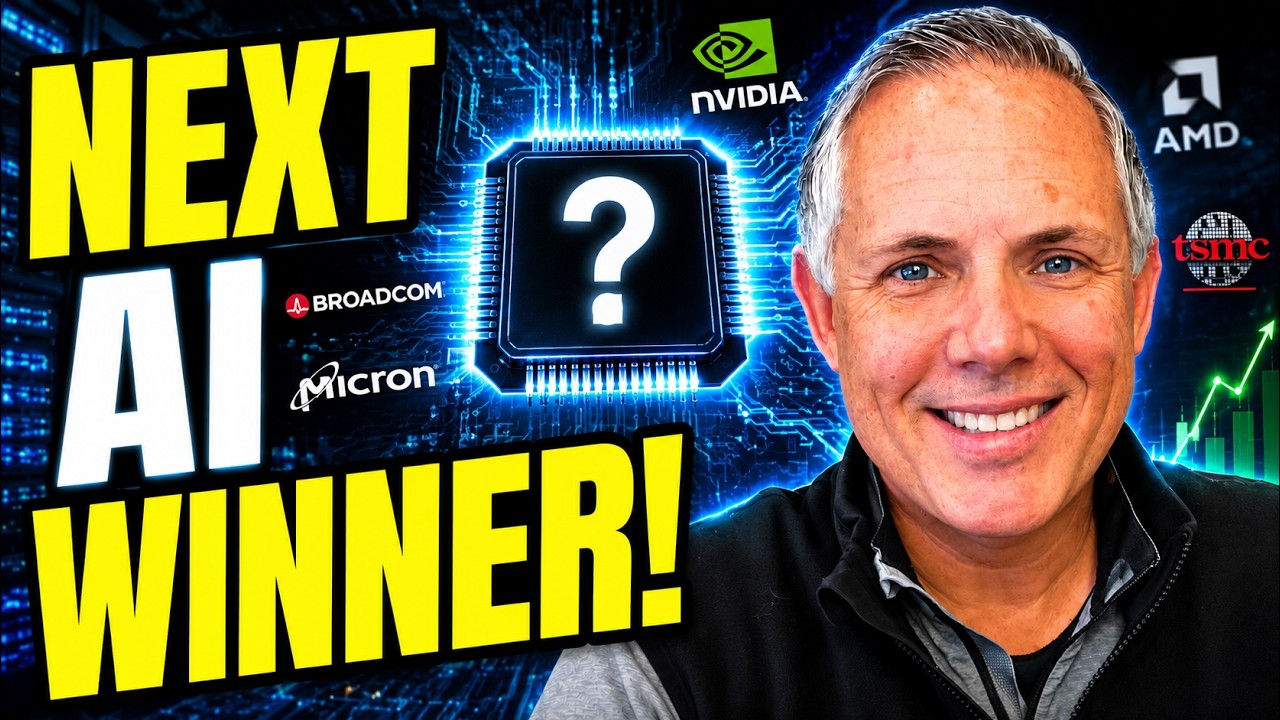
This Forgotten AI Stock Could 10X Before Anyone Notices

- Video return
- -7.53%
- Calls
- 1
- Buy / Sell
- 1 0
- Published
Recommendations
Entry is the asset's closing price on the publication date. Current is the last close on record.
-
Entry $529.14 15 Jul 2026Current $482.61 07 Aug 2026Result −$46.53
AMD is hands-down poised and positioned to directly benefit from the next wave that are coming with AI, agentic AI and inference ultimately, okay?
Context So, the company we're predominantly going to be talking about is AMD. All right, AMD is hands-down poised and positioned to directly benefit from the next wave that are coming with AI, agentic AI and inference ultimately, okay?
Full Transcript
In this video, I want to talk to you about a clear winner, an AI stock that is going to massively benefit from the next huge AI wave that is coming. And that AI wave is agentic AI. It is the deployment of AI agents everywhere, inside of enterprises, inside of massive companies, just deployed everywhere. And it fundamentally shifts the AI stack. And there are companies that will directly benefit from the deployment of these agentic AI, uh, you know, nodes. And so, this is movement from the large language model, the training of AI models and all those kind of things and how we're currently using it to agentic AI. And then ultimately, there's inference AI as well. So, we're going to talk about a clear winner in this video. So, please do me a huge favor. Please hit that subscribe button and tell me what you like about this video. Drop in the comments below. Tell me what you like about the winner here, what I think the company that's going to massively win. All that is here for you. So, let's jump into this. So, I've created this graphic for you. And the company we're predominantly going to be talking about is AMD. All right, AMD is hands-down poised and positioned to directly benefit from the next wave that are coming with AI, agentic AI and inference ultimately, okay? And it's a shift in the semiconductor market because historically right now, what we've seen is we've seen in the current, uh, training model phase, the LLM phase of AI, the company that is directly benefiting from that has been Nvidia with the deployment of GPUs. And GPUs fit the nature of that kind of compute model, okay? As we move towards agentic AI, we are now moving more into where we actually need CPUs, uh, those types of processors. Yes, we're still going to need GPUs, but the CPU model's going to grow and become even bigger. And AMD, with their product offering of CPUs being very strong in that and GPUs and everything else, plus systems, and all that. Now, you see, this graphic says AMD versus Micron versus SK Hynix. I want to clarify something here, okay? I am not talking about selling your Micron or selling your SK Hynix. I am not talking about the fact that AMD beats Micron or beats SK Hynix because it's almost like comparing apples to oranges, okay? But, I wanted to give you a point of reference. I wanted you to understand that we have memory, Micron, SK Hynix, and that market, we all know, I've covered it on my channel quite a bit, that market has obviously a massive demand versus supply problem, all right? There's also a scenario playing out here as we see the deployment of agentic AI where AMD's may start to run into that same type of bottleneck, which ultimately will drive AMD's prices higher, and ultimately, you know, that bottleneck will create an even higher profit margin business for AMD as we see. Now, we'll see how that kind of flows as far as from a bottleneck standpoint, but remember that, keep that in the back of your mind. Where bottlenecks go, where they are, there's massive opportunity. We're seeing it in memory, and I think that semiconductors with this shift to agentic AI is going to be a same kind of model. So, again, I really want to stress, I am not talking about selling your Micron, selling your SK Hynix. I'm talking about using it as a point of comparison so that you understand the landscape, okay? So, agentic AI is coming, we know that, right? So, as we look at this next era, specifically in the light of a lens or the light of AMD in that landscape, that's what we want to talk about. So, let me zoom in on this just a little bit. So, kind of in the upper left-hand corner, the next era is agentic AI. So, we are moving from chatbots to autonomous agents, that's what agentic AI is, that can think, plan, and take action, and these will be deployed everywhere. And we're looking, guys, at almost a one-to-one ratio here of CPU AMD CPUs to a GPU, for example, Nvidia, right? And or AMD because they have GPUs as well, and then the networking component. And I gave you guys a video yesterday, there'll be a link at the end of this video, where you can check out that networking component. We're not going to really get into this, but the networking component is also a massive opportunity because these these these autonomous agentic AI agents will have literally a one-to-one ratio, CPU to GPU to networking. All the stuff really, you know, is is going to be literally real-time processing, okay? And it's going to increase the load dramatically, all right? So, why CPUs in the middle become critical in agentic AI? Think of a GPU as a factory worker. Excellent and massive parallel tasks tasks like training and inference. Now, inference AI is is also coming down the road. So, again, AMD stands to benefit there, okay? But, GPU are factory workers. CPU is a factory manager. It coordinates tasks, manages memory, handles logic, input, output, OS, database database, all that kind of stuff. The more AI agents you run, the more managers CPUs you need. And remember, it's literally a one-to-one ratio, one CPU to one GPU to one to to the networking component. What does that equal? Massive deployment of and or need of AMD's CPU chips, okay? Which historically in the current training model phase of of AI, we have not needed because it's been a very heavy GPU process compute scenario, okay? On the right, let me make sure you guys can see this. Right above my head, you see agentic AI equals more infrastructure demand, really what I've talked about, right? It's scheduling, memory management, networking, all that, operating system, storage access, orchestration of tasks. CPUs orchestrate everything, okay? So, GPUs are kind of the the the workers, the the massive parallel tasks, okay? They're in the background. But, CPUs are the managers. Again, think of them like that. So, again, then there's a one-to-one ratio, one CPU to one GPU to what to the networking component. All right. So, lower left, really this is the heart of the video and what I want to talk to you about. Okay? AMD as we see a genetic AI start to be deployed, and this again, it's not going to be deployed, you know, snap your hands and all be tomorrow. This is the next wave that is coming, and this is the next wave that everybody is not really talking about yet, but it is something that is there. And so, getting into AMD, kind of like where we're seeing it at the current price point like right now it's trading at 519, it's it's down 5%. By the way, if you can't afford AMD at this price, there is absolutely excellent ETFs that give you act that give you exposure to AMD, but remember what an ETF is, it's a basket of different types of of stocks, and there were there are AI semiconductor ETFs out there. But, remember, you're diluting and spreading your risk across multiple you know, multiple you know, companies in that ETF. Again, nothing wrong with that, I'm just telling you that that's how it works. So, AMD's turn it currently trading at 519, and just to give you some Micron example, it's up 7%. Oh, excuse me, it's down 7%. My apologies. I always look at that and say it's up, but you got to look at the little arrow. Yeah, I know, Austin. Okay, it's down 7% today, currently trading at 901. And SK Hynix is on a tear today, it's up 27 plus percent, those are the main three we're talking about. Okay. So, AMD on the left right here. Let me zoom in on this even more for you. There we go, that's probably better. Okay, AMD on the left. What does AMD do? Look, they design and they sell CPUs, GPUs, DPUs, and adaptive chips for data centers, enterprises, and AI workloads. That's really what they do. All right. So, the biggest advantage that AMD brings to this party is that they are they have CPU and GPU exposure. Okay, they manufacture both types of those semiconductor chips. They're built for training, inference, and enterprise AI. Check, check, check, right? As we look down the road to moving, you know, into these different phases of AI, agentic, and inference, so forth. Um they are less dependent on memory cycles, but it does not negate the need for memory because memory is memory, and memory is a vital component of this this this workload as we see it. You know, even at And by the way, as we move into agentic AI, that that memory becomes a very core key component even more so because of that processing and all that communication that has to happen. Okay, so just remember that. But also what AMD brings is they have a they have software and system and software system ecosystem to go with their obviously their their chips, their processors. Those are their advantages. Now, as far as a risk, you know, they are competing with Nvidia in GPUs. And by the way, Nvidia is and has been moving into the CPU market as well. Just saying, right? So again, and I'm not negating Nvidia's role in this. Nvidia is a absolutely key key component. I do own the Nvidia stock, right? And so they're a key layer, a key competitor in this, but this video is really talking about how AMD is uniquely positioned as we roll into these additional these additional, you know, eras, if you will, of AI. So, why AMD stands out? They are a unique full-stack AI platform. They have CPU, GPUs, DPUs, adaptive chips. They have the software and the system ecosystem behind it. Okay? They have leverage in training today and inference and agentic AI tomorrow. So, they are they are part of the AI discussion and involved in obviously the training phase of AI, which is what we're in now, but also again, they're pri- they're they're primed and they're poised to be one of the major major leaders associated with agentic AI and inference AI of tomorrow and down the road for the next 1 3 4 5 years down the road. Again, potential for durable growth and margin power. And I would also add that uh I've done some other videos on this. I think that we are now looking at potential an additional bottleneck, kind of like what we're seeing in the bottleneck with memory from a manufacturing standpoint, as we as we look out and the the amount of fabrication, the amount of manufacturing that's going to have to go on from the companies like Nvidias and AMDs and Intels and all those different things uh associated with the amount of sheer amount of chip demand for the deployment of agentic AI and inference AI. Remember, it almost moves to that one-to-one ratio, whereas before it was really more obviously they needed way more GPUs from like companies like Nvidia than they needed CPUs from companies like AMD. But as we shift to these additional these different AI models, agentic and inference, remember, it literally becomes almost a one-to-one ratio. So that equates to more demand and more that you know, more fabrication, more manufacturing for the CPU uh components, the CPU chips from companies like AMD. All right. So continuing to move on. All right. So again, I'm not going to get into again AMD versus SK Hynix. You can kind of take a look at right here. Let me move the picture of me over here. You can look at at at where at you know, Micron and SK Hynix fit in this role. Again, I created this graphic to give you some context so that you could understand the landscape of where AMD fits and how they fit and then compare and contrast it to the memory sector Micron SK Hynix. I am not saying sell those and get out of them completely. There's massive opportunity, I think upside for Micron and SK Hynix to go up dramatically as we continue to see, again, we know we know about all those memory bottlenecks there. I brought them into phase and into into this discussion because they are a bottleneck and you needed to understand that and compare, contrast, have that discussion for, again, what I think is a is a oncoming bottleneck associated with the manufacturing specifically for CPU semiconductor chips from like AMD. And I think that that's going to be another massive opportunity where we have the disparity or the disconnect from how much supply is needed versus demand, okay? And I think we're going to start to see that that become more of a bottleneck. And again, that's why I brought this into play, all right? So, look, the next massive wave, again, we talked about agentic mostly in this video, but lower left-hand corner, let me move the picture of me, right here in the lower left-hand corner of this graphic, and I'll even I'll zoom in on it so you can even see it better, is the is the discussion about inference AI. Most of this video has been about agentic AI, but if if inference AI is also a wave, an AI wave coming. Training gets the headlines, but inference will be a much larger market over time. Billions of AI agents equal billions of inference requests. And it comes back to that constant communication. It comes back to that one-to-one ratio. A semi a a CPU, right? Go back up here. Remember our factory worker scenario? A CPU relationship where one CPU literally to one GPU, so think of it as one manager to one factory worker uh relationship, and then also that networking component. So, that networking component is going to become crucial, and I'll do another video on that. So, by the way, drop in the comments below if you like this and if you want me to cover AMD even more. I've got some of you guys that were requesting more AMD content uh on my channel and I can start talking about the semiconductor market even more so, but you need to comment below. You need to tell me that's what you want me to do because you guys are actually helping me to build this community and build this channel associated with what you guys want and I've been covering Micron and SK Hynix dramatically quite a bit, but if you want me to also layer in semiconductor AMD and things of this nature and then also layer in additional like hey Marcus that we haven't talked about networking. You know, energy, power production. These are all potential bottleneck markets as we continue to see north of five and a half plus trillion dollars of AI CapEx dollars, you know, dispersed as we roll towards 28 and 2030. Those dollars are already allocated. They're already They're already They're already out there in discussion for building these AI data centers for for, you know, building you know, massive systems for big companies like General Motors and Ford and all these big enterprises all that kind of stuff. So, you need to guys let me know by dropping in the comments what you think and what you're looking for from me because again, I'm building a community here. Also final thought here which was interesting kind of looking at SK Hynix versus leading semiconductors and Micron and talking about kind of PE ratio. So, if let's let's talk about this. So, like SK Hynix right now trades it trades at a PE of 17.53 which is among the lowest, okay? And remember SK right now is having a pretty good day. It's up 27 plus percent just in this recording and right now with this trading session. But I wanted to show you some other PE ratios. Micron's at 22 22, very close to SK which is ironic given the the the price that we're seeing for both respectively. You know, SK is trading at 170 here in the states and 900 here in the states. Obviously, we know SK is a South Korean company and they also trade obviously in South Korea and this is the the United States price if you will on the our markets. But again, right there. Okay, and and Micron is 900 and AMD is 516. Okay, but look at the look at the PE ratio for AMD, 186. Okay, that is a very high PE. It is. Okay, and I but I think ultimately we've got a lot of opportunity for AMD. They've got to meet and and hit those those forward-looking quarter you know earnings and then future forward-looking guidance. But again, I'll bring you back. I will bring you back with final thoughts. As we see agentic and inference AI become more center stage, the people that will benefit from that from a investment standpoint are the people that understand fundamentally this equation and how agentic and inference AI are going to change the amount and the type of CPUs that are required. The amount of the the processing. And and most people don't understand that there's a difference in GPU versus CPU as it relates to AI. It's a different workload. It's a different type of environment and it requires those different types of chips. And everybody's been focusing on Nvidia. Again, I love Nvidia. I own a Nvidia. I own it. But but there's a shift coming and that shift is coming where we were going to need way way way way way way more of these CPU chips. And we're also still going to need a lot of GPU chips as well because again, remember that one-to-one ratio, the manager to factory worker, CPU to GPU. And don't forget don't forget that networking component because it's a constant communication. It's literally real-time, constant constant constant. And then I would add into that obviously there is the memory component, Micron, SK Hynix, Samsung that is standing there as well parallel in addition to all that and all that memory all that that you know that load on the memory is still going to become and still going to be as important. You need to understand that that's what the ecosystem's going to look like. It is a shift um away from massive amounts of GPU to more of a one-to-one ratio. But also the fact and what changes in the situation is the amount of CPU and GPU that you're going to need because you're talking about massive deployments. Remember, there could be in a given in a given one company 50,000 AI agents deployed in one company for internal processing you know, of workload and and work and think of a company like the size of GM or Ford, okay, as an example. And how many [clears throat] ultimate AI agents will they need? Remember, there's that CPU to GPU to memory to networking that that kind of you know, this this scenario that you see right here in the middle, right? But it is the it is the amount and and how the workload's going to be need going to be used or or how that's going to work with all of these AI agents deployed in a given company. Not to mention the hyperscalers. Not to mention how that's going to look. So, you're talking about a massive workload here that is going to have to be deployed, which brings us back to potential bottleneck for a for AMD even before it's happening. Okay, even before it's happening. That's my goal with this video is to give you insight in the fact that this is coming. This is a thing. It is coming. Agentic AI is going to change and and companies like AMD are standing there to benefit from that. All right, thanks for giving me a few minutes. I appreciate you. Drop in the comments below. Let me know what you think. Please hit that subscribe. Become part of the community. Turn that bell notification on and please please hit that like so we can get this out here and you guys can help me grow the channel. I would greatly appreciate it. Bye.
Comments 0
Sign in to join the discussion.
Sign inNo comments yet. Be the first to share your thoughts!