The Hidden Apple Trap Explained: Why Top Wall Street Banks Are Quietly Selling AAPL

- Retorno do vídeo
- +6,26%
- Chamadas
- 1
- Compra / Venda
- 0 1
- Publicado
Recomendações
Entrada é o preço de fechamento do ativo na data de publicação. Atual é o último fechamento registrado.
-
Entrada $333,26 16 jul 2026Atual $312,41 06 ago 2026Resultado +$20,85
a major Wall Street bank has just slammed the stock with a rare and aggressive downgrade to underweight. KeyBank analyst Brandon Nispel shocked the market by telling clients to walk away, setting a price target of $250.
Contexto The transcript says Apple was "slammed the stock with a rare and aggressive downgrade to underweight" and then adds that Brandon Nispel was "telling clients to walk away".
Transcrição Completa
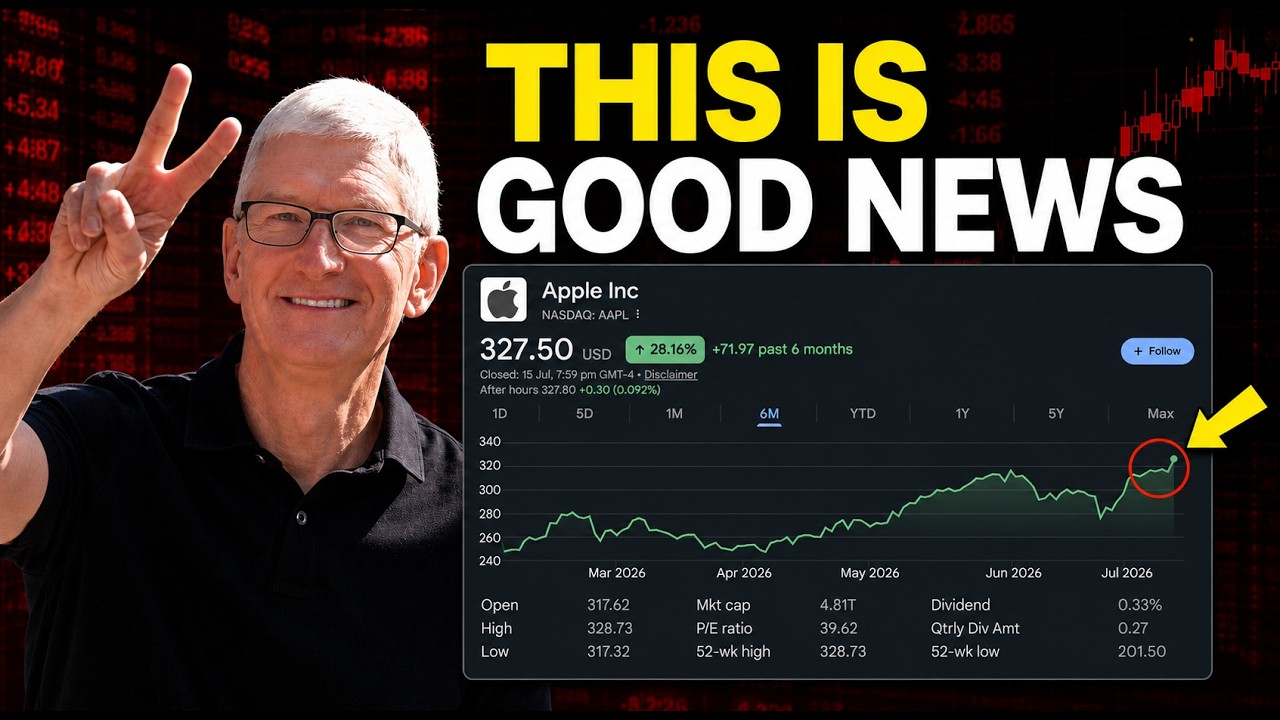
Apple has quietly become the best performing Magnificent Seven stock of 2026, touching an all-time intraday record of $328.71. The massive tech giant is currently sitting on a market valuation of nearly $5 trillion, just 2 weeks before its crucial third-quarter earnings report on July 30th. Yet, while retail investors are celebrating this incredible run, a major Wall Street bank has just slammed the stock with a rare and aggressive downgrade to underweight. KeyBank analyst Brandon Nispel shocked the market by telling clients to walk away, setting a price target of $250. That bearish target implies a massive downside of more than 20% from the stock's recent peak. This creates an extraordinary division on Wall Street, where some analysts see the company hitting $365, while others expect a steep correction. To understand what is truly happening behind the scenes, we need to look beyond the general hype. We are going to examine why Apple's legendary pricing power might actually be backfiring on its hardware sales. We will analyze how skyrocketing memory chip costs are forcing the company to raise retail prices across multiple product lines. We will also inspect the proprietary consumer credit card spending data that shows Apple demand is decelerating rapidly. This analysis is presented strictly for educational comparison, and you should always do your own research first. I do not own a position in Apple stock right now, but I have tracked its valuation closely for over a decade. In this video, we're going to break down the actual growth trends, industry headwinds, and cash flow multiples. Let's dive deep into the financial statements to determine what the smart money is doing with this retail giant. This is the real story of what is happening with the world's most valuable company. To truly evaluate Apple, we must first look at its historical and forecasted revenue growth. The company's revenue for the last 12 months stands at an impressive $451 billion. dollars. For the upcoming third fiscal quarter, Wall Street consensus estimates are predicting total revenue of around $109 billion. This would represent a solid year-over-year revenue expansion of roughly 15% from the previous year. Furthermore, the consensus estimate for Apple's full-year 2026 revenue is pegged at $478 billion. This indicates a double-digit growth rate of nearly 15% compared to the previous fiscal year. On paper, these growth figures look absolutely phenomenal for a company of this immense size. But here's the part that most people are completely missing. >> KeyBank's proprietary customer spending data for the month of June revealed that indexed Apple spending actually fell by 2% month-over-month. This contraction stands in stark contrast to the historical three-year average of 9% growth for the month of June. This sudden drop suggests that the massive demand we saw last year was artificially pulled forward by consumers. Consumers rushed to purchase devices last year to beat expected tariff-related price hikes. Now that earlier buying activity is fading, and Apple is facing a highly challenging baseline. While the market consensus expects iPhone revenue to grow by more than 8% in fiscal 2027, some analysts believe this is far too aggressive. If hardware unit sales begin to decelerate, it creates a dangerous domino effect for the entire business. Slower device sales will ultimately limit the expansion of Apple's active installed user base. Since the services division relies entirely on monetization of this active user base, a smaller base means slower services growth. KeyBank predicts that Apple's services segment growth will slow to just 7% in fiscal 2027. This is significantly below the 12% growth that the broader Wall Street consensus is currently pricing in. With both hardware and services experience a simultaneous slowdown, Apple's high-flying growth narrative could quickly unravel. We must also consider the regional dynamics that are driving current performance. The stock's recent surge was heavily supported by news that China's cyberspace regulator approved Apple intelligence for domestic use. Since China represents roughly 15% of Apple's total revenue, this approval resolves a massive overhang for the company. To make this work, Apple is partnering with domestic tech firms like Alibaba and Baidu to power its AI features. While this partnership is a major regulatory victory, it also shows that Apple is highly dependent on third parties in international markets. If domestic competitors in China continue to launch cheaper, highly capable devices, Apple's market share gains could be short-lived. We are looking at a growth story that has very little margin for error at these prices. Investors are paying a premium today for a future that is far from guaranteed. The divergence between short-term AI enthusiasm and long-term hardware demand is widening. In my opinion, counting on a massive AI-driven hardware super cycle might be a very risky bet. To place Apple's current situation in context, we must examine the broader global smartphone and hardware industries. The global smartphone market is currently experiencing significant macro headwinds. Industry reports show that global smartphone shipments fell by 11% year-over-year in the second quarter. This represents the weakest second quarter for the global industry since 2013. At the same time, a massive global shortage in advanced semiconductor memory chips has sent component costs skyrocketing. Memory pricing, including both DRAM and NAND, has increased dramatically due to the unprecedented demand from artificial intelligence servers. Analysts estimate that Apple's average DRAM costs will surge by around 370% between fiscal 2025 and 2027. Meanwhile, its NAND flash memory costs are projected to rise by 280% over the same period. To protect its industry-leading margins, Apple has been forced to take aggressive pricing actions. In June, the company raised retail prices across several major product categories. MacBook prices increased by $100 to $300, while iPad prices went up by $100 to $200. High-end Mac Studio prices were hiked by $500 to $1,300. Many analysts expect this cost-push pricing strategy to expand to the upcoming iPhone lineup later this year. Some investment banks estimate that the next generation iPhone 18 lineup could see a price hike of up to $200. Now, the key debate on Wall Street is how consumers will react to these higher price tags. Bullish analysts from firms like Morgan Stanley argue that iPhone demand is highly inelastic. They estimate the historical price elasticity of the iPhone to be between 0.2 and 0.5. This means that a 10% price increase would only result in a minor 2 to 5% drop in unit sales. However, bearish analysts warn that this time might be completely different. US mobile carriers are facing intense margin pressure themselves and are publicly discussing plans to scale back device subsidies. Historically, generous carrier subsidies have been the primary engine driving frequent consumer upgrades in the United States. If AT&T, Verizon, and T-Mobile reduce these subsidies, consumers will face the full brunt of these price increases. This would likely lengthen the average smartphone replacement cycle as consumers choose to hold on to their existing devices. If domestic upgrade rates slow down, Apple will be forced to rely much more heavily on highly competitive international markets. But gaining ground in international markets becomes extremely difficult when device prices are rising. The competitive landscape is becoming far less forgiving for high-end consumer hardware. Despite these macro headwinds, we must look at Apple's world-class profitability and margins to understand why the bulls remain confident. The company has historically maintained some of the strongest operating cash flow to sales ratios in the entire technology sector. For the upcoming third fiscal quarter, Apple has guided its gross margins to be between 47.5% and 48.5%. This is an incredibly strong gross margin range considering the rising memory component costs we just discussed. This resilience shows that Apple's legendary supply chain management is still operating at an elite level. The company's recent actions demonstrate that it is aggressively securing critical components to protect its production. For example, Apple recently pledged a massive $1.5 billion investment in Broadcom's manufacturing facility in Fort Collins, Colorado. This investment was specifically designed to secure a reliable supply of advanced wireless connectivity and networking chips. By locking in these chip supplies early, Apple is actively insulating itself from future component shortages. Furthermore, the company is managing its operating expenditures very tightly. Operational expenditure for the third quarter is expected to land between $18.8 billion and $19.1 billion. If If we compare this to the company's projected revenue, we see that Apple maintains a highly disciplined cost structure. Let's do a quick calculation of the expected operating margin by dividing the guided operating income by the projected revenue. If we take the projected revenue of $109 billion and and subtract the guided gross costs and operating expenses, the resulting operating margin is around 30%. A 30% operating margin is virtually unmatched by any other consumer hardware company of this scale. This incredible efficiency explains why the company generates over $100 billion in free cash flow annually. The company is using this massive cash pile to return value to shareholders through aggressive stock buybacks and dividends. In fact, Apple's return on equity stands at a staggering 141%. And its return on invested capital is 71%. These numbers reflect how efficiently the management team utilizes its capital base. But some analysts believe these elite profitability metrics are already fully priced into the stock. When margins are already near historic highs, any unexpected cost pressure can lead to a significant earnings miss. Even a minor contraction in hardware margins could have a major impact on the bottom line. If memory costs continue to climb throughout 2027, Apple's pricing power will be tested like never before. Investors must decide if they are comfortable paying a historic premium for margins that may have already peaked. This is the central dilemma that is currently dividing Wall Street's top analysts. The financial strength is clear, but the path forward is becoming increasingly narrow. Now, we must turn our attention to valuation, which is the most critical metric for any value-focused analyst. Apple is currently trading at a trailing price-to-earnings ratio of nearly 40 times. Its forward price-to-earnings multiple stands at approximately 35 times. To put this in perspective, Apple's 10-year historical average forward price-to-earnings ratio is just 23 times. The stock is currently trading at a premium of more than 50% relative to its own historical valuation. Furthermore, Apple is trading at a massive premium compared to the broader market. The forward price-to-earnings multiple of the S&P 500 is currently sitting at around 20.7 times. This means Apple is trading at a premium of nearly 70% compared to the average stock in the market. In my opinion, this elevated valuation lacks justification given the slowing demand trends we have uncovered. Investors are paying a software-like multiple of 35 times forward earnings for a company that still derives the vast majority of its revenue from hardware sales. Let's perform a valuation comparison using the price-to-operating cash flow metric. If we multiply Apple's expected operating cash flow by its historical multiple of 22 times, we get an estimated fair value that is far below the current market price. Specifically, KeyBank's price target of $250 per share is based on a forward price to earnings multiple of 27 times. While 27 times forward earnings is still a premium, it is much closer to the company's historical reality. The current price of over $327 requires the company to deliver flawless execution. It assumes that Apple Intelligence will drive an unprecedented upgrade cycle that has not yet shown up in the actual data. If the upcoming earnings report on July 30th reveals any signs of weakness, the stock could experience a severe re-rating. We have already seen insider activity reflecting some caution with over $87 million in shares sold over the past 3 months. While insider selling can occur for many reasons, it certainly does not signal that executives believe the stock is deeply undervalued. We must weigh this high valuation against the optimistic targets of other analysts. Some bulls are targeting $365, pointing to potential market share gains and pricing power. But, as a disciplined investor, I prefer to focus on the margin of safety. Right now, that margin of safety appears to be exceptionally thin. In summary, Apple is trading at a record valuation ahead of its July 30th earnings report. The bullish narrative is driven by China's approval of Apple Intelligence and the company's strong pricing power. However, the bearish downgrade from KeyBank highlights real risks, including slowing consumer spending and a pullback in carrier subsidies. Rising memory chip costs are forcing price increases that could hurt hardware unit sales. Investors must decide whether the long-term AI potential justifies paying 35 times forward earnings. I choose to remain cautious and look for a more attractive entry point with a better margin of safety. Please make your own informed decisions based on your own financial research and risk tolerance. I am presenting this data-driven analysis for educational purposes only. Hey, thanks for watching. I truly respect every viewer who takes the time to seek objective data-driven analysis.
Comentários 0
Entre para participar da discussão.
EntrarAinda não há comentários. Seja o primeiro a compartilhar sua opinião!