I view dips as opportunities for investors to responsibly add to positions in small increments.
Context
I think it's reasonable to be bullish on memory makers such as Micron and SKH for at least the next 1 to two years, possibly longer depending on what happens. ... I view dips as opportunities for investors to responsibly add to positions in small increments.
Full Transcript
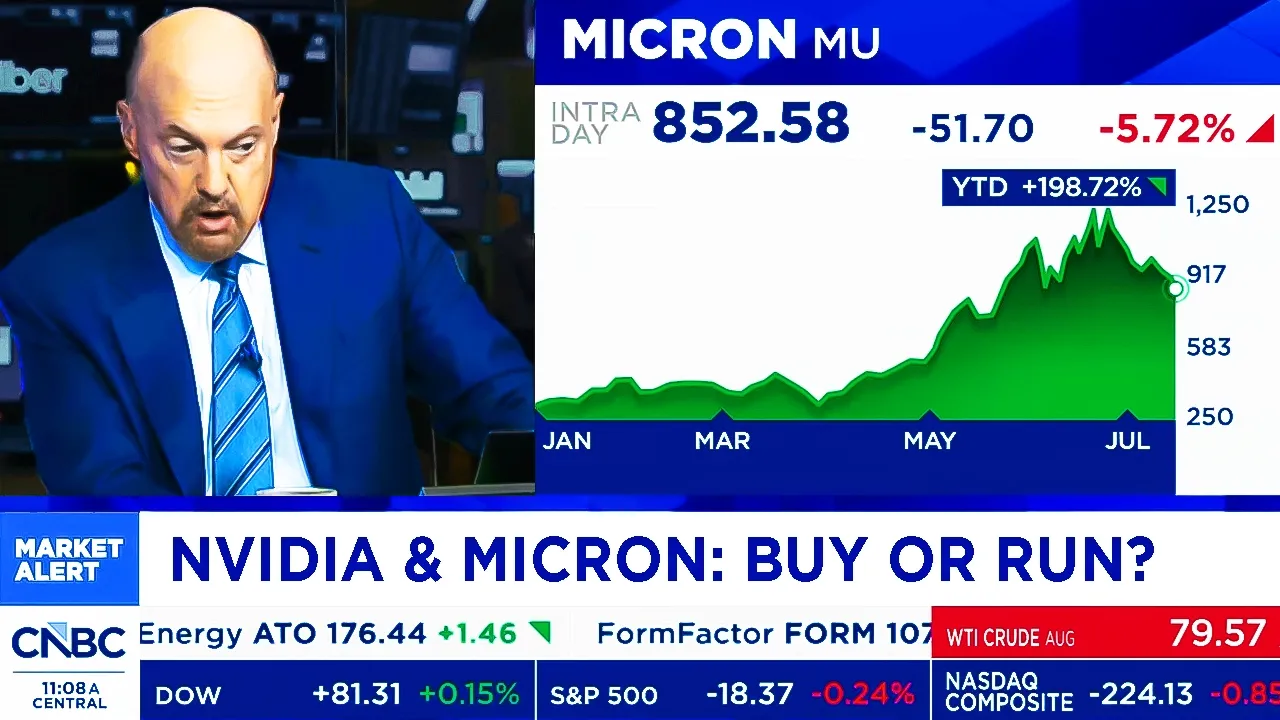
Let's begin though with Taiwan Semi weighing on the chip sector despite posting a Q2 beat 77% jump in profit from a year ago. Company also pledging an additional hundred billion to expand AI chip manufacturing in Arizona and that will bring Jim the total in the state to 265. This is over the course of a few years. >> Yeah, it's extraordinary. I know that I was listening to Steve Satch this morning talking about the water issues. Why would you do it at all in Arizona? A lot of this is is a closed water loop. I'm not worried about that. What I am worried about is how many years how many years it'll take. Uh Rene has I tell you listen three years. Three years before you build anything. Uh now I will say this the Taiwan semi the only number that wasn't so good was that you know they only beat the estimates for revenue by 2.2% but net income 13.3% uh earnings per share 12.5%. Initially when the number came out it was wellreceived and then we start getting this influx of SKH highinex uh money skhx money is now going outflow because they've changed the margin requirements there. People aren't talking about that enough but the government's trying to get things under control. There's been too much >> they're halting listings of leverage ETFs. >> Well that means that there's just not as much buying power as there was. Uh look a lot of people just feel what's happened is there's a great unwind going on with the components. They all had parabolic moves. Parabolic moves coming down. You mentioned Sandis down 40% parabolic move can be down 40 to 60% before you want to buy it. So you got to be a little bit be careful. Uh we own Corning for the chapel trust and you the stock is down 120 points and yet today JP William put sell out. Well thank you so much but I will tell you this stock's still up from 70. >> I got to say though you're what was it last week? Sell half your micron looking. You have to because I look I hate parabolic moves and I know that when when you're in the midst of parabolic that's a straight up move from a curb. When you're in midst of them the last thing you ever want to do is is sell. People just say you know like please why are you trying to hurt me? I bumped through a guy on the street said why you trying to hurt me my rot? Actually it was my gardener. I said no I'm actually trying to help you. No you're trying to hurt me. I said no I'm trying to help you. and and Zigg said, "WELL, OKAY. OKAY, I'LL do it." And you know, he I'll see him this weekend. And I think he'll say, "Well, thank you." Different discussion this weekend. >> Some free mulch this weekend for my uh my tomatoes. >> What about So when you look at those when you look at Micron SanDisk, even Dell today, Jim, touch below 400, right? Right. This was 2 or 460 a couple weeks ago. >> But Dell was at 150 when we discovered that they were actually being able to handle the micron problem, able to handle the memory problem. So then it doubles and that's okay because it the numbers weren't cut. But then to go up again so big even though by the way when we hear when people hear IBM not doing that well what you should be thinking of is okay so people are taking Dell and they're putting on Claude. Uh and that's what's happened. IBM no Dell Claude yes. And I've got that verified but the problem is is that what does it mean when you have a stock that is parabolic and people are trying to figure out where to buy it. Uh, I am looking at Sandis to be the one that tells me when to buy at that bottoms first because that's the one that went most insane. Uh, Sandis, by the way, I I felt they're not collect, but I I felt they weren't putting enough money into expansion unlike Micron where I'm going to go out to see what Sanjay Roach is doing. I mean, so they are competing directly with Taiwan Semi when it comes to SP. >> You want more capacity. You want more memory capacity. >> Yes, we have to. I mean, the Renee Ha interview was uh Renee said it three times within a minute. That that's more than he even talks about uh the Las Vegas Raiders, which is extraordinary since she seems to be incapable of talking about much more than that when I'm with him. But he was just saying, "Listen, it's not a demand problem. It's a spy problem. Not a demand." Now, you look at ARM. ARM was at 350. We sold some for the uh child trust. Why? And I said, "Because it's parabolic. I'm not looking for a fundamental reason. A stock that goes parabolic in any single market is a stock that you have to cut in half. You just have to because you're going to lose a huge amount of money over a three four day period and no one will know why. >> So you think we're at that moment kind of in the unwind and what tells me that we're really in the unwind is that the money's going back to the most reviled group in the world, the hyperscalers. I know it's super early, but do you think that robotics and manufacturing, I mean, Jensen's in Japan right now doing a lot of this stuff. It has anything to do with the lack of manufacturing payroll growth. >> Uh, okay. So, Jen Jensen is not just Jensen. I sometimes people don't realize when you're with Jensen, he's very quick to credit so many other people. He's not one of these CEOs who says the team, the team. He actually has guys. this is the guy sit down. And what the guy who does robots there was just saying we don't have enough people who want to lift boxes, who want dirty jobs, uh who want dangerous jobs. Without the robots, our society is going to, you know, really ground to a halt a few years from now. Now, Ri Supermania at FedEx would tell you, you know what, we don't. And they are very busy trying to develop robots that be able to uh recognize strangeized boxes. Right now, the robots are kind of like, "Okay, I get that box, but I don't know how to do this box." Uh, but they just can't find people. And I think that that's when you look at these numbers and you say, "Well, how are we going to prevent inflation?" Well, it's $90,000 for someone who used to do a job that 60,000 and a huge amount of healthcare cuz they keep getting hurt. >> And you think a robot can go to 20? >> Yeah. I mean that's way >> and you think the data center discussion now now right now it's all about LLMs hosting models but you think it will be eventually about hosting >> robots >> well I think that robots are the solution to the incredible decline in birth rate in our country when I went to your uh Carmine Debia not that long ago getting into the former head of BY uh getting a terrific award for immigration came over here 3 years old when on panam uh he was he shocked us because all he did was talk about the crisis he said this is the crisis the crisis is birth rate and people are like say what what what is he talking about but the crisis is birth rate because if we can't find enough then there is going to be huge inflation but I think that that Jensen is trying to solve that too he's not just celebrating Sega in Japan Jensen has been reduced to somewhat of a cartoon character uh by by the media the guy is between 4 and 8 a.m. does a ton of work when those guys when those people are drawing cartoons and sleeping. >> Yeah. No, he's talking shipyards and all kinds of stuff over he understands it's a labor short. Some of the trading means a lot of computers are involved here, a lot of programs and you could see like yesterday like at 10:15 just a complete collapse and some of this is really just a rotation. I I believe it's temporary hopefully. I really don't know what's going to happen with the war and some of those input costs. But I think when we get the hyperscaler capex news later this month, maybe we can uh start to kind of get back to uh uh normaly which I say kiddingly is semis and hardware leading the pack >> input costs because of like what runs through the straight of hormuz and that goes into the the production of these. I think that I think that if oil prices go up, there's generally pressure on interest rates and and that also impacts some of the growth stocks I cover, but also I think that there there are some concerns about helium uh LNG impacting electricity costs, etc. that go >> in Asia too >> and go through the chain. So, um you know, if you're a computer and you're looking for signals, I mean, there there this is a normal rotation. software has is no supply chain >> or maybe these stocks just got too expensive and then the the reports came out and it was like >> well here's the thing I think that when Micron went from 900 to,200 in 2 weeks in June computers were involved okay that wasn't just picking up every fundamental signal to say that's how much we should be up in 2 weeks right so now you've given it back >> now where are we >> I think that we're on the same trade it's just a temporary pause I mean hopefully the macro works itself out but Well, just a few weeks ago, we were on that path. And I don't think anything's really changed. I think when you see the fundamentals come out for the hyperscalers, uh you'll see capex increases, not decreases. And frankly, if anybody cuts capex, obviously that'll kill that trade. But I I don't know what hyperscaler you're going to want that's giving up on AI. Uh that so I I don't think they're going to do that. I think Meta, I think Google, I think Microsoft all raise capex >> for this for next year for >> next year, maybe the rest of this year. But the signals for next year calendar year have to be higher. >> JP Morgan had a no doubt about that this morning saying uh that retail investors in particular are kind of following that trade with Nvidia, Tesla and Microsoft leading the July buying here. Um Josh, you own Nvidia and Apple. What do you make of this rotation dynamic? How much do you think it has in terms of legs? Look, you could take that JP Morgan retail radar and and put it back in the envelope and I can just Creskin like predict what that's going to say next week. I'll just look at what happened this week. I mean, there's no there's no information there. It's not important. I think that the key to this market this summer, stop acting like a thirsty lunatic. No more thirst. We're grown men and women and we need to comport ourselves. the thirst to own the IT trade every second of every day. And it's not even enough to just own it. You need to own it 2x in an ETF. And that's not even good enough. You need to own it with a zero day till expiration option. This is what's killing people right now. And if you're not playing that game, your portfolio looks amazing. The median semiconductor stock in the SMH is in a 22% draw down from its own high right now. 44% of the SMH names are in a draw down of 25% or worse. That's real money. These are big draw downs considering the fact that we're in an S&P 500 that's within a couple of percentage points of record highs. Imagine having put yourself in that position because of how thirsty you are. There are only three semi-names right now that are even within 10% of an all-time high. Only three. the rest of them have been knocked out of the box and people they they feel like oh well I'll do the DRAM DRM's in a 34% draw down it's actually worse Micron 29% below highs uh Western Dig 36% below highs SanDisk a little bit worse this idea that you have to be allin to whatever's working right this second is kryptonite for portfolios um I was talking offset just now I know a guy that moved a multi-million dollar portfolio just to get the SpaceX IPO. Like broke a relationship with his advisor at a major bank, moved all the money to another advis I don't know what did he get 500 shares. Now it's below the IPO price locked up. >> Stop acting thirsty. It's going to kill you in this tape right now. It is not the time for that. You missed that time. It was May June. >> Bring you in because you own Mic Micron, right? Mhm. >> Micron apparently only trades in increments of 5% a day or more. Um I got news for everybody listening. That's not normal. That's not okay. Don't That's not how stocks trade. It's not worth $50 billion more or less on any given day. Um but what we've got here and what Micron Leslie is an indication of is there is a mismatch right now between the fundamentals that we're all talking about with the markets and the technicalities. Note my use of the word technicalities, not technicals. The charts are whatever they are. Josh, you can help me as much as you want on that, but that's not the point. The technicalities that I'm speaking of are things like this massive supply of capital raised going on in primary markets and secondary markets. Things like margin, and Shannon, I think you used that word, but it may have just been in terms of profit margin. Margin debt is what I mean. If you look at what happened in Korea 3 days ago, 320,000 retail accounts got liquidated on margin calls. I mean, that is an incredible blowup. And that explains why a lot of stocks in that market, a lot of the chip stocks had been hammered. As they say, when the margin clerk comes for you, he doesn't ask if you want to work the order. He just sells your stocks. Period. End of story. >> They just banned uh they just banned the leveraged single stock ETFs in Korea. >> Good. Good. Does anybody disagree that that's a good way? >> Well, we do. In America, we're going to approve 3X. >> Yeah, we're going the other way. >> And guess how it's going to end? I mean, all four of us know how it's all five of us know how it's going to end, but it's just a question of time. These technicalities, by the way, just to lump more on this, I think we know this margin debt in the US is 55% higher now than it was a year ago. I'll grant you the stock market's higher, but that's a lot of margin debt. This is what I mean by technicalities. It's a tough time when we see these rotations every day like this and Micron Leslie is a great example. It tells me this is a market in need of a correction and it's probably gonna go and that margin is not balanced across the S&P 500. We know we know which equities are uh more likely to be owned with a lot of leverage and which aren't. And that's exactly what you see playing out on your screen in front of you is a reason why the banks for the most part were able to react well to their earnings. People aren't sitting in 2x JP Morgan. >> But also when you're when you're buying a two or 3x levered ETF with margin that's a third or fourth order uh uh >> I like to I do want to put a code on this because this is important for people viewing and I think this is consistent with all of us that what we're saying to you is don't play the rotations. All right, you have no idea how these technicalities are going to play out and with what timing. All right, make your fundamental bet or if you're a chartist, make your technical bet and stick with it. Don't get flushed out because the Cosby goes down and liquidates hundreds of thousands of accounts. >> Well, the dollar value on this is huge. Deborra ISI had a stat this morning showing over the past 3 days the average dollar volume traded in levered Korean ETFs was five times that of the US MAG7 single stocks. So this this is real here and I I curious to see how this ban on new listings of single stock levered ETFs works changes things or if that if that >> if you look at a chart >> train has left the station. you look at a chart of uh South Korean stocks like up until the last 18 months. Let's say >> we have two. >> Well, now yeah, two that move the index. But if you just look at that market and it's funny, it's been sort of a forgotten market actually. Um one of the big data providers to the index funds considers it to be emerging markets. The other one doesn't. There's always been a cons uh a discrepancy around the Korean stock market. But now you you could understand the enthusiasm amongst retail investors and traders in South Korea. They have for the first time ever these like global giants that are so important to the to this international buildout of AI. So I understand the enthusiasm, but like from a distance, it's not a game that I necessarily think we want to like join in on. It's like having a soccer team go to the finals in the World Cup. let them be excited about it and let them get all their their uh enjoyment out of trading these things. But for a US investor to say, "Well, they're all doing it, so I'll do it, too." I I don't understand how you think the outcome would be any different than what it is. >> We are back with final trades. Jim, we'll start with you. >> Talked about it earlier. Micron, I mean, it's been down today 6%, tomorrow's probably up 6%. That's the way it's trading. >> All right. I hope you're all doing well today and staying calm in this market. Today was a rough day for many tech hardware stocks and some stocks that are associated with the data center buildout. Google traded lower due to some company specific news. There's a lot of news about multiple companies that we need to cover. So, let's get started. First, TSMC reported strong earnings, providing a bullish readrough for overall AI demand. TSMC raised a 2026 growth outlook, saying it expects 2026 revenue growth to be slightly above 40%. TSMC CEO said demand was quote stronger and stronger and that it is stronger than the prior forecast. He expects the demand trend to remain very strong through approximately 2029 to 2030. He described the gap between leading edge demand and supply as being quote very big. In light of that strong demand, TSMC raised its 2026 capex to the range of 60 to64 billion which is up from the previously announced 52 to 56 billion. TSMC also announced another $100 billion investment in Arizona which brings its planned US investment up to $265 billion. We also saw two ninometer revenue start to show up in a meaningful way, representing 3% of wafer revenue during the quarter. As a reminder, Nvidia's Reuben Ultra, which launches in 2027, is expected to use TSMC's tuninometer process. TSMC said that the steep ramp in tuninometer production is expected to reduce its second half gross margin by about three or four percentage points. I think the announcements of higher capex and the pressure on second half gross margin are probably what caused the stock to trade lower on Thursday. Regardless of the short-term price action in the market, TSMC's results were very strong and their commentary regarding demand was very bullish. They see demand exceeding supply from multiple years. Also on Thursday, Bloomberg published a report claiming that Google's new Gemini 3.5 Pro is months behind schedule due to the tech falling short of internal expectations. According to Bloomberg, the problem is related to coding performance. Agent coding is becoming an increasingly important use case for enterprises. Open AAI and Anthropic are both very competitive in that area and at the moment Google doesn't have a competitive agenda coding offering. We'll see what happens in the days ahead. But this story is what led Google to trade notably lower on Thursday. Let's cover some of today's memory news. First, I should mention that overnight in South Korea, the country's central bank raised interest rates for the first time in 3 years, which led to the Cosby trading lower overnight. I mentioned this because Samsung and SKH Heinix alone represent over half of Cosby's market value, plus margin debt in that market is near record levels. The downward price action overnight in South Korea contributed to the red action we saw in memory stocks on Thursday. Also on Thursday, Micron announced that they've completed strategic customer agreements with key tier 1 suppliers and ecosystem partners supporting the global automotive industry and automotive manufacturers. Micron announced seven of the companies that they've entered strategic customer agreements with. Those seven seas are part of the 16 seas that Micron announced on their most recent earnings call. I want to say something very important about this before I cover more of today's news. In recent weeks, and even on Thursday, I've heard multiple people in the financial press speculate that the SCAS can be rolled back at some point, and they assume that Micron's SCAS are the same as the LTAs of the past. This is a great example of something I've said in recent videos. Many market participants just blindly assume that this current moment is the same as the memory cycles of the past, and they're not even willing to consider the fundamental differences between the two. Listen to me right now. The 16 strategic customer agreements that Micron announced on their earnings call are structured very differently from the LTAs that we've seen from memory suppliers in the past. Historically, memory suppliers have used long-term agreements or LTAs to plan. However, those LTAs did not eliminate downside risk for the memory suppliers. The LTA of the past were generally planning forecasts. They were not unconditional multi-year purchase obligations. And so, in the past, under the old LTAs, pricing and volumes were periodically renegotiated as spot and contract markets changed. They were not unconditional purchase obligations. But now Micron's seas are take or pay. That means that customers must either take the contractually committed product or bear the financial consequence for not taking it. These agreements are contractual purchase obligations with minimum floor pricing and volumes locked in over multiple years. Most of the SCAs Micron announced on their earnings call extend through the end of 2030. And Micron expect half or more of their revenue to be under these SCAS once completed. Again, these SCAs are not the same as the LTAs of past memory cycles. They are fundamentally different. Unfortunately, some market participants are not willing to consider the fundamental differences between the two. The fact that large customers are willing to lock in supply over the next four and a half years tells us that this current moment is different from the memory cycles of the past, and it's likely going to last longer than the cycles of the past. Now, let's carry on with today's news. Chinese memory maker CXMT's IPO in China is reportedly seeing very strong demand with the retail portion more than 200 times overs subscribed. The reason this news weighs on memory stocks is because CXMT is expected to use the funds they raise from their IPO to increase memory capacity. CXMT is a big player, don't get me wrong. That said, as I've mentioned in recent videos, CXMT cannot fully satisfy the memory demand domestically in China, let alone globally, because the demand is so strong. There is simply not enough available supply for there to be a dumping situation that would challenge incumbent memory makers pricing power anytime soon. That's not something we should have to worry about for multiple years. But right now, market participants are extra sensitive to any news or rumor that they perceive as being a threat to memory makers pricing power. Speaking of CXMT, you may remember that reports recently suggested that Apple was trying to convince the White House to allow them to purchase memory from CXMT because of the shortages. And then today, US lawmakers announced they've sent a letter to Commerce Secretary Lutnik urging him to not authorize American purchases of memory chips from Chinese companies. We'll see what happens in the days ahead. If the Commerce Department were to ban American companies from purchasing Chinese memory chips, that would likely be perceived by market participants as being positive for companies like Micron, SKH, and Samsung. I'm going to cover some of today's Nvidia news in a moment, but really quick, let me say something important about memory stocks. I see what's been happening in these stocks over the past few weeks. I understand the nervousness among market participants, and I understand why they're quick to declare a top in the memory cycle given what happened during the cycles of the past. Memory has been cyclical for decades. That said, I do think this current moment is a fundamentally different from the cycles of the past and that it's going to last longer than the cycles of the past. Despite all the short-term hysteria and leverage unwind happening in the market, the fundamentals appear to remain firmly in place. I'll give a couple examples that have happened just this week, even as memory stocks have sold off. Taiwan's PSMC announced that they're raising DRAM foundry pricing by approximately 45% in July due to strong demand and a lack of supply. IBM CEO published a letter to shareholders explaining why they released preliminary results early, saying that at the end of June, large customers shifted their budgets away from software toward things like servers, memory, and storage ahead of feared shortages and price increases. He's quite literally telling us where the money is going right now. Again, those two announcements were made just this week. And so, don't let the short-term volatility or hysteria for the financial press cause you to lose sight of the fundamentals. Now, let's cover today's Nvidia news. Nvidia announced that Japan's government, industrial leaders, and Nvidia will launch the world's first national AI infrastructure. Nvidia is to partner with Notra Corp to build the Nvidia Vera Rubin AI factory with 13,750 Vera CPUs and 27,500 Reuben GPUs to deliver 140 megawatts of data center capacity based on Nvidia's DSX platform. The initiative is being supported by Japan's Ministry of Economy, Trade, and Industry and will help strengthen Japan's ecosystem across manufacturing logistics healthcare and more. Japan will be a very important market for physical AI as the government has stated that they want Japan to capture more than 30% of the global AI robotics market by 2040. Also on Wednesday, Nvidia published a blog post highlighting how Japan's enterprises and startups are building specialized AI with Nvidia's Neatron open models. As I've said previously, Nvidia being the leader in open-source models should lead to a very advantageous situation for Nvidia in the future in which many AI applications are built upon Nvidia's own models. Open models drive greater consumption throughout the ecosystem. Greater consumption leads to greater compute demand. And of course, Nvidia sells the compute. Nvidia also published a blog post introducing new Jetson Thor computers. The new T3000 and T2000 modules are based on the Nvidia Thor architecture, and they enable mass market robotics and edge AI applications at scale. It's not a coincidence that Nvidia recently changed their reporting framework and separated edge computing as its own market platform. Edge computing is a relatively small portion of Nvidia's business today, but it should grow notably over the coming years as physical AI ramps and real-time inference at the edge becomes increasingly important. Nvidia is positioning themselves to be the underlying foundation supporting physical AI. As mentioned earlier, right now, market participants are nervous about how long the memory makers pricing power will last. On top of that, there's a notable margin unwind happening in South Korea where memory makers Samsung and SKH trade. That is not helping the price action here in the US. As I've said previously, based on what I can see today, I expect the world to be compute constrained at least through the first half of 2028, possibly longer. I also think it will likely be multiple years before memory supply catches up to demand. Therefore, I think it's reasonable to be bullish on memory makers such as Micron and SKH for at least the next 1 to two years, possibly longer depending on what happens. That said, these stocks will be volatile as market participants are nervous due to the historical cyclicality of the memory business. It appears that we have a market sentiment problem, not a fundamental problem. If memory makers report great results, some market participants will think that the cycle is peaking because the results are so strong and can't get any better. Just look at what happened to Samsung after it recently reported operating profit up more than 1,800% year-over-year. The stock traded lower because of what I just mentioned. And on the other hand, if expectations run too hot and memory makers slightly mis expectations, then there will be some market participants who think that the peak is behind us and that the cycle is starting to roll over. It's unfortunate, but that's where we are right now when it comes to market sentiment regarding the memory makers. But again, I view that as a market sentiment problem, not a fundamental problem. Do not let short-term volatility cause you to lose sight of the fundamentals. These stocks are going to be volatile. Therefore, these stocks are not for everyone, and that's okay. I don't know when or where this current sell-off ends. That said, given that the fundamentals remain strong and demand continues to vastly outpace available supply. I view dips as opportunities for investors to responsibly add to positions in small increments. That does not mean that it's time to back up the truck and load up like crazy. That's not at all what I'm saying. What I'm saying is that I think it's reasonable for investors to consider gradually dollar cost averaging into the stocks that they want to own and to do so in small amounts. Dollar cost averaging in small amounts over a long period of time can be a great way to gain exposure without having to deal with a bunch of stress. If you buy and the stock moves higher, great. You have exposure and you're up on your position. If you buy and the stock moves lower, then you still have cash available to buy the dip at lower prices because you didn't buy it all at one time. I'm not a financial adviser and so I cannot tell you what to do. I'm just sharing some thoughts that I think may be helpful for you to consider. If you need help with your unique situation, consider reaching out to a certified financial professional who can help you with your unique circumstance. Looking ahead to next week, we have the start of Hypers scale earnings with Alphabet earnings scheduled for Wednesday, July 22nd. Meta and Microsoft both report earnings on July 29th, and Amazon is scheduled to report earnings on July 30th. Overall, I'm expecting strong capex guidance and commentary from each of the major four hypers scale companies. Let's briefly cover each of them ahead of earnings. As for Meta, I'm expecting them to announce strong capex guidance. I know there was a bunch of hoopla on July 1st after Bloomberg reported that Meta was developing plans for cloud business. Some days after that report, Zuckerberg clarified that they do not have excess compute. It's just that some of the deals are very attractive and Meta could charge a premium if they rented out a portion of their capacity given the constraints throughout the industry. Meta also recently announced they are expanding their Hyperion data center in Louisiana from 2 gawatt up to 5 gawatt. Last earning season, Meta CFO said that they continue to underestimate their compute needs even as they've been ramping capacity significantly. Plus, Meta Super Intelligence Labs just recently launched Muse Image, Muse Video, Muse 1.1, and a new model API. Meta is not dropping out of the AI race anytime soon, and I expect their capex guidance to be strong. As for Alphabet, I think they're also likely to report strong capex guidance. Last earnings season, Alphabet CEO said that they're computed and would have had higher cloud revenue if they had more supply to meet demand. Also, Alphabet CFO said on the earnings call, quote, "We expect our 2027 capex to significantly increase compared to 2026." As for Amazon, I'm also expecting strong commentary and guidance regarding capex. Amazon CEO Andy Jasse spoke at length last earning season about Amazon having very high confidence that they will monetize the capacity they're bringing online. As a reminder, AWS is monetizing new capacity as soon as it comes online. Last earning season, Jasse said, quote, "The faster AWS grows, the more short-term capex will spend." And then on July 1st, AWS raised GPU rental prices by 20%. And they made that decision based on supply and demand. In other words, demand is very strong and outpacing available supply. As Jasse said last earnings season, the faster AWS grows, the more they will spend on capex. AWS is clearly growing and so I expect strong capex guidance from Amazon. Now, let's talk about Microsoft because I think this is the most interesting of the four this earning season. I want to remind you of a few things. First, Microsoft will be reporting results for the end of their fiscal year. And so, they're likely to provide commentary on the earnings call regarding capex over the next 12 months. This is going to be a very important earnings call for the entire AI ecosystem. As a reminder, last earnings call, Microsoft guided fiscal Q4 capex at $40 billion. They also told us that for calendar 2026, they expect to spend $190 billion. Again, that's for the calendar year. And so, calendar 2026 would include the third and fourth quarters of fiscal 2026, as well as the first two quarters of fiscal 2027. And so if Q3 capex was 31.9 billion and let's just assume Q4 is 40 billion as Microsoft guided, that leaves $118.1 billion that Microsoft intends to spend in just the first two quarters of fiscal 2027. That would be an average of roughly $59 billion per quarter, much higher than their capex so far. What's the reason for that increase? There are two reasons. First, Microsoft is investing heavily in additional capacity for their cloud business. And secondly, Microsoft stated earlier this year that they want to have their own state-of-the-art models inhouse by 2027. and they're going to need a lot of capacity to do it. As I said repeatedly ahead of Microsoft's last earnings report, I thought their capex guidance was going to be notably higher than what many market participants were expecting. That turned out to be correct. Now, I'll be completely honest. I don't know what they're going to say on the earnings call regarding capex over the next 12 months for fiscal 2027. If I had to guess, given the fact that they need additional capacity to compete on cloud, they need to have enough capacity to train their own state-of-the-art models and also what we're seeing in rising component costs, especially in memory, I think we're likely to get strong next quarter capex guidance. But I just want you to know that market participants main focus as it relates to capex is what Microsoft will say about capex over the next 12 months in fiscal 2027. That is what will likely have an impact on the stocks of companies like Nvidia, Micron, SKH, the Neoclouds, and many others. There's some important nuance in Microsoft's AI strategy. And so we need to listen in to the earnings call to get a better understanding of what's going on. If I could only listen to one earnings call from the four major hypers scale companies this earning season, I would choose Microsoft's. What they say about capex over the next 12 months will likely determine how tech hardware stocks trade the next day. Overall, I'm expecting all four of the major hypers scale companies to report strong capex guidance and important commentary regarding AI monetization this earnings season. I don't know what's going to happen in the short term, but from a long-term perspective, I am very confident that Nvidia will be worth much more in future years than it is today. When Jensen was on the Lex Freedman podcast not that long ago, he was very seriously raising the possibility of Nvidia becoming a $3 trillion revenue company in the near future. If that happens in the coming years, then it is very plausible that Nvidia could one day be worth tens of trillions of dollars in market cap. That might sound crazy, but that's what Jensen is implying when he raises the possibility of Nvidia becoming a $3 trillion revenue company. I guess the question at that point is what multiple the street will be willing to give Nvidia. I don't know the answer to that question, but I truly do think that Nvidia will be worth much more in future years than it is today based purely on the fundamental growth of the business. Based on everything I'm seeing, the world is still compute constrained and I expect that to continue at least through the first half of calendar 2028. In a computed environment, developers will use whatever viable compute they can get their hands on. Today, there are no GPUs that are sitting dark due to a lack of demand, like there was fiber sitting dark due to a lack of demand at the height of the.com bubble. Back then, companies were laying fiber in the hopes that use cases and demand would eventually show up. Today, we are seeing the complete opposite. As I've said many times, when market participants compare this AI revolution to the dotcom bubble, they ignore the fact that the internet is already here this time. This means that mass adoption of the technology and new use case development at scale are immediately possible. We don't have to wait years for it to show up. It's already here. The world is compute constrained, which means there is not enough supply to satisfy demand. New capacity is utilized as soon as it comes online. The hyperscalers are monetizing capacity as soon as it comes online. Each of the hyperscalers spoke about being supply constrained on their most recent earnings calls. Alphabet CEO specifically said that they are compute constrained and would have higher cloud revenues if they had more supply. Additionally, many of the clouds are building out into contracted demand. They're not blindly building in the hopes that demand will eventually show up. No, they're building out because they have signed contracts and in some cases significant prepayments from their paying customers. This AI revolution is fundamentally different from the dotcom bubble and 2026 will be a pivotal year for the AI industry. Thanks to the rapid adoption of Agentic AI and the proliferation of Agentic systems in the world's leading enterprises, the leading AI labs revenues are surging right now. Aentic coding and the implementation of Agentic systems in large enterprises are new use cases that are increasing inference demand significantly that subsequently is increasing compute demand. The rapid adoption of Agenic AI is why we're seeing an inflection in inference demand. It's why we're seeing the leading AI labs revenue surge. I wish both Anthropic and Open AAI were public so the public could see the ramp in their revenues. Anthropics ARR has surpassed 47 billion up from $9 billion just at the end of 2025. Open AAI is growing rapidly as well. I think the leading labs surging revenues may be the initial proof point that grabs market participants attention and causes them to realize that there will be a clear ROI on AI infrastructure. I think the leading labs surging revenues will also help assure investors of the longevity of Nvidia's growth since these labs revenues are directly tied to compute. If they had more compute, they would have greater revenues. It really is that simple. Demand is not the problem. The problem is a lack of supply to meet the demand. As I've said previously, I expect the world to be compute constrained at least through the first half of 2028, possibly longer. And so regardless of what happens in the short term, it's important for long-term investors to remain focused on the fundamentals, maintain a long-term perspective, and remember that we are only in the early stages of aic systems being adopted at scale. This will increase compute demand significantly. And after that, the next surge in compute demand will likely be fueled by physical AI. We're no longer talking about digital agents performing digital tasks. With physical AI, we're talking about physical AI agents performing physical tasks in the real world. NVIDIA CFO has called physical AI, quote, a multi-trillion dollar opportunity. and the next leg of growth for Nvidia. This industry will fundamentally transform society and Nvidia has positioned themselves to benefit massively. Nvidia sells the hardware for the data centers where the models are trained. They offer omniverse where the models are taught and tested. And Nvidia also sells the hardware that allows ondevice real-time inference through Nvidia AGX allowing robots to have intelligent interactions with the real world even when they are not connected to a data center. Notice that Nvidia is taking a holistic platform approach to physical AI and they're embedding themselves as the underlying foundation supporting all of it. Over 2 million developers are already building on the Nvidia robotic stack and this is not getting enough attention. As for production ramps, Blackwell Ultra has ramped quickly and remains in high demand. Reuben is on track to launch in 2026. Then we're expecting Nvidia Gro 3 LPX in the second half of 2026. Later on, we're expecting the launch of Reuben Ultra in 2027 and Fineman after that in 2028. We have a clear data center product roadmap stretching into 2028 and Jensen believes that AI infrastructure spinning will reach 3 to4 trillion annually by the end of the decade. That means Jensen is expecting growing AI demand and an expanding total addressable market underpinning all of this. I don't think we are anywhere near any type of bubble bursting type of event. With all of this in mind, I seriously think that Nvidia still has plenty of runway ahead of it. And I think this company will be worth substantially more in future years than it is today. At least that's my view of the situation. Quick note before I wrap up. All of the compilations on this channel are edited by Finn Vid with original structure and commentary. Occasionally the same edits appear elsewhere on YouTube. If you're looking for the original version, it's always here on this channel. Thanks for watching. ing Finn Vid. I appreciate your support. Remember to stay calm in this market. Remember to maintain a long-term perspective and do not make any hasty or irrational decisions. With all of that being said, I hope you all have a great rest of the day. And I'm curious to hear your thoughts about Nvidia in the comments below. Please leave a like on this video so more people will see it. And while you're down there, please consider subscribing. It's free and you can always change your mind. Thanks for watching and hopefully I'll see you in the next

Comments 0
Sign in to join the discussion.
Sign inNo comments yet. Be the first to share your thoughts!