I do own shares of SpaceX and intend to add more to my position if it remains at these levels
Context
...I do own shares of SpaceX and intend to add more to my position if it remains at these levels...
Full Transcript
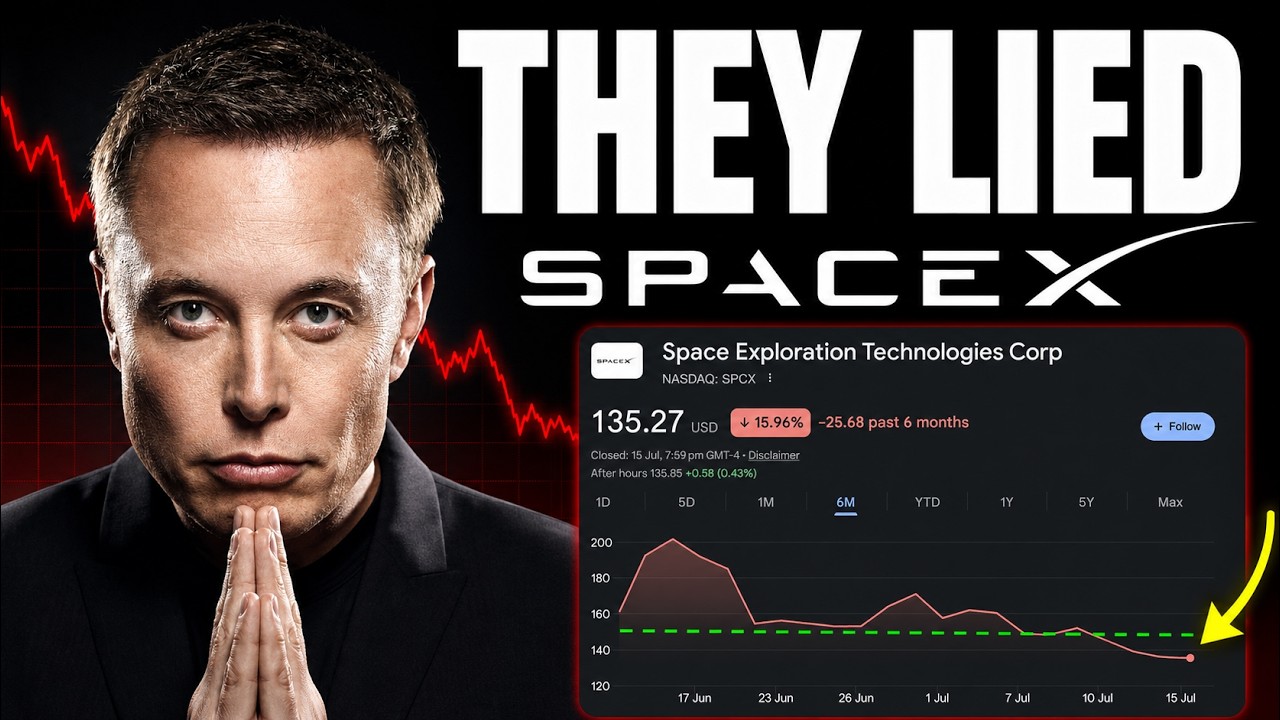
Good day to you everyone. Welcome back to the channel. Today we will talk about SPCX stock, SpaceX. The market has officially pushed SpaceX's stock trading under the ticker symbol SPCX below its initial public offering price of $135 per share. This is a historic moment because just last month on June 12th, 2026, SpaceX completed the largest initial public offering in financial history, raising $86 billion and reaching a peak valuation of over $2 trillion. At its peak on June 16th, the stock was trading at $225, but a rapid rotation out of high multiple tech names has dragged it down by 40% to its current level near the IPO floor. The sudden decline has sparked intense fear and panic among retail investors with many worrying that the high-flying aerospace giant is headed for a massive and prolonged correction. However, professional analysts and institutional funds are looking at this pullback from a completely different perspective. Recognizing that the fundamental business remains stronger than ever, we are seeing a unique technical setup where the market's short-term emotional reaction has completely disconnected from the underlying economic reality of the business. In this deep dive, we're going to examine the hard data to see why this temporary dip represents a highly compelling buy for the short term driven by powerful technical momentum and shifting macro events. We will analyze how passive index funds are creating a structural supply squeeze, how Starlink's recurring cash flow provides a bulletproof financial safety net, and how the recent acquisition of XAI changes the entire valuation model. By the end of this video, you will have a clear objective framework to evaluate whether SPCX belongs in your portfolio at these current price levels. First, let's look at the revenue and growth dynamics of SpaceX. The company reported a massive 18.67 billion in consolidated revenue for fiscal year 2025, growing 33% compared to 2024. The massive engine of this growth is Starlink, which accounted for 11.4 4 billion of total revenue, representing over 60% of the company's business. Starlink's subscriber base has officially doubled to over 10 million subscribers across 160 countries, making it a highly reliable recurring cash machine. Meanwhile, the launch services segment, bringing satellites and astronauts to space, grew at a steady pace, and the company's newly consolidated artificial intelligence division is scaling rapidly. Hey guys, quick pause. If you have not realized yet, this person you are seeing right here is a digital clone of me. I am making these videos in the hope of bringing a fresh perspective and datadriven analysis to the stock market. If you like what you are hearing so far, please consider giving me a follow as it really helps bring this video to more people in our investing community. For the first quarter of 2026, SpaceX brought in $4.69 billion in total revenue, which is a 15% increase year-over-year, showing that the growth thesis is very much intact. Wall Street analysts are exceptionally bullish on the company's long-term trajectory. Goldman Sachs projects that SpaceX's artificial intelligence division will see its revenues soar to 15.6 billion in 2026 and reach an astronomical $322 billion by 2030. This would represent a 100fold increase in AI revenue over just 5 years, powered by their newly developed space-based AI data centers and custom satellite computing infrastructure. This massive revenue trajectory is completely changing the way we look at SpaceX, shifting it from a pure aerospace play to a massive globally dominant artificial intelligence infrastructure powerhouse. But here's the part most people miss. While the AI division consumes a significant amount of capital, the rocket launch segment is completely self- sustaining and Starlink is already generating highly profitable high margin cash flows. This structural balance between high-spend research and highly profitable recurring software-like revenue makes SpaceX's business model incredibly unique and highly resilient to short-term market downturns. To truly understand the short-term thesis for SpaceX, we need to analyze the broader industry landscape. The space economy is no longer a speculative playground for governmentbacked programs. It has evolved into a highly competitive and strategically critical commercial frontier. Over the last decade, we have witnessed a massive drop in the cost of launching payloads into low Earth orbit, which has unlocked entirely new commercial applications. SpaceX is the undisputed king of this market, conducting more orbital launches annually than every other country and company on Earth combined. On one front, we are looking at the global telecommunications sector. High-speed, low latency broadband is a necessity for modern commerce. Yet, billions of people still live in regions without reliable groundbased fiber networks. This is where Starlink's satellite constellation steps in, creating a virtual monopoly over rural and maritime internet connectivity. The demand for satellite bandwidth is growing exponentially, not just from retail consumers, but also from major enterprise clients, airlines, shipping conglomerates, and national defense agencies. On another front, we have the massive artificial intelligence hardware race. Traditional tech giants like Meta, Google, and Amazon are spending hundreds of billions of dollars constructing massive groundbased data centers. However, these facilities are running into severe bottlenecks, particularly regarding power grid capacity and the massive amount of water needed for cooling. The industry is desperately looking for alternatives to handle the soaring compute requirements of next generation AI models. This is where the genius of the XAI merger becomes clear. By moving AI compute into space-based data centers, the company can leverage constant solar energy and the natural cooling of outer space. We are seeing a fundamental shift in the AI hardware industry where orbital compute is becoming a viable and highly sought after solution. As a result, major index funds and institutional managers are looking at SpaceX not just as an aerospace manufacturer, but as the premier AI infrastructure play of the next decade. This dual exposure is why the recent correction in both tech and space stocks has created such a strong opportunity. The broader market is currently punishing SpaceX because of short-term interest rate fears, but the structural demand for both space bandwidth and AI compute continues to grow at an accelerating rate. Now, here's the thing. This temporary market volatility creates an incredibly attractive entry point for short-term traders looking to ride the next wave of momentum as institutional capital reallocates. To build a strong datadriven investment thesis, we have to look past the topline revenue and dig into the actual profitability of the business. SpaceX's financial S1 filing revealed a highly cash generative core business that is currently funding massive capital expenditures. In fiscal year 2025, the company recorded an operating income of $4.4 $4 billion, specifically from its Starlink connectivity segment. Starlink's operating cash flow is exceptionally strong, reflecting a highly profitable software as a service model with high gross margins. However, on a consolidated basis, the company reported a net loss of $4.9 billion for 2025. Short-term skeptics point to this net loss as a reason to avoid the stock. But we have to understand what is driving that number. The company spent a massive $3 billion on research and development for the Starship heavy lift launch system in 2025 alone. This research and development is an investment in future dominance, not an operational failure. Additionally, the company absorbed the heavy losses of XAI in early 2026, which experienced an operating loss of 2.47 billion on $818 million in revenue in the first quarter of 2026. The key metric we should focus on is adjusted EBITDA, which came in at a robust $6.58 billion for 2025. This shows that the core operations of SpaceX are incredibly healthy and highly cash generative. Starlink is essentially acting as a cash cow, subsidizing the temporary high-spend phases of the Starship program and the expansion of the SpaceX AI compute infrastructure. As SpaceX transitions to its Starlink version 3 satellites, which will be launched using the Starship heavy lift system, the cost per gigabit of satellite bandwidth, is projected to fall dramatically. This transition will expand operating margins even further. For the short-term investor, this means the company has a strong financial cushion. This is not a speculative pre-revenue startup. This is a massive business with $6.58 billion in operating cash flow before research and development, which gives it the financial runway to execute its roadmap without the risk of dilution or insolveny. The temporary consolidated net losses are a strategic choice to invest in absolute dominance, making the current sell-off highly irrational. But here's the part most people miss. Once Starship achieves full commercial operations, the cost to launch Starlink satellites will drop significantly, which will immediately translate into a massive spike in consolidated operating cash flow. Now, let's address the critical question of valuation. At its initial public offering price of $135, SpaceX carries a price to sales ratio of approximately 94 times its 2025 revenues. For traditional aerospace manufacturers like Boeing or Loheed Martin, this multiple would be considered absurdly high. But SpaceX is not a traditional manufacturing company as over 60% of its revenue comes from high margin recurring subscriptions. When we value SpaceX based on forward price to operating cash flow, the picture becomes much more reasonable as forward multiples compress rapidly due to Starlink's incredible scale. The sudden 40% correction from its high of $225 back to its IPO floor has completely reset the riskto-reward ratio. Now, here's the thing. The short-term catalyst of NASDAQ 100 inclusion on July 7th means there is a massive wave of forced buying. Because the public float of SPCX is only around 4.3%, passive index funds like the Invesco QQQ trust must acquire billions of dollars in shares regardless of valuation. This price agnostic buying of shares on a tight supply creates a powerful structural cushion against any further downside. The retail panic has pushed the stock below its IPO price while passive index rebalancing is forcing billions of dollars of institutional capital into a highly illquid float. I calculate that this technical imbalance is highly likely to trigger a rapid short-term short squeeze and rebound back towards the $150 to $160 range, representing a compelling 20% short-term upside. For investors who missed the original initial public offering, this correction back to the IPO floor is an exceptionally rare second chance to gain exposure at the same price as the institutional founders. To wrap things up, the recent marketwide tech correction has presented a highly unique short-term setup for SpaceX. While a 40% drop from its post IPO highs looks dramatic on paper, it's essential to separate stock price volatility from the company's robust operational execution. The combination of structural index inclusion inflows from the NASDAQ 100 rebalancing, the massive recurring revenues of Starlink and the unprecedented growth runway of the newly merged SpaceX AI division creates a massive cushion for the stock at these levels. The technical support near the $135 IPO floor is extremely strong, making this a highly compelling dip buying opportunity for short-term momentum. I do own shares of SpaceX and intend to add more to my position if it remains at these levels, but this is purely my personal journey and opinion. So, you should always do your own research first before making any investment decisions. Hey, thanks for watching. I truly respect every viewer who takes the time to seek objective datadriven analysis. Please share your thoughts on SPCX in the comments section below and I look forward to seeing you in the next deep dive.

Comments 0
Sign in to join the discussion.
Sign inNo comments yet. Be the first to share your thoughts!