What ASML Earnings Means for AMAT, Chip Manufacturers & AI Memory

- Video return
- +2.47%
- Calls
- 1
- Buy / Sell
- 0 1
- Published
Recommendations
Entry is the asset's closing price on the publication date. Current is the last close on record.
-
Entry $1,747.58 18 Jul 2026Current $1,704.37 06 Aug 2026Result +$43.21
It's not a stock we'd be stepping into at this point in time, but if we found it at a more attractive valuation, we sure would.
Context “So I think you're pricing in a lot of the good news at this level. It's not a stock we'd be stepping into at this point in time, but if we found it at a more attractive valuation, we sure would.”
Full Transcript
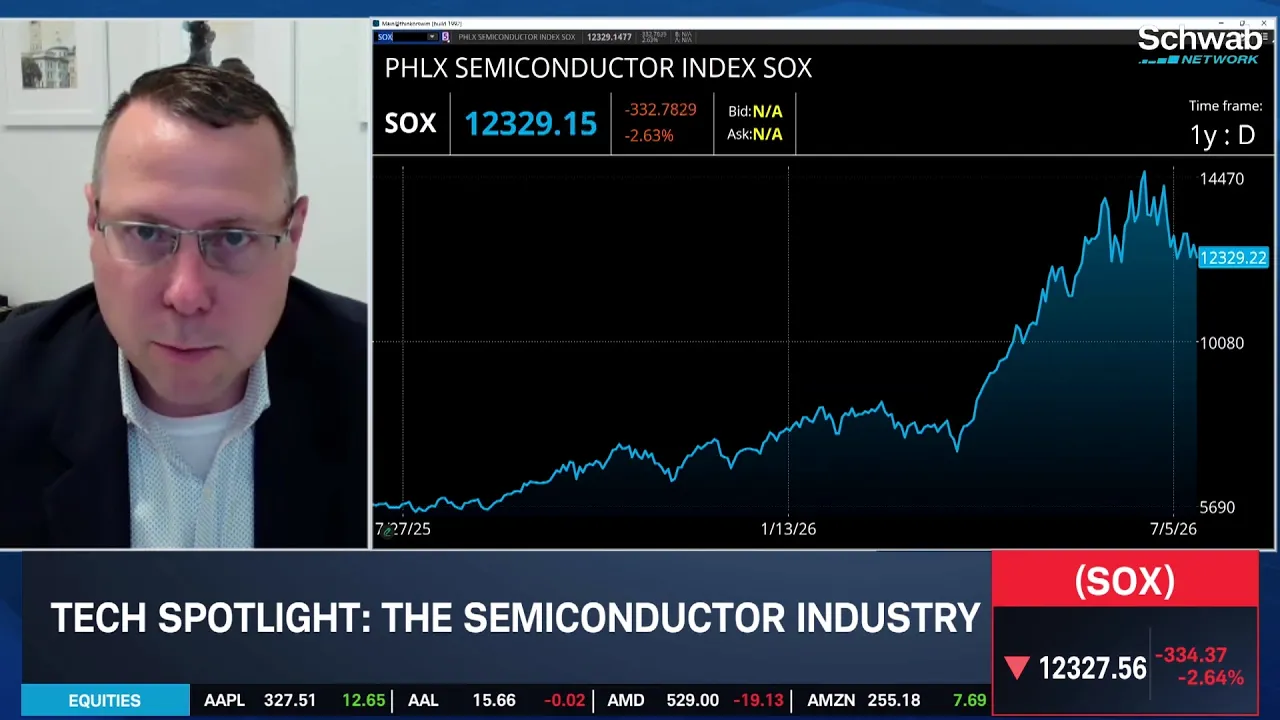
now. Meantime, ASML Holdings reported earnings earlier today. Let's go deeper on that and see me equipment makers in our tech spotlight. Joining us now is Matt Dmytryshyn. He's the CIO of composition. Well Matt, thank you so much for joining us today. So the share reaction of investors has been fluctuating today, even though obviously ASML has a strong hold of the segment it's in. They beat earnings. They raised guidance. The stock initially gave back some gains. What's your overall reaction to its results. They had a they had a great quarter. And I think what's really compelling is they are also talking about long term agreements in place with their customers. So you look at what's going on and you feel much more comfortable as investor, knowing there's kind of this multiyear trajectory that's kind of in place with minimum prices and minimum volumes in place. So the fundamentals on ASML and just the entire semi cap equipment space appear to be getting better. I think the challenge investors are looking at, not just with the semi cap space, but across all of the semiconductors is valuations. And then kind of you're seeing a little bit of a momentum unwind as investors are choosing to take some profits in the space. Our valuation is justified here. It's tricky. I mean you're looking across the space. And a lot of the semi cap equipment companies are trading around 50 times earnings. That's a pretty high multiple. You I think feel comfortable paying a higher multiple today. Just given greater visibility into these businesses that are not only feeding demand around memory and logic, but you also have this longer term trend around just greater supply chain diversification, more onshoring in the US of semiconductor manufacturing. So I think you've got some good fundamentals in place. This is a you know, if you look at ASML, this is a stock that has, you know, over the last ten years averaged a 35 times multiple. So I think you're pricing in a lot of the good news at this level. It's not a stock we'd be stepping into at this point in time, but if we found it at a more attractive valuation, we sure would. Let me ask you, this is the AI spending story still intact? I ask you this because ASML, they said chip makers are accelerating their expansion plans. And this is obviously all about AI demand. So when you think about that, where do you think we sit in the AI, the innings? Are we in the early innings? What's your view on that? Yeah, I think we're probably in the early middle innings. So there's clearly going to be a long term runway. Multiyear runway. The questions right now in the street are well is it through 27 or 228 that we have this memory cycle. It's clearly going to be through 2028. Just given the long term supply agreements in place. What's kind of coming on the other side is there's a lot of investment going on, and companies like ASML are beneficiaries of that, but we're going to have more capacity coming online, especially as we get to the later end of the decade. And you also have this open question of what happened about China chips manufactured in China, and could that play a role? And so I think our question is really more as we get to 2029, 20, 2030, could there be excess supply and maybe the runway shortens a little bit at that point in time, but it sure looks like a more compelling elongated cycle than what we've seen in past semiconductor cycles. Matt, let me ask you this. So earlier today, there was a report from the information that ASML plans to raise prices. That actually puts some pressure on shares. When that headline first hit, if they did successfully raise prices, does it to you, would you interpret it as them having pricing power, or would that create some kind of worry or turbulence that you'd be looking out for on its customers? For instance? We think it's pricing power, right? You look at this environment where you're not only are you able to take price, there's much more greater demand than there is supply which would support it. But you're also getting customers to engage in long term supply agreements at minimum prices that clearly assigned to us that they have pricing power. Okay. I want to go back to the point you made about, you know, you said, for instance, for ASML, you wouldn't want to get in at this level. But when you think broadly across the semiconductor space, what's the best way or across chips and memory in general, what's the best way to position now? Are you looking at hardware? Are you looking at the picks and shovels? Where is the best positioning now? So we've spread out our exposure to some degree. You mentioned hardware. That's an area we've been adding to in the past month because we found more attractive. Those fundamentals are really starting to improve. We've got better valuation behind them. And really up until the last couple of weeks, you've had some pretty strong sentiment. The semi cap equipment companies, we've been kind of holding our positioning in at the moment. Memory got a little stretched. We're seeing that start to sell off a little bit here. Thus far in July, I think if we started to get more technical support for those stocks, and we may be starting to see that you're seeing the semiconductor index bounce back a little bit today. I think it's down 2% at the moment had been down five. I think if we get more comfortable with the technical support there, we could see ourselves maybe adding a little bit of exposure to the memory side of things. So it's more of a diversified approach, but at the moment it's more on the hardware side that we see the most compelling opportunities. Okay. Hardware side, most compelling opportunity. On the memory side, it's technical, right? You'd be looking at the charts for this one. Let me ask you this question in terms of where we are in the cycle. It is cyclical for memory. The view now is that we're looking at super cycles. Now. What are the indicators that you look for now where you say, okay, this cycle is turning back over? Yeah, it's a good question. It's always having been through a number of cycles in my career, it's always harder to do in the moment and easier to do after the fact. You mentioned it, it's pricing power. So I think for us, it's a question of, you know, what is the pricing going to be? I think this this new trend towards these long term agreements. I think we're going to be watching that. Are they signing more agreements? Are the minimum prices going up? Are they coming down? How are customers are reacting? Are they wanting to renew those contracts? I we'll kind of see how much those companies share. But that is really to us what we're going to be paying attention to, because I think that'll give us a little bit of a sign of are things starting to ease around the edges in terms of demand? All right, Matt, great conversation. That's Matt Dmytryshyn.
Comments 0
Sign in to join the discussion.
Sign inNo comments yet. Be the first to share your thoughts!