
- Video return
- +11.74%
- Calls
- 2
- Buy / Sell
- 2 0
- Published
Recommendations
Entry is the asset's closing price on the publication date. Current is the last close on record.
-
Entry $103.24 19 Jul 2026Current $125.40 07 Aug 2026Result +$22.16
So my analysis would be a buy, but to expect volatility.
Context ServiceNow section: "So my analysis would be a buy, but to expect volatility."
-
Entry $212.67 19 Jul 2026Current $234.77 07 Aug 2026Result +$22.10
So, my verdict is watch or in fact a small buy after earnings confirmation at 212.
Context IBM section: "So, my verdict is watch or in fact a small buy after earnings confirmation at 212."
Full Transcript
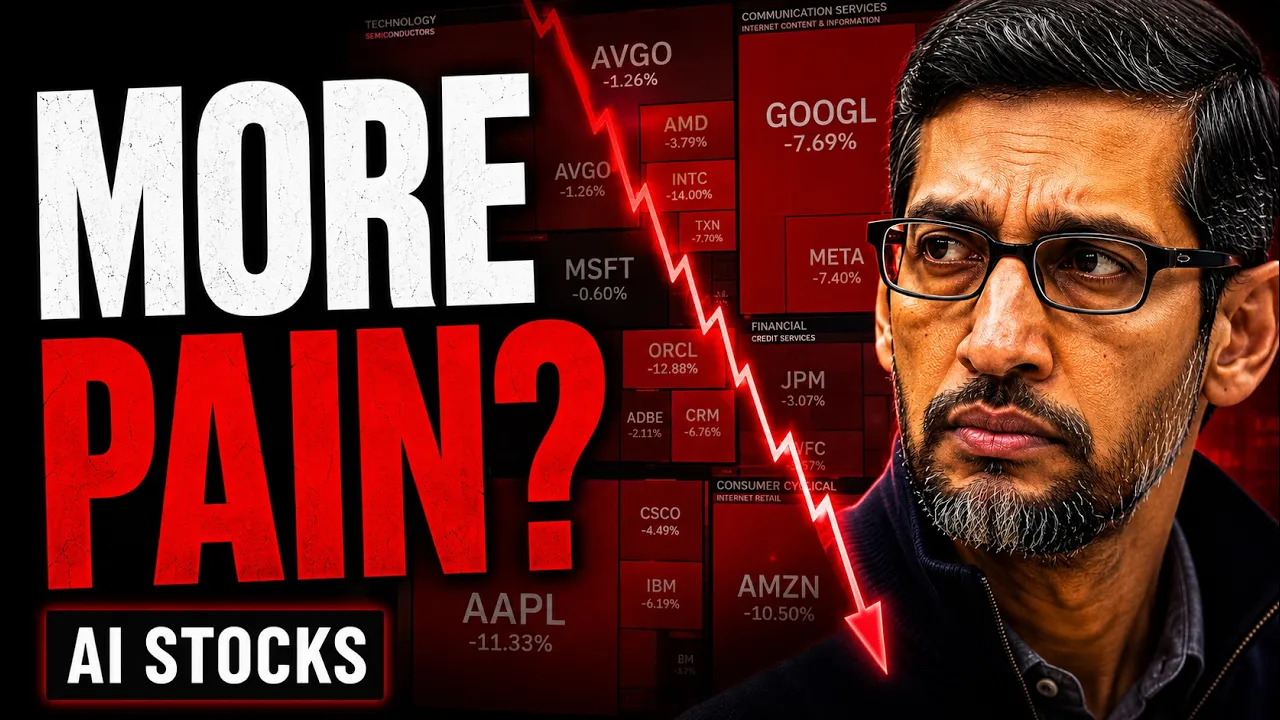
The AI trade has just suffered one of its sharpest reversals of the year. We've got Google down around 15% from its recent high. Microsoft suffered a much deeper draw down. And across semiconductors, several former market leaders have fallen by 25, 30, or even 40%. But this wasn't just another random red week. Some of the biggest companies at the center of the AI boom are about to report earnings. And those results could decide whether this selloff finally produces a rebound or whether in fact the AI stock crash becomes significantly worse. We've got the likes of Alphabet, Service Now, and others all reporting this week, and each one represents a completely different test for investors. One is arguably among the highest quality businesses in the world. But even my optimistic valuation assumptions struggles to justify its current share price. Another has fallen by more than 30% this year. Yet my discounted cash flow model suggests it could be now trading with a margin of safety above 35%. And the final stock has just suffered a historic collapse even though the market now appears to be pricing in almost no future cash flow growth whatsoever. So today we're going to determine whether the recent AI selloff is warning us about something much bigger or in fact creating the best buying opportunities we've seen all year. And at the end I'll rank all three is either buy before earnings, wait for the results or avoid at the current valuation. So let's begin. And the first thing that we need to understand is that the selling has not been evenly distributed. Apple that's actually higher over the last month. Amazon's roughly flat and Meta remains positive. But the areas most closely connected to AI infrastructure, well, they've been hit extremely hard. We've got the likes of Micron down nearly 17%, Intel down close to 19, and several memory, storage, and equipment names where they're down between 15 and more than 30% tells us this is not simply investors abandoning technology altogether. In fact, we can see monies rotating, financials, parts of healthcare, and several defensive sectors while they've held up considerably better while investors are reduced exposure to the most crowded AI trades. But there is an important complication. Even after these pullbacks, many AI stocks remain massively higher in 2026. SanDisk is still up almost 500%. Micron roughly 200, Western Digital 170, and AMD remains up over 130%. So when investors see a 15 or 20% correction, they aren't necessarily seeing a bargain. They may simply be seeing a stocks render a fraction of an enormous earlier gain, and that creates the first major risk for earnings week. Expectations are still incredibly high. And we have one veteran investor who believes the current behavior is starting to resemble previous market peaks. Not necessarily because today's AI companies are fraudulent, but because investors may have become far too comfortable with the risk. >> We're certainly not in the camp of saying things are wildly overvalued. that there's a lot of investor behavior that's somewhat reminiscent of prior peaks especially like the dotcom uh bubble where there's a new language that everyone's learned uh with AI and people think because they've learned the language they've got expertise on investing in the area uh there's kind of a lack of fear of risk um easy money has been made uh I like to say like if you if you watch somebody bet on red in a casino you know, uh, playing roulette and you see them win, it's obvious they could have lost just as easily. But when they buy a stock at 300 that trades at 600 6 weeks later, uh, it's less obvious that that could have gone the wrong way for them. That distinction is incredibly important. The argument is not that every AI company is another pets.com. The argument is that excellent businesses can still become terrible investments when investors pay a price that assumes almost everything goes right. And you can see that the sickly adjusted earnings multiple for US stocks is now close to levels rarely seen outside the late '90s tech bubble and the strongest recent market peaks doesn't predict an immediate crash, but it does reduce the market's tolerant for disappointment. and technologies weight in US equities has also moved above levels seen around the original tech bubble. So when a handful of may companies disappoint, the damage isn't isolated to individual shareholders, it can pull down the entire index. And we're also noting that corporate insiders are also selling at one of the fastest rates seen in more than two decades. executives sold around 78 billion of stock during the first half of 2026, roughly 20% more than a year earlier. Now, we have to be honest here. Insider selling is never a perfect market timing signal. executive sales for taxes, diversification and personal spending that when valuations elevated and insider selling accelerate simultaneously, it reinforces the idea that selectivity matters far more than simply buying every single dip. And then we have the latest threat from China. Chinese developers continue releasing cheaper openweight models that are narrowing the performance gap with leading US systems. Now for many in fact everyday business tasks customers may not require the absolute best model on the planet. They may choose a model that is simply good enough well at a fraction of the cost. So all of this in fact it creates a potential problem for American AI companies spending tens of billions of dollars to remain at the frontier. If model performance converges while pricing falls the return on those enormous investments while they become less certain. And that is exactly why this week's earnings cannot just show higher AI usage. Investors need evidence that AI usage is becoming profitable enough to justify the capital being deployed. And there's also a growing relationship between Korean market weakness and the NASDAQ. It matters because Korea contains several of the largest memory and semiconductor companies in the world. When those stocks suffer, the pressure can quickly spread across global technology markets. But here is where the story becomes much more interesting. Despite the stock price declines, the underlining economics of AI have not disappeared. In fact, forward-f free cash flow for major semiconductors is actually accelerated dramatically. And the next investor about to see argues that the market is now focusing too heavily on how far the stocks have risen and not enough on the fact that genuine economic activity is developing underneath the AI boom. the profit taking is a part of it. Uh but investors just overall are concerned. They there's a notion in a sense that because we're spending so much because earnings for these companies have gone up so much that can't possibly continue. And we would argue that we are seeing signs that there is a lot of activity a lot of real economic activity happening around AI. If you add up the revenue run rate for OpenAI and Nanthropic and maybe pieces of Google and uh and Meta that are relevant, XAI that are relevant, you get to about a hundred billion dollar revenue run rate. That number was zero two years ago. >> That is the central contradiction in this market. Sentiment is weakening, but semiconductor cash flows are strengthening. Investors fear the cycle is peaking, but the companies buying the chips while they're still spending at record levels. We've got capital expenditure across Amazon, Alphabet, and Microsoft, which has all exploded. Combined quarterly spending risen from relatively modest levels several years ago to more than 100 billion in the latest period. Now, that is phenomenal demand for chips, servers, memory, networking equipment, and data center infrastructure. But it's also a major risk for the hyperscalers themselves because eventually shareholders while they need to see the return. I mean we've got Alphabet trading cash from operations that's grown to approximately 174 billion but trading capital expenditure that's also surged to around 110 billion. The business is producing more cash but increasing portion that's being immediately reinvested. It essentially means these earnings need to accomplish two things simultaneously. Show that AI revenue is accelerating while reassuring investors that spending will not grow faster than returns forever. >> Yeah, I think they need to thread the needle. So what I would expect, let's use Microsoft as an example because it's their fiscal year end. So they're going to guide 12 months ahead on capex and revenue growth. If they say Azure is going to grow more than 40%, it's going to accelerate and capex is going to decelerate, grow less than last year and less than 40%. That's a very positive message. That means AI is working. Microsoft's getting a return and they don't need to continue to accelerate capex in order to achieve that. And that brings us to Alphabet, the company at the center of next week's earnings. The biggest report of the week probably and possibly the stock that decides the next major move in AI sentiment. The company today, well, it's trading around $347. The stock, well, that's up around 11% this year, but it has dropped meaningfully from its recent peak, which we can see around $49. And it's now heading into earnings with several major questions hanging over it. And from its highs, Alphabet well has fallen around 15%. That's enough to create renewed interest, but not necessarily enough to make the stock objectively cheap. Now, the most immediate concern is that competition in Frontier AI appears to be intensifying just as Google prepares report and a recent report sent the stock sharply lower. Now bear in mind, all of this matters for Google because its investment case relies heavily on the belief that its distribution advantage can offset any temporary weakness in model leadership. >> But shares taking that turn lower, now down nearly 4% after Bloomberg reported that Google is months behind schedule on Gemini 3.5 Pro, its next flagship AI model. The company reportedly still working to improve the LLM, particularly its coding capabilities after a recent change to the training data produced disappointing results. Now, the report says the delay is frustrating engineers, researchers, and managers inside of Google with some worried the company is losing ground as OpenAI, Anthropic, and Meta roll out stronger coding models. >> Now, this is not just a product delay story. Open AI, anthropic, meta, and Chinese developers are all moving rapidly. And if Google repeatedly arrives late with flagship models, its enormous distribution network may not be enough to guarantee leadership. And then the second risk, well, that's pricing. Google is spending enormous amounts of money building leading models at exactly the moment. Lowercost alternatives are becoming more capable. That creates pressure from both directions. higher costs and potentially lower model pricing. Now, the current expectations are demanding. Analysts are forecasting that Alphabet will generate $1425 of earnings per share in 2026. That's around 32% year-on-year growth for the full year, but then growth is expected to slow dramatically in 2027 with EPS rising by less than 3%. Now, the slowdown means investors will focus heavily on management's guidance beyond the current quarter, and near-term quarterly growth is expected to remain positive. However, the projected year-over-year growth rate, well, that falls sharply by the first quarter of 2027. So, merely beating this quarter, well, that may not be enough. And it's worth pointing out that when we zoom out and look at the last eight quarters over the last two years, Alphabet, they've beaten EPS in seven of the last eight quarters. Revenue that's been less consistent, five out of eight. The market will want a broad result, not just another earnings beat produced through cost control or one-off items. And consensus revenue forecast, they remain extremely strong. Revenue is expected to reach around 489 billion in 2026, rising by around 21% followed by around 20% growth in 2027. And longer term, analysts expect Alphabet to eventually become what a $1 trillion annual revenue company. That is an extraordinary forecast. But those numbers also illustrate how much future success is already embedded in market expectations and their most recent income statement. Well, we can demonstrate here why investors continue paying a premium. Their quarterly revenue that was at around 110 billion, up 22% year-over-year. Search advertising, well, that generated 60 billion. We can see YouTube advertising that was around 10 billion. And cloud that contributed around 20 billion, growing around 63% year-over-year. And you'll notice subscription devices platform that added another 12 billion. Alphabet is no longer dependent on a single revenue stream and search. It remains the largest advertising engine producing around 234 billion over the training period. Meta, well, they're closing the gap quickly, but Google search business, that's still expanding. Now, it's worth pointing out that Meta's family of apps has grown faster, but Google search still generates more revenue. The real earnings question is whether AI answers improved search engagement and monetization or gradually weakens Google's traditional advertising economics. And I'd also say that YouTube is another asset investors sometimes undervalue. It represented around 13.4% as we can note here of US television time in April well ahead of Netflix which sat at 7.8% as well as every other individual streaming platform. And then when we look at Google's subscriptions, platform and devices revenue, well, that's increased from around 20 billion in 2020 to around 50 billion on a trailing basis. It gives Alphabet another large increasingly recurring source of revenue. But the strongest part of Alphabet's current thesis is probably Google Cloud. We can see here that their quarterly growth accelerated around 63%. Compare that with around 40% for Azour and 28% for AWS while also adding around 9.5 billion in new annual recurring revenue in the latest quarter. That also exceeded AWS's which sat at 8 billion. And look, one quarter can never establish a permanent trend, but it does show Google is no longer a distant third place afterthought. Profitability, well, that's transformed as well. Google Cloud once operated at a deeply negative margin. margins now. Well, it's climbed to around 33%, closing much of the gap with AWS at around 38%. And in fact, it moved from a negative 62% operating margin, we're talking in 2020, to now at 33. That is one of the most impressive profit transformations anywhere in mega cap technology. This is where Alphabet can begin turning AI infrastructure into meaningful shareholder value and management. They also said enterprise AI solutions became cloud's primary growth driver for the first time. Revenue from products built on Google's generative AI models that reportedly grew nearly 800% year-over-year. They also reported faster customer acquisition, more large contracts, and several billion dollar plus deals. This is the evidence that Bulls need. AI is not simply an experimental feature is beginning to drive enterprise spending. But now we reach Alphabet's biggest problem. Cash from operations has grown around 91% over the period, but capital expendes increased nearly 250%. Yes, the business is scaling, but the investment required to compete, that's scaling even faster. Now, Alphabet, they're not alone. Amazon, Microsoft, and Google are locked in an infrastructure race in which no company can afford to stop spending without risking strategic defeat. and their long-term investments that's also surged reaching around 107 billion. Look, the company clearly sees enormous opportunities ahead. The questions for shareholders is whether those investments eventually earn returns above Alphabet's cost of capital. And you can see that institutional investors, they remain heavily involved. We can see over the last year, they sold around 78 billion. We're talking in the last 12 months versus buys of 157 billion. On top of that, in the most recent quarter, well, there's more than three time the buyers 1 billion versus the selling of 304 million. And Alphabet also sits pretty much in first place, right at the top of the most widely held positions among the funds from super investors. It is being held by around 40 managers. And we can also note it's also among the most frequently purchased large cap positions in the first half of 2026. Now all of this doesn't guarantee future returns but large investors have not abandoned the company and it was also the second most frequently purchased stock among disclosed congressional common stock transactions in the first half the year. Again not a reason to buy a loan but another sign the recent weakness has started to attract attention and perhaps the most striking endorsement comes from Burkshire Hathaway which has built an enormous alphabet position. In fact, just last month, it added $10 billion as part of a private stock purchase of those Alphabet shares. Now, there's been a lot of speculation as to who decided to rep to purchase those shares, with many pointing to the stake as a sign of how Greg Ael will be putting his mark on the Berkshire portfolio. I asked Buffett whose idea it was to buy the tech giant. >> I initiate it. I mean, I normally wouldn't give you an answer on something like that, but I will. And Wall Street's average price target sits around $434. That's around 25% higher than the price that we can see today. So, the professional consensus and Burkshire's positioning both suggest considerable long-term confidence. But my own valuation tells a more cautious story. And if we take a look at the forward earnings multiple, it's above the 5-year norm. We can see here essentially highlighting that the company is trading at a premium. And it's even clearer when we take a look at the blue tunnel which points out the intrinsic fair value. It's sitting above which would indicate potential overvaluation. Bear in mind over the last 5 years there have been many times as discussed on this channel where this was sitting in a severely undervalued level. Now my own discounted cash flow model produces an intrinsic price of $311 against today's value. It implies the stock is trading around an 11% premium. And the medium scenario we've used today, well, that sits around 16% long-term free cash flow growth. Now, it's not a pessimistic assumption yet. We can see the model still in fact does produce downside. If we use the lower end of 14%, the growth model suggests $284. And even at the 18% higher end, the value only rises to 340, just slightly below the market value today. With one of the most important features being the reverse DCF, it suggests the market is already pricing in free cash flow growth of around 18.4%. Now, Alphabet may absolutely deliver that, but the valuation gives investors very little room for a major operational mistake. So, Alphabet, I'd probably say, is arguably the best overall business that we're covering today. Search remains dominant. Cloud is accelerating. Cloud margins have transformed. YouTube has unmatched reach. and enterprise AI revenue that's expanding rapidly. But competition is increasing. Model pricing is falling and Gemini's reported delay creates added uncertainty before earnings. And more importantly, Alphabet must prove that his record capital spending will generate returns fast enough to protect free cash flow. So my overall verdict before earnings is weight. I wouldn't chase the company at today's price before a potentially volatile report. The risk reward becomes far more attractive around the low 300s. And the second stock we're looking at is completely different. Unlike Alphabet, this company's share price has already collapsed and the decline may have created the most interesting valuation in today's episode. And that service now, which trades around $103, the stock itself down 33% this year, is trading towards 52- week lows and has collapsed from their 52- week high of just above $210. Is not a routine correction. It's a complete valuation reset and it's happened despite Service Now continuing to generate strong revenue growth, excellent profitability, and consistent earnings beat. Now, Wall Street's average price target $142. That's around 37% above the current price. Now, the target range is wide, $85 to 236. It tells us uncertainty is high, but the average analyst remains firmly bullish. and Service Now. Well, when we look at the last four quarters, they've beaten in three of those, and with the most recent one, it's sad in line. Analysts, well, they're expecting quarterly EPS growth to reacelerate. Where consensus project EPS growth around 13% in the next quarter, followed by 32% later in the year and around 21% entering 2027. This is a much stronger earnings profile than the share price performance suggests. And it's good to see that over the last two years, Service Now has delivered eight EPS beats and zero misses. Although revenue has been expectation six times and missed twice. So execution has generally remained fairly strong. Now annual EPS is forecast to increase from around $4.13 in 26 to $5.3 in 2027 and $611 by 2028. That represents a growth of roughly 18% followed by 22% followed by 21 across those three years and revenues expected to reach around 16.2 billion in 2026 increasing by approximately 22%. Consensus then expects close around 19% growth in revenue for both 2027 and 2028 and growth as we can see when we do move further down. Well, it gradually moderates late in the forecast period as it should for a larger company, but the business is still expected to more than double annual revenue over the coming decade. And we can see that service now gets an overall growth grade of a B minus. Revenue growth, well, that was up 22% year-over-year. Forward revenue sitting around 20 21%. Forward EPS growth, well, that's estimated above 20%. And led free cash flow, well, that recently grew by around 38%. Now growth is slightly below service now's own 5year averages in fact in several categories but it remains far far above the wider sector median is not a broken growth company is a growth company experiencing a major multiple compression now profitability is even more impressive it receives an A+ profitability grade gross margin 77% le free cash flow margin 37% and when we take a look at cash from operations it generated 5.4 4 billion with EBIT, Ebit and in fact net income margin all comfortably as we can see it above sector medians and they've improved relative to Service Now's historical average. The company's not sacrificing profitability to maintain growth. But this is where the analysis requires nuance on a non-GAAP basis. service now trades around 25 times Ford earnings only modestly above by in fact 4% than the sector median and almost 60% lower than its own 5-year average but the gap earnings well we can see that does in fact produce a multiple above 50 forward price of sales remains above six so service now is cheaper than its own history but it's not a traditional deep value stock on every single metric now the most attractive point is the relationship between price and growth the forward non-gap PG ratio sits around one and the 4P is expected to decline from around 25 and 26 to around 21 by 2027 and below 17 by 2028. That is if in fact service now delivers the expected earnings growth then the current multiple becomes increasingly reasonable without requiring the share price to fall further. And we can see based on the DCF with the medium case which assumes around 10% growth. Well, that would bring an intrinsic value of $160. Bear in mind the medium rate of the 10% that we've used is lower than their most recent year of 35, their 5year ker of 26 and their 10year keer that sits at 64. Even in the low case, we can see $118. That's still around 15% above the current price. The high case 216, that's more than a double from where it sits today. But the reverse DCF, that's the most striking number. The market appears to be requiring only 2.9% future free cash flow growth. That's dramatically below Service Now's historical performance and below current analyst expectations. So based on the analysis, we have a margin of safety around 36% and potential upside above 50%. The risk here is that the market may be discounting something the backward-looking numbers do not yet fully reveal. Enterprise customers could reduce software budgets. AI tools could pressure traditional software pricing or management could guide to slower future growth. Service Now must therefore prove three things. Revenue can remain near 20%, the earnings can continue compounding above 20% and that AI expands the platform rather than commoditizing it. That unlike Alphabet Service Now's valuation already reflects a significant amount of fear. The share price being cut in half from its high while the fundamental forecast remains relatively strong. So my analysis would be a buy, but to expect volatility. This is the strongest risk setup among the three stocks today. The business is still growing. Profitability is excellent. The historical premium has been crushed. And even the low DCF scenario that produces upside. And the final company we're looking at looks cheaper than Alphabet and slower growing than Service Now. But after it recent collapse, IBM may now be the most controversial opportunity of the entire week. The company itself traded around $212 is down 28% this year and the sharpest part decline followed preliminary results that frighten investors about software demand, infrastructure spending and customer budgets. And the initial reaction was severe because management did not simply miss expectations. It acknowledged that customer spending had shifted in ways the company had not fully anticipated. results. Company s cites weakness in its software and infrastructure business as clients shifted their spend towards servers, storage, and memory in advance of potentially some price increases. In his letter to investors, Arvin Krishna said, quote, "This quarter we faltered." Uh Jim T down 24p premarket I think would be the worst since at least the early 60s. >> Yeah, when I spoke to Arvin and I Christian CEO use it too. I mean pretty abstract. uh look there are these concerns he did not anticipate them putting the magnitude of the capex uh repartization >> the crucial question is whether IBM experienced a short delay in customer orders or whether AI infrastructure is permanently taking money away from IBM's traditional software and mainframe business and consensus EPS growth while that's expected to remain modest the next several quarters range from slightly negative growth to low singledigit and high singledigit growth it means IBM does not have much growth momentum to absorb another disappointment. And one explanation is that enterprise technology budgets have been overwhelmed by unexpected AI costs. Companies planned spending months ago, but token usage, compute, and memory became much more expensive than anticipated. And an IBM representative argued that the weakness may be a temporary budget rebalancing issue rather than evidence that IBM software is being permanently disrupted. >> Again, we're in this weird supply demand area. Let's go back to the whole supply demand scenario. We're back in an area where it budgets of companies are have were made months and months ago and now today in those budgets, people are spending exorbitantly more actual dollars on tokens than they would have thought they would be spending at this time. If your budget's X and you spent.9x on tokens, you're not going to invest in capex. You're not going to buy that new new machine. And all of a sudden, I think companies got caught up in this wave that they had spent so much of their token budget on their IT budget that they had to cut back somewhere. But I actually think what's really going on is, and you've seen this, is people are starting to think about what's been the return on investment in my AI tokens. Are they a good investment? Are they paying for themselves? Should I cut down on tokens? Should I actually go back to reinvesting in my enterprise infrastructure that I know works very well? That explanation is plausible. Business are still trying to determine the return they receive from AI spending. If token and infrastructure costs fail to produce acceptable returns, some spending could eventually rotate back towards proven enterprise systems. But investors should not assume that outcome. IBM's revenue is expected to grow by only around 5% in 2026, 4% in 2027, and roughly 4 to 5% annually in the years after that. where EPS growth is also modest. Consensus projects approximately $128 in 2026 and $139 in 27, growth of roughly 4% as well as 8% in the following year. It remains a mature, slow growth business. IBM has nevertheless delivered eight EPS and zero misses across the past two years. Revenues beaten five times and missed three times. And the size of those earnings beats while they've generally been modest, but Mandarin has consistently cleared the bottom line bar. The concern is not whether IBM can beat a lowered estimate, is whether the underlying demand environment is deteriorating. Now, we can see they get an F for growth. And unlike with many sell-offs, the grade is not difficult to understand. Forward revenue, that's only sitting at 5%. Long-term EPS growth, that's below 7% and free cash flow growth, that's anticipated to rise below 9. The recent year-over-year EPS numbers, they look impressive, partly because of easy comparisons and business changes, but the forward growth profile here is much less exciting. It's not a company investor should value like service now. And on profitability, they get an A+ gross margin sitting at 58%. We can see lever free cash flow margin sitting at 19 and cash from operations sits around the 14 billion mark. Return on equity we can see just above 35% and operating and net margins are materially stronger than IBM's 5-year average. So while growth remains weak, the quality of the profits have improved. And IBM today offers a forward yield of 3.2%. That's actually below the 5-year, meaning the stock is not unusually cheap based on dividend yield alone. And the forward P7 pretty much sits in line with their 5year average. So the headline multiple does not scream deep value either. And you'll notice on the blue tunnel pretty much sitting firmly in the middle of that reasonable signal. Worth highlighting this one before the crash pretty much was trading at a significant premium. And Wall Street's average price target sits at $274. That's around 29% higher than today's value. But the ranges wide 175 to the upper end of 350 showing substantial disagreement about whether the weakness is temporary. And we've used a medium case a day sitting at 4%. Now, I'd say these assumptions 0, four, and eight are pretty much fairly conservative for a profitable company, but they only leave a narrow spread between long-term growth and the discount rate. Now, in the zero growth scenario, we can see $22, 5% lower in fact than today's price. Medium case 277, higher case around 373. But the reverse DCF super interesting here suggesting IBM only needs to grow future free cash flow growth by 6% annually to justify the current market price. That is an extremely low hurdle and the middle rate of $277 implies a margin of safety of $24%. It also sits remarkably close to Wall Street's average of $274. So my conclusion for IBM is that it's not the cleanest opportunity. Growth is weak. Traditional enterprise spending may be losing budget share to compute, memory, and AI infrastructure. And the preliminary warning has reduced confidence in near-term execution, but the business remains highly profitable, generates substantial cash, and does not require ambitious growth to justify today's valuation. So, my verdict is watch or in fact a small buy after earnings confirmation at 212. It does offer attractive long-term valuation, but because the company's already pre-announced weakness, I would prefer confirmation that delayed spending is temporary before taking a full position. So, could the AI stock crash get much worse this week? Yes. If Alphabet's cloud growth disappoints, if search monetization weakens, or if capital expenditure continues accelerating without strong returns, the pressure could spread across the entire AI complex. If IBM confirms that enterprise budgets are being permanently redirected away from traditional software or service now lowers its growth outlook, the software selloff could deepen as well. But the fundamental evidence does not support blindly abandoning AI. Semiconductor cash flows are growing, cloud demand remains strong, enterprise AI revenues expanding, and several highquality stocks have already experienced meaningful valuation resets. So, I would say that Alphabet is probably a weight is the strongest overall business, but it currently offers the weakest margin of safety. My central valuation $311. While that's lower than the market price of 346, cloud and enterprise AI could absolutely justify a higher value eventually, but before earnings, investors are paying for a significant amount of that success in advance. IBM, I'd say watch or a small buy. We can see here that both the DCF and Wall Street price sit around $275. The market requires almost no future free cash flow growth, but it has to prove itself operationally. Until we know whether the recent spending weakness is temporary, I'd size the position cautiously or wait for the full report. And for service now, I would say as a buyer is experienced the deepest valuation reset while retaining the strongest combination of growth and profitability. Revenue remains near 20%, EPS growth expected above 20, free cash flow margin around 37% and the company's delivered eight consecutive EPS beats. And the low DCF scenario, well, that still produces upside. The medium case is $160. I'd say it gives Service Now the clearest risk reward advantage. So, the biggest mistake investors can make this week is treating every falling AI stock in exactly the same way. A lower share price doesn't automatically create value and a red heat map does not automatically mean the AI investment cycle is over. But let me know your own thoughts in the comments below. Which one of these perhaps you would buy before earnings? Maybe there other companies coming up that you want a bit more of a deeper dive. Let me know. And don't forget, we release one weekly article every single Monday morning covering severely undervalued stocks as well as what's gone in the market over the last few days. You can click below, sign up, read all of these straight away. More importantly, have a great day.
Comments 0
Sign in to join the discussion.
Sign inNo comments yet. Be the first to share your thoughts!