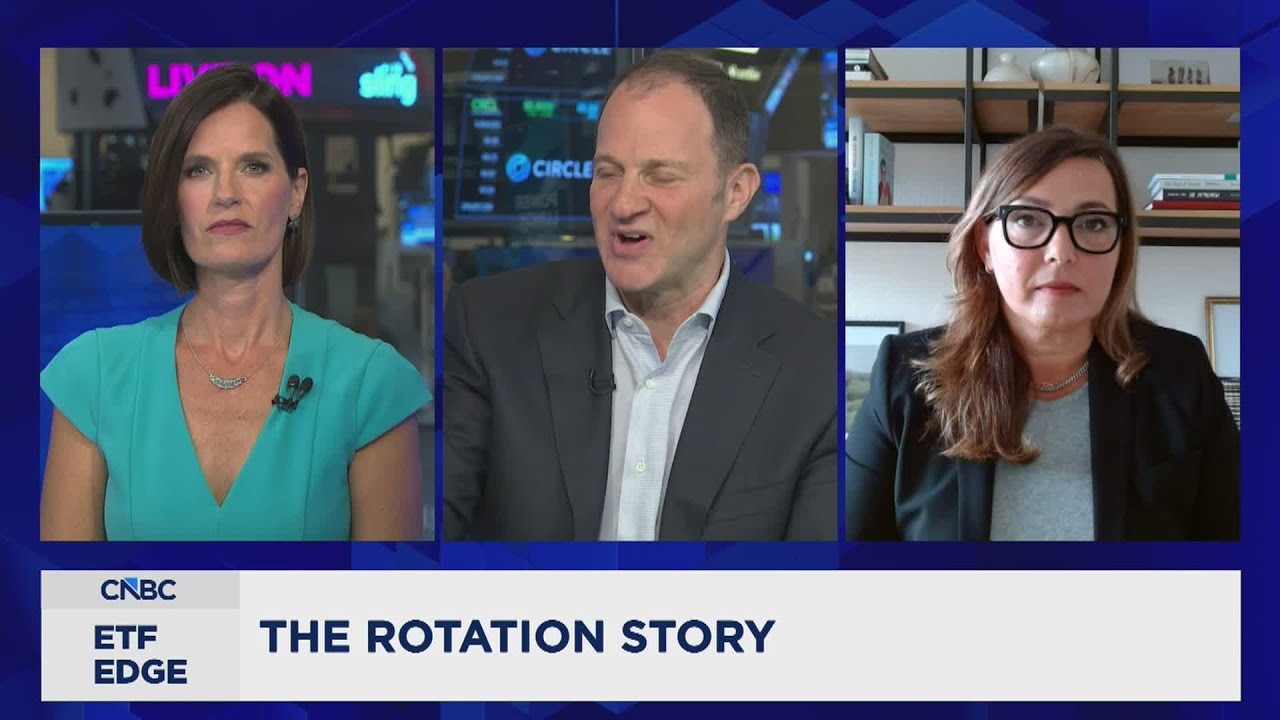
ETF Edge on setting up for earnings season with ETFs

- Video return
- -1.35%
- Calls
- 1
- Buy / Sell
- 1 0
- Published
Recommendations
Entry is the asset's closing price on the publication date. Current is the last close on record.
-
Entry $100.48 21 Jul 2026Current $99.12 06 Aug 2026Result −$1.36
you can benefit um as an investor buying an ETF like J-Tech JTEK is one of our technology ETFs by not just being exposed to very a very narrow segment.
Full Transcript
Welcome to ETF Edge, your go-to place for all things exchange traded funds. I'm Contessa Brewer in for Domu today. You know, earning season is off and running, but we're still a week away from the busiest period for quarterly results. There's a risk of course that expectations are so elevated that even if you get better than expected results, they're just disappointing. Joining me now is John Mayer, chief ETF strategist at JP Morgan, and Cynthia Murphy, director of research at Vetify. It's nice to see both of you today. Look, I want to get your perspective on what we've seen so far from earnings and can we apply it, John, do you think for the rest of earnings season to come? >> You know, it's been a great earning season as everybody knows. The banks have reported about 50 companies have reported. Now, uh, solid there's been solid reward for beats so far. one day after earnings announcements. So that's a positive. We also know there's a tremendous amount of money that's being spent uh by the hyperscalers that's filtering through to many different sectors whether it be industrials and materials um and energy sectors. So we are expecting that the this this season's going to be pretty robust. >> We've seen a sort of a broadening in terms of who's gaining in the market. And Cynthia, when you're looking at how earnings have come through so far, Faxet says 88% of S&P companies that have reported have reported uh earnings that beat expectations sometimes by double digits here. So, what's your expectation moving forward through the rest of earning season? >> You know, to to John's point, I think uh this this broadening this trickling effect is really important. We're all watching for that this time around. If you think about what has really driven the equity markets, look at the tech stocks, the mega7, the mega cap technology, the expectations for combined earnings for these firms is around 28 29% which is massive compared to the S&P 500 overall, but it's much smaller than it was last quarter. So there is a sense that that gap between the top seven and the 493, if you will, is is narrowing. So the broadening is in effect. So we're all going to be watching for the signs of this trickling into other sectors into other parts of the the market of of that earnings benefit from all this capback spending and and AI we've been chasing. >> You know that's great Cynthia. Um also the banks are like uh telling us a few things. So they are indicating that the consumer is strong. um capital markets have been crazy, super strong. So that leads me to believe that that's there's going to be a broadening out in the marketplace um for these these earnings reports that are coming up. So when the banks give you an indication that American consumers are still spending I look I cover the travel sector and what I've heard from travel companies is that even if people are holding on to their cash in other areas maybe they're trading down at the grocery store but they still want to travel. It it it is a pervasive signal of strength in these American consumers. How do you play that when you're choosing your ETFs? What sectors, Cynthia, do you look for that say, "Oh, the American consumer is doing surprisingly well." >> You know, that's a great question. And what's really interesting about that is that we see a little bit of this dichotomy between consumer sentiment data showing uh really really low readings and then we see consumer spendings still really strong. So you know a fund like I buy for example you know online retail and then a lot of spending an interesting play. We also see a lot of these kind of luxury and consumer focused names like a Walt Disney company for example in a fund like Vflow which is looking at high quality companies that are benefiting in this market you know generating really high free cash flow really high growth prospects. There's a lot of these types of names in this portfolio which is performing really well. So it's not a direct, you know, luxury spending play, but you see a lot of these names in these kind of high quality portfolios as well. >> Are you Cynthia seeing any areas of weakness that could foretell disappointing results in some of the keystone companies that we watch? >> Yeah, I think you know I think what is I I echo John's sentiment here. The broadening is a big story. So I think it's it's been interesting for me to watch. I'm really amazed at the persistence of the semiconductor and memory play. So as much as we like to say this is really overrun and it needs a correction and you know we've see headlines about chips being in a bare market. Now I mean we see a ton of money flowing into this part of you know the hardware infrastructure of the AI story that's still running. Is it going to run forever? No. But uh the concept of the bottleneck remains a big strong driver of asset flows and performance. So that's been really interesting to watch. >> The there's just so much appetite as well. I mean, if you look at the DRAM here, it here's a brand new ETF that comes out focused on memory and it goes from zero to $60 billion in flows already. I mean, what do you make of the just incredible hunger there is for this space? >> Yeah, it's a little bit less than that, but it's it's an area that is is very exciting. So the technology area uh probably received about $60 billion in flows this year. Last year >> in all of technology, not just the DRAM >> and and $40 billion last year. So it's increased a lot. You know what I find and from my experience working with financial advisors and clients is that people like these exciting things like wow I want to have these 100% returns. There's a FOMO that exists. Now with that comes a lot of risk. That's what from my perspective having an active manager which is JP Morgan we are active managers we do bottoms up research we may focus on some of these memory companies we may focus on some old line companies depending on kind of the strategy by having these managers looking at really where the earnings are coming from >> right >> and the valuation too high or low that's where you can benefit um as an investor buying an ETF like J-Tech JTEK is one of our technology ETFs by not just being exposed to very a very narrow segment. >> It's enticing though. >> But but Cynthia, do you agree? Like is there a a hedge against volatility that happens if you remain in ETFs that have broader exposure than these slices within the greater sector? >> I I think it's you can have both ways. So if we look at the broad market performance and our expectations for earnings and everything, we're talking about the broadening. We're talking about beware of high concentration. The market is very concentrated and anytime you're you're really heavily you have 40% of your portfolio in 10 stocks, uh you're going to be really exposed to volatility, which is what we've seen all year long. So, the story of broadening is a story of good investing long-term, especially if you don't want to have a lot of heartburn. The bottleneck story is a little bit different. like if you're really focused on say the AI memory opportunity of of a fund like DRAM that's a a kind of a growth component it's it shouldn't be your core portfolio it can be like a thematic play that you would add on top of your broader technology segment. So you can do both things but anytime you choose concentration you are choosing potentially higher risk and higher heartburn uh any given day. So you got to be aware of those choices. >> You know, Cynthia, most most clients money kind of sits in that moderate moderately aggressive area. Now, also most clients don't necessarily have a stomach for volatility. And volatility right now is relatively low. It's about the VIX is 18 or 19 or so. But if you actually drill down and look at the individual companies, some of those companies and particularly the MAG uh seven or the top 10 and the S&P 500, volatility is relatively high, but volatility could be lower from some of the other companies. So that kind of sort of cancels it out and bring brings volatility lower. Now, if investors are looking to lower their volatility, they can look to things like derivative income. Um, we have a fund Jeepy JPI which is the second largest actively managed ETF. It has a volatility of about 60 65% of the S&P 500. It's not designed to return what the S&P 500 returns because it has lower volatility. >> Well, what's what's the return on it? >> The the return is first of all, you get an income of around uh 7 to 9%. Right now is about 8%. And because it's lower volatility stocks in the underlying brings down volatility because um of the option overlay brings down volatility. You you get that 60 65% and you are getting that 8 approximately 8% distribution on the fund. Can we talk a little bit about industrials here and the way those have been lifted by the AI data center ambitions of a lot of these companies and and how that's how we're seeing ETF funds react Cynthia? >> Yeah, I mean with with Cintat industrial it really is part of the infrastructure play. uh you know AI is a tech play but nothing happens without the build out of the infrastructure as we know whether it's data centers uh we see that energy grid there's a whole backbone infrastructure that needs to be built and that has really pushed up industrials if you look at uh XLI uh from state street the sector spider it's uh the valuations are really high uh relative to the S&P 500 it's as high as as tech so it really is a sector that has really had its moment in the sun and picked up a lot of attention, a lot of flows because nothing of going to happen without a lot of focus on infrastructure and and the buildout that comes with it. What's interesting is that's that not only the AI driving performance here, but also just geopolitics and the the concept of defense. So that has also supported industrial. So it's been a really good year for for industrial stocks and there's a lot of tailwinds there. Yeah, good point. Um, Cynthia, the flows really have been strong, $17 billion. On the active side, 34% of all the flows into industrials have been actively managed. Um, the capex spending is really kind of feeding into that industrial component. Um, security, we talked earlier about cyber security. Security and resilience is really important and that's going to play even bigger and bigger of a role. And that's one reason why insurers in fact are looking at the data center build and everything from the very first shovel that hits the ground on through operation and there are opportunities now for coverage but probably I in fact a global reinsurer CEO just told me today there's probably not enough capital in the space right now to handle some of these projects that provides opportunity moving forward in the future. >> Absolutely. And I think you know the market is always forward looking and that's really what a stock price is the cash flow of future earnings. So >> uh point that we just heard from the Fed chair last week. Uh talk to me a little bit about what we're seeing with bonds and in fixed income. >> Well the first of all the fixed income the bond market overall is an act an active market for the most part. ETFs generally have have grown up passive, but if you think about like how the baskets are constructed, you're trying to even if it's passive, you're trying to find a basket that's similar to the passive index. It's not exact. Now, active managers and the active the ETF market has largely always been active um typically outperforms because the A only has half the market. There's this portion the securitized market which is not in the aggreg just a little bit um which can fi you can find real alpha um duration and yield in that market. So the active market is really important. Now with respect to the Fed um the inflation is a little bit higher um that could be a one-off or could be declining a bit. We are seeing indications that it's declining as energy is declining. Tariff noise the tariffs are coming down. So those things could bring down inflation. Uh uh the Fed is only one the chairman of the Fed is only one vote out of 12 votes. So he would have to do some persuasion for the other 12 voting members to increase rates um to decrease rates. He's not going to decrease rates. >> Could he increase one or two? Possibly. >> What do you think, Cynthia? One, are you seeing more investors turn toward active ETFs for bond adjustments? And two, what are you expecting from the Fed? So I the the Fed last week when the the testimony to Congress I remember Walsh saying you know we are going to deliver price stability. The expectation is for rates to come up uh maybe neutral this year and higher next year. In that sense what we've seen ETF investors do we're seeing almost record amount of money going into bond ETFs. Over 35% of all flows year to date have gone into bond ETFs. But we're seeing that money being allocated either in the very short end your cashlike defensive positioning or you know on the other end but it's mostly to to John's point securitized debt some credit avoiding that treasury duration because rates are expected to potentially go higher. So we're seeing a kind of a barbell approach that is looking for the short end and then securitize that and alternative uh fixed income uh sources on the other end. And uh it's been really interesting because it's defense, it's income generation things to to John's point, Jappy and and funds that are generating that equity income that is not fixed income related at all, but trying to manage expectation for higher rates coming up. >> Yeah. And if you look at the Treasury rates, they've been kind of hovering at 4.5 4.6%. So that gives you a sense of inflation expectations. And you know, I manage the guide to ETF program at JP Morgan. We have a really cool slides that looks at flows with different duration metrics and you'll see on the long end of the curve very very little money going into the long end of the curve. >> It's so interesting. I want to mention you just released your quarterly guide to ETFs and what we're seeing is I mean one of the the charts that really caught my eye was this timeline of thematic assets under management. When we're when we're looking at ETFs, what we're seeing is say from 2018 to today, just a skyrocket, a rocket ship going up of AI investment. You might imagine that, but look back to our point about infrastructure that has been high and has stayed high almost in line in in conjunction with AI and then defense, cyber security, natural resources lagging more. Does this surprise you or do you think it's to be expected? >> Well, first of all, you know, I've been involved in thematics both at JP Morgan as my previous firm, Global X. You know, back in around 2021, there was just a huge push into thematics like electrification like electric vehicles and robotics and things like that. Many things are are kind of morphing towards AI and the ecosystem surrounding AI. So infrastructure which has been doing very well for several years kind of feeds into that story um as as well as energy and materials things like that. So doesn't surprise me at all. It's all kind of feeding into the AI story. We talked about the layer cake before um the applications the energy um the AI models um >> and the icing on the cake. got the cake there. It's I The other thing that this report points out pretty dramatically, and it's new to me, is how precipitously the flows into mutual funds have tapered off. I mean, it's it's dramatic. What is it about ETFs that is so much more appealing to investors than the mutual funds that we grew up with? Yeah, you know, I think mutual funds will be around for quite some time, but we have a great chart in the guide to ETFs that shows negative flows into mutual funds consistently since like 2020, and that's only going to continue. Now, the ETF provides five basic um advantages, which I won't go into all, but liquidity. Um, and the key particularly for uh equity funds is tax efficiency. they typically don't pay a capital gain. And if they pay a capital gain, it's kind of like on a narrow portion of the market, which are um like levered and inverse ETFs. Some fall into the active space, but it's kind of like a just a different thing. >> So, a mutual fund's just a thing of the past. They're dinosaurs. >> They're not a thing of the past, but imagine if you bought a mutual fund in 2022 and you're down 20, 30, 40% depending on what part of the market you bought, and you still got a capital gain of 6%. You're not happy. >> Nah. when we're looking ahead, uh, what I mean, look, we've had geopolitical instability, energy prices going up, there's been a lot of, um, worries about the American consumer. All of this seems to be easing somewhat. Cynthia, what do you expect for the next six months? I >> I think uh, this earnings report season is going to tell us a lot and we're all going to be looking at the forward guidance to figure out where to go next. That said, uh if expectations for higher rates stays as they are, I think you know we'll continue to see a push towards the more defensive sectors uh push more toward value that broadening play. I think we're going to see that happen and uh we should continue to see things like Vflow do well, quality quality ETFs, things that are either focused on the bottlenecks or the broadening type of of exposure that has that quality tilt and maybe a little more defensive tilt to it. So, I think it should be an interesting second half of the year. Cynthia, I was teasing John before he came on because John Mayor, you know, and John Mayer and I said, "Well, what's the what's the link from John Mayer to what you do?" And we we have landed on slow dancing in a burning room. You want to explain the the theory behind this, how this goes into investment thesis? >> Yeah. You don't want to be caught in that burning room. You want to kind of expand out. So if you're just going to focus on memory, I would say you focus on something broader than memory. You can stay thematic. You can stay with technology like J-Tech, which I talked about earlier. If you want to reduce your volatility, you stay with something like Jeppy. International, we haven't really talked about international. Flows into international have been super strong. $190 billion year to date. Last year, that's half the year. Last year was 220 billion the full year. So NATO is spending more individual companies have defense spending. Banks are improving. Um so Europe is becoming a thing. >> So just focus on the slow dancing just not in the burning room. >> Yeah. Get out of the room. >> John Mayor, thank you very much. Cynthia, it's good to have you with us. Thank you for your time today. >> You can catch the edge podcast and all of our other content at ETFedge.cmbnbc.com. Thank you so much for watching. Get the ABCs of ETFs with the ETF Edge newsletter. Your weekly update on the hottest trends, expert analysis, actionable ideas, and exclusive insight from top industry experts. Sign up now at cnbc.com/etfedge newsletter.
Comments 0
Sign in to join the discussion.
Sign inNo comments yet. Be the first to share your thoughts!