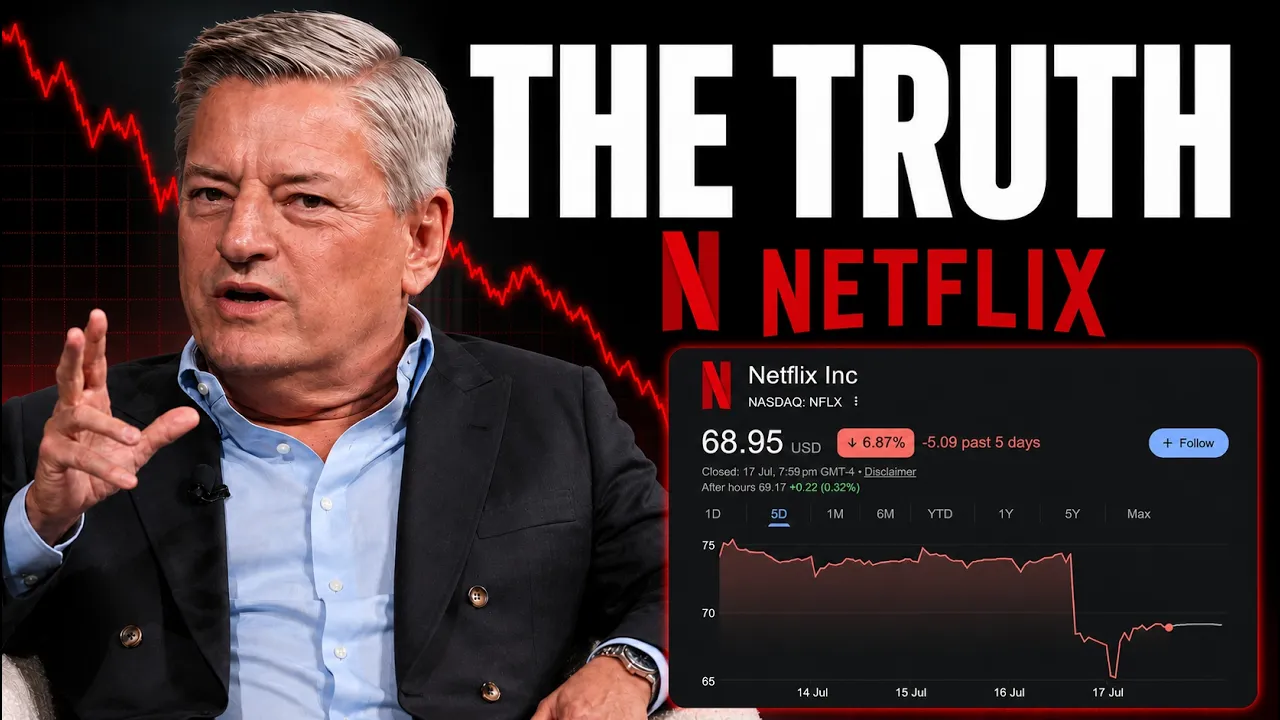
Wall Street is Hiding the Real Truth About Netflix Stock — Do NOT Buy Yet

- Video return
- +16.50%
- Calls
- 3
- Buy / Sell
- 3 0
- Published
Recommendations
Entry is the asset's closing price on the publication date. Current is the last close on record.
-
Entry $68.53 22 Jul 2026Current $80.13 28 Aug 2026Result +$11.60
another massive buying opportunity like 2022
Context "...or if this is another massive buying opportunity like 2022."
-
Entry $68.53 22 Jul 2026Current $80.13 28 Aug 2026Result +$11.60
offers a margin of safety for patient long-term investors
Context "The stock is trading at a historically low valuation, which offers a margin of safety for patient long-term investors."
-
Entry $68.53 22 Jul 2026Current $80.13 28 Aug 2026Result +$11.60
buying this dip
Context "Let me know in the comments if you are buying this dip."
Full Transcript
Good day to you everyone. Welcome back to the channel. Today we are going to talk about the highly debated and confusing situation with Netflix stock. The streaming giant is currently trading near its 52- week low of around $68, representing a severe decline of 25% this year. This sudden sell-off occurred right after the company reported its second quarter earnings, where they delivered a mixed performance that left Wall Street deeply divided. Even though they managed to beat expectations on earnings, their topline revenue growth showed clear signs of slowing down and their future guidance disappointed analysts. This combination triggered a massive wave of panic selling which pushed the stock down by 8% in a single day and erased billions in value. Now, many investors are left debating whether the streaming growth story is officially over or if this is another massive buying opportunity like 2022. To understand if Netflix is actually a bargain at these beaten down prices, we must look closely at how the business model is shifting today. Their core engine is simple. Powered by over 300 million subscribers globally who pay a monthly recurring fee to access movies and shows. However, this pure subscription model is undergoing a dramatic evolution because management is focusing heavily on expanding their cheaper ads supported subscription tier. This adup supported plan has quickly become a massive driver of subscriber additions now accounting for more than 60% of new signups. They have been raising prices across all plans and charging extra user fees to offset slowing subscriber growth which has drawn some regulatory scrutiny. These strategic pricing levers allow Netflix to boost revenue even when the absolute count of subscribers remains relatively flat. The company is on track to generate approximately $3 billion in advertising revenue this year, doubling their total from 2025. This shift to advertising helps insulate the business from subscriber saturation, allowing Netflix to effectively monetize costconscious viewers in mature international regions. It also creates a highly profitable double monetization stream where they collect both recurring subscription fees and high margin premium advertising dollars. Their profitability metrics remain incredibly strong across the board with their operating margin climbing to over 33% during the second quarter. They are projecting a fullear operating margin of 31.5%. Showcasing the scale advantages they hold over legacy media. The incremental margins on their platform are approaching 50%. Which means almost half of every new dollar goes straight to cash flow. This highly efficient cash generation machine has enabled their board of directors to approve an expanded $25 billion share buyback program. But despite these stellar financial metrics, the stock market is choosing to ignore the profits and focus strictly on the decelerating growth engine. Hey guys, quick pause. If you guys have not realized, this person you are seeing here is actually a digital clone of me. I am making these videos in hope of bringing fresh perspectives and deep analysis on stocks and markets in general. If you like what you are hearing, do consider giving me a follow as it really helps bring this video to more people. Now we must examine why the stock is falling so sharply even though the underlying business is generating so much cash and showing incredible profitability. The answer lies in the details of the second quarter report and the specific financial guidance management provided for the coming months. For the second quarter, Netflix reported revenue of 12.56 billion, representing roughly 13.4% year-over-year growth. While that sounds like solid double-digit expansion, it actually missed Wall Street's consensus estimate of $12.58 billion. Earnings per share came in at 80, beating expectations by a single penny, but this beat was completely overshadowed by forward guidance. For the third quarter, Netflix is forecasting revenue of 12.86 billion and earnings of 82 cents per share. Both of these figures are lower than the $13 billion in revenue and 84 cents in earnings that analysts had modeled. Management also narrowed their fullear revenue outlook to 51 billion to 51.4 billion, indicating slowing momentum. This indicates that the massive tailwind from the password sharing crackdown is finally coming to an end, leaving them with slower organic growth. This comes at a time of leadership transition. as co-founder Reed Hastings has stepped down from the board of directors with Jay Hogue taking over as chairman. Wall Street often dislikes simultaneous leadership changes and operational shifts which only adds to the current negative sentiment surrounding the stock. But the biggest blow to investor sentiment was the announcement regarding how they will share viewing data in the future. Starting in 2027, Netflix will only release its viewing hours engagement reports once a year instead of twice a year. This reduction in transparency comes right after they stopped reporting quarterly subscriber editions, which has made Wall Street very uneasy. When a major tech company begins hiding its operational data, investors naturally assume that the metrics are starting to deteriorate. Viewing hours grew by only 2% in the first half of this year, which shows that subscriber engagement is barely moving. This raises serious questions about their ability to continuously raise subscription prices without causing a significant increase in user cancellations. There is also a concern regarding a massive $2.8 billion one-off gain that artificially boosted their net income. This gain was a termination fee from their abandoned pursuit of Warner Brothers discovery, meaning it is non-recurring and distorts the true profitability. Once institutional investors strip out this one-time benefit, the underlying growth rate of the business looks much less impressive. Because of this sell-off, we must analyze the valuation to see if the market has overreacted to these short-term issues. Following this latest dip, the stock trades at roughly 19 times expected 2026 earnings, which is a massive discount. This is an incredibly low multiple for a company that has a near monopoly on the global streaming market and zero debt concerns. To put this in perspective, the broader market is trading at a significantly higher multiple, making Netflix look historically cheap today. When compared to other massive software compounders, Netflix is trading at a steep valuation discount despite possessing similar platform economics and scale. This discount is highly unusual for a business that generates such steady cash flow and maintains a robust competitive advantage. If we assume that Netflix can grow its earnings by 10% annually over the next 3 years, its forward multiple drops to just 14. This level of valuation suggests that the market has already priced in a very severe and prolonged growth deceleration for the company. With a market capitalization of around $294 billion, Netflix is being valued as a slow growing utility. However, they are still on track to generate 12.5 billion in free cash flow for the full year. This immense cash generation gives them the flexibility to buy back shares, invest in new intellectual property, and explore alternative growth avenues. They are also continuing to lead the industry in content spend, planning to deploy billions of dollars to maintain their competitive advantage. So, while legacy media companies are struggling to achieve profitability with their streaming platforms, Netflix is in a class of its own. This massive divergence in profitability suggests that the market is treating Netflix too harshly compared to its struggling legacy competitors. Many investors are terrified that this could be a repeat of the disastrous sell-off we witnessed back in 2022. During that period, the stock plummeted over 70% after they reported their first subscriber loss in over a decade. But today's setup is structurally different because Netflix is not losing subscribers, nor are they losing money on content. Instead, the primary risk is that they are reaching a natural saturation point in their most profitable regions like North America. To combat this saturation, management is forced to make huge, expensive bets on live sports and global entertainment events. They've recently acquired broadcasting rights for NFL games and WWE weekly shows, which require massive upfront content spend. While live sports can attract a broader audience, they carry much lower profit margins than their traditional licensed content. If these expensive live events do not successfully drive high-paying ant subscribers, their stellar operating margins will face downward pressure. There is also the threat of rising competition from platforms like YouTube, which dominates overall screen time among younger demographics. YouTube has built a highly dominant position because it does not have to spend billions of dollars on content acquisition and development. Since its massive user base creates all of its material, the platform operates on an inherently superior margin profile that Netflix cannot easily match. As long as YouTube continues to capture more consumer attention, Netflix will have to fight harder and spend more to retain its audience. This is the core risk that investors are buying into when they purchase Netflix stock at these current levels. We must also address the widespread concern regarding the threat of artificial intelligence to the traditional entertainment industry. Many commentators believe that generative AI video tools will allow anyone to create highquality movies at virtually zero cost. This democratization of content creation could theoretically flood the market, destroying the value of Netflix's expensive library. However, this bearish narrative represents a deep misunderstanding of how professional entertainment is actually produced and consumed. While generative AI models are advancing rapidly, creating a coherent 2-hour film with deep emotional arcs and consistent characters is still years away. The specialized human element in professional film making will protect top tier networks like Netflix from being replaced by simple automated software generators. AI is actually turning out to be a massive productivity tool and costsaver for the major studios. Netflix is already leveraging AI to generate complex background crowds, build realistic digital environments, and speed up post-production visual effects. This technology allows them to lower their physical production budgets and get highquality content to viewers much faster. They are also deploying AI to automate and optimize their programmatic advertising suite. making their ad space more valuable to buyers. Creating cultural phenomena and prestige dramas still requires human emotion, directing, acting, and writing, which AI cannot easily replicate. Therefore, AI is far more likely to widen Netflix's competitive mode by reducing their costs and improving their ad targeting. In conclusion, Netflix is navigating a complex transition from a high- growth disruptor to a highly profitable medium mature giant. The stock is trading at a historically low valuation, which offers a margin of safety for patient long-term investors. However, the slowing revenue growth and reduced transparency are legitimate reasons for the market's cautious stance. This is purely my opinion and my personal journey. So, you should always do your own research first. Let me know in the comments if you are buying this dip. And if you enjoyed this video, please follow for more deep deep dives.
Comments 0
Sign in to join the discussion.
Sign inNo comments yet. Be the first to share your thoughts!