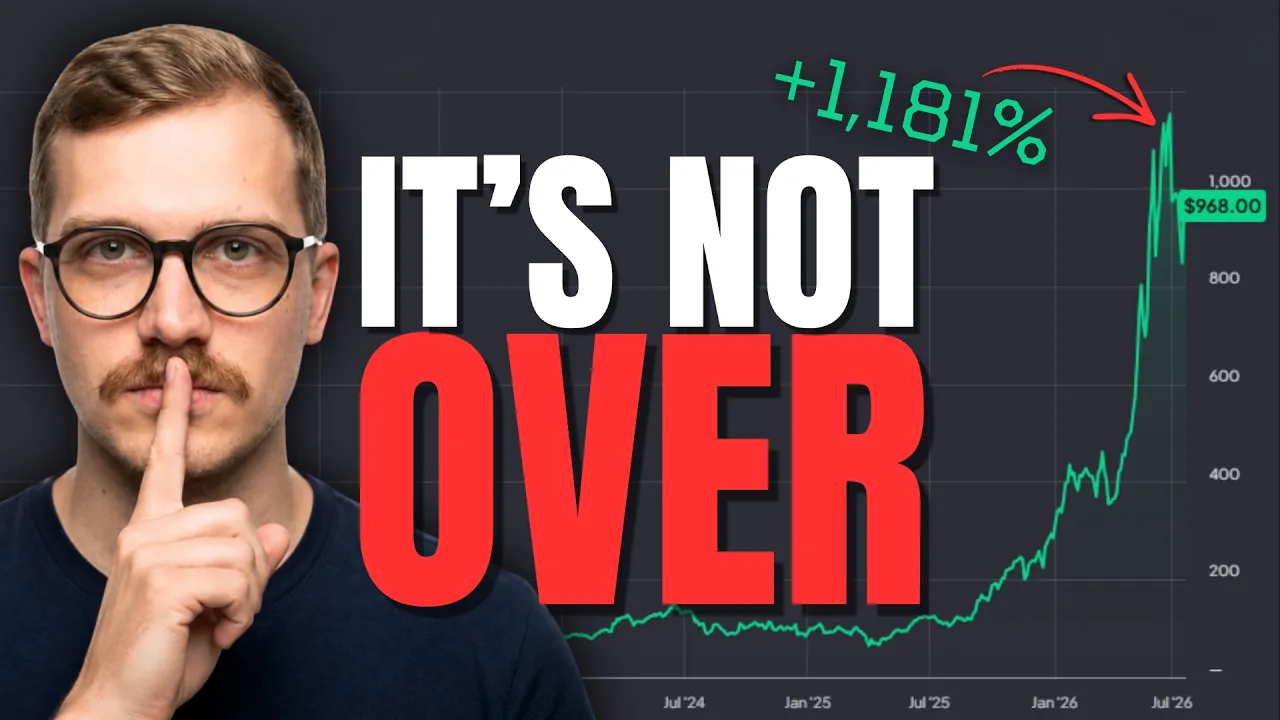
Elon Musk Just Confirmed Why Micron Stock Is a Buy

- Video return
- -2.51%
- Calls
- 2
- Buy / Sell
- 2 0
- Published
Recommendations
Entry is the asset's closing price on the publication date. Current is the last close on record.
-
Entry $959.48 22 Jul 2026Current $916.61 28 Aug 2026Result −$42.87
Micron might still be a buy here
Context So today I want to talk to you guys about why I believe Micron might still be a buy here even after a massive runup in the stock price.
-
Entry $959.48 22 Jul 2026Current $916.61 28 Aug 2026Result −$42.87
I may end up dipping in and buying potentially more.
Context I'm bullish Micron. I think as we end up continuing to sell off and people end up questioning this stock, I may end up dipping in and buying potentially more. Maybe not at 970, but in sort of the closer to 800 range, I think I can get a little bit greedy and try to find those purchases.
Full Transcript
Micron investors just received one of the strongest customer validations possible and it came directly from Elon Musk. During Tesla's earnings call, Elon Musk confirmed that Micron is giving them a very significant allocation to their memory for many years to come. This is so much bigger than a single customer announcement. Memory has become one of the largest bottlenecks in artificial intelligence, autonomous vehicles, and robotics. And now some of the world's largest companies are fighting to get access to supply years in advance. So today I want to talk to you guys about why I believe Micron might still be a buy here even after a massive runup in the stock price. Let's talk about this huge memory opportunity. First up, we have to understand that the amount of actual DRAM that goes into each one of Nvidia's chips. And mind you, it's not just Nvidia. This is across TPUs. This is across AMD. This is across every single custom silicon or ASIC that they all are having big booms in their amount of memory just because that's what we're needing in the products that we're using. Aentic artificial intelligence and all these things seeing big ramp up. So, we're looking at roughly about a 10x between 2022 and 2028. And with Nvidia's revenue jumping up 85%, likely 100% next quarter whenever we get to $93.5 billion, which is pretty much what they're calling for, that this will likely show us that on top of a 10x per chip, we're also selling more chips. So, it's way more of a 10x type ramp up. And this is mainly due to the types of models that we have that are really really popular are the most demanding for whenever it comes to HBM pressure. So this is why all the new chip designs like Vera Rubin are much more heavy on memory and the amount of capex that you're spending on memory versus previous architectures. In the last quarter, what we ended up seeing was roughly $33.5 billion in revenue. Gross margins 81% and then EPS of around $19.15. This was Micron's numbers for last quarter. What we ended up seeing was $41.4 billion. And mind you, this is almost identical to what we saw last quarter as well were these like 20% beats from both Wall Street and Micron's own guidance. So they called between 33.5 and 35 billion in revenue. Those were their guidances for May's quarter here. And obviously Micron destroyed that. On top of that, that 81% margin that they called for actually came up to about 84.56% margins. Meaning the cost to essentially make what they're selling is about 15% of the total cost. And this has climbed up from being 60% of the total cost or 63% of the total cost just a year ago. So this is really showing the tightness. Mind you, this is not based on new volume. The supply that we're actually giving to the market is roughly the same as it was last year because there's not new factories. All factory lines are fully working. Now they have to go build a new factory. The new factories are not coming online till late 2027. So this is all we have. So where does this gross margin come up from? Average selling price. Different customers tell you that hey we're willing to pay higher and higher prices. Please give us that demand. We would love to pay more in order to take the product from you. What this is also doing because average selling price is going up but the actual cost to run the factories that you're already running to run the back offices and the sales teams and all of this remains roughly the same. And so margins are falling for all of these. The cost of R&D, the cost of sales general and administrative, the cost of stockbased compensation is even falling because you're not necessarily paying more for all of this growth. That makes operating profit skyrocket. you had 84% gross margins and 80% operating margins after all of those expenses that we just talked about. On top of that, you have consolidated net income at roughly $28 billion and continuing to be high like 66% 67% margins. Extremely high growth. Once again, year-over-year that net income margin more than tripled from 20% into the mid60s. You're growing a company from 1.8 8 billion up to $28 billion in total net income growth. That's all the way to the bottom line. So that original guidance that we saw from last quarter of being $19.15 actually turned out to be on a diluted basis $2467 which beat both Wall Street estimates and their own guidance by between 22 to 28%. The beats here were wild. You don't see this from many companies. If you were to look to a traditional business, you can essentially point to Microsoft or something like this or an Nvidia even as of most recently, they might be beating revenue by 3 to 4%, beating EPS by anywhere from 5 to 8%. EPS can be a little bit harder to judge cuz there's tax implications and all these things that you can have some accounting shenanigans with. To beat revenue by 18%, to beat EPS by mid20s percentages, it's unheard of. This is only marked for some of the best companies in the world. Whenever we also look at their cash pile as well, during this time of taking advantage of higher average selling prices, Micron has brought up their total cash pile from 10 billion last year to 26 billion. They also paid off their debt. Debt went from 15 billion down to 5 billion. So 10 billion went to pay off debt. Another $16 billion just adding on to their cash. So whenever you look at this, what are they going to do with their operating cash flow and all this stuff? capital expenditures to build out those new facilities. We even have ones coming in New York City, many in America, many all over the world to try to get more access to the NAND, DRAM, HBM that we love. But yet, even though we're spending a lot on capex, free cash flow has still climbed up to over $17 billion. Last quarter, it was less than onetenth of that. We've gone from essentially 1.6 billion, which a year before that was 400 million. So 400 million, 1.6 6 billion, $17.5 billion. All of this would be extremely worrisome if we were essentially peeking out on that demand and then crashing. The interesting part about this is Q4 guidance. Q4 guidance is essentially calling for now $50 billion, give or take1 billion. Gross margins staying at that 86% and diluted EPS of around $31. If we take a look at what that looks like, the growth is continuing to go up. If we go back to Q3, they beat revenue estimates which were already supposed to be 33.5 billion. They beat that by 18%. So this is their current estimate. Imagine what an extra 10% would look like $5 billion more or 18% beat on top of that. We could be destroying numbers, almost putting up $60 billion if that's the case. But yet, Wall Street actually has, and this is current Wall Street numbers taken as of today, that they are currently projecting that this growth is not going to start slowing down at least till roughly mid2029. So all the way through 2027 and into 2028, these numbers are going to continue to climb and then we're talking about potentially starting to dip down years after. They are also saying that they're on track to get new production for DRAM and NAND in sort of the second half of calendar 2027. They are leveraging their massive ramp up of HBM4. So their 12 high volume ramp which is tracking twice as fast as HBM 3e is already shipped over a billion dollars. So it's not just about their two flagship products DRAM and NAND, but they're also expanding and those are doing well. Also, they also said that they signed 16 strategic customer agreements that are roughly in line of about $100 billion worth of total revenue and they've signed a lot more since then with a lot of auto manufacturers. I think there was four other auto manufacturers that have signed up for memory because the new computers of today are essentially computers. But all of this goes to the actual valuation, the spike up in growth, which actually brings us to a forward PE today of roughly 6.4 times. 6.4 four times. This massive spike down was earnings in a revaluation of what their future growth would look like. And now we're just climbing back up because the stock price is obviously readjusted from $400 up to today's value of like $970. As we continue to bring up this total amount of price and revenue is skyrocketing, that Ford P is almost staying flat because the amount of EPS growth that we've seen is making Micron stock price look cheap even though the stock price is climbing extremely quickly. That's the weirdest part about this is usually whenever stocks go up 150% in a six-month time frame, right, which is essentially what we're looking at here, the stock gets more expensive. We're not really seeing that. UBS just came out and said that they could repurchase based on the amount of cash that they're generating roughly 40% of their shares by the end of 2028. So while people are potentially valuing when does this buildout start to slow down, which we don't fully know. We're taking guesses at, but that requires a knowledge of where the agents are going to be and how much we're going to pay for them into the future. And that's hard to judge years out. But while that happens, they're making real cash flow. UBS expects Micron to generate over $40 billion in free cash flow through 2028 and once its buyback restriction expires on December 9th that the company could potentially use that cash to repurchase more than 40% of its shares at its current price. So if they think it's too cheap and they have this cash pile that's now like $26 billion and quickly adding over time, they could potentially put that to work. And I don't think people are really anticipating how big those buybacks could be. So currently we're looking at a Micron share price from 29 analysts for which one of them has a hold. None of them are calling for a sell of roughly $1,568 per share roughly at 81% upside. Although I've trimmed my initial cost base out of Micron and now I'm just playing with the market's money and we initially built that position around $370. Like I said, the earnings have continuously beat our expectations. And so now that sub $1,000 price is starting to look interesting, especially if these sort of reports like Kimmy K3 being fully utilized and they're stopping subscriptions. All of these new models also require a ton of memory. Regardless of the type of model and whether or not you can benchmark their intelligence, there's one thing that's going to remain true is that memory is still needed for the agentic work, right? Same as CPU. While GPUs definitely are doing most of the heavy lifting in artificial intelligence now because of the tool use with artificial intelligence, you're needing CPUs for all the basic agentic needs, right? So it scales alongside it. Memory is going to be the exact same thing. Whether you're using Enthropic or Kimmy K3 or any of these things, you're going to need a ton of memory because it's going to scale with the types of work that you're actually doing with those AI agents. I'm bullish Micron. I think as we end up continuing to sell off and people end up questioning this stock, I may end up dipping in and buying potentially more. Maybe not at 970, but in sort of the closer to 800 range, I think I can get a little bit greedy and try to find those purchases. If not, I still already have built out a pretty uh decent position and am likely to hold this for the next year, two years, something like this, and see how I feel as we get updates on new fabs coming online and these sort of things that could potentially change the thesis. But right now, I'm just playing it by
Comments 0
Sign in to join the discussion.
Sign inNo comments yet. Be the first to share your thoughts!