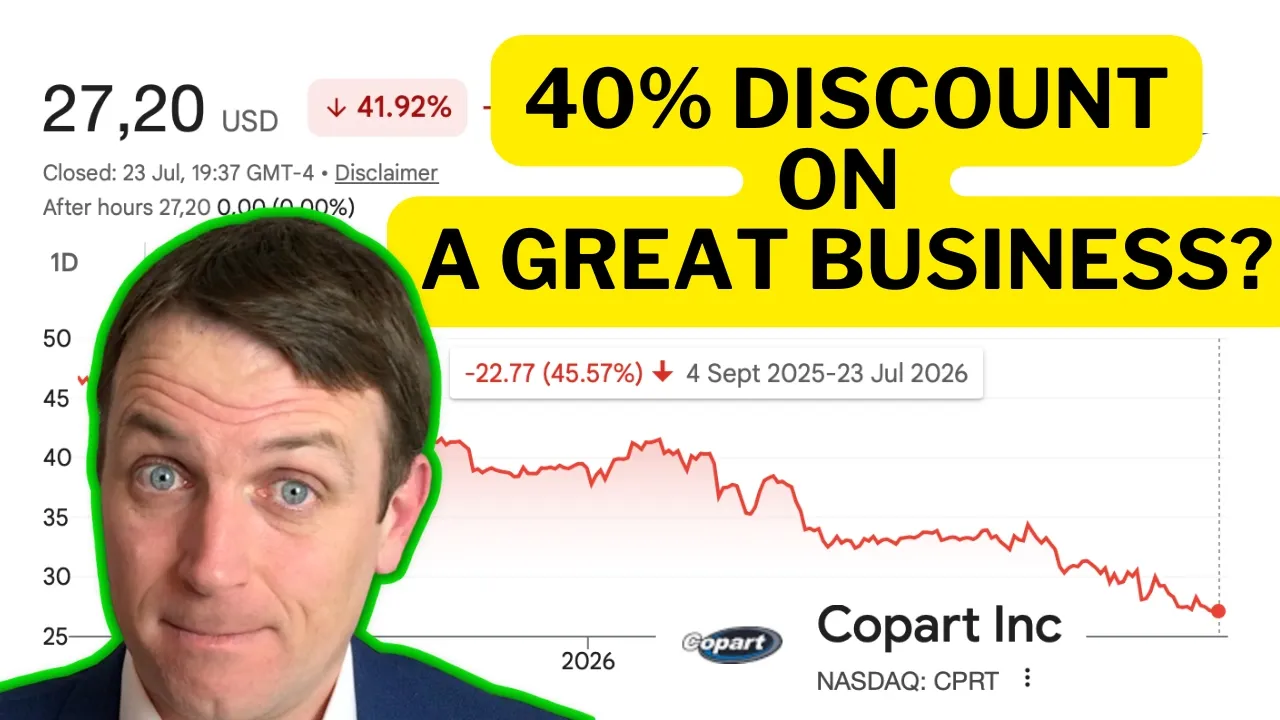
Copart CPRT Stock Analysis - Great Business at Junkyard Price?

- Video return
- +3.83%
- Calls
- 1
- Buy / Sell
- 1 0
- Published
Recommendations
Entry is the asset's closing price on the publication date. Current is the last close on record.
-
Entry $27.94 24 Jul 2026Current $29.27 07 Aug 2026Result +$1.33
Copart was a great buy according to Sven Cload AI.
Context "We already discussed Copart and Copart was a great buy according to Sven Cload AI."
Full Transcript
Good day fellow investors. One of the highly requested videos for me to make was to analyze Copart with a lot of likes. Please suggest new stocks to analyze and like those comments so that I get to it faster. And if we dig into the discussions here, multiple interconnected great modes, strong financials, relatively cheap, kind of cyclical, and more importantly, it makes me excited. Okay, everyone gets excited by different things, I guess. Make a video on Copart. Copart would be good again. P/E ratio of 17. They own the majority of the market even if it is a duopoly with IAA, if I get it right. At one point it should stop crashing. Buybacks, things like that. Similar to 2010-ish. Could be a nice entry for a company that averages a P/E ratio of 29. We already discussed Copart and Copart was a great buy according to Sven Cload AI. That's somebody developed. But now the stock is down another 20% since we discussed it. The P/E ratio went from 20 to below 17 for a company that has been a compounder over time. This is getting interesting. For those who don't know what Copart is is when you crash your car, the insurance takes it over and insurance companies are not there to sell parts or cars. So Copart takes over. They have these junkyards and then sell those on auctions. Auctions online, 100% online auto auctions, over 4 million used wholesale and repairable cars, trucks, and SUVs sold per year. You have membership options so that you can bid there. Premium, you can buy up to 100,000 of these crashed junk cars per day. Wholesale automobiles, motorcycles, everything that insurance companies get rid of, they buy. Of course, the early 2020s post-pandemic huge boom in second car. Everyone was excited about it. Then we saw a deep and then again another boom in insurance traffic this. So, we had two booms that now have reverted and the stock is consequently down. Plus, there are some other issues. Copart announces CEO transition, so we are now back to the old CEO after the latest CEO is gone. However, we have to understand that this CEO that just left came in at around 50. At around 50, if we look at the stock price now, he didn't make any benefits. That means that his whole payment package is likely gone with the stock price going down. Therefore, he's leaving, going somewhere else. It might just be a money situation based on the stock market. Anyway, old CEO in the 50s, let's see what will be the future. Then there are some other short-term news, a director selling 80,000 shares. Okay, but just 14% still 2.2 million. But if I look at the numbers, look at the compounding. Revenue growth has been there, up and down, up and down, and we are now at zero for the last quarter. And then something like 2015 or earlier, too. Is it structural or a temporary issue is the key question here. If we look at the financial results, revenue there 2.1%, 3.7%, 2.4% earnings per share, nothing spectacular. So, a no-growth company. If you have now a 2% growth rate, you have to be revalued, and that's exactly what has happened. Copart, P/E ratio 43, November 2024, and now it is 16. As we went from a company that was growing at double digits, even faster, >> [snorts] >> to a company that is not growing. Just that explained everything that's going on. Because if I look at the numbers, revenues are there, profitability is there. This company is hugely profitable. Just look at this. Three billion in revenues for the first nine months ended. If I adjust that on the net income, 1.1 billion, that's a huge net profit margin of 30-something percent. So, that's very interesting, and that makes Copart a very interesting business to analyze. 33% net profit margin, unlikely to go bust with such profits. And now the question when it comes to investing is owning this business, especially for the long term. If I look at the return on equity, return on invested capital, huge, great returns, double digits. And Charlie Munger always said that if you own a great business, over the long term, your investment return will be similar to the return on invested capital, or in this case, equity. And we are in the 20% range. If that happens, that's a great return. Then, something very interesting, and this is something I really, really like. 2011 buybacks, 2015-16, remember the stock was down, buybacks. No buybacks for a long time, and now, the last few quarters, huge buybacks, 1.6 billion of buybacks, which means that the management is very opportunistic. This is something extremely rare, that a company management buys back stock when the stock is down, not the other way around. Most of the S&P 500 buy stocks when they are high and they have the cash, not when the stock is down. That's anti-cyclical. This is something Warren Buffett would applaud. However, there are also risks. AI, automation, cyber taxes, Elon Musk, all of the what he's doing, there will never be a crash anymore. Maybe they will insure rockets. Those crash here and there. Who knows? The SpaceX stock certainly did crash. You can buy it on a junkyard for sure in a few years. Apart from the jokes, perhaps it will be both, perhaps who knows what the car market will look like. There will always be something. Perhaps there will be many robots that have to be insured, break, get crazy, AI behave like humans. Who knows? But for now, the market is still there. We still drive those cars. So, for the next 10 years, the business still seems like they are expanding internationally. Now, Spain, Germany, Finland, Middle East, Canada, Brazil, etc. being profitable. If we look at what analysts are saying, they are half and half, buys and sells. When a Wall Street analyst says hold, that you can translate into sell. If we look at the targets, where the stock price is now and a little bit high, the average is certainly 47% upside. But you have to understand analysts, they're usually just follow the stock price. And if the stock price stays lower, they might revert this. We have some recent analyst upgrades and downgrades. Barclays don't like it. They say that slowing salvage vehicle volumes, the abrupt leadership transition, and recent insider selling. That's all what we already mentioned. But if this is a temporary thing, then investors might be getting a good business on the cheap. Bull case, underlying fundamental, structural tailwinds, long-term 6% growth for the company, salvage market, scale, digital auction, and global things. Other companies hold equal weight, taking a wait-and-see approach until the dust settles. So, on the bull case, huge moat, network effect, total loss met. Now, with more technology into the cars, just a small crash is a total loss, more work for them, international expansion. The bear case, core engine is stalling, so different changes in insurance company, Geico issues, things like that. AI, advanced driver assistance systems, things like that. Robotaxis, less crashes, could be, but that is already there with all the technology we have on the cars. Capital allocation, and this is something very interesting for me. So, analysts, in this case summarized by AI, raises concerns about management ability to accurately value their own stock, because they spent 1.6 billion and then the stock went lower. This is crazy. This is like predicting where the stock price will go in the next 6 months. They didn't buy when it was high, they waited for it to drop and then they started buying. Can you predict whether the stock will go lower or not? Impossible. Margin compression, but still they make money, 37 or 33. Let's go to our intrinsic value table that you can download in the link in the description below. Let's do Copart. And we have 1.61, the current earnings. And now we have to calculate the growth rate there for the next few years and then going forward. If we grow at 8%. So, let's say there are cyclicals ups and downs, 6 5% over the long term for on buybacks, a few percent as the market grows, expansion, inflation, things like that. Terminal multiple of just 15, the intrinsic value is just 17. So, that would be a very conservative situation. If they grow 6% on buybacks, 6% as the market, that's 12% I will put here. 10% going forward. Terminal multiple goes to 20, perhaps even a little bit more exuberant, 25. The present value is 40 for a 10% return. And if this happens again, just 1 year of 10% growth, 12% growth, you can estimate a higher PE ratio, and then you have already a great return. I would say the stock would then almost double. That's the best case. Margin of safety, recession, big issues, things like that, less demand for cars, lower prices, everything disaster, growth rate, terminal multiple just of 12, and then over the long term the intrinsic value is very low, then I would say perhaps the bottom will be 10 times earnings per share or around 15. So, that's the downside, not the present value. The present value is not the downside. The present value just calculates the terminal value from the growth rate, the terminal multiple, and discount rate. I would say, "Okay, present value will have to Let's put here 15 in a recession, 4% so that it gives a better number." Okay, that would be a really, really bad situation, but a fairly priced. Now, normal case, 40% best case, let's say 40% stock price now 27. It is again fairly priced for a 10% return. So, where are we going to put copper? 10% return. I will see it as a good business, perhaps a little bit exuberant, but should we put it here, somewhere around where we analyzed Netflix. Let's put it here. I will look a little bit at these and then put them more into a comparison. It's summer. I'm a little bit exuberant. So, why not start following it and then we will see over time. Let me know in the comments what you think. I always get a lot of info, a lot of feeling about the stock, the business in your comments. Of course, this is not a margin of safety. This is not the crazy value investment now because you need a bigger margin of safety. This is getting interesting from this relative stock market investing perspective. If there is a rebound, if there is a recession, the market keeps declining, this and that, this can get much, much more ugly. Always mind the risks when it comes to investing. We'll follow. Subscribe. Check my portfolio on my research platform. I'll see you in the next video.
Comments 0
Sign in to join the discussion.
Sign inNo comments yet. Be the first to share your thoughts!