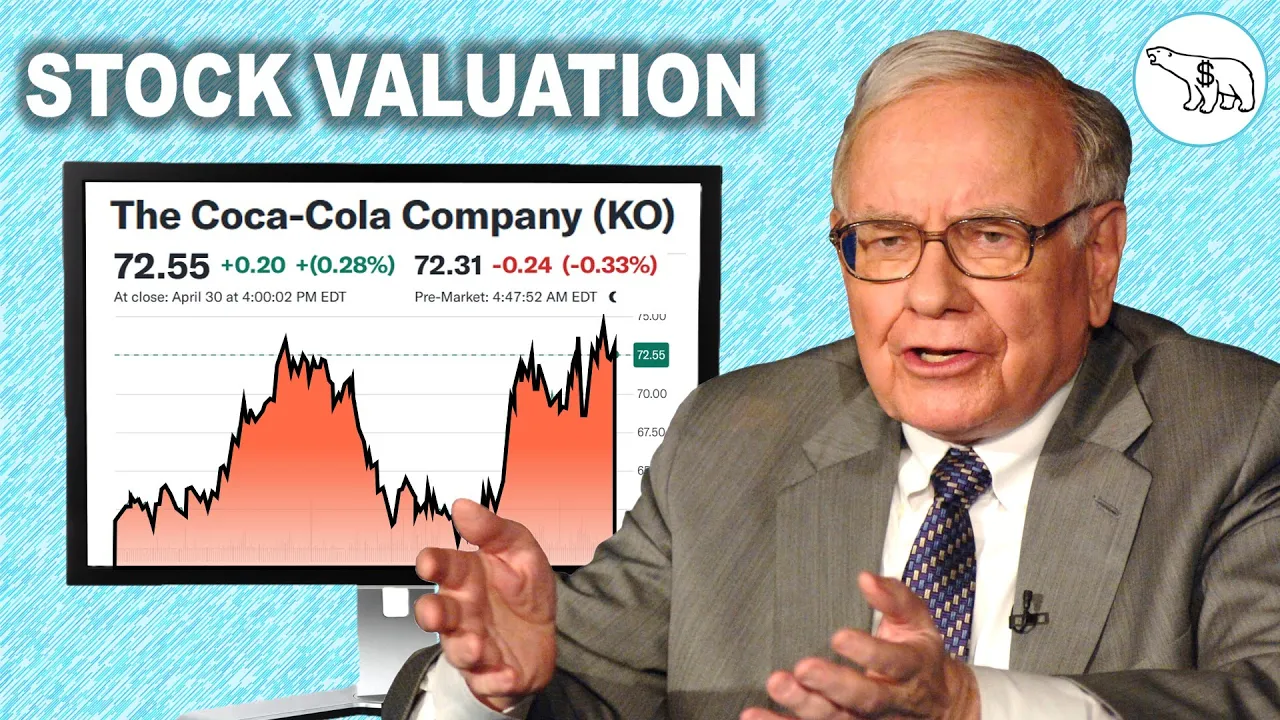
How to Tell When a Stock is Cheap/Expensive (Masterclass in Stock Valuation)

- Video return
- -13.97%
- Calls
- 4
- Buy / Sell
- 0 4
- Published
Recommendations
Entry is the asset's closing price on the publication date. Current is the last close on record.
-
Entry $69.47 26 Jun 2025Current $86.85 07 Aug 2026Result −$17.38
If 23 times forward earnings is Cola's correct value, we wouldn't want to buy it right now because the price is 24 times.
-
Entry $155.02 26 Jun 2025Current $223.78 07 Aug 2026Result −$68.76
This means that Buffett would most likely avoid investing in businesses like Nvidia, Eli Liy and Netflix even though they have terrific past records.
-
Entry $795.12 26 Jun 2025Current $1,191.91 07 Aug 2026Result −$396.79
This means that Buffett would most likely avoid investing in businesses like Nvidia, Eli Liy and Netflix even though they have terrific past records.
-
Entry $130.67 26 Jun 2025Current $74.13 07 Aug 2026Result +$56.54
This means that Buffett would most likely avoid investing in businesses like Nvidia, Eli Liy and Netflix even though they have terrific past records.
Full Transcript
You've probably heard the age-old stock market advice to buy low and sell high, but how do you know what's high and what's low in advance? Is a stock like Ford Motor cheap because it trades for the same price as two Big Macs, while Bshire Haway is expensive because it costs more than most people's houses? Well, no. It simply isn't that simple. But in this video, you'll learn how to value a stock properly with three different methods. By using PE ratios, by using DCF, and finally, by using a third option, a much lesser known method, which falls somewhere in between the two most common approaches. And yes, there will be tons of references to Warren Buffett, but you'll have to wait a little until his first appearance. This is the Swedish investor bringing you the best tips and tools for reaching financial freedom through stock market investing. Ticker.com is the sponsor of this video and it's a platform I've used personally for years. It gives individual investors access to the same institutional quality financial data and analyst estimates that professionals use. The best part is it's free to create an account. I'll actually be using Ticker later in this video to show how you can quickly value stocks using their brand new valuation tool. The link to sign up is in the description. Now, let's get on with the valuation. To make this really handson and practical, let's value a company that I think most of you have heard about before, Coca-Cola. But where do we start? Let's turn back time some 15 years to when I had my first stock market aha moment. This didn't happen on Wall Street or anything, but on the streets of Stormwind in World of Warcraft. I wanted to maximize the compound interest on my in-game gold, just like I want to maximize it on my real money today. I began to use the in-game auction house to trade items. So, I might have bought some rare sword and then resold it for profit. How did I know when it was a good time to buy? There was a website that listed the average price of all items across all servers, and I simply compared that to the price on my server. When something sold with a margin of safety, a concept that we'll get back to soon, of 50% or more, I bought it. It was really profitable. And I kid you not when I say that this strategy that emerged when I was geeking out on World of Warcraft has been a cornerstone of my investing strategy for 12 years now. So how do you apply this strategy in the stock market? You buy stocks when they are cheaper than their historical averages and or when they are cheap compared to peers in the market. This is referred to as relative valuation. And to understand how to apply this, one needs to understand valuation multiples. As alluded to earlier, it's not useful to say that Berkshire Hathway's stock is expensive just because it costs more than most people's houses. It is the equivalent of saying that a brand new Ferrari is expensive at $100,000. It might be a lot of money, but it can still be a great deal. and bargain deals are what we are hunting for in the markets. Warren Buffett would say that price is what you pay, value is what you get. Let's turn to Coca-Cola now, but keep in mind that you can do this exercise for any stock that you are interested in. I'm just using cola so that you can connect the dots to a real world example. It's easy to see how much we'll have to pay. That's just the stock price. But what value do we get? Investors use many different yard sticks, but one of the most common ones is earnings. If you go to college, you might want to know what your future salary will be, and you compare that with the price of the education. If you pay $200,000 and your future salary will be $100,000 a year higher than without the degree, it's probably a good idea. The payback period is 2 years. If you buy a stock, you should also be interested in how quickly you can recoup the money you've laid out. As of this writing, you can buy Coca-Cola at a price of about $72, and it earns $2.5 per share. If the company keeps up this performance, it'll take 72 divided by 2.5 equals to 28.8 years for you to recoup your investment. This is referred to as the PE or price toearnings ratio and it's the most common valuation multiple out there. But this is backwardlooking and as Buffett would say, you can't pay bills with past performance. There's a sibling to the PE which is called forward PE. That's the current price of the company divided by analysts expectations for next year's earnings. forward PE partially fixes the problem of driving while looking in the rear view mirror. You can find this figure for free at something like Yahoo Finance. Analysts expect higher earnings in the future for Cola. So therefore, the forward PE is at 24.3, which is lower than the trailing PE. Now, getting my money back in 24 years time isn't exactly something that get my juices flowing, but it's not the end of the story because for a relative valuation, one also needs to know how much cola usually costs and how much investors are willing to pay for similar companies in the market. You can find historical valuations on something like ticker. Five years data is accessible through a free account, but I like to use 10 years of history, especially for something as stable as Cola. Going 10 years back might not be a good idea for a company in an industry with a lot of flux, but Cola's industry is quite constant. Investors have been willing to pay for 23 years of future earnings when buying Cola during the last 10 years. So forward PE 23. If 23 times forward earnings is Cola's correct value, we wouldn't want to buy it right now because the price is 24 times. Let's turn to Cola's peers next. There's a bunch of listed companies who also produce carbonated non-alcoholic beverages like PepsiCo, Dr. Pepper, Monster, and a lesserk known Scottish company called AG Bar. On average, if we also include cola, the future PE for this group is 21.3. This means that should cola get valued like this group, the price of the stock stands to fall some 12%. Here's a bonus tip. What's interesting about doing peer comparisons is that sometimes one of them emerges like a more interesting investment opportunity than the original candidate. And since you presumably already know quite a bit about the industry, the marginal time spent researching an additional company could be very low. Take AG Bar here for instance. It has an 18% upside if it can get valued like it has been historically. Moreover, it is in the lower range of this peer group. And if it can get valued like the others, it has a 33% upside. Now, at least on a surface level, I think that sounds like a better deal than cola. But, um, is it good enough? Here's where maybe the three most important words in investing come in. That's Benjamin Graham's concept of a margin of safety. You might have seen this graph before. I think it illustrates the point very well. We don't want to buy a stock when its price is as high as its value, which Graham calls intrinsic value by the way, but we wouldn't really want to buy it at 99% of what it's worth either. Why? Seth Clarman, one of Benjamin Graham's value investing proteges, might have said it best. A margin of safety is necessary because valuation is an imprecise art. The future is unpredictable and investors are human and do make mistakes. How big does this margin of safety have to be? Let's ask the greatest investor of all time. Time to enter the stage, Warren Buffett. How do you judge the right margin of safety to use when investing in various common stocks? For example, in a dominant longstanding stable business, would you demand a 10% margin of safety? And if so, how would you increase this in a weaker business? Thank you. We favor the businesses where we really think we know the answer. Therefore, if a business gets to the point where we think the industry in which it operates, the competitive position uh or anything is is so chancy that we can't really come up with a figure. We don't really try to compensate for that sort of thing by having some extra large margin of safety. We really go on try to go on to something that we understand better. So, if we buy something like Seas Candy as a business or Coca-Cola as a stock, we don't think we need a huge margin of safety because we don't think we're going to be wrong about our assumptions in any material way. We'd love to find them when they're selling at 40 cents on the dollar, but we will buy those at much closer to a dollar on the dollar. We don't like to pay a dollar on the dollar, but we'll pay something close. I think most of the businesses in the carbonated beverage industry falls into this category where Buffett would require a lower margin of safety. At least from a relative valuation perspective, I think his conditions are met for AG Bar. As Buffett says, he'd prefer to get it when it's selling at 40 cents on the dollar, but today's prices might actually be good enough. There are however limitations to using valuation multiples and relative value analysis. Imagine that your friend comes over and tells you that he's bought a new dog. You ask, "How much did it cost?" "$100,000?" he responds, " $100,000? How the heck can you afford that?" "Well, I sold my $200,000 cat." Sometimes the stock market behaves like this when everything in an industry is overpriced. You found an IT company that you think is really cheap because it only trades at PE 100 when all other software firms are at PE 2000. That's a 50% margin of safety. This was the year 2000. And 3 years later, people were eating their shirts for thinking that PE 100 was cheap. Moreover, when comparing today's PE multiple to historical ones and to competitors, we assume that everything else is equal, but usually everything else is not equal. Maybe the company isn't as strong as it used to be. Maybe competitors are growing a lot quicker and have much greater futures. Then they deserve higher valuation multiples. As Joel Greenblat would put it, the last thing you want to do is to buy a stock in a company that is cheap for a good reason, because it stinks. Warren Buffett also has something to add on the subject. Common yard sticks such as dividend yield, the ratio of price to earnings or to book value, and even growth rates have nothing to do with valuation except to the extent that they provide clues to the amount and timing of cash flows into and from the business. So even though valuation multiples and relative value analysis is a good first step, it can lead us astray. We need at least one complimenting valuation technique. That takes us to part two of this video, discounted cash flow analysis. Hello, Mr. Buffett. I got two short questions. One is how do you find intrinsic value in a company? Well, intrinsic value is what is the number that if you were all knowing about the future and could predict all the cash that a a business would give you between now and judgment day discounted at the proper discount rate. That number is what the intrinsic value of business is. In other words, the only reason for making investment and laying out money now is to get more money later on. Right? That's that's what investing is all about. And the question is is how much are you going to get? When are you going to get it? And how sure are you? Okay, so that's three questions that Buffett asks. How much cash are you going to get? When are you going to get it? And how certain are you? This is the basis for DCF, the discounted cash flow valuation model. Buff it again. Just insert the correct numbers and you can rank the attractiveness of all possible uses of capital throughout the universe. Yes, pretty much anything can be valued using a DCF. A stock, a lemonade stand, a startup, a bond, a rental property, a lottery ticket, a relationship if you're a gold digger. So, it's powerful stuff. Let's go through Buffett's three steps again by using Coca-Cola as our example. So, first, how much cash are you going to get? There are two things to notice here right away. A, it's a question about the future. However, we are going to heed the wisdom of Mark Twain. History doesn't repeat itself, but it often rhymes. So we are going to use history as a proxy for the future. B notice the wording cash. It's not earnings like we used before. But in the DCF model, we need to understand how much cold hard cash that's being produced. It's called discounted cash flow model, not discounted uh earnings flow model. What we are looking for is often referred to as free cash flow. This can be calculated by taking cash from operations minus capital expenditures or capex. I don't want this video to turn into a course on accounting. However, you can think of free cash flow as being very close to earnings. But in addition, we've taken into account investments that a company has made in additional inventory, machinery, and production facilities. If we want to do this the easy way, we pull up the historical numbers which have been calculated for us on a financial data provider like ticker. If we want to do it the hard way, we head over to cola's 10k or annual report. More specifically, the section which is called consolidated statements of cash flows. Unfortunately, the lines we are looking for aren't always named cash from operations or capital expenditures. As you can see, Cola uses net cash provided by operating activities and purchases of property, plant, and equipment. While uh Apple calls it cash generated by operating activities and payments for acquisitions of property, plant and equipment, for example. No matter which method you use, you'll want to create a graph of the historical numbers. A graphical representation like this is a very effective way to understand what's been happening in the past. By the way, COLA's 2024 results are impacted by a $6 billion tax related item which isn't recurring. Adjusting for that makes the historical record look a little more reliable. In theory, we'd want to forecast cash flows from today until infinity. In practice, infinity is quite a long time and investors Excel sheets are limited to 16,384 columns. Therefore, we typically stop the forecast at year 10 and then add something called a terminal value, which we'll get to soon. For cola, I think $10 billion doesn't look far-fetched for what we can expect it to earn during a normal year. And now we must ask ourselves, will this grow or shrink in the coming years? And by how much? Careful so that you're not too optimistic when predicting growth rates. By the way, I think it's a mistake for any company to predict 15% a year growth. There plenty of them do. For one thing, unless the US economy grows at 15% a year, eventually any 15% number catches up with you. It it just it doesn't make sense. Very very few large companies can compound their earnings at 15%. It isn't going to happen. Some useful reality checks include historical company and industry growth numbers and what analysts think about the companies and industry's future. Cola has been able to grow free cash flow by something like 3.5% per year since 2019. If we assume that they can earn around $10 billion today, according to Grand View Research, which is good for industry numbers, the global carbonated beverage industry is expected to grow by 6.4% per year from 2025 to 2030. Based on those two data points, I place more weight on the company's historical growth. Let's say um around 4% going forward. This means that Cola would be able to cash in something like $14.8 billion per year in 10 years. Now onwards to the terminal value mentioned before. Basically, we use a terminal value as a replacement for the cash flows for years 11 to infinity. There are two options here. Exit multiple and perpetuity growth. I'll cover perpetuity growth in a couple of minutes. And for now, let's focus on exit multiple. Imagine that we sell the business in year 10. How much could we then sell it for? Essentially, any valuation multiple can be used. We covered PE before, but that's just one example. You could also calculate P2 FCF or price to free cash flow. And um it's a little bit more practical to do as we've just forecasted how much free cash flow cola will earn in year 10. Now we just have to think about an appropriate multiple. It's the same exercise as we performed earlier. Look at historical averages for the company and for its peers. As you'll notice, this historical multiple is a little all over the place, even for a stable company like Cola. For this reason, I think it makes sense to look at the 10-year median, and it is approximately 33. That also happens to be very close to where the industry peers are trading. This time, I used 10-year medians for all of them, by the way, due to the volatility of the multiple. Let's be clear, a price to free cash flow of 33 is not cheap in any way, shape, or form. But in a low interest environment, well, it could make sense. Let's say that price to free cash flow of 33 is a reasonable exit multiple in year 10. Then we can sell the whole business for 14.8 billion * 33 equals to $488.4 billion at that point. So let's sum up these cash flows which represent today until judgment day as Buffett calls it. Then we end up at $613 billion. Compared to what the company is worth today, it looks like it has almost a 100% upside. Can this make sense? Based on the relative value calculations we did previously, it looks highly unlikely. What we are missing is Buffett's second question. When are you going to get it? Money today is worth more than money next year, which is worth more than the year after that, and so on. For one thing, we could be dead next year. So, it makes sense from that perspective. But a less morbid reason is that we could also just put the money in a bank account, earn interest on it, and have more money next year. Now, we can actually get to a true mathematical formula for valuing stocks using a DCF model. It's FCF divided by 1 + R to the power of T where FCF is free cash flows, R is the discount rate, and T is the number of years into the future that you expect to get one particular cash flow stream. The so-called discount rate means how much lower we value next year's cash compared to this year's. 10% means that we value money in the next year at 90 cents a dollar rather than a dollar. 5% means that we value it at 95. This number is very important for valuing a company. If we use 10% for cola, the value is just $260 billion and it's a loss to purchase at today's prices. If we use 5%, it's $394 billion and a pretty decent purchase with a little over 20% margin of safety. So, which number is correct? As usual, there are many ways to skin a cat, but I'd argue that we should just ask our favorite oracle. Again, I'm very curious how you come up with your discount rate. You might want to discuss your discount rates used for CocaCola, J&J, or some of your past investments. Yeah, we don't we don't formally have discount rates, but uh we are going to want to get a significantly higher return obviously for a business than we are from a government bond. That has to be the yard stick at a base. Then how much more do we want? If government bond rates were 2%, we're not going to buy a business to earn three or three and a half% expectancy over the years. We just don't want to commit our money that way. We'd rather sit around and wait a little while. If they're four and 3/4%, you know what? do we hope to get over time? Well, we want to get a fair amount more than that. We want enough so that we feel very comfortable. If they close on the stock market for a couple of years, if interest rates go up another 100 basis points or 200 basis points, we're still happy with what we bought. And above that, I really, you know, I know it sounds kind of fuzzy, but it is fuzzy. It's interesting to see that when this meeting was held in May 2007, long-term government bond rates were almost exactly at what Buffett was talking about. they were at 4.9%. And that's very close to where they are today, too, at 4.5%. So, what he said back then has applicability for today, too. And he said he wants a higher number than that. It's not clear how much higher, but Buffett mentions at least 200 basis points. In an even earlier meeting from 1994, he is more specific. Well, I would say that that um in a world of 7% long-term bond rates that uh we would certainly want to think we were discounting future after tax streams of cash at at least a 10% rate. Government rates were just above 7% at this point. And Buffett says at least 10%. So, I think we've got something that we can use here. The 10-year Treasury yield plus 3 percentage points. At least we'll be in the right ballpark. So what does that lead to with cola? If we use 4.5 + 3 equals 7.5% as our discount rate, Cola is worth $320 billion today. Not enough to give us a big margin of safety perhaps, but not bad either. I mentioned that there are two ways of calculating the terminal value. a value that replaces cash flows from years 11 to infinity. We've used the exit multiple version, but one can also use perpetuity growth. You take the free cash flow of the year after the final year and divide it by the discount rate minus the growth rate you expect. This isn't necessarily the same growth rate as we use for the first 10 years, by the way. As this is a perpetual growth, it is often lower. For COLA, I'll assume something like 3%, just a tiny bit higher than inflation. Now, the DCF model suggests COLA is worth just $248 billion. Which one is correct? It's hard to say. One might want to use an average. In this case, one might also argue that it doesn't matter too much because neither method results in a screaming buy for colum. By the way, if you expect your growth rate to be higher than your discount rate, the perpetuity growth calculation falls apart. If you think the growth rate will be that high in perpetuity, you might want to reconsider your assumptions. But moreover, it might just be better to use the exit multiple. We may also want to get back to AG Bar and do the same exercise for that company as it seemed to beat Cola in the relative value analysis previously. £33 million in free cash flow might be reasonable to assume currently based on an average of the last 5 years performance. Uh 3% growth rate doesn't feel crazy perhaps 2% in perpetuity. Same discount rate as cola. The historical valuation is and probably should be a little lower perhaps price to free cash flow of 28. Then the value of AG bar is 660 to860 million pounds depending on your choice of terminal value calculation. So maybe not too interesting at current levels but that could well change. I don't think that these calculations would have been materially different on January 14th for example when AG bar traded at 620 million. It is clear that an investor must act like a spear fisher. If you just stand by the stream patiently waiting, you will be served a good opportunity to spear a fish at some point. The third question that Buffett asks is how certain are you? Some businesses are the equivalent of Harry Kane taking a penalty kick. You know, you're quite sure that they're going to score. Others you cannot be as certain about. Once again, history is a good guide for this. We tend to judge by the past record. By and large, if the thing has a lousy past record and a bright future, we we're going to miss the opportunity. Cola clearly passes this test. If you look at the history of the company's financial performance, this is really stable and growing on pretty much any financial metric. The same thing cannot be said about something like IBM, General Electric or Ford Motor. But it isn't just that the past record must be good. It is also that it mustn't be susceptible to change. Our own emphasis is on trying to find businesses that are predictable in a general way as to where they'll be in 10 or 15 or 20 years. And that means we're looking for businesses that in general are are not going to be susceptible to very much change. We we view change as more of a threat into the investment process than an opportunity. That's quite contrary to the way most people are looking at at equities now. But we do not get enthused about with a few exceptions. We do not get enthused about change as a way to make a lot of money. We're looking for the absence of change to protect ways that are already making a lot of money and and allow them to make even more in the future. So, we look at we look at change as a threat. And whenever we look at a business and we see lots of change coming, nine times out of 10, we're going to pass on that. And when we see something we think is very likely to look the same 10 years from now or 20 years from now as it does now, we feel much more confident about predicting it. I mean, Coca-Cola is still selling a product that is very, very similar to uh one that was sold 110 plus years ago, and the fundamentals of distribution and talking to the consumer and all of that sort of thing really haven't changed at all. Your analysis of Coca-Cola 50 years ago can pretty well serve as an analysis now. We're more comfortable in those kind of businesses. It means we miss some a lot of very big winners, but we wouldn't know how to pick those out anyway. And it doesn't mean also that we have very few uh big losers and that's quite helpful over time. Yeah, the uh peanut brittle has very little technological change too. This means that Buffett would most likely avoid investing in businesses like Nvidia, Eli Liy, and Netflix even though they have terrific past records. As discussed previously, Buffett typically views certainty as a go no-go factor when valuing businesses. Some people would say that sure, you could invest in IBM if after you've done your calculations, you just apply a larger margin of safety or perhaps an even higher discount rate, but for Buffett, it seems to be a factor where he doesn't like to compensate. By the way, when discussing how the Oracle values his businesses, I would be admiss if I didn't include the following clip. Warren talks about these discounted cash flows. I've never seen him do one. Yeah. If it isn't, there are some things you only do in private. Charlie if if it isn't blue perfect obvious that it's going to work out well if you do the calculation he tends to go on to the next idea. Yeah it it sort of ought to I it is true you don't if you have to if you have actually do it on with pencil and paper it's too close to think about. I mean it ought to just kind of scream at you that you've got this huge margin of safety. I think this might be the Buffett advice that most people working in the professional investment industry tend to ignore. To be fair, Buffett is so quick in his head with mental math that he is basically a human calculator and a spreadsheet. What applies to the oracle himself might not necessarily be true for us other mortals. For what it's worth, I like to use a calculator and spreadsheet when doing my own stock market valuations. I can't do these things in my head. Now, that's the two most common valuation methods covered. I've used a third option quite extensively, though. Ticker has just released a feature which can help you immensely when applying this valuation technique, and I'm excited to share it with you once again by looking at COLA as our practical example. Essentially, you plug in sales, operating margins, interest, tax rates, buybacks, dividends, and evaluation multiple, and then ticker does the calculations for you, which is presented in an easy to understand chart. We have all the numbers necessary for making our assumptions already filled out in this table where you can see the historical financial values up to 10 years back and you'll get analysts estimates for the coming five. This is very useful for reality checking your assumptions. For instance, our 4% projected growth rate is fairly similar to what analysts are forecasting for revenue growth for COLA 2. Of course, the model is only as good as your assumptions going into it. And that goes for any of these three valuation techniques. If you put garbage in, you'll get garbage out. But ticker gives us a great head start by making sure that we have the correct calculations and the best historical and forecasted data available. After plugging in my estimates, the model says that Cola should be worth $91 per share by the end of December 2029. That's about 6.2% return per year. Not too shabby, but not very high either. Of course, I tried doing it for AG bar too, and there I got 9.3% per year for my return. Is that high enough? Once again, we must get back to the concept of a margin of safety. Since we used a 7.5% discount rate in the DCF, it makes sense to apply that here too. Getting a 7.5% return for about 4.5 years. Remember we are forecasting until December 2029 would mean something like a 38% return. That's what we are expecting. If we get 9.3% over 4.5 years, that's a 49% return instead. 1 - 38 / 49 equals to 22% margin of safety. That's pretty decent for a stable business like AG Bar. Now, don't hold me accountable for the assumptions made in this video. By the way, I've only made a back of the envelope analysis of Cola and AG Bar, not a true deep dive one. Which of these three approaches is the best one? We might want to listen to Charlie Mer for this. When you're trying to determine something like intrinsic value and margin of safety and so on, there is no one easy method that could be simply mechanically applied by say a computer and make anybody who could punch the buttons rich. By definition, this is going to be a game which you play with multiple techniques and multiple models and a lot of experience is very helpful. I would agree and argue that each and every one of these valuation techniques have their place in an investor's toolkit. It is always a good idea to triangulate. Preferably, we can find a company which looks like a phenomenal investment no matter which lens we choose. If you are interested in signing up for Ticker so that you can use their new tool featured in this video, you can use the link right here or in the description of the video. If you do, you'll also help finance future videos for this channel as I'm affiliated with them. Also, they are running a 15% discount on their annual plans, but only until July the 2nd. Cheers.
Comments 0
Sign in to join the discussion.
Sign inNo comments yet. Be the first to share your thoughts!