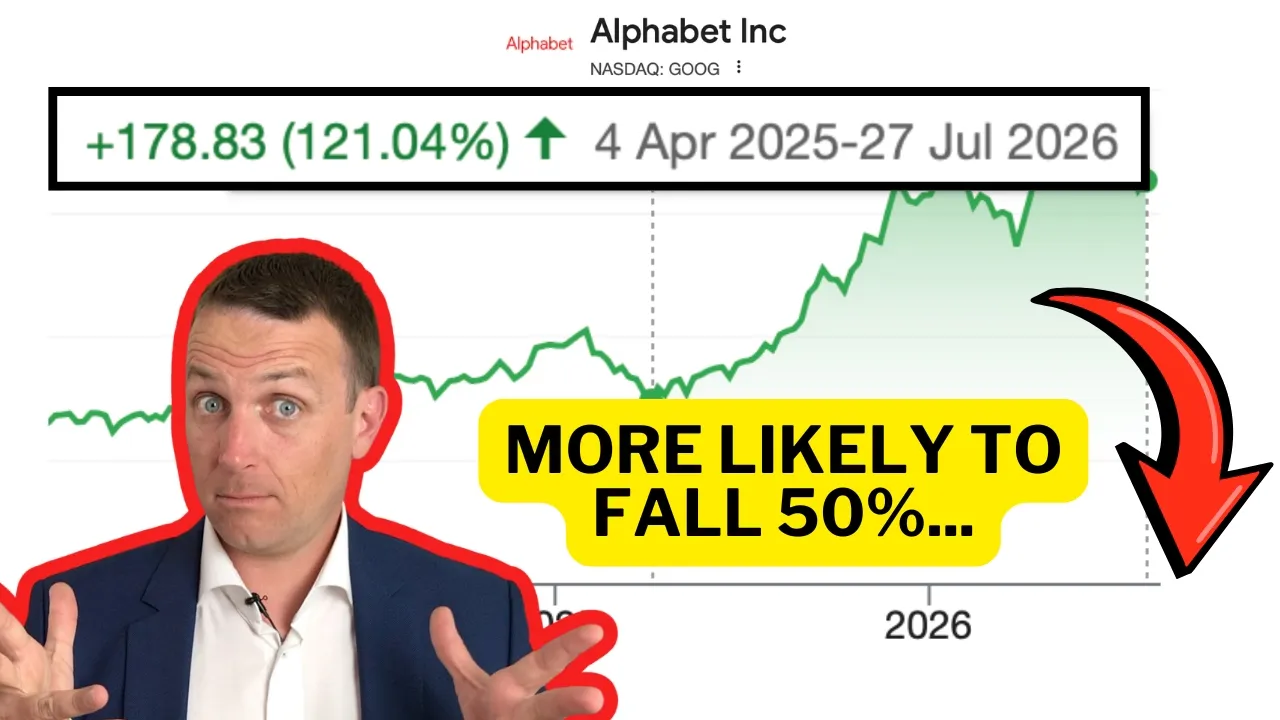
Capex, D&A, $707 Billion in Commitments Make Google a Very RISKY Stock to Buy!

- Video return
- -7.20%
- Calls
- 1
- Buy / Sell
- 0 1
- Published
Recommendations
Entry is the asset's closing price on the publication date. Current is the last close on record.
-
Entry $333.71 28 Jul 2026Current $357.75 06 Aug 2026Result −$24.04
I'm not taking the risk.
Context When it comes to the stock outlook, wake me up when the stock is down 50%. ... from an investing perspective, it is simply too risky for me. It's just an AI gamble now. ... I'm not taking the risk.
Full Transcript
Good day, fellow investors. Google reported earnings last week, staggering earnings, 24% growth in revenue. If we go to search, also growing that many of us, including me, were thinking it will not grow that fast. 950 million Gemini monthly active users, but the key is 82, crazy 82% growth, and 514 billion in backlog on cloud. Amazing numbers. The stock is down 13% over the last, let's say, 2 weeks, despite the situation, 20% down from the peak. And this is now something really we have to discuss. Great earnings, Google stock down, let's discuss. Do we need to change growth rates in our intrinsic value calculation? That we'll discuss. What are the key factors going forward when it comes to investing in Google? What is the risk and reward, and you have to see how that risk and reward fits your portfolio. Also, we'll mention Buffett buying Google. We'll see if that is perhaps his last mistake, and then, of course, conclude with the stock outlook. If you enjoy this, smash that like button. Speaking of intrinsic value, when I made the calculation, average intrinsic value came at 200, but it was based on 12% growth rate per year for the next 10 years. The current revenue growth is double my estimation. Was I too conservative? I went to 15% for my exuberant case. Well, let's see whether we have to adjust or not. Because if you look at the numbers, okay. First, we have to understand earnings per share or net income has been considerably skewed by other income. 97 million positive for this quarter and that is because Google owns a stake in SpaceX, owns a stake in Entropic and all those fair values went up at least according to estimations and therefore Google has to record huge improvements in net income. But I have adjusted this 9.11, deducted the Entropic and and we are at adjusted earnings of 2.67. And the key factor is what is the true value of these businesses. So we have a lot of investments, invest more 40 billion, 30 billion additional. SpaceX, they didn't invest, but SpaceX will also look for more investments perhaps in the future. The thing is that Entropic, okay, 30 billion revenues, it's not much for Google, especially not much given the valuation. Profit, some profit, but that depends on the accounting operating profit, so it's not really profitable. And we also know SpaceX is not me a miracle either. So the true value will be seen in 5 years. Could be great value, could be not. Could be is definitely not value investing. So as value investors, we always approach these things as, okay, if it happens, great, if not, it has to also be good. So I'm giving zero value to those stakes over the next 5 years from a conservative margin of safety investment perspective. And that case might be emphasized by the recent developments, constant developments. It was DeepMind first, now it's Kimi. In a few months will be something else and that is my key concern that we'll discuss a little bit later in this video. But, let's start with Google with the revenue growth rate and the earnings growth rate. If you look at the income statement now, everything great. Income from operations 30% growth. Everything looks good. If you just look here at the numbers, everything is going up. All the sectors up except Google network. But, okay. Everything else is growing. Still looking great. Cloud revenues surging 82% staggering growth rates. And also, more importantly, that is very, very profitable with higher operating margins than one would even expect. However, the key factor here is capital expenditures booming to 44 45 billion this quarter. And this is perhaps the key when it comes to Google. This is an excerpt from the transcript for the conference call. And they are clearly saying that they will increase capex for this year to 205 billion. And then, in 2027, you can expect capex to increase even more. And they will provide details later. This is crazy. I understand everyone is crazy about AI. There is growing demand. Everyone is experimenting, trying. However, there is also competition. Yes. Also, the question is always about profitability. For now, it's just accounting profitability. Things will be completely different in a few years. Because when you look at Google, the average expenditure was 30 billion, a little bit less than that per year. And then, it skyrocketed to 90 billion in 2025. And we are now at 200 billion. And then, more expected for 2027. If you put that into perspective, revenues, so we have had 250 billion, 300 billion, and spending 25 billion of those revenues in CapEx. That is CapEx used to be 10% of revenue, and the revenue growth rate 40, of course, pandemic 8 13, something like that. However, last 12 months sales 445 billion, expected CapEx 200 205 billion. Further, in 2027, even more than that. That means that CapEx will go from 10% of revenues to 50% of revenues. That's a huge change in the business in the business model, in everything that investors looked into Google 2 years ago, 10 years ago, and now. This is a complete shift. And this is finalized by the first time Google going into negative 3 months cash flows of almost 6 billion. The question is, will Google win AI? For now, it's greatly positioned, it is winning, but nobody knows. What we know is the following. These were the March 2026 contingencies and commitments by Google. 232 billion. I adjust for June, so Google has added more than what is this? 300 Help me with my math. 470 billion in commitments in one quarter. 470 470 billion. Who's crazy here? Of course, also the backlog has jumped from 467 to just 50 514, I think. That's not in relation to the jump in crazy commitments. So, for now, we have a huge jump in commitments, huge burdens coming forward. We'll discuss depreciation and amortization in a second. But, the key factor is the key bet for Google is that AI investments, and especially more importantly, return on invested capital will stay high and grow over the next 5 to 6 6 years. Now, some people say that AI might not work. I'm saying the opposite. The key risk for Google is that AI works. Because if AI works, then it will be so smart. Everything can be done cheaper, as we have seen with Kimmy. Commodity, constant supply, you can get new supply with newer Vera Rubin's Nvidia chips growing better, and then all these older guys simply make not enough profits. Who was the leader of online investments and everything? The providers of the internet. Did the internet change the world? Did they invest billions in fiber and this and that? Yes. What happened to the stock price over 25 years? Nothing. So, the key factor here is what will be the long-term return on invested capital for Google. We have to understand depreciation and amortization. If they invest 250 billion in data centers, amortize that over 5 years depreciation, that's an additional 50 billion of cost per year. So, they need to make extra 50 billion in profits just to justify the spending. And that is something that's very interesting. If we look at operating income, in this case, services. Okay, when you sum all up, 160 billion. But, I have to cut that profit by 50 billion next year, so the prof- profits will be a just 100 billion. So, they need to constantly keep on growing because if they keep on spending 200 250 billion in CapEx by 2030, the depreciation amortization will be more than 250 billion per year. And if you put that into a net income perspective, now the depreciation is just 25 billion. If we go to net income excluding excluding unusual items, we have revenues and we have net income of 150. If let's say in 5 years, revenues doubles to 900 billion, a staggering rate. At the same profitability, we have profits of 300 billion dollars, okay? Great. But, at the same rate, I have also 250 billion in depreciation and amortization, which leads to just a total of 50 billion in profit for Google. If they double their revenue, they double their revenue in 5 years. That's insane. So, when it comes to Google, if they double in 5 years, huge growth rate, what's that? 15% per year, which means that they will have no profit. So, just to reach profits, they will need to grow faster than 15% per year for the next 5 years and then also forward. 20 25%. Now, it's the booming era of AI. They are leading everything and they reached 24% growth. What will happen in the next 5 years? It's hard to predict, but I know there will be huge pressure on profits, which leads to the next situation when it comes to investing, risk reward, what can happen, what might happen, what can I'm not here to predict anything. I'm here to see, okay, this can happen, how it fits me, this can happen, that can happen, and how it fits. That's it. If we look at analysts, they are all very, very positive on Google as analysts always are. But, targets higher, you can make 42% upside on average target over the next 12 months as they do, but you can see here, they always just merrily follow the stock. If we go to our comparative intrinsic value table, which you can download in the link in the description below, you'll go here, you have Google on my free investment course, and we have had here the situation. I have adjusted earnings per share from 861 to 9 because of the growth for the last quarter, and then we have to see, okay, what will be the growth rate going forward. Will it be 12% on earnings? Because of the huge cost of depreciation and amortization, I cannot say that Google will keep on growing at 24%. It's easy to grow at 24% when you're spending more on CapEx than you are getting growth in revenue. That's crazy, but if they are spending, they will keep on growing. The fact The key question is, when does this affect profitability, and it starts affecting next year as depreciation and amortization explode through the roof. So, I would not change things here. In the exuberant raise case in the exuberant case scenario, 15% growth rate, and then, okay, margin of safety, this is not projected for the next 10 years, but just if it happens in 1 year, if the market gets panic or recession, something like that, where can the stock price go? However, for valuation, I'm saying 40%. Now, for the normal case scenario, 20% for the exuberant case scenario, and I'm increasing the worst-case scenario, given the high investment, given the uncertainty there. Therefore, I'm lowering actually my intrinsic value for Google, and it's still very, very far from the current stock price. If we go back to our comparative table, for me, Google is pretty expensive. Perhaps a good return, but definitely not a great return. If we go to our value quadrant, I had put Google here as a risky low return, especially when it was at 400. Just all else equal, I would have to put it somewhere here at 5, 6% because the stock price went down 20%, but I'm transferring it to just here, to the bets, and I'm putting it as a bet that I would not take. But Sven, Warren Buffett bought Google. Yes, perhaps liquidity because he can sell the position. It's better than Treasuries, but I think now, especially with all the things that are changing, this is not a Berkshire business. A Berkshire business does not have negative cash flows. So, it might be Warren Buffett's final last mistake. When it comes to the stock outlook, wake me up when the stock is down 50%. Of course, the stock can just keep on going on exuberance or this on that, but from an investing perspective, it is simply too risky for me. It's just an AI gamble now. I hope I'm wrong. I'm not here to predict. I'm just saying, I'm not taking the risk. That's value investing. The first question we ask is, okay, how much can I lose? Can I lose 50% with Google? Yes, I can. Can you make money? That's always a possibility, but in this situation, with the information we have now, Google doesn't offer margin of safety. It is very risky for the low return. Actually, we have to YOMO this. Joy of missing out. Happy for others if it goes well, but this is an AI bet that's not good. Unfortunately, most passive investors have almost 6% of their portfolio in Google, and that's why the market is ugly. And we can also compare this with Oracle, that highly leveraged, completely different business model, not financial fortress, but also investing in similar things. And the market has already been hating that for 12 months. This might be next for Google. If you are a Google shareholder, I wish you all the best. If and when the stock price goes lower, wake me up.
Comments 0
Sign in to join the discussion.
Sign inNo comments yet. Be the first to share your thoughts!