you continue to describe this as an opportunity to buy the chip dip.
Context
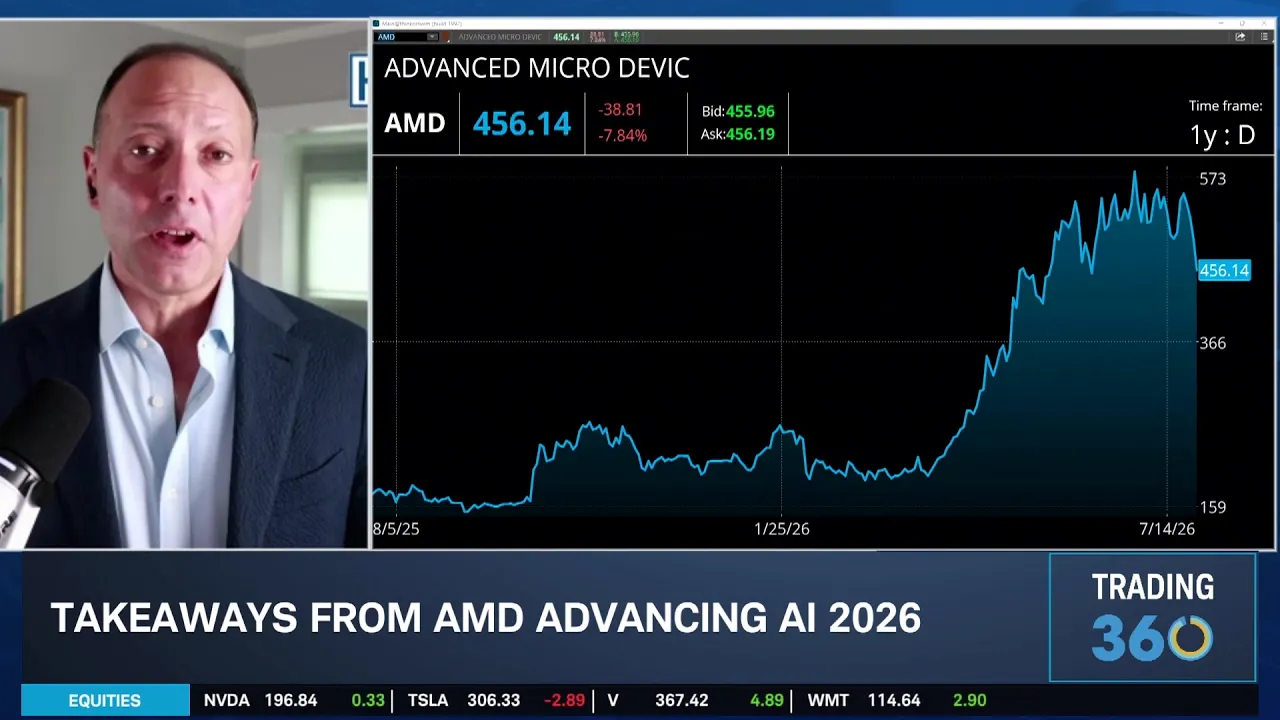
"So knowing that we're still in this dip, we're still seeing the sell off today. I mean, AMD is down 7.5%. Intel's down almost 5%. Nvidia bucking that trend though oddly today in the green. ... you continue to describe this as an opportunity to buy the chip dip."
you continue to describe this as an opportunity to buy the chip dip.
Context
"So knowing that we're still in this dip, we're still seeing the sell off today. I mean, AMD is down 7.5%. Intel's down almost 5%. Nvidia bucking that trend though oddly today in the green. ... you continue to describe this as an opportunity to buy the chip dip."
you continue to describe this as an opportunity to buy the chip dip.
Context
"So knowing that we're still in this dip, we're still seeing the sell off today. I mean, AMD is down 7.5%. Intel's down almost 5%. Nvidia bucking that trend though oddly today in the green. ... you continue to describe this as an opportunity to buy the chip dip."
Full Transcript
trade after AMD's advancing AI 2026 conference. Joining us now, Dave Altavilla, the president principal analyst at Hot Tech Vision and Analysis. Dave, great to have you on. So let's talk about this conference. I mean, set up to be basically the answer to Nvidia's GTC conference. It was Lisa Sue's arguably biggest push for AMD that we've seen yet. What do you view as the biggest takeaways from the conference? Absolutely. Good to see you Charlie. Thanks for having me. Yeah. Last week, AMD's advancing AI conference in San Francisco. The company had a lot of announcements ranging from robotics to AI client PCs for workstation and developer professionals. But the big focus was its Helios rack scale architecture, AI rack scale architecture for the data center. The. The key differentiator here is that AMD is no longer competing on just GPUs alone, but a full rack scale solution comprised of AMD Epyc, Venice, many core CPUs, as well as mi 455 XE GPU accelerators, and Pensando networking, and the company's Rocm software enablement stack. So really a full platform solution, which is now beginning to ship in the second half of this year to initial customers. And so they are finally, they have all the pieces in place now to compete with Nvidia on a full rack scale solution. Helios is here. It's shipping. And that was the big focus of the conference for sure. So Dave, was this the moment that we saw AMD really officially transition from chip company to full AI infrastructure company? Yeah, absolutely. That's, that's what this is all about. You know, in, in prior quarters, you know, and last year, the company was assembling the solution. They, they acquired ZT systems, which gave them the engineering, the architecture for full rack scale design partnered with meta. And Helios is based on the open compute platform that that meta helped standardize as well. It's an open architecture. And so they, they really have fleshed out the full complement of what they needed to deliver a rack scale solution. And they're being adopted. They had an announcement right before the show. Yeah, right before the show in San Francisco, where anthropic went on record to say, we're committing to Helios deployments previously open. AI said, you know, significant deployments in the back side of this year ramping into 2027. And what the adoption from the frontier AI model developers like anthropic and OpenAI signifies is really a flywheel for AMD, for developer ecosystem adoption. And so really, it's going to catapult Helios and AMD front and center in the AI, you know, core AI data center, build out platform architecture story. So as they're now front and center, I mean, you mentioned meta, OpenAI, anthropic, we should put Microsoft into that conversation as a customer for them as well. Now we've got this Helios that puts them fully in line as an AI infrastructure play. At what point are investors going to start seeing that show up in some meaningful way in terms of revenue growth? Because that is the question that I keep getting asked or hearing is the most important question. Yeah. Well, Helios is shipping now. So these are initial customer deployments that will take bring up and ramp up. I think what we will see when AMD posts earnings in a few days is that we'll see a nice bump from Agentic AI, CPU demand. So those epic data center CPUs will be driving, I believe, a strong beat. And then the guide I think is going to be significant on the upside. And I think you're going to start seeing meaningful revenue in, you know, Q4 ramping through Q1 2027. And because that's when those deployments start happening. Helios, to give you a sense of scale, is a 7 to 8 zero zero 0 pound rack when fully configured. This is big iron, high profit margin business for AMD. And, and I think, you know, we're talking the next couple of quarters. And so as we, as we look at this then with this setup, and we might start to see this show up this year, perhaps in the numbers, does this then mean that AMD is now a credible number two to Nvidia, or does Nvidia still just have too much of the market share and too big of a lead? Yeah. You know, that's that's the $64,000 question, right. I think to put it this way, I don't think Nvidia needs to lose for Helios to succeed. And by that I mean the market demand for AI compute still far outstrips supply. And so I think the two will coexist for a while. Before we start talking about share percentage gains on one side or the other. And so yeah, I think I think we're talking about incremental revenue for AMD, Nvidia still, you know, essentially supply constrained shipping all they can with Blackwell and now their Vera Rubin architecture, which they're, they're moving towards next. And so yeah, I think, I think the two will coexist for some time. And you talked about the GPU versus the CPU debate and how you expect CPUs to be a driver here in AMD's report. We have spent the last several years talking almost exclusively about GPUs. Have we moved in? I'll stay with the baseball analogy that everybody likes to use. Are we now into a more middle inning here, as CPUs are rising in importance as AI workloads become more sophisticated? Yeah, I think we're still in the early innings of AI, but agentic workloads, AI workloads definitely drive additional CPU demand and additional CPU resources in the rack. So when you talk about agents harnessing tools, there's a lot of data orchestration that needs to take place. And CPUs are really good for that low latency, fast compute. And they're good at being traffic cops and data managers and, and working with GPUs to, to send them the workloads that are optimized for GPUs. And so I think as, as agents continue to, to catch on, we'll see continued, you know, CPU demand. And if you look at the Helios rack, I believe the CPU to GPU mix is about 1 to 4. Now, back in the earlier days of of AI, that mix was more like 1 to 8 CPUs to GPUs. Now it's one CPU to four GPUs. So the demand on CPUs is is increasing. I think it's going to continue to increase as Agentic workflows drive more impact in the market. And, and really, I think there's a growth driver there for CPUs. They're, they're sexy again. And so let's talk about what's, what's seemingly not sexy right now is the semiconductor trade, the sell off that keeps getting punished and the questioning of the AI spending and the CapEx spend, and the punishment we're seeing for matching numbers that I think were expected all along, particularly I'm talking about alphabet so far sort of as our prime example right now. But as you look at this, you continue to describe this as an opportunity to buy the chip dip. So knowing that we're still in this dip, we're still seeing the sell off today. I mean, AMD is down 7.5%. Intel's down almost 5%. Nvidia bucking that trend though oddly today in the green. How are you looking at this. I mean the market clearly beginning to question this AI spend. It doesn't appear that the AI spend is going to to slow down in any meaningful way. So are we just going to start looking past it? Is this one quarter of reaction? And then hopefully we start seeing results that are backing up the spend, or are we just going to move the goalpost a little next quarter? Yeah. You know that's that's a great question, Marley. And you know, I think we're going to continue to see, especially from the major chip players like AMD and Nvidia. I think Intel, by the way, beginning to ramp up now based on its foundry business, but also spurred by Agentic CPU demand for for its Xeon CPUs in the data center. You know, I think we're still building out the infrastructure. We have to remember two things. One, this is certainly I don't even want to say it's an internet moment. It's almost an electricity moment. We are we have now a new technology that is going to impact every facet of our lives. People everywhere are going to be using it. The demand on the data center is going to continue. The other thing that's important to understand is that we're not only building out the data center for capacity and compute and servicing this GPU demand, but we're retooling existing data centers that have not been optimized for AI workloads. And so, you know, whether you talk about data center all the way to the edge, whether it's handsets, PCs, AI is being infused everywhere. We're retooling for that workload. It's a different way of compute. It's a different way of accelerating things. And I think the chip demand continues. All right. Well we shall see. We'll hear from AMD on August 4th. We'll get Nvidia at the end of the month. They are set to report on August 26th. But Dave really appreciate you joining us to highlight some of those developments from the advancing AI conference and also just from the

Comments 0
Sign in to join the discussion.
Sign inNo comments yet. Be the first to share your thoughts!