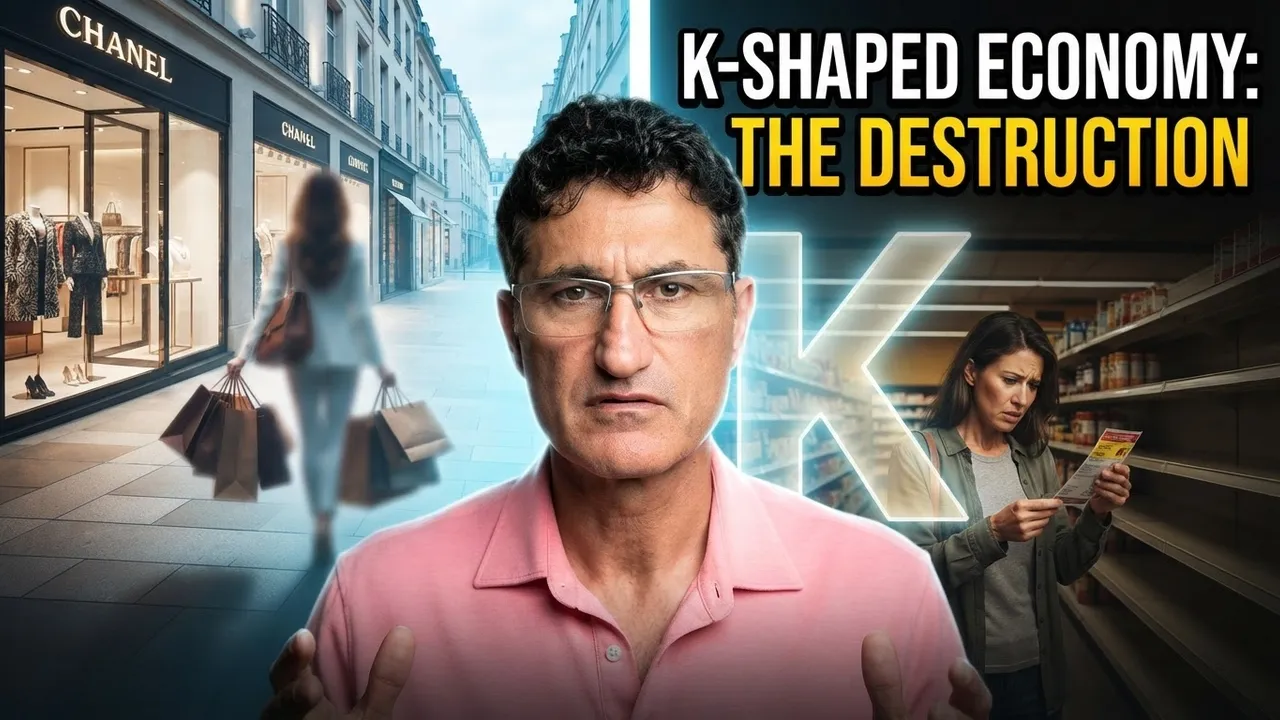
K-shaped Economy is Destroying Lower-Income Shoppers

- Video return
- +17.93%
- Calls
- 1
- Buy / Sell
- 1 0
- Published
Recommendations
Entry is the asset's closing price on the publication date. Current is the last close on record.
-
Entry $230.86 28 Jul 2026Current $272.26 06 Aug 2026Result +$41.40
when I look at companies like Walmart and Amazon in the retail sector, um I feel really good about where they're going because they are built to be integrated online, offline, new retail companies.
Full Transcript
Albertsons shares sank after the grocer warned consumers are pulling back on spending. Next week we'll get more quarterly reports from several major consumer names giving investors a snapshot on retail spending. Joining us now with more, Michael Zakhour, CEO at 5 New Digital and the author of The New Retail. Michael, great to have you with us. >> Morning. Thanks for having me back. >> Uh Albertsons really seem to underscore what we know already about the consumer and that is the K-shaped economy. Albertsons largely caters to the lower K and what's interesting is how the company was talking about how they're dealing with those pressures because they're basically saying that they would eat some of their margin in order to keep prices low to keep those consumers coming back to the stores. What can you sort of extrapolate from that? >> Yeah, I know. I think, you know, the Albertsons news is is a bit of a bellwether for what's coming up in a little bit more action in retail earnings next week and then obviously, you know, third week of August being the real the real um uh signs that we're looking forward I think Albertsons is is a good indicator that the consumer is is finally starting to um really feel the pinch and they are changing their spending habits. Um in some cases they're reducing, in other cases they're reallocating and you know, what Albertsons tells us is the top of the list, you know, armies and families march on their stomach and you know, the stubbornly high grocery prices combined with, you know, continuing inflation um tariffs, there's a lot of headwinds and we're expecting this to be, you know, could be a rough couple months here in the retail sector. >> Do you think it's an Albertsons specific way and I know you you know, Albertsons is not necessarily, you know, the company that you you focus on and specialize but what they're saying is basically that they've got to keep those prices low. They are willing to make price investment or eat those costs. Where does that tell you the power lies because even if they're pushing back, they're saying that they're trying to push back on suppliers and they're working on that but it seems to indicate a little bit of an upper hand to um the the food companies themselves and maybe less of an upper hand for the distributors. >> Yeah, for sure. And and you know, we've seen that um you know, over over the last couple of years and whether it's tariffs and and retailers and companies like Walmart and Target and others being willing to eat some of their own margin. Um I think they have to and I think it's going to be a trend that continues through the rest of the retail earning season. Um simply because people are being monetized to death. Um you know, there only so many times you can see the price go up, another hidden fee, whether it's in products, whether in services, grocery. I mean, gas has been up and down all over the place. So, I think Albertsons is doing the right thing here and I think other retailers will follow suit, which is the consumer is at a breaking point. I've been incredibly um surprised and and delighted by the resilience of the US consumer. You know, we all are up about 4% year-over-year. That's, you know, accounting for a major troll last August, but you know, throughout the last two years, the American consumers kept spending, but I I think we're starting to reach a breaking point and I think these retailers have to eat margin or an indicator of that. >> And you make the case, Michael, also that, you know, the upper K, the the wealthier consumers, higher household income, those are sort of uh masking some of the weakness that we are seeing uh in the consumer economy. And so, there's different parts of the K. And so, on the upper part of the K, the lower part of the upper K, I mean, we're seeing gas prices at $4 a gallon, etc. At what point do you start seeing that even that upper part of the K start to break a little bit? >> Yeah, so it's it's it's not quite there yet. Uh you know, we do uh a lot of research and a lot a lot of analysis here every day and and one of the things we have been tracking most closely over the last couple of years um is the increasing percentage of consumption and consumer dollars that are supported by the top 20%. So, right now, about 20% of all spending households in the US are making up about 80% of the um product value purchases. That's not sustainable. And and you know, we're seeing it in everything from you know, even now it's it's touching outside of grocery and consumer products, but services, whether it's hotels and travel. So, yeah, there's a lot of masking here because those wealthier premium luxury consumers are are really propping up the rest of the industry, but I think you're going to start to see a break there as well. You know, remember luxury is is a global business and you know, there are China concerns for luxury, there are US concerns. As right now, I think it's going to hold, but you know, I think we might see some trimming there as well in the next 6 months. >> In terms of all of the sort of economic indicators, what what's the one thing that's going to make you doubt even that upper income consumer? I mean, obviously it's not necessarily gas prices. I mean, is it higher mortgage rates, higher interest rates? So, what would it be? >> Yeah, you know, that's a great question. I I I think um it's not going to be so much around mortgage rates or or the price of of groceries, but I think there I think it might be a bit of a self-policing mechanism where, you know, these spenders are going to realize, "Hey, look, you know, we're not immune from the vagaries of the market as much as we thought we were." But, they're also going to be sensitive to we're not seeing it, but they could be sensitive to um you don't want to be driving your brand new Jaguar down a street full of 79 Pintos. Um so, you know, I think that that wealthy consumer is going to continue to prop up retail, but I think perception as well as some realities in terms of the tariffs and the ongoing situation with Iran, I think both of those could be breaking points even for the the upper level consumer. >> And what sorts of retailers will fare best in your view in this environment where there might be this sort of self-policing on the horizon? >> Yeah, Uh you know, it's what's happening right now is, you know, while all of this is happening, we're having all this new technology emerge and then you know how AI is working into retail and the supply chain. And so, when I look at companies like Walmart and Amazon in the retail sector, um I feel really good about where they're going because they are built to be integrated online, offline, new retail companies. They're building the technology that's going to help them save money and get through the efficiencies. So, I think what we're going to see here is consolidation at the top of retail in the same way that we're seeing consolidation at the top of emerging technologies, which is the companies that have the mass, the volume, and the data are continuing will continue to grow bigger. Um and you'll have those, you know, newcomers and competitors at the bottom, but I see a continual squeezing of the middle market, middle retail, and the middle-class consumer.
Comments 0
Sign in to join the discussion.
Sign inNo comments yet. Be the first to share your thoughts!