I'm pretty much bullish across the board here across Amazon, Google meta Microsoft Nvidia and micron as we sort of look across some of the big names that we talk about as you look out the next 3 to 5 years
I'm pretty much bullish across the board here across Amazon, Google meta Microsoft Nvidia and micron as we sort of look across some of the big names that we talk about as you look out the next 3 to 5 years
I'm pretty much bullish across the board here across Amazon, Google meta Microsoft Nvidia and micron as we sort of look across some of the big names that we talk about as you look out the next 3 to 5 years
I'm pretty much bullish across the board here across Amazon, Google meta Microsoft Nvidia and micron as we sort of look across some of the big names that we talk about as you look out the next 3 to 5 years
I'm pretty much bullish across the board here across Amazon, Google meta Microsoft Nvidia and micron as we sort of look across some of the big names that we talk about as you look out the next 3 to 5 years
I'm pretty much bullish across the board here across Amazon, Google meta Microsoft Nvidia and micron as we sort of look across some of the big names that we talk about as you look out the next 3 to 5 years
Full Transcript
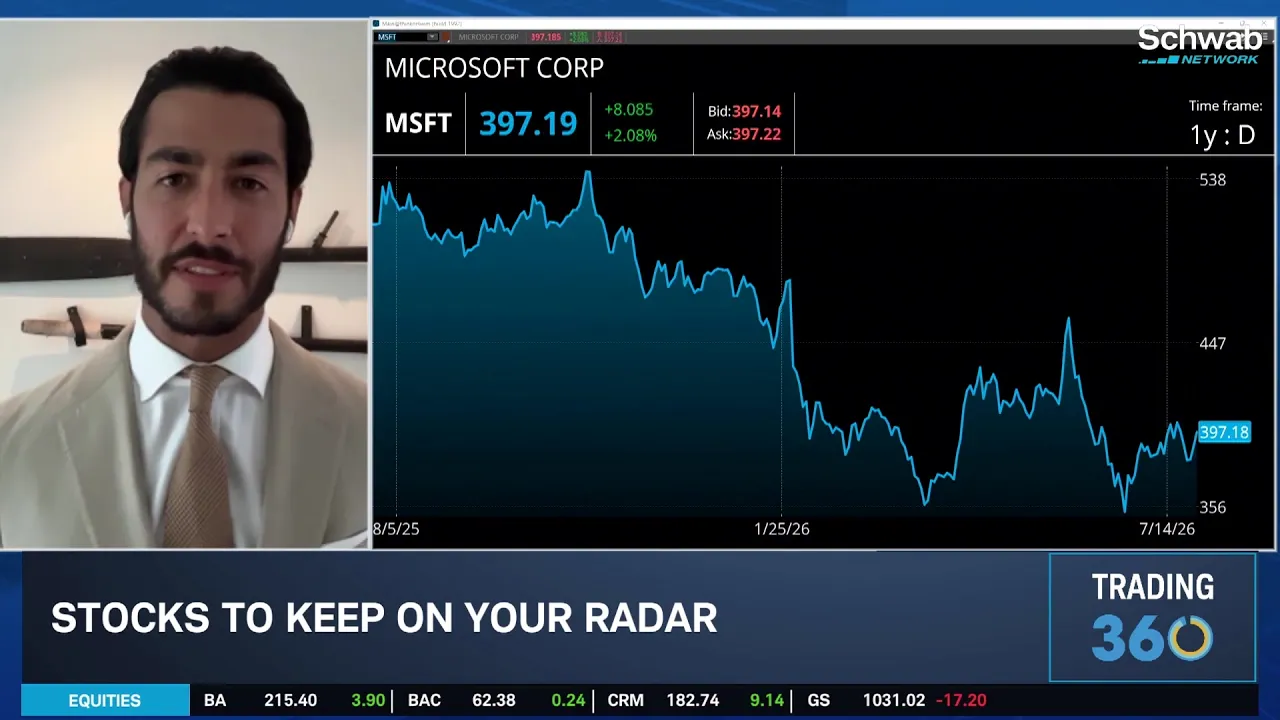
really appreciate you breaking down those earnings for us and the market reaction that we're seeing to them. But while we're talking about earnings and market reactions, I want to bring in our next guest. Joining us this morning Ted Thatcher, president of Bright Lake Wealth Management. Ted, great to have you on the show. I was just talking about coke with Jenny. Let's move to the ones that have been a bit more of a head scratcher, though. We'll talk about the AI trade. We've clearly seen this cooling off here. How are you looking at this. Is this a healthy reset because valuations had gotten so far out over their skis. Or are we really starting to question the viability of the AI buildout and the AI trade now? I think it's an important question for investors to ask, but I would not jump to the alarm bell headlines here. I think we've been talking on your program since maybe late May, early June about the summer being choppy. You know, obviously the AI trade is cooling. I think Google, of course, being punished because they're raising CapEx again, the micron's of the world, the chip names selling off in a big way today. You know, obviously they've had this huge rally. It's retracting significantly at this point. And I think that basically puts an exclamation point on that whole cyclical, I think, bumpy summer that we've expected. There's a lot of uncertainty in the markets right now. Again, with the AI trade cooling, with the interest rate discussion, the on again, off again relationship the U.S. has had with Iran has, you know, investors in the street kind of questioning exactly where the strength lies. I think, you know, you well highlighted Coca-Cola this morning as one of those kind of blue chip names, actually. So where does this strength lie then, Ted? Because, I mean, you mentioned Google there. We saw the response to alphabet. Great numbers, 82% growth in cloud. I mean, the things people wanted to see, they got. But they also knew a spend was coming. Guess what? The spend came and then they got mad about the spend. So what does that say? Where is the value? What companies are going to meet success? Because we've got four other mag seven names coming this week who likely will all increase spend. Although maybe we should take Apple slightly out of that conversation. Yeah, I think you're right to kind of set Apple to the side there, although I think in this market with as choppy as it is morally, the patient and systematic investor is the one that's set up for most success. Because I still do believe in names like Google the Mag seven, you know, hyperscalers, the Meta's, the Microsofts, the Amazons of the world that we are going to see report this week. Google has been a real bellwether for what we see from those companies. I expect them to actually raise CapEx, if not, if just marginally, and to see similar results. I don't think that we might see as big of beats as we saw with alphabet. But when I look at the big tech trade right now, where I'm looking at is fundamentally where the demand lies. I think we've gotten a real signal from this Kimmy K three release about what the dynamic looks like in big tech right now. You know, I wouldn't want to necessarily be a frontier model company when we see, you know, a 50 X order of magnitude decrease in cost with only maybe a 5 to 10% marginal difference in intelligence that we're getting out of these models. Again, kind of comparing that, like open source Kimmy K three compared to, say, the frontier cloud models, what does that what does that mean though, in terms of demand? Well, it means that, well, the Compute Tollbooth that's being set up by these hyperscalers puts Google puts meta puts Amazon and Microsoft in a great position for collecting basically that toll. And I actually think it also means some demand for continued demand, I should say, for the chip companies. And then finally, actually, I'm looking at the application layer of that stack as well. So let's talk about this open source versus closed source debate. Because when Kimmy came out to such massive success that it actually had to stop subscription sales because it was six times oversubscribed within the first 48 hours. How is that changing the investment landscape? Because obviously, we've had all these conversations about the unicorn mega IPOs that are coming from open AI and anthropic and what these models mean. This is a clear threat as it's a much lower cost product, it appears to be, and argues to be similarly capable, if not more capable, depending on which metrics and which tests you're looking at. How has this completely flipped the narrative on its head? Well, fundamentally it comes down to cost, right? I mean, if I have to pay $50, you know, for a batch of tokens from anthropic, or I can pay $0.50 for a batch of tokens from Kimmy K three and get similar, you know, performance. I'd rather just pay for, you know, that tiny, tiny expense and maybe, you know, incur the cost of energy and whatever hardware I need. And so whether, you know, obviously this last two weeks, it's been Kimmy K three, but these open source models and, you know, models more broadly, they're all competing and they're all doing the same kind of thing. They're all distilling from one another, whether it's OpenAI from anthropic, anthropic from OpenAI, Kimmy from them. And so it's sort of leveling the playing field. And what I see when I look at that is effectively, you know, I think investors have to say, okay, is this intelligence actually going to quickly become a commodity? And again, then you come back to where does the demand go? If that is true, I don't want to be hyperbolic and say that there's, you know, not very much value being created by these frontier models. Of course, there's a tremendous amount of value there. But where I sort of see the puck going is toward, again, that compute layer that's being built out, obviously much criticized because of the amount of CapEx. But when you look at I think Google's a really good example of this. Investors should be thoughtful about where they put their capital and they have to underwrite that. But when you look at a name like Google over the last 20 years, Mali, they have a 32% compounded rate of their return on invested capital, their ROIC. And so while I think that you see their first quarter ever of negative free cash flow, and you could be afraid of that headline, when you zoom out a little bit, you could say, okay, you know, maybe they're on to something here. And Ted, you're pretty much bullish across the board here across Amazon, Google meta Microsoft Nvidia and micron as we sort of look across some of the big names that we talk about as you look out the next 3 to 5 years, because you mentioned here a bit of knee jerk reaction we're seeing to some of the spend. So let's look a little bit longer down the road as you look at those names that you're bullish on, which one do you think has the best risk reward over that time frame? You know, I think when I see a Microsoft having come down as far as it has, that one stands out to me just from a, you know, pure price to earnings ratio compared to some of its historicals. I think I'm really interested to see what Azure does, since, you know, just in Q2, I want to see that number above 30%. Specifically, if we get too slow of growth there, if we don't see the type of backlog that we, you know, want to see, of course. And certainly if they go way above their CapEx spending expectations, those could be short term, you know, negative for the company. But fundamentally these hyperscaler names, I think they're building out that tollbooth right now. And eventually we're going to see that reward come back. All right. Well, if we look at Microsoft as we come into those earnings tomorrow, down about 18% year to date, but some momentum on their side over the last month. So we'll see how it shakes out for them. We'll of course have those earnings live on my

Comments 0
Sign in to join the discussion.
Sign inNo comments yet. Be the first to share your thoughts!