Ca$htag$: META Earnings Ahead & Consumer Demand Stats

- Video return
- +0.73%
- Calls
- 3
- Buy / Sell
- 3 0
- Published
Recommendations
Entry is the asset's closing price on the publication date. Current is the last close on record.
-
Entry $585.61 29 Jul 2026Current $589.90 06 Aug 2026Result +$4.29
we're, we're fairly bullish on them, especially at these prices.
Context "we're fairly bullish on them, especially at these prices."
-
Entry $585.61 29 Jul 2026Current $589.90 06 Aug 2026Result +$4.29
this is a, you know, a healthy company at a discounted price, in my opinion.
Context "this is a healthy company at a discounted price, in my opinion."
-
Entry $585.61 29 Jul 2026Current $589.90 06 Aug 2026Result +$4.29
So we're bullish heading into this.
Full Transcript
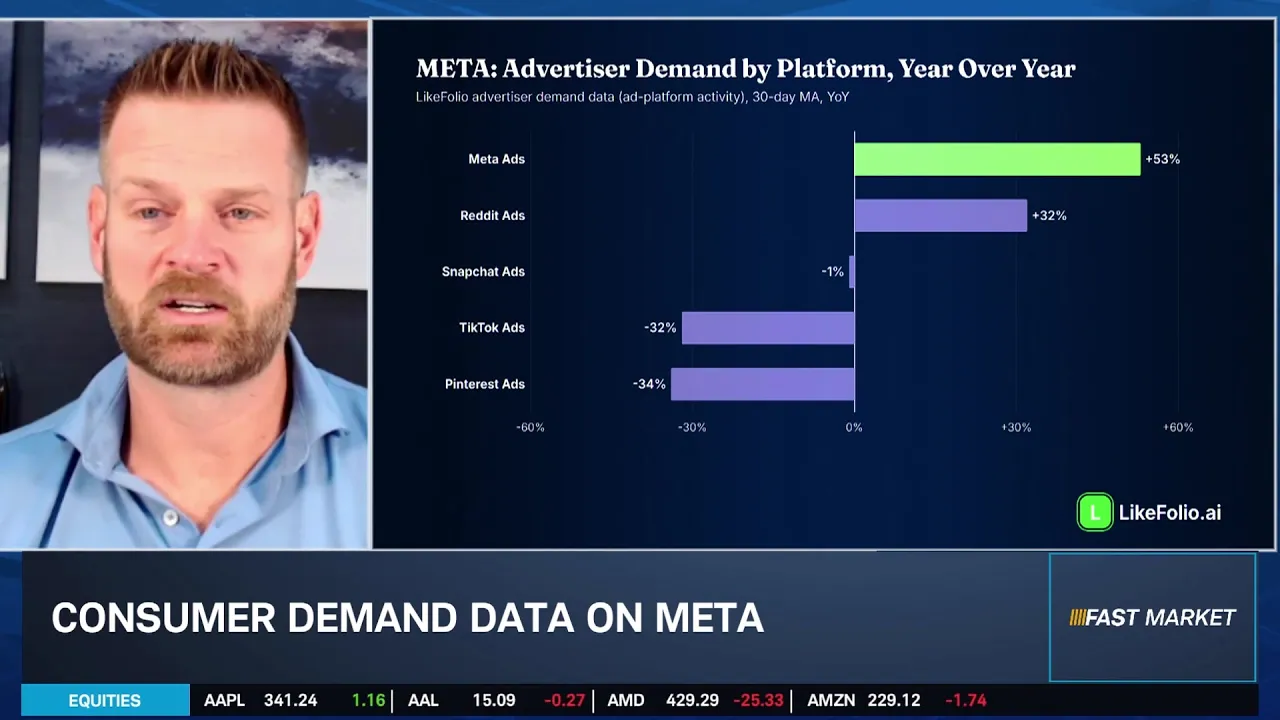
here on Schwab Network. I'm Diane King Hall alongside Kevin Henkes over at the CBO. Time now for our segment. For that, we want to bring in our next guest. And that is Landon Swan, co-founder of like folio, taking a look at meta platforms today. It's another one with a big test in front of it. It's got earnings due today. Year to date the stock's been under pressure year over year. It's a little worse than even year to date. You've got fresh sentiment data and things actually look pretty solid there. What is your latest data show us. Yeah I mean it does. I mean when you look at what the stock has done high of I think just under 800. And now we're a little bit under 600. I mean we're talking about a you know 2,526% drop from from the one year highs to now this is a pretty, pretty sold off stock right now. And when we look at the data, generally speaking, it's pretty strong. You know, obviously it depends on which segment you're talking about. Facebook is I think pretty flat on a year over year basis. But Instagram is doing extremely well. WhatsApp is doing well. And so a lot of the advertisers are moving money into those. And we're seeing that advertising demand is up significantly. You know, when you look at how well they did last year, their advertising revenue was up, I think 33% impressions were up 19%, average price was up 12%. So more people were advertising and they were spending more money per per ad. And so you can kind of see overall how meta is shaping up here of, of the advertising demand that we track their number one by far. In fact, they're the, you know, one of two that are positive on the year, on a year over year basis. So they're, they're doing a lot. Right. And I think a lot of it comes down to a lot of the investment that they've put into all the compute and the AI infrastructure because they're super intelligence labs have, you know, taken AI, and now it's allowing it to target individuals and lift returns and that return on ad spend, that's a big number. We're seeing that, you know, companies are reporting that going up and up. And of course, if you're advertising somewhere and your return on your ad spend is going up, what are you going to do? You're going to advertise more. And if everybody's doing that, the prices go up, but you still pay more. And of course, that's how you know, that's how you see a company like meta do so well on, on a quarter over quarter year over year basis. And so, you know, we're, we're fairly bullish on them, especially at these prices. I think that's really the key is this is not, you know, touching all time highs. This has pulled back quite a bit. And I think a lot of the pullback is just based on how much CapEx they're spending. I mean it's it's twice what it was last year. We're talking about massive numbers. I think it's 125 to $145 billion is what they're expecting to spend this year. And, you know, investors, I think sometimes investors see that as an expense as as a compared to an investment. You know, they're, they're showing that this is turning into real returns with the, you know, the return on ad spend increases through their AI infrastructure plays. Plus now they're able to sell some of that compute. We'll see if the deals go through. But they've got, you know, Anthropic's talking about buying $10 billion worth of compute from them. So that's always an option. It's an asset that they can use. And they can either, you know, make their their clients, the advertisers do better so they'll spend more or maybe they can sell some of that compute. So I don't see a big problem with it, especially when they're making as much money as they're making. I think last quarter, you know, when you take away the one time tax charge, they made $19 billion. And so we're talking about, yeah, we're talking about spending more than they're making in a year. But, you know, they're still doing just fine. They've got they've got a little cushion there and it's starting to definitely pay some dividends as far as that investment goes. So I think a lot of those fears are overblown. And if they raised it slightly, it wouldn't spook me as an investor. I just want to see that all of the like folio data is true, that all of the, you know, the demand on the on the from the client side is up and the demand from the advertiser side is up as well. That's what we've got showing. So this is a, you know, a healthy company at a discounted price, in my opinion, Landon, you're the like folio data is overwhelmingly positive. And this is a company that who knew that Instagram could become what it's become. We all knew that Facebook was popular. We didn't know be this popular, but we knew it was popular. It was Instagram. We always had doubts about their ability to monetize Instagram. Now they've clearly done that. And Instagram is becoming its own force in social media. Now it gets to this next moment. I was reading this morning about when Amazon came out with AWS. It was 2006, and some of the news releases that were seeing from meta feels like we maybe having like a Amazon AWS moment for meta with them actually getting in that business and creating another business. We know they're dominated by advertising and advertising is going to pay all their bills. But other than the perception that Mark Zuckerberg can't control his spending, this is a company that is doing incredibly well. And if they could initiate like a year of efficiency 2.0, this could be an explosive earnings release. Landon. Yeah. And you know what? They're on that path. I mean, they, you know, they cut 10% of their staff. And then they took another 10% and they moved them over into AI. And so they had, you know, they, they really, you know, restructured quite a bit. That's 20% of their workforce. And so they are, you know, they're, they're all in on AI, obviously. And you can see here on the chart what you're talking about, Instagram is just doing extremely well. WhatsApp also doing well. But Instagram that number, again, this is year over year that that number was high last year. It was high the year before. So it just keeps growing and growing and growing. Facebook's kind of just there. It's you know, it's chugging along. It's doing great. It's got a ton of users. The company overall has over 3.5 billion daily active users, up 4% on a year over year basis. Just crazy. But yeah, I think that, you know, they're looking to become more efficient. And they're looking to invest in things that are going to pay long term. And if that means cutting some employees, moving them over to AI, and then also buying a ton of compute, either for internal purposes or like you're saying, maybe for external customers. I agree, I can remember everyone was doubting Amazon, you know, why, why are they switching into this business? Like it doesn't make sense. Basically they just took one of their biggest costs and turned it into a revenue source, which is incredible. And I think that, you know, meta is maybe along that same path, this is one of their biggest costs is compute and dealing with AI and offering up the best ads to everyone. Well, what if it, you know, when, when things are a little bit leaner, they can sell off capacity or if it's profitable to sell off capacity, just keep making it. So, you know, I think this is a great move by them. And I'm not scared by the CapEx numbers. And when you look at this chart, it's, you know, the, the demand is slightly up on a year over year basis. The stock has gotten, you know, hit pretty hard. It's not absolutely decimated, but it's hit pretty hard and I think unjustifiably. So you look at the p e ratios that, you know, 18, its five year average is 26. Google's or meta Google alphabet is like 24. So you know, at 18 they're they're at a discount. And so there's a lot of positive things, especially when you're talking about like the value play side of stuff. You know, we look at a lot of like folio data and when we, we break it down into the main street score, which is what consumers and advertisers think of meta. That's at a 90 out of 100 right now. And when we look at what Wall Street thinks of it, that's investors. What do they think of the stock that's at a 55 out of 100. So that's a big disagreement. So we like it a lot more than investors do. And I think that that has to reconcile sometime over the next 3 to 6 months. And what better catalyst than an earnings report. So is that is that your earnings score. Can you just explain that a little bit. Sure. So that those those two things go into earnings score. Earnings score is plus 32. So there's a significant difference between what consumers think and what investors think. Consumers like it a lot more. And everything that we've got pointing upwards. It's not like crazy all in you know by out of the money calls. But it's definitely a solid signal at plus 32. So we're bullish heading into this. Okay. So plus 32. All right. Thank you. Landon. That's Landon Swan,
Comments 0
Sign in to join the discussion.
Sign inNo comments yet. Be the first to share your thoughts!