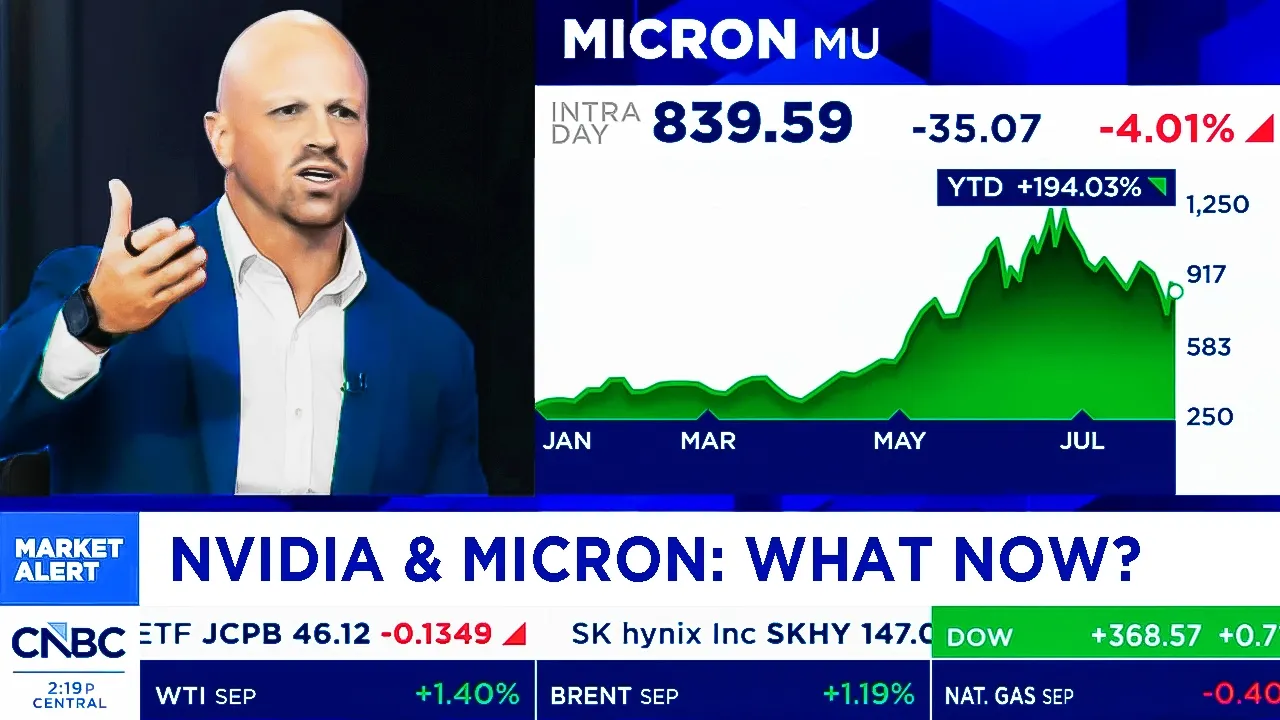
The News Today On NVIDIA Stock, Micron Stock, SK Hynix Stock, Big Tech Earnings - NVDA Update

- Video return
- +8.09%
- Calls
- 2
- Buy / Sell
- 2 0
- Published
Recommendations
Entry is the asset's closing price on the publication date. Current is the last close on record.
-
Entry $823.03 31 Jul 2026Current $858.03 07 Aug 2026Result +$35.00
I also think it's reasonable to be bullish on memory makers like Micron and SKH at least through most of 2027, possibly longer depending on what happens.
-
Entry $200.75 31 Jul 2026Current $223.78 07 Aug 2026Result +$23.03
I am very confident that Nvidia will be worth much more in future years than it is today.
Full Transcript
And Daniel, I mean, Microsoft yesterday, a nearly $500 billion gain in gain in market cap. That's the largest daily gain we've seen for any stock ever in the history of the world. You could look to the move we saw in semiconductor stocks in South Korea overnight, too. Uh, and the massive volatility in the Cosby. How does it speak to this trading environment and what we are getting from tech results? Look, the results have been pretty good across the board, but what we just saw this week was it looks like the unwind of a whole lot of deleveraging, a little bit of capitulation and a tech trade that was really structurally always sound. A week ago, we got Google's earnings. They had 80 plus% growth in their cloud business. They announced a small increase in capex and the market sold it and the entire world started to think maybe this AI trade is falling apart. We had the China Kimmy news and there was concerns, you know, are the frontier labs not going to be as successful as we thought. But then you have AWS, you have Google, you have, to your point, Microsoft all beating, all seeing margins expanding, all with half trillion backlogs. And what we believe is that this 10 to 12 trillion in cumulative capex that is going to be spent between now and 2030 is very much intact. This was all about the deleveraging. AI is looking very good now. >> Yeah. Thomas, I'm going to bring you to the conversation first. Just a quick followup for you, Daniel. And that is, are you surprised by the move we're seeing this morning in Amazon when they raised capex? I realize AWS numbers smashed expectations. >> Um, no, I'm not. I I think this is where we see there is a big separation between Google last week and Amazon this week with the Cosby and now with the US markets having that deleveraging. I think the market was completely wrong about what was going on. The market thought it was an AI problem, but the real problem was leverage. And now we're on the seemingly on the other side of this because it wasn't only Microsoft and Amazon that are running all of these capacity and energy and micron memory names. All of them saw a huge boost. There was there was multiple things going on, but AI took the blame. >> Thomas, want to get your thoughts on all of this. >> Sure. Well, I think the important thing is what you started off with with the ETFs and that it's retail and sentiment that is has been driving the market for quite some time. So, the market is logically following um good fundamentals. Um and the fundamentals of the semiconductor stocks were just fantastic and so those got bid up to very high prices. Um and the sentiment was good. People want to participate while it's going up and then when it reaches a certain point the narrative changes or the fear changes. The underlying fundamental story hasn't changed as we've just said. Um but the valuations have changed then the fish swim to the other direction. um and it goes down for a while and nobody wants to own these in anticipation of getting caught holding the bag at the end. Um and that seems to have run its course with some of these stocks down 40 or more% um and the fundamental story not changed. So let's get back in and maybe some of this pressure from retail or from leverage um has been relieved. And they increased their capex guidance to 220 billion. >> The number is by the way almost inconceivable. >> Part of that was memory, >> right? And a lot they were at 200 billion and a lot of it is just higher memory cost. But you're confident >> that that money is going to be well spent. >> Andy Andy Jasse is a a diff difficult kind of guy. He you don't disagree with him, I think, because he's comes in with the facts. >> You don't disagree with him because you're probably wrong. When he did the line of sight of why this works, it was so clear that he wants to be in this business because he's going to make so much money. David, he's the first of these execs who have said, "Look, this is where the money is." >> And that's why I'm, you know, you can make an argument that everybody else is going to just have to try to keep up. You can't let the field. >> Let's listen to Jasse because he also said something important when it comes to overall demand. Take a listen. We now believe we will spend approximately $220 billion in cash capex in 2026. The higher cost of memory pushing this number up from our prior estimate of about 200 billion. But even at that amount, we will still not have enough capacity to meet all the demand we have in 2026. And I believe this dynamic will also be true in 2027 too. In fact, the demand I don't know why I cut out we already have for 2028 he went on to add is striking. See you know there you listen I had told him in a meeting I had I said look I how much you willing to lose and he said no look we we we have line of sight probability big probability but he had never explained that suddenly we get this quarter in a calm manner he explains basically why they need to be c flow negative if they have to be and then I said you know what borrow away Andy you've obviously got it the demand is so great and you can charge a lot. >> Ask outgoing CEO Tim Cook, and I can't believe I'm even calling him outgoing, about why the ALEC wasn't strong. He would probably reference the memory chip shortage hampering many makers of consumer electronics. >> We reluctantly raise prices, I would say. We did it because we're in uh what I would characterize as a 100red-year flood on the memory pricing uh with uh exponential increases in in memory prices. TO THE BOATS, on the flip side of this, we are seeing strong rebounds and beat up memory chip names like Micron and SanDisk. As it becomes clear, they have pricing power well into the future. Whereas Apple's outlook was a complete letdown, Amazon was a total opposite. The company reported accelerated growth in its monster AWS business along with surging profit margins for that segment. CEO Andy Jasse came out very bullish on AWS on his earnings call. >> Our backlog stands at $496 billion, growing triple digits year-over-year. AWS is now a $169 billion annualized revenue run rate business, which for perspective would place it 24th in the Fortune 500 list if it was a standalone company. Chinese AI champion Moonshot has a computing power agreement with Alibaba for the use of around 20,000 Nvidia chips, according to sources. Those sources say that the hardware forms a substantial chunk of the computing capacity Moonshot uses for its Kimmy models, the latest of which rival US competitors. You'll remember, of course, that Washington have restricted China's access to some generations of Nvidia chip on national security grounds. Bloomberg's executive editor, Peter Stri joins us. Let's let's start with the basics of what we're reporting here. >> Yeah. Well, just to back up one step, of course, Moonshot uh announced itself uh really to the Western world at least uh a couple weeks ago where it came out with this Kimmy K3 model which has very uh strong performance uh really near the leading edge of the frontier labs uh in the models at uh OpenAI and Anthropic. And one of the questions since then has been how did they do it? Uh we know that there's been breakthrough engineering at a number of the different Chinese companies. Of course, Deep Seek was really the phenomenon last year, but now the questions are around Moonshot and how did they actually pull this off? And we've seen a couple of bits and pieces of it, but this kind of helps us understand the broader picture. We know that Alibaba has an investment in Moonshot and what we we're reporting in this story is that Alibaba is also supplying a bunch of the computing power behind that model. We know that they're using 20,000 of Nvidia chips, the hopper generation of chips from Nvidia. Uh Alibaba did get back to us and they said they're not the H200 chips uh which are the leading edge. Our sources have told us that they actually are those H200 uh chips, but they're definitely the hopper generation of chips that they're providing and Moonshot has been able to use that to build out this model. We also of course had the White House uh Mike Kratzios saying that they believe they're also accessing Grace Blackwell chips, even more advanced chips from Nvidia. >> We're just showing that sort of uh communication from Alibaba on what what what they are denying and what they're not. I guess that you know it's it's worth a discussion, Peter, of what we don't know, right? For a long time, we've been asking um about well how many uh Nvidia chips are actually going into China? Are Chinese firms using this technology outside of the United States and outside of China? Pose some of those questions for us. >> Yeah, it's a complicated picture and we do have this shifting regime of uh export regulations that's affected a bunch of this. Nvidia is not allowed to sell its most advanced chips, the Blackwell chips into China right now. What we have seen in the past is they were able to sell a number of the Hopper generation of chips, some of the earlier generations of chips. More recently, the US signed off on Nvidia selling those H200s into China. That would be a a pretty advanced chip for many of these companies to use, including Moonshot and Deep Seek. But Beijing has pushed back on that idea that domestic companies should use those chips. It would prefer to continue building out its own semiconductor industry, particularly supporting companies like Huawei and Cambercon in particular. So, if you are using H200 chips, that would be it's possible from the US standpoint uh within within China, but there would be a little bit of push back from Beijing if you're using H200 chips that they would prefer you not use. At this point, just to just to flag one other loophole here, uh it is still entirely possible, entirely legal for Chinese companies to access all of Nvidia's chips outside of the country. They can go to Southeast Asia and they can get access to some of these chips, um including the H200's there. That's that's not forbidden in any case. This is a loophole that some of the China hawks have wanted to close for a long period of time, but at least at this period of time, you can't still access there. >> We have a Bloomberg terminal client just sent me an IB and make a point that's in the story that, you know, Alibab Alibaba is one of Moonshot's biggest investors and of course they're also competitors. I go away and read it. Bloomberg's Peter Lstrom. >> You have also been talking about AIM for bottlenecks, right? And you know, they haven't gone away. uh some of these stocks like the photonics memory and what do you I guess until they're resolved you still think there's an opportunity to make money there >> absolutely I think you heard a lot of commentary from the hyperscalers whether it be Microsoft uh Amazon yesterday as well as from Google just talking about the bottlene bottlenecks um at the data center we've all heard about the memory chip bottlenecks as well and everybody's supply constrained all the way out until 2020 28. So I do think they that there are is some legs to this story for quite some time. It's just whether or not the stocks have already reflected that and we think that just given the pullback that we've seen recently, there's a little bit more to go. >> Yeah. And I was going to say, you know, if we had this conversation 3 weeks ago, we might say it's reflecting that, but some of these names are still down a lot. I mean, would you be buying some of them here? >> Absolutely. You know, from a valuation perspective, they're still relatively attractive. You know, I do think we have to be uh cognizant of that second derivative in terms of are they going to continue to grow at the rates that they have grown so far? Probably not. But given the duration of the AI infrastructure buildout, we do think that there is still some value left in many of these names. >> So semiconductors have been all over the place. A lot of application software still in the toilet. What should investors be watching potentially buying with all this volatility that might be underpriced? >> Yeah. Well, I also think we have to remember with semiconductors, we just came off the best quarter ever in the history of the index. It was up over 80%. So, you know, right now the the group um after having this massive run is is getting a bit oversold. I think, you know, partly we've had a rebound, but we're kind of in this middle zone where we want to see some further strength. I think semiconductors and micron is is ground zero for the trade. So, at this point, I would say I I think that trade is just going to be a bit bouncier. I do think there's more upside in the MAG 7 which collectively is only uh actually as of today down 1% for the year and I think you'll see more money rotate over there in the interim. I think longer term though the compute and the demand is still there. I just think the semiconductors are likely to have a longer period of cooling after this tremendous run that it had earlier in the year. >> All right, I hope you're all doing well today and staying calm in this market. Friday was a mixed day throughout the market with most of the MAG seven solidly in the green following positive AWS results Thursday evening. Apple was an exception to the green action we saw in mega cap tech stocks after Apple reported earnings Thursday evening. We also saw some memory and momentum names trade solidly in the red on Friday due to a few reasons I'm going to address now. First, we got some hawkish commentary from members of the Federal Reserve and we saw a surge in Treasury yields. The 10-year reached its highest level since January 2025 and the 30-year reached its highest level since 2007. That put pressure on high beta stocks like Micron as market participants worry about higher borrowing costs. Keep in mind that many of the Neo clouds and now even the hypers scale companies are tapping the debt market to help fund their AI buildouts. So higher yields are going to put pressure on volatile names that are connected to the AI buildout such as Micron and many of the Neocloud stocks. The timing is unfortunate because Micron opened decently higher Friday morning after Amazon and Apple's comments about higher memory prices Thursday evening. We also got some memory specific news overnight. Memory maker Kiia reported earnings overnight in Japan. Revenue EPS and operating profit fell short of lofty expectations. Additionally, Kioxia's outlook was slightly below consensus expectations. It's important to consider that despite the lofty expectations, results and forward-looking commentary were not necessarily bearish. Kioa expects revenue to rise roughly 35% in the September quarter. They expect demand to exceed supply in calendar 2027, and the company remains on track toward having approximately 50% of shipment volume covered by long-term agreements by 2028. They also characterized NAND demand driven by AI inference as being at the very beginning of its growth curve. They also announced a stock split and an up to 800 billion yen share buyback that's slightly more than5 billion US. So overall results and commentary were not necessarily bearish. I think this was a situation of expectations running too hot ahead of the print rather than an indication that the cycle is rolling over right now. We have to understand that sentiment is very fragile as it relates to memory stocks and so it doesn't take much to knock these stocks lower right now. I'll talk more about that in a moment. Also on Friday, Bloomberg published a report claiming that China's Moonshot AI, which recently launched the Kim K3 open model, has a compute agreement with Alibaba to use 20,000 Nvidia hopper generation GPUs. Alibaba is an investor in Moonshot. Some sources claim that the chips are Nvidia H200 GPUs. According to Reuters, an Alibaba spokesperson told them, quote, "The alleged supply of H200 chips to Moonshot from us is completely groundless." Bloomberg has also reported that Moonshot has a channel for accessing newer Blackwell GPUs through Southeast Asia. I want to point out a few things on this. First, as I said shortly after Kim K3 was released, while newer generation Nvidia GPUs are restricted from being sold in China, many Chinese companies can still access those GPUs and clouds outside of China. Additionally, concerns that Kim K3 was not trained on Nvidia GPUs is misplaced because it clearly was. And third, the idea that open- source models will result in less compute demand is incorrect. Open models help drive greater consumption throughout the ecosystem. Greater consumption ultimately leads to greater compute demand. After Kimmy K3 was released, some market participants incorrectly sold stocks like Nvidia. But then a couple days later, Moonshot posted online saying the demand was already nearing the limits of their capacity and they were working to secure additional capacity. Thankfully, many market participants woke up much sooner this time than they did back in early 2025 after the release of Deep Seeks or one model. I'm not saying that Kimmy K3 is cheaper than Frontier US models because that's not entirely accurate. But moving forward, I want you to understand that cheaper models and lower token costs are not negatives for compute demand. They actually help catalyze greater usage which ultimately results in more compute demand, not less. Now, I want to talk about the price action that we've seen over the past month and some of the high-flying memory and momentum names associated with the AI buildout. Listen to me. Price action over the past month in these stocks have been rough, and I'm not going to pretend otherwise. That said, there's some very important context that we need to keep in mind. I'm once again going to share this clip of what I said back on July 8th because it's very relevant to what we've seen over the past month. But for right now, especially considering the run that memory stocks have had this year, many market participants are extra sensitive to any news or speculation that they perceive as being a threat to the memory makers pricing power. And so anytime you get a headline or a rumor about additional supply coming online, memory stocks get hammered, even if that new supply doesn't come online for multiple years. Unfortunately, you're going to see some outlets capitalize on that nervous sentiment by publishing stories they cannot prove. Stories that will cause short-term price swings and knee-jerk reactions in the market. My honest opinion is that the recent action in many tech hardware stocks is just short-term noise. The fundamentals remain firmly in place despite the nervousness in the market. The price action we've seen over the past month has largely been driven by sentiment. Multiple sensationalized headlines and major margin unwinds both in South Korea and the US. Listen to me. Those are all short-term noise that have caused volatility in these stocks, but they are not fundamentals. And even as many of these stocks have gotten hammered over the past month, the fundamental backdrop has actually been strengthening, not deteriorating. Over the past month, there appears to be a dislocation between the souring sentiment and the improving fundamentals. The good news for long-term investors is that it all eventually comes back to fundamentals. Even though it usually takes time for market participants to wake up, think about everything we've learned just over the past couple of weeks. All three of the major CSPs reported accelerating cloud revenue growth and expanding operating margins. Microsoft increased next quarter capex and told us they expect to remain free cash flow positive in fiscal 2027. Amazon saw AWS revenue growth accelerate to 37% in the quarter, which is massive for AWS considering that is by far the largest cloud. Amazon raised 2026 capex by $20 billion due mainly to rising memory prices. Alphabet told us to expect significantly greater capex in 2027. Apple's Tim Cook spoke about high memory prices and said that memory prices will continue to rise. All the hyperscalers told us demand continues to exceed supply. SKH reported revenue up 257% year-over-year and operating profit up 557% year-over-year. Samsung reported strong earnings as AI server demand and memory pricing drove a record 70% operating margin. CXMT has reportedly been raising prices for months and is charging some customers more than Samsung and SKH even as some market participants are worrying about a dumping situation. Elon Musk spoke on the Tesla earnings call about high memory prices and specifically thank Micron. Intel said they expect some demand destruction among consumers because of higher memory prices driven by AI demand. GM CEO spoke about the importance of the company's multi-year partnerships with Micron and Samsung. Alphabet CEO spoke about their need for larger base models, which is positive for memory makers. Meta raised the lower end of their capex guidance range and clarified that they don't have excess compute. It's just that they can charge a premium if they rent out a portion of their compute due to the shortages throughout the industry. All of the stuff that I just mentioned, all of it happened within the past 2 weeks, even as memory stocks have been hammered. As I've said repeatedly over the past month, the memory business has been cyclical for decades, and many market participants are not even willing to consider the possibility that this current moment could last longer than the typical cycles of the past. Because of that, we're in a lose-lose situation right now as it relates to market sentiment regarding the memory makers. If memory makers report great results, some market participants assume that the cycle is peaking because the results are so good. Samsung trading lower earlier this month is a great example of this. The stock traded lower after Samsung released preliminary earnings results showing operating profit up over 1,800%. And on the other hand, if expectations run too hot and memory makers slightly miss those lofty expectations, some market participants assume that the peak must be behind us and that the cycle is starting to roll over. The reaction to SKH Heinik's earnings this past week is a great example of that. It's unfortunate, but that's what we're dealing with right now in the short term as it relates to market sentiment. That fragile sentiment is also why we've seen memory stocks get hammered on headlines about increasing supply, even if that supply doesn't come online for multiple years, and even if that supply will not be enough to satisfy demand. The fragile sentiment is also why memory stocks have gotten hammered on headlines about Nvidia reportedly backstopping open AI, headlines about homegrown immersion DUV machines in China, even though future production volumes are very low compared to what ASML already sells in China, and sensationalized headlines about Nvidia renting capacity from other companies for their own internal workloads over the course of many years. By the way, this headline that you're looking at from the FT, it's a story about Nvidia leasing capacity for less than $2 billion per year. That's nothing for Nvidia. You also have to remember that Nvidia needs a lot of capacity to train and serve their own open models. Nvidia does not manufacture their products. So if Nvidia needs a lot of capacity, it makes sense for them to just rent the capacity from other companies so that Nvidia doesn't have to deal with unnecessary headaches related to securing land and power, data center construction, and dealing with local governments. Nvidia can just rent the capacity they need and let other companies deal with all of those headaches. There have been multiple articles from multiple outlets this month in which the details of the articles appear to contradict the sensationalized nature of the headlines. Cinnamon has caused many of the high-flying memory stocks to trade lower. I shared that clip of my commentary from early July for a reason. I told you to expect this given the fragile sentiment among market participants regarding memory stocks. I want you to understand that these stocks are going to be very volatile due to sentiment. Therefore, these stocks are not suitable for everyone to own and that's okay. Additionally, proper position sizing is extremely important. You do not want to own a position in a single stock or sector that is so large that you get scared during sell-offs and end up making irrational decisions. Proper position sizing is extremely important. It's also important to remember that you don't have to buy into a position all at once, nor do you have to sell out of a position all at once. For many people, gradually dollar cost averaging into positions in small increments over a long period of time can be a great way to add exposure without having to deal with a bunch of stress. If you buy and the stock trades higher, great. You've gained exposure and you're up on your position. If you buy and the stock trades lower, you still have cash available to buy the dip at lower prices because you didn't buy it all at one time. I'm not a financial adviser and so I cannot tell you what to do. I'm just sharing some thoughts that I think may be helpful for some of you to consider. If you need help with your unique situation, consider reaching out to a certified financial professional who can help you with your unique circumstance. Now, despite the price action we've seen over the past month, and despite all the hysteria and sensationalized headlines weighing on these stocks, the fundamentals appear to remain intact. In fact, I would argue that the fundamental backdrop has actually strengthened based on what we've heard from various companies over the past two weeks. Do not let short-term volatility cause you to lose sight of the fundamentals because the fundamentals appear to be intact. Based on what I can see today at this current moment, I still expect the world to be compute constrained at least through the first half of calendar 2028, possibly longer. I also think it's reasonable to be bullish on memory makers like Micron and SKH at least through most of 2027, possibly longer depending on what happens. I wouldn't be surprised if I eventually extend those time horizons as we gradually gain greater visibility into the future. As more information becomes available, I will have to adjust my expected time frames, whether that means extending them or shortening them. But for now, based on what I can see today, that is what I'm expecting. I don't know what's going to happen in the short term, but from a long-term perspective, I am very confident that Nvidia will be worth much more in future years than it is today. When Jensen was on the Lex Freedman podcast not that long ago, he was very seriously raising the possibility of Nvidia becoming a $3 trillion revenue company in the near future. If that happens in the coming years, then it is very plausible that Nvidia could one day be worth tens of trillions of dollars in market cap. That might sound crazy, but that's what Jensen is implying when he raises the possibility of Nvidia becoming a $3 trillion revenue company. I guess the question at that point is what multiple the street will be willing to give Nvidia. I don't know the answer to that question, but I truly do think that Nvidia will be worth much more in future years than it is today based purely on the fundamental growth of the business. Based on everything I'm seeing, the world is still computed and I expect that to continue at least through the first half of calendar 2028. In a computed environment, developers will use whatever viable compute they can get their hands on. Today, there are no GPUs that are sitting dark due to a lack of demand. like there was fiber sitting dark due to a lack of demand at the height of the dotcom bubble. Back then, companies were laying fiber in the hopes that use cases and demand would eventually show up. Today, we are seeing the complete opposite. As I've said many times, when market participants compare this AI revolution to the dotcom bubble, they ignore the fact that the internet is already here this time. This means that mass adoption of the technology and new use case development at scale are immediately possible. We don't have to wait years for it to show up. It's already here. The world is compute constrained, which means there is not enough supply to satisfy demand. New capacity is utilized as soon as it comes online. The hyperscalers are monetizing capacity as soon as it comes online. Each of the hyperscalers spoke about being supply constrained on their most recent earnings calls. Additionally, many of the clouds are building out into contracted demand. They're not blindly building in the hopes that demand will eventually show up. No, they're building out because they have signed contracts and in some cases significant prepayments from their paying customers. This AI revolution is fundamentally different from the dotcom bubble. And 2026 will be a pivotal year for the AI industry thanks to the rapid adoption of agentic AI and the proliferation of agentic systems in the world's leading enterprises. The leading AI labs revenues are surging right now. Agentic coding and the implementation of agentic systems in large enterprises are new use cases that are increasing inference demand significantly that subsequently is increasing compute demand. The rapid adoption of agentic AI is why we're seeing an inflection in inference demand. It's why we're seeing the leading AI labs revenues surge. I wish both Anthropic and Open AI were public so the public could see the ramp in their revenues. Anthropic ARR has surpassed 47 billion up from $9 billion just at the end of 2025. Open AI is growing rapidly as well. I think the leading labs surging revenues may be the initial proof point that grabs market participants attention and causes them to realize that there will be a clear ROI on AI infrastructure. I think the leading labs surging revenues will also help assure investors of the longevity of Nvidia's growth since these labs revenues are directly tied to compute. If they had more compute, they would have greater revenues. It really is that simple. Demand is not the problem. The problem is a lack of supply to meet the demand. As I've said previously, I expect the world to be compute constrained at least through the first half of 2028, possibly longer. And so regardless of what happens in the short term, it's important for long-term investors to remain focused on the fundamentals, maintain a long-term perspective, and remember that we are only in the early stages of Agenic systems being adopted at scale. This will increase compute demand significantly. And after that, the next surge in comput demand will likely be fueled by physical AI. We're no longer talking about digital agents performing digital tasks. With physical AI, we're talking about physical AI agents performing physical tasks in the real world. NVIDIA CFO has called physical AI, quote, a multi-t trillion dollar opportunity. and the next leg of growth for Nvidia. This industry will fundamentally transform society and Nvidia has positioned themselves to benefit massively. NVIDIA sells the hardware for the data centers where the models are trained. They offer omniverse where the models are taught and tested. And NVIDIA also sells the hardware that allows ondevice real-time inference through NVIDIA AGX allowing robots to have intelligent interactions with the real world even when they are not connected to a data center. Notice that Nvidia is taking a holistic platform approach to physical AI and they're embedding themselves as the underlying foundation supporting all of it. Over two million developers are already building on the Nvidia robotic stack and this is not getting enough attention. As for production ramps, Blackwell Ultra has ramped quickly and remains in high demand. Reuben is on track to launch in 2026. Then we're expecting Nvidia Gro 3 LPX in the second half of 2026. Later on, we're expecting the launch of Reuben Ultra in 2027 and Fineman after that in 2028. We have a clear data center product roadmap stretching into 2028 and Jensen believes that AI infrastructure spending will reach 3 to4 trillion annually by the end of the decade. That means Jensen is expecting growing AI demand and an expanding total addressable market underpinning all of this. I don't think we are anywhere near any type of bubble bursting type of event. With all of this in mind, I seriously think that Nvidia still has plenty of runway ahead of it. And I think this company will be worth substantially more in future years than it is today. At least that's my view of the situation. Quick note before I wrap up. All of the compilations on this channel are edited by Finn Vid with original structure and commentary. Occasionally the same edits appear elsewhere on YouTube. If you're looking for the original version, it's always here on this channel. Thanks for watching. Finnvid, I appreciate your support. Remember to stay calm in this market. Remember to maintain a long-term perspective and do not make any hasty or irrational decisions. With all of that being said, I hope you all have a great rest of the day. And I'm curious to hear your thoughts about Nvidia in the comments below. Please leave a like on this video so more people will see it. And while you're down there, please consider subscribing. It's free and you can always change your mind. Thanks for watching and hopefully I'll see you in the next
Comments 0
Sign in to join the discussion.
Sign inNo comments yet. Be the first to share your thoughts!