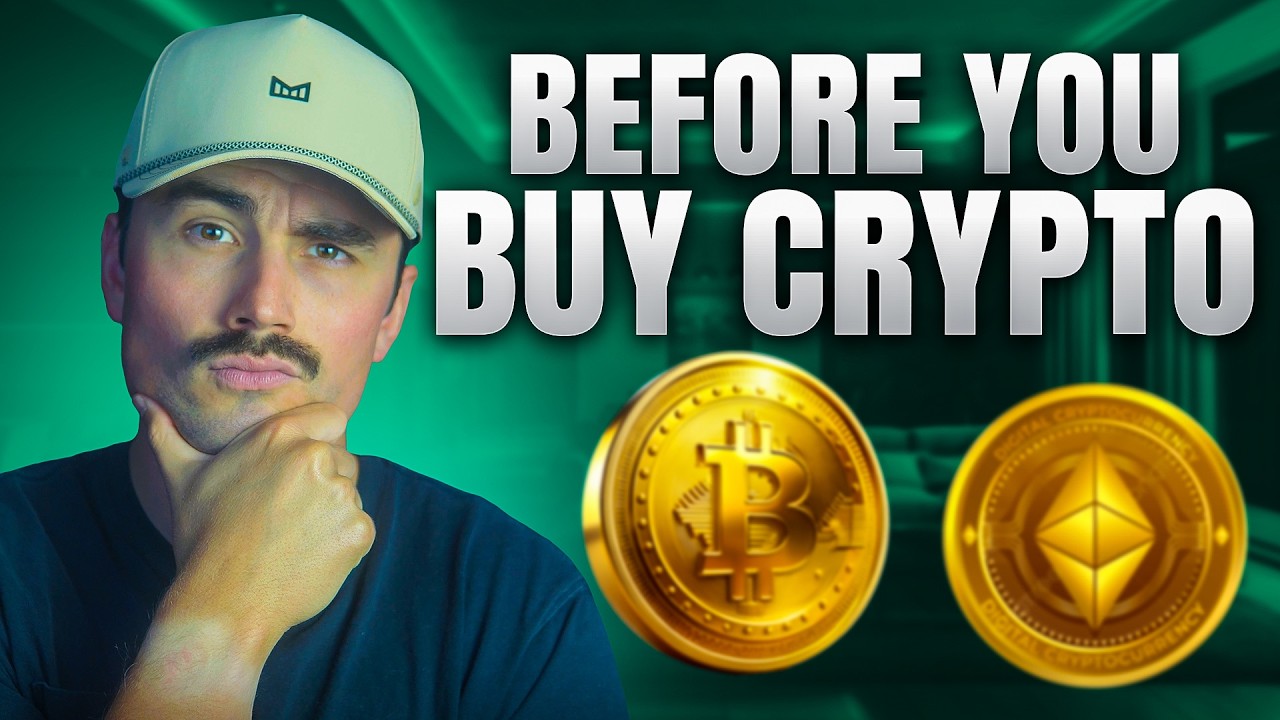
I Finally Bought Crypto: Here s What I Wish Someone Had Told Me First!

- Retorno do vídeo
- —
- Chamadas
- 2
- Compra / Venda
- 2 0
- Publicado
Recomendações
Entrada é o preço de fechamento do ativo na data de publicação. Atual é o último fechamento registrado.
-
Entrada $146,50 03 ago 2026Atual $152,94 07 ago 2026Resultado +$6,44
So, for beginners, I recommend Coinbase.
Contexto "So, for beginners, I recommend Coinbase. It's regulated in the United States."
-
Entrada $63.784,00 03 ago 2026Atual $64.261,00 07 ago 2026Resultado +$477,00
Start with Bitcoin
Contexto "Start with Bitcoin and Ethereum. That's it."
Transcrição Completa
The first week I owned crypto, I checked the price roughly 40 times a day and I'm not exaggerating. I'd open the app at breakfast, close it, open it again by the time I finished my coffee. I had no idea what I'd bought was going to double or go to zero and in truth I barely understood what I'd actually even done. That experience is more common than the crypto crowd will ever admit. Everyone online talks about it like it's obvious. Buy the dip, stack sats, don't be a noob. But for most people who are new to this, it feels like everyone else got a manual that you never received. What's going on everyone? My name is Aaron on Secure and here on this channel we talk about money in a way that actually makes sense. And today I want to walk through everything I wish someone had sat down and told me before I bought my first coin. Not the hype, not the promises, but just the real stuff. Why I kept putting it off. For a long time I had every reason to stay away from crypto. It seemed technical and every time I started reading about it I hit a wall of acronyms and terminology that felt designed to make you feel dumb. People in my life had strong opinions in every direction. My friend swore it was going to zero. My coworker swore it was the future of everything. Neither of them really explained why and underneath all of that was the simplest fear of all. I didn't want to lose money. When you're not dealing with extra cash, every dollar you put somewhere feels like a dollar you can't afford to watch disappear. So I get it if you've been putting this off. The hesitation makes sense. What I found was that the confusion isn't really about crypto being complicated. It's about no one explaining it in plain terms. So let's do that. Picking an exchange you can actually trust. The first decision you make is where to buy. The place where you buy crypto is called an exchange. Think of it like a brokerage account but for digital currencies. There are a lot of them out there and they're not all the same. Some are poorly regulated, some have had serious security problems, some them bankrupt and taken customer money with them. I'm not saying that to scare you. I'm just saying it because picking a trustworthy exchange is the most important decision you'll make in this whole process. So, for beginners, I recommend Coinbase. It's regulated in the United States. It's been around since 2012, and it carries the widest selection of coins, and the interface is clearly designed for people who are new to this. You're not going to feel like you need a finance degree to navigate it. So, if you want to get started with Coinbase and follow along with the video, we've got a link for it down in the description below. Hot wallets and cold wallets. This is the one nobody explains well, so let me try. When you buy crypto, it lives somewhere. Where it lives determines how safe it is, and there are two categories. So, a hot wallet is connected to the internet. The wallet that Coinbase gives you when you create an account is a hot wallet. So is any app on your phone that holds crypto. Hot wallets are convenient and easy to access. The trade-off is that everything connected to the internet can theoretically be hacked. A cold wallet is a physical device, like a USB drive that stores your crypto completely offline. The most well-known brands are Ledger and Trezor. Nothing stored on that device can be touched without the physical hardware in your hands. Cold wallets are the gold standard for security, especially for large amounts. Here's what I'd tell you if you are just starting out. Leaving your crypto on Coinbase while you're learning is fine. The exchange has strong security, insurance coverage for custodial holdings, and two-factor authentication. For your first few months, the priority is understanding what you're doing. Once your holdings grow to a size that feels significant to you, that's the time to look into a hardware wallet. Which coins to start with? This is where people go wrong the most quickly. The crypto market has thousands of coins. Most of them are speculation. Some of them are outright scams. The number of options can push you toward chasing whatever coin everyone's talking about on social media that given week. It's usually a fast way to lose money. Start with Bitcoin and Ethereum. That's it. Bitcoin is the oldest, most established cryptocurrency. It has the longest track record, the deepest liquidity, and the clearest narrative. Ethereum is the second largest and powers most of the decentralized application ecosystem. If you want to understand how crypto actually works as a technology, Ethereum is where that education lives. Every other coin, including the ones with the most hype at any given moment, is a higher risk bet. There are good altcoins out there, but you're not in a position to evaluate them well until you've held Bitcoin or Ethereum through a real market cycle. You need to know what it feels like when something you own drops 40%. How you handle that emotionally tells you a lot about how you should invest going forward. The tax part everyone ignores. Stick with me here because this section will save you a very unpleasant surprise when tax season rolls around. So, a lot of people assume crypto is somehow off the radar for taxes. It is not. The IRS treats cryptocurrency as property, and that has specific consequences you need to understand. Buying crypto and holding it is not a taxable event. Nothing happens on your taxes just because you own it. Selling it is a taxable event. So, every time you sell, that triggers a capital gain or loss. Swapping one coin for another also counts as a taxable event because the IRS treats that as selling the first coin. So, here's where the rate matters. If you held the coin for less than a year before selling, that's a short-term capital gain, and it gets taxed at your normal income rate, anywhere from 10 to 37% depending on your tax bracket. If you held it for more than a year, it becomes a long-term capital gain, which is taxed at 0, 15, or 20%. That difference is significant. Starting in 2026, US exchanges, including Coinbase, are required to issue a form 1099-DA to both you and the IRS for every sale you make. The IRS will know. So, keep records on every transaction. When you bought it, what you paid, when you sold it, and what you received. There are apps that can pull this data but build a habit of tracking it as you go. The habits that protect your money. A few simple habits that matter more than most people realize. Turn on two-factor authentication on your exchange account. This means that even if someone gets your password, they still can't access your account without a second code from your phone. So, do this before you buy anything. Never share your seed phrase with anyone. A seed phrase is a set of words that can be used to recover a wallet. Any message asking you for your seed phrase is a scam. No exceptions. No one legitimate will ever ask for it. Don't keep large amounts of crypto on the exchange long-term. For significant holdings, a hardware wallet is worth the cost. And this is the most important one. Only put in what you'd be okay losing. Crypto is volatile in a way that most traditional investments are not. The potential upside is real. So is the downside. If losing the money you put in would cause you real financial hardship, that's the wrong amount to put in. This isn't pessimism. It's just the honest framing that you deserve before you start. So, if you've been curious about crypto and kept putting it off because it felt confusing or risky, I hope this helped make it feel more approachable. The confusion is real, but it's solvable. The risk is real, but it's manageable if you go in with eyes open. So, start with a trusted exchange. Coinbase is where I'd point you, and again, that link's down in the description if you want to get started. Stick to Bitcoin and Ethereum until you understand what you're holding. Learn the tax rules before your first sale, and never invest more than you can afford to lose. That's the version I wish someone had given me before week one. So, if this kind of money conversation is useful to you, then subscribe to the channel. We talk about money in a way that actually makes sense, and we're here every week. Other than that, thanks so much for watching. Don't forget to like and subscribe, and I'll see you here in the next video. [music] >> [music] [music] >> Oh.
Comentários 0
Entre para participar da discussão.
EntrarAinda não há comentários. Seja o primeiro a compartilhar sua opinião!