it's reasonable to be bullish on memory makers like Micron and SKH Heinix, at least through most of 2027, possibly longer.
Context
I also think that based on what I can see today at this current moment, it's reasonable to be bullish on memory makers like Micron and SKH Heinix, at least through most of 2027, possibly longer.
we think that earnings estimates for future quarters and years are going to go up, you know, probably double digits on the back of that earnings report. You put all that together combined with a stock that's reasonably priced is one of our favorite ideas.
Context
We expect really strong revenue and earnings growth from them when they report in 3 weeks and we think that earnings estimates for future quarters and years are going to go up, you know, probably double digits on the back of that earnings report.
Nvidia still has plenty of runway ahead of it and I think this company will be worth substantially more in future years than it is today.
Context
I seriously think that Nvidia still has plenty of runway ahead of it and I think this company will be worth substantially more in future years than it is today.
Full Transcript
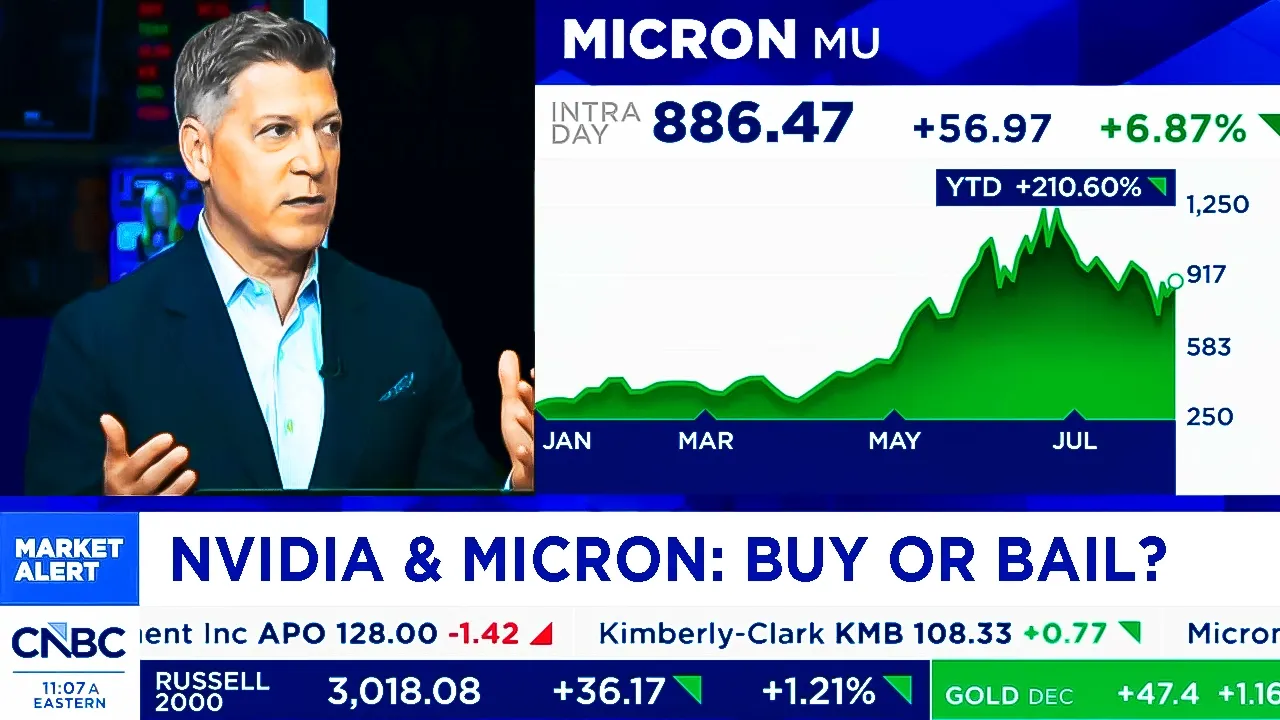
Who's his partner? >> Nvidia. >> Nvidia has an open-source cloud. >> And Nvidia is the leader of the of the open- source movement. >> Yes, they are, right? >> But the real leader is China. >> Well, okay. If you keep the service here, you're fine. I wish that Jensen had said that Jensen >> around the world. It may not be that we can do it here. So, yes, we do have Nvidia's model. Uh, you got reflection AI, private company. I've talked to the CEO here once, Misha Laskin, about that. Uh there's any number of other potential. >> I agree with that. >> Yeah. Okay. >> But this is a real battle, >> right? But I think this what I was saying to Carl, you my invit um this is like you wake up and you say, "Wow, we are really clashing." And uh I hope that you know I does anyone be looking at the the glass piece the Trump draft ban on Chinese. >> Yeah, that that that's but that's not what we're talking about. >> No, but this is against China. I'm saying he's going to see she soon. Um the Chinese all the glass companies coherent uh lummentum uh Marll up be up big is there any chance that that there's some bargaining going on with she where when he when the press gets over there say listen we will let you have Nvidia >> I don't know >> they all want Nvidia >> this is not going over there again >> well no I'm saying when they talk when they talk >> there oh I don't I don't know Jim >> because I think Nvidia is very much in play remember Nvidia was the one that wanted it to open Nvidia is saying listen let's get them on harsh on our hardware software. Let's get them on so we know what they're up to. We failed earlier. Remember Nvidia failed initially. Why is Nvidia so far? Well, okay. Every there a lot of people in favor of open >> but there are a lot this is really good for people are in favor of of open source but this is great for Alex Karp being certainly one of the uh one of the more enthusiastic supporters because it's so important to Palunteer's business as well. >> These are your darling stocks, right? The the semiconductors. What do you think has been nagging the trade lately? Do you think it's just, you know, the the hedge fund for selling the positioning or is there something deeper going on here? >> Well, I think that occasionally in this AI trade, people doubt the rates of return on investment and have this view that, you know, a lot of the bears talk about the bubble just cuz they were alive back then. I guess they're experts in picking this bubble. Um, so, you know, there these things happen. It tends to happen on it seems like every 6 months or so. But yeah, that force selling was was a little nuts. That was something we're scratching our heads like wondering if we needed our heads examined. But also Korea as a whole too is highly levered. Got super volatile. That spooked people. And I think the open model trend really was like had people scratching their heads going, "Hey, what if the margin stack collapses at some of these labs? Does that mean we can't spend?" And I think that created confusion. But this force selling really actually was like the exclamation point creating the opportunity. Now I feel like I have my head back on my shoulders and we're back to normal. Uh semis are ripping and I think they should be. >> Exactly. Micron's up 6%. So that that's your normal your preferred normal. Ben, what but what about the open question that you just raised the the open source trend and what that ultimately means for for semi margins? Well, see, semis win no matter what because token costs are going to collapse more and more and we're going to need more and more infrastructure to drive AI. So, semis over the long term should do great. I mean the infrastructure uh it actually if open models had their way uh and the world had their way that would collapse the margin stack to the infrastructure layer and infrastructure actually gets promoted in importance usage goes up and they should crush uh and then that the clouds will actually wind up doing pretty well there too. However, the worry would be like in between, do we have some kind of blowup because all there's so much compute on the hook from the AI labs and whatnot. So, if their margins are impacted, does that create some kind of hiccup in between? How do we get from point A to point B? What we're seeing right now is that results and checks at OpenAI and Anthropic are actually outstanding. And there's a view which is espoused by Jensen which we've tried to thread that needle and write about as well that there's place for all the models open weights and open as well as closed. Uh that's because there's certain tasks that need certain models and the big thing that's coming now is this model routing capability which we've written extensively about. uh where companies like Microsoft and Amazon are creating these technologies where they write where and and obviously Palunteer where they route the right model to the right task at the right price at the right time securely. So we'll see how it all shakes out but should be great for chips and memory long term. >> Uh that said names like Micron and Ben still in a 29 30% draw down. You think we get back to new highs this year? >> You know we we have a pretty high target. Um, it's almost embarrassing to say how high it is. It's over 2,000. [laughter] Um, >> it got to 1250. >> You know, so the more memory you use, the better AI gets. More memory you use, the better AI gets. Memory makes AI work well. When you have more memory, AI is more enjoyable. It works better. Has longer context context windows. Uh and the the crazy part about it is that we are going to have a boom at the edge. So what's going to happen is a lot of people are going to download these open models and want to use them securely without pinging token costs in the in the cloud and they're going to want to run all this stuff on on devices too which is then going to cause DRAM demand on the edge to go berserk and they already can't get it. So I know there's adding capacity which all hits in like 28 And I'm telling you, the commentary we're going to hear in memory over the next six quarters is going to be pretty darn good. And uh sand SanDisk also is a winner. >> So you think we can avoid that classic cyclical moment where capacity comes online and the cycle rolls? You think that that gets absorbed? >> Look, I mean I mean everybody, you know, see memory got reinvented in 2023 in in when AI happened. I know that there's a lot of people that like to say I know memory. Um um I was around when Micron was, you know, I was in a Micron when they were almost bankrupt. I I remember I visited them with Alpa. I mean, they were dark times in memory, but it sort of got reinvented with AI. So, you got to think a little differently or you got to just kind of amend your thinking a little bit. So, I think memory is an AI chip at least for now. And I think that uh people are getting used to it and uh it'll be real interesting. In fact, there was a there was a development today about high bandwidth flash with SanDisk and SKHEX and they just keep innovating on the tiers. So AI did change the game. Uh and I uh I think people are going to realize that and this creates a good opportunity. Well, besides the the chips, you also cover a lot of these hyperscalers that are spending so much the alphabets and >> and I'm curious, Microsoft, >> Meta, what what did you make of the cop capex commentary as it relates to their stocks, but also some of the chipmakers? >> Let me tell you, Andy Jasse did everybody a favor. He said, "No more breadcrumbs. Let's explain this so the layman can understand how we make a return on AI." and he did everybody a favor and he basically said, "We're going to make a great return on this AI, you know, so all the naysayers, look, AI is tough. A lot of people think they're experts and think they can just talk about ROI and say there's no ROI." They don't know what they're talking about. Andy Jasse invented the frigin cloud. And he basically said, "I'm going to have a trillion dollar business." Well, when he does that trillion dollar business, his free cash flow at a mature state could be as much as, you know, half a trillion dollars. and maybe just a little lower than that. That is that is like unbelievable. That's a huge amount of value. [snorts] Like right there, he basically did a favor for all the semis and said, "I'm going for it. All the other clouds are going to see the same return he does and they're going to go for it." So, I thought the Amazon thing was the best for the cohort. It was great for Amazon stock. It was great for Andy Jasse. But if you're listening closely, ROI equals chip purchases, folks. Yeah. So, you know, that was good. Now, Microsoft had a great quarter beat. It was like they looked at every concern I had and said, "What did what did he say? Okay, let's do that. He's wrong there. He's wrong there. He's wrong there." But, uh, you know, they did a great job. So, >> So, you're not convinced on Microsoft? Sounds like >> Hey, look, you know, sometimes, look, I was right for seven months, wrong for a month. [laughter] Uh, look, I mean, you know, what do you what do you guys want? I mean, they did a great job. It's a good company. I still have concerns about the application layer. I think if I'm anthropic and open AI and I have open models coming, I'm going to attack more of the application layer, not less >> because I have to create value. >> We'll see. But great job, great job for Microsoft management on that call. >> Micron, >> Bank of America is reiterating its buy and a $1,550 price target. They called the recent selloff a buying opportunity. Shares are at $8.92 today. They say they are gaining market share in memory revenue increasing fivefold in the past year. >> That's a trader paradise that kind of volatility but only traders can do it. >> Like if I said in July the socks was down 21%, Sandis was down 46, KLA was down 39, Marll was down 37, Lamb was down 32, and Applied was down 30 and Micron was down 29. You'd say, "Wow." And some did try to say, "Well, maybe we're topping in the AI trade." In fact, what this gentleman at Citadel Securities is saying, no, no, nothing changed structurally about where we are. The story isn't different at all. We've just reset it in a more healthy way. Do you agree? I completely agree. And just to be a little bit more specific, when the markets and particularly the semiconductors were going down throughout most of July, there was, as you said, Scott, this concern that maybe the whole trade was at a top, maybe the market was anticipating peak earnings, peak buildout of AI. And I think that we have not only disproved that by seeing the markets rally, but we've actually given a very cogent explanation for what happened in July. And it was not peak earnings or peak buildout. It was, as you've already mentioned, Scott, the delevering I whoever mentioned it in that note. It's very specific. We saw this two weeks ago with the Cosby and the Korean markets. 1.2 million accounts got margin called then situational awareness. And I want to be clear, I'm not dancing on anybody's graves. I'm not engaging in shot and Friday. I am saying that very infrequently does the market explain itself as crystal clearly as it did with those events explaining what happened in July with those events behind us. Now you look at what Joe Rob and Josh have already said about the earnings growth which is what the market should focus on. It's extraordinary. It shows no sign of easing. And one other positive from last week that I don't think we've mentioned so far is nobody in the capex buildout is blinking. Nobody. I mean these at best I think Microsoft kept its capex plans constant but everybody else is raising them. I mean this is not slowing down anytime soon. >> You you got you got a you got uh 20% of the SMH are back at 20-day highs. That is the highest reading since the end of June. You have uh you have 100% of SMH names are green today. And when you think about where that's come from, you know, it was an artificial sort of like um uh momentum wash out/deleveraging because uh about uh when I look at like the distance below the 52- week highs for the semis at their worst, we were like at a a 25% draw down for the overall group and now we're less than 15% below those old highs on on the entire index. And yeah, we could look at each individual story and pick apart uh this one's guidance, that one's uh chip design, blah blah. The the message of the market here is exactly what Jim is talking about. You just had people going absolutely crazy with 2x single stock ETFs in the semis. The Koreans lost their minds. And then you had a couple of hedge funds that were riding this thing like it would never have a down day. Once you clear that out, you could focus once again on the actual results these companies are delivering and they probably didn't belong 25% from their highs based on that fundamental outlook. >> So SK high speaking of Korea and chips and momentum bunch of bullish initiations uh today 240 at Stiffel outperform at Blair. Uh we're going for four straight up days on the SMH. Marll is surging along with many of the other optical receiver names on a report of a potential China import ban around data center u uh receivers. So look at that stock right there. You have that uh Corning is up big. >> I want to I want to talk about this because this is the only area that I'm really concerned about right now. Not the end but this s sort of financing part of this thing, right? And now we come up with these scenarios. You got closed models, a hybrid perhaps and open models. And this is a great piece by Morgan Stanley thinking of showing the biggest beneficiaries and other beneficiaries for the audience. Cloud makes money either way. Cyber security makes money on-site providers neocloud they all make money. But h how do you see this shaking out? In other words, will there be will we end up with a closed model, open model or hybrid? >> Yeah, good question. Particularly the financing, Charles, and I think is what you're talking about. And while we should continue to keep an eye on them using the bond markets to finance themselves, do you realize that there's only about one turn of leverage on some of these companies? Microsoft, for example, has a higher rating than the US government, right? So you're talking about financing, yes, but the average company has about two turns of leverage that they finance and these companies are nowhere near that. >> So on that note, I know you see capex, it's going to continue. Yeah. >> Right. and and across all scenarios. Uh uh so so with that in mind is it time to start looking when we think about hyperscalers for instance right uh and I think one of the reasons they're turning is people now believe there will be a return on invested capital will be ROI and you can see it here with the backlogs >> backlogs so but you like you like the semis it seems like in your notes a little bit more than the hyperscalers >> yeah the semis is something that we continue to like Charles and I you know if you look at la last month July there was a complete dislocation between the fundamental story of these companies and you mentioned the e-word earnings right so it was the worst performing sectors towards the end of the month all had positive earnings revisions right you're talking about industrials you're talking about tech you're talking about communication services all of these sectors had positive earnings revisions which by far is the biggest reason to buy a sector >> so I've got that table up here this is the nonsense on global scale but again to your point folks the dark blue are your 12 month forward earnings they've they've actually not been factored, they've been negatively factored when technology, comm services, and you also like industrials. You think this can start to change and that's one of the reasons you like those sectors. >> Yeah, 100%. And and at the end of the day, Charles, we're just getting started on this trade. Like you were talking about people are focused on when the end is. We're not even getting started. We write about the AI theme and the productivity boom as the third industrial revolution behind the industrial revolution, the internet, and now the AI theme. We write about it over the next three to five years as an important theme. We write about it over the next 10 to 15 years as a theme. Yeah. Companies are spending on capex, but the adoption isn't happening. >> Right. Right. Been a talk of town since July. Semiconductors taking it on the chin. You can look at the chart here, right? And see uh even though we're making a series of lower highs, we're not out of the woods yet. Although I will note when RSI relative strength has gotten to a certain level, it's been oversold. In the past, it's come back. Uh, of course, individual names inside of this, if you think that's bad, forget about it. Some of the names inside of this have been absolutely shellacked. Now, my next guest, I think, is the best on the street when it comes to covering these names. I want to bring in Angelo Zeno. He's CFR uh equity analyst, senior vice president. Angelo, I just first, let's talk about, you know, what's why did this happen? You know, with the first guest today said there was just a major dislocation and he likes the semis here. >> Yeah, Charles, thanks for having me. You know, I'd say for the most part, the reason it happened was, listen, this is a momentum area or was a momentum area for a couple of months. It got maybe a little bit too overheated. Um, we're talking about potentially peak growth rates in terms of Q2, at least that was our view. Um, so the multiples had to come in a little bit. Um, we saw a sell off. Obviously, we we saw kind of, you know, some force selling out there that probably accelerated the the multiple compression quicker than we anticipated. But now that we have it, um we do think this is actually a great time to to be looking at some of those beaten down names that still have great stories ahead of themselves here over the next couple years. >> Let's talk about that. I mean, this is just uh from the 52- week high uh anywhere from down just 7% which is the best Google, but some of these names are down 39% 43%. It's just it's just a lot of carnage out there. Is this normal discovery or was it to your point just a momentum trade and a lot of fast money coming in and out? >> Yeah, I think it it was probably the latter. Um you do get you know do you get normal periods in terms of tech wrecks every single year, right? I mean we saw um semiconductors essentially pull back 35 to 40% last year clearly on the tariff fears. We saw it actually happen in 20 off the June 24 lows as well. So investors to some extent if you've been investing in semis here for you know the last couple of years you're somewhat used to some of this volatility but yeah I mean what we've seen here over the last couple of years I'd say kind of tops the cake. >> You know we're always used to until we hit it again like oh boy here we go. Let's talk about some of your strong buys. Uh Nvidia is one of them. Uh you know listen it's it's one of these names that it's hold it holds up but the stock doesn't seem to reflect just how amazing and how influential this company is. What gets it to move? But it'll be maybe the next earnings report. >> I'm hoping it's the next earnings report, right? I think this is going to be a really important one because you've now got um you know uh Vera Rubin actually starting to ramp. Um it's going to be in the guidance numbers. It's going to be I think a big contributor and you I think you'll see a nice beat and raise from Nvidia when they [clears throat] report in late August. So the hope here is um you know this at at the multiples it's trading at only about 12 13 times our calendar 28 estimate. It's a It's an ultra cheap stock and if you can kind of get some nice another nice beat here this quarter, I think that should be enough here with this new cycle ramping. >> Last week's blowout earnings really reinforce one of our long-term themes, >> which is cloud demand exceeds supply and will continue to exceed supply for at least another year, year and a half. Secondly, we all talk there's questions about the return on this cloud investment, the capex, the large amounts. If you look at operating earnings, funds from operations, which we call OCF, and look at it over the next 12 months for the large hyperscalers Amazon Google uh and uh, Amazon, Google, and Microsoft. >> Microsoft. Yeah, slipped there. Okay. >> All right. >> They're they're expected to generate 210 to 200. Yeah, that's Google. Okay. 210 to$250 billion in operating cash flow next year. If you go back 3 years and look at what they were generating, it's up anywhere from 110 to 140% in 3 years. So, if we're looking for a return on that massive capex investment, look at the operating cash flows. They're growing dramatically. And that's what we should be focusing on as a return on that massive capex investment. You also like Nvidia and it's interesting because this actually ties back to SpaceX because I was looking at some uh headlines here on SpaceX and actually they're just inking a deal with they're partnering with Nvidia. SpaceX SpaceX is designing the Star Mind A 11 I believe satellite compute payload. Uh but Nvidia is one of your picks. >> Yeah, we think Nvidia's business is growing at a at a really an incredible rate. investors have been so excited really year-to- date to invest in these areas of shortage within the data center capex um beneficiary group. Um Nvidia isn't one of those. Nvidia is not an an AMD or a or a Micron that's benefiting from shortages, but they just have persistently strong demand and their innovation is what's made this accelerating accelerated computing cycle possible. We expect really strong um revenue and earnings growth from them when they report in 3 weeks and we think that earnings estimates for future quarters and years are going to go up, you know, probably double digits on the back of that earnings report. You put all that together combined with a stock that's reasonably priced is one of our favorite ideas. Sorry to keep going. >> That's interesting. No, no, no. We've got some bells that we're about to ring here. Uh but no, certainly an interesting perspective on Nvidia from you. Thank you very much. >> Can the Helio stack actually chip away at at Nvidia and its position in the market? Well, be be careful about chip away. Like, are are they taking share? Are they growing? Sure. I mean, they're going from not very much to hopefully a lot. At the same time, it's not like Nvidia and frankly like everybody is isn't growing. I I mean, and I think I've said this here a number of times, but I still feel like the the right question is not so much who's winning or losing. It is the opportunity still big or is it not? I I think if it's big, everybody should be doing great. And frankly, that's what we've been seeing right now. But I do think there is an opportunity for AMD here to go from what's been, you know, good results, but still, you know, not where they could be to having a real inflection as as the Mi450 and the Helios rack starts starts to ramp into next year. >> So, as we see Intel and AMD compete on the on the server CPU side, Stacy, you're saying it doesn't really matter like there's enough demand at this point where all the boats will will rise. >> Well, so those comments I just made were on on the GPU side. On the CPU side, I demand is is so strong. Everybody's just shipping everything that they can possibly make. And you take Intel for example, in Intel by their own admission, their products right now are not are not as competitive as they want them to be. Um, it doesn't matter. Like customers are buying them anyways. A couple quarters ago, they they actually had oh 200 basis points of margin upside because they sold previously written off products, stuff that they didn't think that anybody would want to buy, so they wrote them off. Customers said, "We don't care. We'll take them." That's that's how strong demand has been. And I would say AMD actually has products that people actually want to buy. [laughter] So I'd expect that to be pretty good for them. >> All right, I hope you're all doing well today and staying calm in this market. Today was a very positive day throughout the market with tech hardware stocks trading solidly higher. Tensions appear to have eased in the Middle East, at least for now, as oil traded lower. It also appears that sentiment may be rebuilding after the flush out into leveraging we saw in many tech hardware stocks in July. We got a few pieces of Nvidia news on Tuesday. First, it was reported that Nvidia Volulta announced a $300 million funding round at a $2.4 billion valuation. They also announced a $10 billion compute partnership with Anthropic. As a reminder, back in July, Morgan Stanley spoke with Nvidia executives and said that Nvidia is rapidly gaining comput share at Anthropic. They didn't address Anthropic by name, but it was obvious that they were talking about Anthropic. Also, Tuesday evening on SpaceX's earnings call, leadership made comments that are very positive for both Nvidia and memory stocks. First, Elon Musk said, quote, "Going forward, we've decided to build exclusively on Nvidia because we think the Vera Rubin architecture is the best architecture. We think it's the best AI computer, and we greatly value our close cooperation and partnership on many levels with Nvidia. We're exclusive to Nvidia. That is the main reason why Nvidia traded higher Tuesday evening during after hours." Later in the call, Elon added to that by saying, quote, "Our understanding with Nvidia is that we will receive a very significant percentage of their GPUs next year. All of that is very positive for Nvidia. We're essentially talking about SpaceX being another major hypers scale customer for Nvidia. And in contrast to the other hypers scale customers, SpaceX, based on Elon's comments, will be exclusively building on Nvidia's architecture going forward. That is very positive for Nvidia. Hopefully, that will help calm some investors concerns about rising competition and market share. As I keep saying, now is not the time for Nvidia investors to be worried about market share. Elon also made some very bullish comments about memory on the earnings call by saying, quote, "Look at the rate at which logic and memory is being produced. One must always consider the limiting factor here. Limiting factor currently is memory. The memory output is increasing by around 20% per year. Now, normally that would be fantastically fast and amazing for any large mature industry. Ask yourself, is the demand increasing by 20% a year? No. The demand is increasing by 200% a year, maybe higher. If you have got demand increasing much faster than supply, economics 101 would suggest that the price increases. It does not decrease. Overall, SpaceX's earnings call was very positive for AI infrastructure and AI demand. Also on Tuesday, Reuters published a report saying that the administration is drafting a ban on US imports of new Chinese optical transceivers. This caused stocks like Lmentum and Coherent to trade higher on the news. I went back and looked at the chart at the time the news came out, and it looks like this news also helped lift Micron shares Tuesday morning in pre-market. Just a couple weeks ago, the Wall Street Journal reported that Micron executives lobbyed the administration to block Apple's plan to purchase memory from China's CXMT and YMTC, arguing that it could devastate the domestic memory industry in the US, similar to what happened in other industries such as steel. Given that context, Reuters reporting Tuesday morning that the administration is drafting a ban on new Chinese optical transceivers is especially relevant to Micron stock as market participants wonder if perhaps the administration will take it a step further and honor Micron's request by preventing US companies from purchasing Chinese memory. I don't know if that will happen or not. I'm just explaining market participants rationale as it relates to the news we got on Tuesday. This is also especially relevant because there's been a lot of news recently about China's CXMT working to expand memory capacity. In fact, just yesterday, Reuters reported that CXMT plans to build a second new FAB in Beijing. If US companies were banned from purchasing Chinese memory, that would be perceived by market participants as being positive for incumbent memory makers Micron Samsung and SKHix. It's also important to consider that the presidents of both countries are scheduled to meet in September. So perhaps this is a situation of the administration trying to gain additional leverage ahead of that meeting. We have to keep in mind that geopolitics are involved in this situation. In other news, I noticed Counterpoint Research mentioned that Micron's overall DRAM revenue share rose to 25% and that Micron could soon overtake SKH for second place as they gain market share. VC Arya's team at Bank of America reinforced their bullish view on Micron citing high GPU to HBM utilization, hyperscaler spending, LTAs, and limited competition from China CXMT in advanced AI memory. As I've said previously, I expect the world to be compute constrained at least through the first half of calendar 2028, possibly longer. I also think that based on what I can see today at this current moment, it's reasonable to be bullish on memory makers like Micron and SKH Heinix, at least through most of 2027, possibly longer depending on what happens. As time goes on and we gradually gain greater visibility into the future, I will have to adjust those time frames, whether that means extending them out further or shortening them. Now, in case you're new to the channel, I want to make sure that you have at least a basic understanding of the underlying long-term thesis. So, let's cover that. Now, I don't know what's going to happen in the short term, but from a long-term perspective, I am very confident that Nvidia will be worth much more in future years than it is today. When Jensen was on the Lex Freedman podcast not that long ago, he was very seriously raising the possibility of Nvidia becoming a $3 trillion revenue company in the near future. If that happens in the coming years, then it is very plausible that Nvidia could one day be worth tens of trillions of dollars in market cap. That might sound crazy, but that's what Jensen is implying when he raises the possibility of Nvidia becoming a $3 trillion revenue company. I guess the question at that point is what multiple the street will be willing to give Nvidia. I don't know the answer to that question, but I truly do think that Nvidia will be worth much more in future years than it is today based purely on the fundamental growth of the business. Based on everything I'm seeing, the world is still computed and I expect that to continue at least through the first half of calendar 2028. In a computed environment, developers will use whatever viable compute they can get their hands on. Today, there are no GPUs that are sitting dark due to a lack of demand. Like there was fiber sitting dark due to a lack of demand at the height of the dotcom bubble. Back then, companies were laying fiber in the hopes that use cases and demand would eventually show up. Today, we are seeing the complete opposite. As I've said many times, when market participants compare this AI revolution to the dotcom bubble, they ignore the fact that the internet is already here this time. This means that mass adoption of the technology and new use case development at scale are immediately possible. We don't have to wait years for it to show up. It's already here. The world is compute constrained which means there is not enough supply to satisfy demand. New capacity is utilized as soon as it comes online. The hyperscalers are monetizing capacity as soon as it comes online. Each of the hyperscalers spoke about being supply constrained on their most recent earnings calls. Additionally, many of the clouds are building out into contracted demand. They're not blindly building in the hopes that demand will eventually show up. No, they're building out because they have signed contracts and in some cases significant prepayments from their paying customers. This AI revolution is fundamentally different from the dotcom bubble and 2026 will be a pivotal year for the AI industry thanks to the rapid adoption of agentic AI and the proliferation of agentic systems in the world's leading enterprises. The leading AI labs revenues are surging right now. Agentic coding and the implementation of agentic systems in large enterprises are new use cases that are increasing inference demand significantly that subsequently is increasing compute demand. The rapid adoption of agentic AI is why we're seeing an inflection in inference demand. It's why we're seeing the leading AI labs revenue surge. I wish both Anthropic and Open AAI were public so the public could see the ramp in their revenues. Anthropics ARR has surpassed $47 billion, up from $9 billion just at the end of 2025. Open AI is growing rapidly as well. I think the leading labs surging revenues may be the initial proof point that grabs market participants attention and causes them to realize that there will be a clear ROI on AI infrastructure. I think the leading labs surging revenues will also help assure investors of the longevity of Nvidia's growth since these labs revenues are directly tied to compute. If they had more compute, they would have greater revenues. It really is that simple. Demand is not the problem. The problem is a lack of supply to meet the demand. As I've said previously, I expect the world to be compute constrained at least through the first half of 2028, possibly longer. And so regardless of what happens in the short term, it's important for long-term investors to remain focused on the fundamentals, maintain a long-term perspective, and remember that we are only in the early stages of aic systems being adopted at scale. This will increase compute demand significantly. And after that, the next surge in compute demand will likely be fueled by physical AI. We're no longer talking about digital agents performing digital tasks. With physical AI, we're talking about physical AI agents performing physical tasks in the real world. Nvidia CFO has called physical AI quote a multi-t trillion dollar opportunity and the next leg of growth for Nvidia. This industry will fundamentally transform society and Nvidia has positioned themselves to benefit massively. Nvidia sells the hardware for the data centers where the models are trained. They offer omniverse where the models are taught and tested and Nvidia also sells the hardware that allows ondevice real-time inference through NVIDIA AGX allowing robots to have intelligent interactions with the real world even when they are not connected to a data center. Notice that Nvidia is taking a holistic platform approach to physical AI and they're embedding themselves as the underlying foundation supporting all of it. Over 2 million developers are already building on the Nvidia robotic stack and this is not getting enough attention. As for production ramps, Blackwell Ultra has ramped quickly and remains in high demand. Reuben is on track to launch in 2026. Then we're expecting Nvidia Gro 3 LPX in the second half of 2026. Later on, we're expecting the launch of Reuben Ultra in 2027 and Fineman after that in 2028. We have a clear data center product roadmap stretching into 2028. And Jensen believes that AI infrastructure spending will reach three to$4 trillion annually by the end of the decade. That means Jensen is expecting growing AI demand and an expanding total addressable market underpinning all of this. I don't think we are anywhere near any type of bubble bursting type of event. With all of this in mind, I seriously think that Nvidia still has plenty of runway ahead of it and I think this company will be worth substantially more in future years than it is today. At least that's my view of the situation. Quick note before I wrap up. All of the compilations on this channel are edited by Finn Vid with original structure and commentary. Occasionally, the same edits appear elsewhere on YouTube. If you're looking for the original version, it's always here on this channel. Thanks for watching, Finn Vid. I appreciate your support. Remember to stay calm in this market. Remember to maintain a long-term perspective and do not make any hasty or irrational decisions. With all of that being said, I hope you all have a great rest of the day. And I'm curious to hear your thoughts about Nvidia in the comments below. Please leave a like on this video so more people will see it. And while you're down there, please consider subscribing. It's free and you can always change your mind.

Comments 0
Sign in to join the discussion.
Sign inNo comments yet. Be the first to share your thoughts!