
- Video return
- +2.99%
- Calls
- 3
- Buy / Sell
- 0 3
- Published
Recommendations
Entry is the asset's closing price on the publication date. Current is the last close on record.
-
Entry $149.89 05 Aug 2026Current $145.41 06 Aug 2026Result +$4.48
Mizuo cuts target to $45 on the 31st of July, saying the Clarity Act is unlikely to pass this year because there are too many unresolved issues.
-
Entry $149.89 05 Aug 2026Current $145.41 06 Aug 2026Result +$4.48
Morgan Stanley took it to a street low $38.
-
Entry $149.89 05 Aug 2026Current $145.41 06 Aug 2026Result +$4.48
Bernstein warned a delay could trigger another knee-jerk sell-off.
Full Transcript
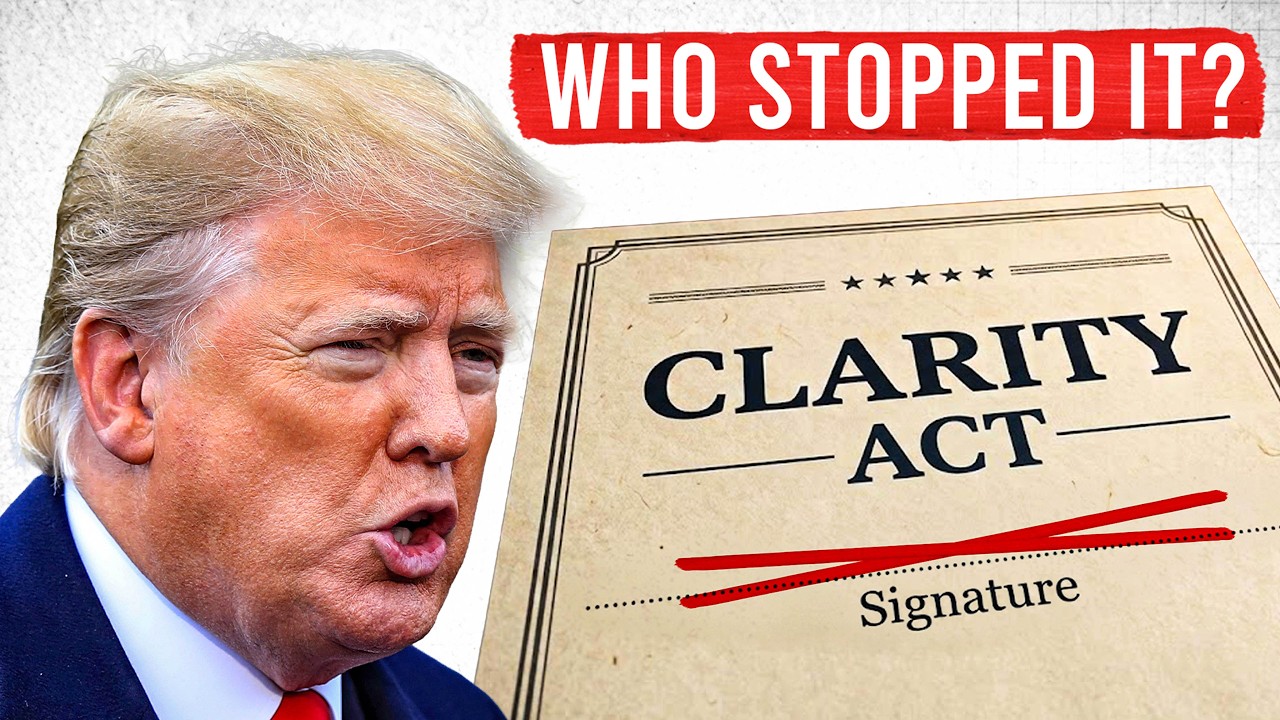
If you log on to crypto Twitter right now, you'll see people arguing about how the banks are killing the Clarity Act or stressing over senators squabbbling and running out of time to get this bill passed. But the focus should be elsewhere because one document has been sitting on the White House desk since the 30th of July, and nobody in that building, including [music] the so-called crypto president himself, has addressed it. And since it landed, the Clarity Act has not appeared on the Senate floor orders a single time. Meanwhile, a Senate Banking Committee Minority Report recently put the Trump family's 2025 crypto income at about $1.4 billion. And the document sitting unanswered on Trump's desk is the one clause in the entire [music] bill that would touch it. Gridlock, Wall Street, Elizabeth Warren, none of them are blocking [music] this bill. It comes down to a single missing signature. So today we're going to look at exactly what's in that document, why the silence around it is so telling and what it'll cost the industry when the music stops in November. My name is Guy and this is the Coin Bureau. Now to understand why one piece of paper is holding up the Clarity Act, we have to look at what it actually says. On the 30th of July, Senators Tom Tillis and Ruben Galgo sent the White House a compromise on the ethics title of the Clarity Act. We're not talking about an overhaul of the whole bill, just one title. And what it does is fairly simple. Federal officials and their spouses would be barred from issuing or sponsoring digital assets while in office with enforcement handed to the attorney general. Reporting also suggests the compromise adds a backs stop letting state attorneys general sue the justice department if it declines to act modeled on the Lake Riley act. That backs stop exists because Galgo had already dismissed an earlier Republican draft as not a serious effort on the grounds that DOJon enforcement wasn't strong enough. So this was the fix and the response from the White House was well nothing. no comment at all through the weekend and into this week. Meanwhile, Majority Leader John Ton told reporters he still expected a vote, but conceded he wasn't sure they could get on the bill. Tom Tillis, one of the two authors, said the sides were not quite there. And today was the ordinary rule 22 window. That's the Senate's clo rule. Put simply, a motion filed today is the last that can clear the waiting period before the August recess. No motion was filed, so the window is shut. And the prediction markets have been adjusting the odds accordingly. Poly market had the Clarity Act passing in 2026 near 80% back in February. By this week, though, it's been trading between 27 and 37%. Now, why would a White House that has spent 18 months branding itself as the most pro- crypto administration in history sit on a bill it says it wants? Well, let's revise the numbers for a second. The Office of Government Ethics released the president's 2025 financial disclosure on the 30th of June. Senate Banking's minority staff read it and published their figures on the 22nd of July. almost $800 million tied to World Liberty Financial, $636 million from the Trump memecoin, and total crypto income of more than $1.4 billion in a single year. That's roughly 23 of the president's reported income for the year, and by the committee's reckoning, more than any publicly traded American crypto company earned in the same period. spokesperson Anna Kelly says the president's assets sit in fully discretionary accounts run by independent third parties, that he was a successful businessman long before taking office, and that there are no conflicts of interest. She also pointed out that the ethics restrictions would bind the vice president, lawmakers, and their spouses too, not just one family. But then on the 4th of August, Senators Warren and Blumenntal wrote to SEC Chair Paul Atkins asking him to investigate whether the Trump token amounted to an illegal scam or what they called a soft rugpull. The letter even cites Nansen data reported by the New York Times. Nearly 1 million wallets, an estimated $3.8 8 billion in losses on a token that peaked near a $9 billion market cap the day before the inauguration and has since fallen roughly 97%. And in fairness, the SEC's February 2025 guidance says memecoins generally aren't securities. And blockchain analytics firm TRM Labs concluded back in January 2025 that the token didn't show the hallmarks of a traditional rugpull. So, this probe may go nowhere, but that's not really the point. The issue here is what it does to the temperature in the room while senators are being asked to take a vote. So, here's what we're dealing with. The industry finally got to write its own rule book. And the single clause it cannot get into that rule book is the one that touches the family earning the most from the industry it governs. So, in a weird way, this is like regulatory capture running in reverse. Now, keeping track of a bill that changes every 48 hours and countless crypto assets repricing as a result is a tall order. So, we made it easier for you. Right here on YouTube, you can join the Coin Bureau Club light plan for just $10 a month. You get daily updates across crypto and tradi. Our dedicated teams read on the best opportunities in the markets and none of the filler. So, just tap the join button below this video to get started. Right, back to the vote. Now, there are 53 Republicans in the Senate. Cloer needs 60. So, that's a gap of exactly seven. And there are exactly seven Democrats at the table. Cortez, Masto, Booker, Hickinlooper Warner Waro Oserbrooks and Galgo. They issued a joint statement on the 22nd of July saying the Republican ethics language falls short. So the entire bill now rests on a block whose price is one title and it's the title the White House won't clear. And while that sits there, Treasury Secretary Scott Bessant went on X on the 30th of July to publicly demand a vote, invoking [clears throat] Satoshi and accusing Senate Democrats of stalling out of fear. That is quite something. The Treasury is publicly begging for a bill the president is privately sitting on. Now, despite Trump sitting on this contentious element of the Clarity Act, some people are still blaming Wall Street for stalling things. But on the 28th of July, Black Rockck, Fidelity, Franklin Templeton, Goldman Sachs, and Sofi all publicly endorsed the merged text. Goldman's David Solomon called it imperfect but supportive of a level playing field. Franklin Templeton, with $1.79 trillion under management, said that it's time to give the industry the clarity it needs. So, Wall Street isn't the blocker. The other sector people love to point the finger at is the community banks. That fight was no joke, and it was over section 404, the provision banning yield on payment stable coins. The ABA, the ICBA, and 76 state banking associations want one word changed. Meanwhile, America's credit unions warn $6.6 trillion in deposits is exposed. But ABA Chief Rob Nichols said on the 29th of July that the bill has a lot of good in it and he's after small surgical targeted fixes. That sounds like someone negotiating, not blocking. And bleeding out underneath all of this is section 604, the developer shield that says non-custodial coders, validators, and node operators aren't money transmitters. The National Sheriff's Association wants it gone. Ron Weiden wants it kept. Cortez Masto and Warner have tied their votes to law enforcement signing off on it, but nobody's watching that one because everybody's either watching the clock or watching the Bitcoin chart. Over the last month, Bitcoin has gone precisely nowhere, chopping away relentlessly. Meanwhile, the S&P is up 2.63% over the same stretch. Coinbase is down over 10%. Circle is down nearly 8%. You can view that divergence in performance as a legislative risk premium and anyone holding crypto exposure is paying it right now. Mizuo cuts target to $45 on the 31st of July, saying the Clarity Act is unlikely to pass this year because there are too many unresolved issues. Morgan Stanley took it to a street low $38. Bernstein warned a delay could trigger another knee-jerk sell-off. But while investors are paying the price for Washington's delay, the crypto industry is preparing to make politicians pay for it. Crypto super PAC Fairshake said its allies are sitting on close to $200 million heading into the November midterms. They have gone 38 and2 in congressional races this cycle and say they will score every senator's vote on this bill. Cynthia Lumis, the Clarity Act's major champion, isn't seeking reelection and is gone in January 2027. And she's warned that if this doesn't pass in 2026, it may not come back around this decade. So, the banks, the Senate calendar, and Elizabeth Warren are convenient excuses, but they didn't stop this bill. An unanswered one-page compromise and a $1.4 billion conflict of interest did. But on the plus side, politicians are no longer debating whether crypto needs a regulatory framework. Crypto was once politically untouchable. Now, politicians are mostly arguing over the details. And what's more, the SEC's project crypto will build most of the regulatory infrastructure the industry needs. Granted, those rules could be reversed when a new administration takes office, but it's good enough for now. In any case, clarity for crypto in the US will come. It's just a matter of time. But what do you think? Will the Clarity Act somehow squeeze through before the summer recess? Or will crypto have to wait much longer for a proper regulatory framework to be written into law. Let us know down below. And if you want to understand what the SEC is building while Congress argues, then definitely check out our breakdown of Project Crypto right over here. Okay. Thank you all so much for watching and I'll see you again very soon. This is Guy signing off.
Comments 0
Sign in to join the discussion.
Sign inNo comments yet. Be the first to share your thoughts!