
- Video return
- +3.42%
- Calls
- 4
- Buy / Sell
- 4 0
- Published
Recommendations
Entry is the asset's closing price on the publication date. Current is the last close on record.
-
Entry $70.47 06 Aug 2026Current $75.02 07 Aug 2026Result +$4.55
I think this one's going back to $100 per share. It'll only take a matter of time.
-
Entry $213.26 06 Aug 2026Current $216.26 07 Aug 2026Result +$3.00
I am investing in what I believe is the next iteration of convenience across the US economy.
-
Entry $122.58 06 Aug 2026Current $130.90 07 Aug 2026Result +$8.32
For that reason, I'm staying in the stock and I'll continue to as long as they continue posting results like this.
-
Entry $357.75 06 Aug 2026Current $354.30 07 Aug 2026Result −$3.45
I believe investors have it wrong when they look at departures like this and believe that that means you should become negative on Google or view it as a big bearish point.
Full Transcript
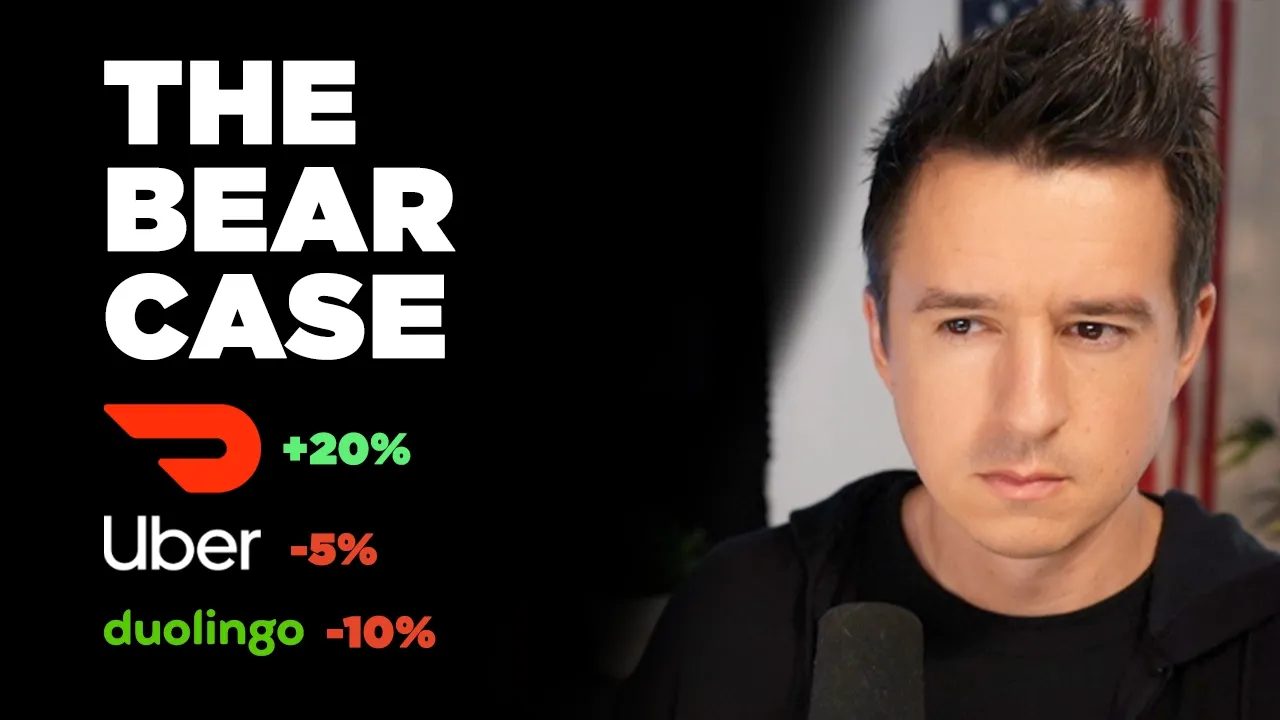
Welcome back everyone to the Joseph Carlson show. We've had a busy earnings week. We had Uber, Door Dash, and Duelingo all report their earnings. These are all stocks that I own. Some of them are up, some of them are down. We're going to be going through them. Not only what's going on with the stock and the fundamentals, but we'll also be going through the bare case for each of them and my take on the bare case because I believe bears have it wrong. They often do, but in this case, I think it's proven wrong in the numbers itself. Google is having a bit of a shakeup. some major AI figures are leaving the company. A lot of investors are bearish on Google because of this and I believe they're wrong here. We'll be going over why. And then we have the fail of the week, which in this case, I must highlight BMW. BMW thought it was a good idea to plug in a Spider-Man ad for the new Spider-Man movie in the console of their vehicles. We'll be going over the entire thing in the fail of the week of this episode. So, we have a ton to get to. Let's go ahead and jump in. Now, before we even get started, if you're saying, "Hey, Joseph, I love investing content. I love talking about stocks. Well, we have more exclusive content in the qualum.com membership. You can join at $10 a month that comes with a free trial. It's very easy to sign up and it gives you access to hundreds of exclusive videos. You gain access to a moderated exclusive investor community full of tens of thousands of investors as well as you gain access to Qualram's website which has all the stock analysis software that we've been working on. All of that included in the same membership. Try it out at qualrim.com. Now, let's go ahead and start off. First of all, we can look at my portfolios. I own three of the companies that we'll be talking about today. I have a holding in Door Dash, Uber, and I have in the Story Fund, which is my more aggressive growth centered portfolio, Dualingo. So, I have a holding in all three of these companies, but you'll also notice just by looking at it that I hold a number of other companies. I also have Amazon, Netflix, I have a lot of Google and Microsoft. I really like the big four capex spender companies. I like Mastercard and I've had some OG companies like Costco and Texas Roadhouse in the portfolio for a long time. Those ones have been some of my best investments. So when we look overall, my portfolio is a mixture of the big four tech companies. Google, Microsoft, Amazon, and Meta. Those four in particular, I don't own any Tesla. I don't own Nvidia. I don't own any Micron or any of those that are also in the index. So there's a number of companies that I don't own, but I do have a big concentration in these companies that I believe have massive distribution. And you'll notice that distribution is the name of the game. That is what I like owning. Most of the companies that I've made a lot of money on, they just have a massive customer base. They have massive amounts of distribution and they have annuity- like income streams. With Google, they have billions of users every day on multiple apps all across their platform. Microsoft, of course, has the biggest distribution in the S&P 500 with the Microsoft bundle. Meta has 3.6 billion daily active users. one of the biggest distribution networks in the world. We have Amazon which has distribution everywhere through AWS, through their retail and logistics, their Amazon Prime membership and so on. So these companies win by owning a huge outlet to customers. And with these companies, it's no different. I view Door Dash and Uber as companies that are massive networks. They have massive amounts of distribution. They have a growing number of daily users on their platforms and they have embedded inside subscription businesses. And with Dualingo, this is no different. Duelingo has over 50 million daily active users. They have even more monthly active users. The company has a growing amount of distribution on a digital platform. So, these are companies that I'm very attracted to. Not all of them will do great, but I believe the huge majority of them will over a long period of time. And three of these companies just gave us an update on their earnings. Let's go ahead and start off with Uber. When we look at Uber's fundamentals, they're not flat. They are growing substantially. For example, if we look at some of the key fundamentals here, we can look at the trailing 12 months revenue. It grew by 16.7% which is pretty fast. That's in the upper echelon of companies in terms of growth in the S&P 500. It's about twice as fast as the average company grows in the S&P 500. So Uber would still be a very fast growing company. Now if we look at the monthly active users on the platform, they also reported an increase in that by 15 a.5% year-over-year. It reached an all-time high of 208 million. We have the number of trips. the trips in Uber continue to look like a straight line. One thing that I've looked at with Uber, which is I believe the primary bare case for this company. So the thing that people are the most worried about with Uber is Whimo, is Tesla, is Zuks, it's any other AV company that's directly competing with them and taking market share from them. And the biggest competitor right now is Whimo. I have about $220,000 invested in Google. So big position in this one. It's my largest position. And I have huge respect for Whimo and what they've accomplished. Whimo is the real deal. They're really conducting an incredible robo taxi experience. They have the app, the Whimo app, which has five-star reviews with over a million reviews. They have people using Whimo every single day. In fact, the numbers are pretty substantial. Whimo does around 500,000 weekly rides. Now, it might be up to around 550,000 at this point because they're continually growing, but it's in that range. Whimo does on average around 500,000 weekly paid trips. Now again, this is the big bear case. Whimo is the biggest bare case for Uber along with these other companies that are developing their own robo taxi network. That's what's causing Uber to have multiple compression for the stock price to go down despite the fact that they're growing earnings and revenue so quickly. But I think it's important to put it in context here. As much respect as I have for Whimo and as heavily invested as I am in Google, which is far more than Uber, I believe that investors have this bare case wrong. When you look at the scale that Uber operates at, I believe it paints a very different picture. For example, when we look at the scale of Whimo compared to Uber today, Uber is approximately by the number of rides they do, 595 times bigger than Whimo. And just the increase from here, the same quarter last year, to here is 92 times the size of Whimo currently. Now, this isn't to say that Whimo will never present a threat or it isn't important, but it just shows that Uber has a ton of time. It's going to take a very long time before Whimo represents a meaningful amount of market share taken from Uber. And by that time, it's highly likely that Uber will have a lot of its own AVs and robo taxis and things in its network as well. And in most cases, the dominant network aggregator, the company that controls the dominant network, they continue to get bigger and bigger, like we're seeing with Uber. The monthly active users increased by 15 1.5%. The trips increased by 18%. The gross bookings also increased 24% overall. In terms of the Whimo relationship and the competition that Whimo presents, Uber management also noted that a more mature AV market such as San Francisco, Los Angeles, or Phoenix. Uber said trip growth accelerated in Q2 versus Q1 and its category position improved year-over-year. Meaning that even in those competitive markets with robo taxis, Uber is still gaining market share. They're still growing faster than anyone else. So, we can look at the narrative that Uber is being disrupted by robo taxis. But this is again one of those situations where we don't see it in any of the numbers and we know how that typically plays out long term. When the narrative is one thing and the actual numbers being reported every single quarter are a different thing. The numbers typically win out in the end. We have the CEO going on to basically say the same thing. >> Yeah. The the gross bookings of the company we grew 22%. It was actually an acceleration over Q1 uh of 22%. revenue grew 14, which is lower than gross bookings, but that's actually because of an accounting change that we had in the UK. We changed how we account for revenue in the UK. So, I wouldn't call that a fundamental issue in any way. Uh, and then you saw our adjusted earnings per share uh up 35% on a year-on-year basis. And we had free cash flow over 10 billion dollars over the last 12 months, which is a record high for us. So the business continues to execute incredibly well, very healthy across both the mobility business and the delivery business. >> After highlighting the strong fundamentals of the company and its continued performance, he's asked once again about the AV disruption risk, which is what's on everyone's mind. And here's the CEO's thoughts on how that will play out. >> AVs represent a very important uh future of mobility. We are uh partnering with the entire ecosystem. and we've got partnerships with over 30 AV players. Uh we're going to be in 15 markets uh across the world by the end of the year. So, we're leaning forward and investing in AV, whether that's in partnerships uh like Wave or Wabby or whether that's vehicle commitments with uh partnerships with Lucid and other OEMs like Rivian to make sure that we have enough AV vehicles when this technology hits a prime time. We think it's worth investment. Obviously, with $10 billion of free cash flow on a 12-month basis, we've got the balance sheet and more importantly, the cash flow to fund these kinds of investments for future growth. >> So, they are making large investments, $10 billion into integrating AVs directly into their network. Once I believe Uber has the solution down where they have their own AVs licensed by other companies operating autonomously, I believe that the stock price will recover. I think this one's going back to $100 per share. It'll only take a matter of time. Now, still looking at my portfolio, we have Door Dash up next. They also reported earnings. This one's actually moving in the right direction. It's moved up 21%. I've gained around $4,400 on this one. With the case of Door Dash, I am investing in what I believe is the next iteration of convenience across the US economy. For years now, people have been using restaurants. You go out to restaurants, you have a meal, you sit in the restaurant and eat. And then we came up with the drive-thru. The drive-through is where we line up our cars. Everybody gets sent online. You drive through the drive-thru, get your food, and go about your business. Now, I believe we're moving to the next iteration, an extension from the drive-thru, the next level of convenience, which is instead of you waiting in the drive-thru, you simply have everything delivered to you. Now, just like the drive-thru, it's not going to be the only thing people use. People still dine in. People still go to the drive-thru. But I believe that food delivery will be an increasingly growing and accepted and normalized part of society. It is going to be the next iteration of convenience. And Door Dash is making that possible. They're making everything about it far more convenient. When I look at Door Dash, this is also a company that a lot of people are confused about. For example, people look at uh the valuation, the free cash flow yield, and they look at the stock price and wonder why this company continues to go up, especially when you compare it to Uber. Door Dash and Uber trade at very different valuations, and that's for a couple different reasons. One of them is that Uber is further along in its scaling. And when you get further along in your scaling, your earnings actually outpace the growth of your revenue by a huge extent. Door Dash is just more early. So, we should see an influx of earnings per share growth with Door Dash. And that's exactly what's happening. This company is scaling its earnings super fast. But the other aspect is market position. For example, both Door Dash and Uber compete with food delivery. You have Uber Eats, you have Door Dash, and then you have distant third place competitors like GrubHub. But the market's basically split between Uber Eats and Door Dash. So you might get the impression that both of them are in the mix. Both of them are just competing one-on-one. But in the United States, it's a different story. There is already a winner. Door Dash has already won food delivery in the US. Door Dash has approximately 65% of food delivery market share within the US. It is over double the market share of Uber Eats. So Uber Eats is somewhere around 20 to 23%. Then you look at the rate of growth. Door Dash is actually growing its food delivery business in the United States at a faster dollar rate than Uber. So Door Dash is expected to take even greater market share within the United States and move from 65% up to 70% even up to maybe 75% market share of food delivery within the US. So if you look at this just conceptually, you have a business here that has the dominant and growing market share of food delivery within the United States. We're talking about the United States here. This is the place that people like food. We love food and we love convenience. When we look at Door Dash, the numbers are wild. The revenue is growing like crazy. It's up 35% year-over-year. Some of this is through inquisitive growth, but a lot of it is organic growth. We also have the Dash Pass. Now, they did not give an exact number update on the Dash Pass, but they did mention it in their earnings results. In the 12 months through Q2 of 2026, we increased the number of US-Paid Dashpass members by more than we did over the previous 24 months combined. So, the rate of growth of their Dashpass members is increasing. It's not actually decelerating. We have orders, which also is is growing like crazy. A 27% increase in the amount of order volume. More and more people are using Door Dash. it it just continues to grow. Another thing that they mention is that their order frequency, the amount that they're making per customer, even in their more old cohort of customers, continues to increase. So basically, when somebody signs up for Door Dash's Dash Pass, they actually like the service. They continue to use it more and more over time. Even when we look at grocery and retail, so outside of food delivery, if we just look at grocery and retail, that is this top part of this chart, the dark kind of reddish part, that's also growing dramatically. It's up like 5x from where it was just a year ago. The gross order volume of Door Dash was up 36.4% year-over-year. These are crazy numbers. This is an incredibly fast growing business. Now, the bare case for Door Dash is interesting. A lot of people say, "Why should Door Dash be doing so well when it's a single vertical, when they're just a food delivery company? They have no ride sharing business." And this is an outdated look. Door Dash is not a single vertical company. In fact, they are rapidly expanding into other massive verticals, which is delivery across the board. We have management describing grocery as the fastest growing part of its marketplace business with continued strength in user growth, purchase frequency, and basket size. So people that sign up for Door Dash, typically because of food delivery, they find out that you can order groceries through Door Dash and then they start doing that. They find out it's super convenient. It's cheaper than they expect. They start doing it in greater frequency. They also mentioned that in grocery they became the order volume share leader in this new vertical and they're continuing to extend that position. So while it's currently a tight battle outside of the US, we have Uber Eats and Door Dash fighting it out and it actually may look like Uber Eats will win outside of the US. The battle within the US I believe is largely decided. Door Dash has actually won and I believe that marketplace position will prove to be very valuable over time. The other aspect of Door Dash is that they are a company similar to Uber which is going into AVs. Door Dash is heavily invested in autonomous vehicles in robotics in all different ways to accomplish what they're doing with greater efficiency. Door Dash Dot which is like this little Door Dash robot that just drives around on the sidewalk and crosses roads and stuff. It just delivers your food that way. Yeah, it's operating at meaningful scale in Phoenix, which management characterize as representing the Door Dash market. They have a lot of challenges that they face figuring out these robots that deliver your food, including merchant loading, restaurant preparation time estimates, retail inventory accuracy, gate access, high-rise drop offs, package designs, and mixed human plus autonomous delivery routes. So, this is a highly complex problem. Trying to make it so a robot can take food from one place to the other is is way more difficult than it looks. And it actually is a good thing for Door Dash because if they can figure this out, it means that they've spent a lot of time solving it. It means that they've they've already overcome a lot of the challenges and it means that they'll be the first to the market to be able to solve these hard challenges. They're also developing an autonomous delivery platform that determines which vehicle or delivery mode should serve each order and manages operational complexity for merchants and customers. Merchants can access autonomous delivery through their existing Door Dash integrations without changing their workflows. So basically what Door Dash is doing is a bit like the Whimo plus Uber debate. Which one is going to work in which situation? But Door Dash owns both sides of it. They're trying to figure out when it's best to send a robot out to get the food and when it's best to just have a human pick it up. And they'll have a system automatically identify the customer and what works best for that customer. Overall, when I look at Door Dash's earnings, it's exactly what I expect. It's a massive network continuing to gain market share, investing in robotics, and the trend of people liking convenience and having a premium for it continues to play out. And remember that entire Substack article that went super viral, that Citroeny Research, the top Substack in the financial category that they posted about Door Dash months ago. They said that Door Dash was the poster child for AI disruption. That coding agents have collapsed the barrier to entry for launching a delivery app. I rebuted this saying it was a ridiculous thing to say, that there's no chance AI is going to disrupt Door Dash. In fact, it will likely help out the company. Well, that's exactly what happened. There has been no such disruption. This entire bare case that dropped the Door Dash stock has has not happened at all and the stock is up something like 20% over the past couple of months. Finally, we get to Dolingo, which also reported earnings this week. Let's go ahead and first take a look at my position in the stock. This is what it looks like today. So, we're down $17,000 on it. It it's dropped around 8% on the day. If we go to Dualingo here, now this looks like a huge drop. Normally, 8% is a huge move for a company, but I want to again put this into some context. Dualingo is a highly volatile company. This year so far, it's traded up 5% or dropped 5% for 25 days. So approximately 16% of every single trading day. So basically like once a week, maybe one out of five or one out of six days, Duolingo trades up and down more than 5%. So this is a move down. It's not what we want, but it puts Dualingo stock back to where it was about 2 weeks ago. Still, when we look at Duolingo, it's well off the lows. It got as low as $90 per share. We look at it today and now it's up to $124 per share. It was up to around$1 135, but then it gave up the $11 per share after this earnings dropping back to the 124. Now, when we look at the actual numbers, they're decent. We look at revenue that continues to grow, but there is strong revenue deceleration. That word that everybody's terrified of deceleration is happening with this company. Although this was expected, this was already priced in. Annal assessments already had the company decelerating. And in fact the number in terms of revenue and operating margin and their financials came in above expectations. So in terms of the deceleration or the margin compression those were all expected in the stock. They actually reported better than expected numbers on that end. We have subscription revenue also decelerating down to 22%. Again this is heavily expected. Part of what Dualingo said they were going to do is not focus so much on growing monetization at this point. They wanted to see if they could get user growth to start to accelerate again. So user growth meaning engagement, daily active users, monthly active users. And that they have been successful at so far. User growth accelerated. Their daily active users increased by 23% year-over-year compared to the previous quarter of 21%. And sequentially they grew their daily active users by over 2 million. More and more people are using Dualingo every day. We have the monthly active users, which also started to accelerate in the quarter, growing by 10% year-over-year. Remember, we had this number decline. That was really spooky, but now it's starting to go back up. Now, when I look at Dualingo, again, I'm always observing what is the bare case for this company. What have people been really scared of over the past year? And there's a lot of bare cases for Dolingo. Some people had concerns about the valuation. Other people had concerns about it being just an app. But if I was to summarize the primary concern, the biggest bare case for this company and the primary reason it had massive multiple compression, it was because of the potential for AI disruption. Many investors thought that with how advanced AI is becoming that general chat applications like chatbt or Gemini or Grock or Claude, they'll be able to work as AI assistants and tutors and teach you language which will commoditize Dualingo. That is the overall biggest bare case of this company for the past year. In fact, when I plugged this into Claude, Gemini, ChachiBT, all the AIS and I asked it, what has been the single biggest bare case for Dualingo over the past year? This is the answer that Claude gave. Over the past year, the dominant bear case has really been AI disintermediation risk. the fear that as generalpurpose AI tools like chatbt get better at conversational practice and tutoring they will erode the need for a structured app like Dualingo shrinking its addressable market and pricing power over time. So this accurately summarizes the biggest risk, AI disintermediation. And every single source says the same thing. When you summarize all the concerns of all the investors, it's AI disintermediation. Meaning that people think AI is going to disrupt Dualingo, that engagement will go down, its user base will decline, and therefore its pricing power and it and its overall utility will decline as well. But again, what we're seeing here is that this bear case doesn't seem to be working. It's not really happening. The user base just grew to an all-time high. They just gained 2 million daily active users. Monthly active users just climbed to an all-time high. So, where is the disintermediation? Why aren't people fleeing Duolingo and going to other AI competitor apps? Why aren't they cancelling and going to ChatBeT or Claude to learn how to speak a language? That's the big that's a big bear case and it's just not happening. Furthermore, we look at their most recent shareholder letter. This just happened yesterday. They say that our cur curr R current user retention rate which is basically a way of saying churn or their retention rate is at an all-time high. It's up to 84% and it's up 1% from last year. So they explicitly give you the turn rate, the amount of people that are cancelling every year. And that metric's actually improved year-over-year. People who sign up for Dualingo are slightly more likely to continue using it this year than last year. Now, how would that work? If if AI was supposed to be a big disruption risk and intermediation risk for Duolingo, why is user retention increasing? Why is their retention rate going up? Why are people more engaged with their service? Obviously, there's something wrong with the bear case. So, now what I believe you'll see is a changing of the bear thesis. Instead of saying, "Hey, their viral marketing has ended, their engagement's going down, and they're going to be disrupted by AI," the Bears can no longer really say that, at least with the data showing us it's not happening. Engagement continues to rise. User growth continues to happen. So, I believe the Bears are going to switch their messaging. They're going to say, "Hey, Dolingo is growing. That's true. But the margins went down this quarter, and the company's valuation is a little high." I think that's what's going to be the narrative shift. When I look at Duolingo, it is true that there is valuation risk and it is true that the margins went down, but there are reasons to believe that that will improve. When I look at the overall company, I believe that the current margin profile is not the primary concern. The primary concern is still, is Duolingo a good product that will continue to grow. And so far, we're seeing that. For that reason, I'm staying in the stock and I'll continue to as long as they continue posting results like this. Now, moving on. I don't want to spend too much time on this news, but I think it's worth covering because we had we had some big news. Some bigrained people at Google. A couple of the key figures that have the reputation, they are leaving Google or they're changing their position. We have a number of people like three or four that are shaking up Google a little bit. One of them is Jeff Dean who's credited with creating a lot of the procedures and things that Google does. He's he's part of the AI team that really founded a lot of parts of it. Now, this news caused Google's stock to drop like 4% in a single day, shaving off hundreds of billions of dollars of market cap for Google. And I don't want to undercut how valuable these guys have been or undercut their career or try to uh downplay any of the importance that they play. That's not my goal here. I have nothing against these individuals, but I believe investors have it wrong when they look at departures like this and believe that that means you should become negative on Google or view it as a big bearish point. First of all, there are multiple reasons that people change jobs, and it's not always because of bad culture or incentive problems. When you look at, for example, Jeff Dean, the key figure leaving here to start his own AI discovery startup, Jeff Dean is enormously rich. He's worth over hund00 million. Now, just put yourself in his shoes. You've worked at Google for like forever. you're worth a hundred plus million dollars and you're in a big company where your impact is becoming more and more limited because you're just one person out of tens of thousands of AI researchers, PhDs, developers, uh you name it, scientists working at Google, he has an incentive to want to shake things up and go on to new ventures, try something himself where he has more of a hands-on role. So, it makes sense that he wants to start a AI discovery startup that he wants to try something. He has all the money in the world. he can support himself financially forever for multiple lifetimes and he wants to do something that's interesting and new. That doesn't mean that Google's going downhill. It doesn't mean that there's anything wrong with Google's culture. So, when the bears look at this, they go, "Oh, there must be something dramatically wrong with Google." And I don't believe that. Another thing that I'll point out here, which should be fairly obvious, but obviously the market's not getting it, is the value of Google, the actual company and its earnings growth. It's not contained in just a couple key brilliant people. That's not what makes Google valuable. What makes Google valuable is its market position. Google is a massive behemoth that has all the distribution. It has all the infrastructure. It has the ownership of the AI models. When all of that is working in cohesion together, that's what creates the value proposition. And none of that is reliant entirely on any individual. In fact, I think it would be risky to invest in a company that is reliant on one key figure to lead and guide the company perfectly. That would be very risky. Google's not that situation. Google has a very deep bench of AI researchers and PhD and qualified people that have worked in this industry for a long time. They have very qualified figures that can step up to the plate. Furthermore, they have tens of thousands of researchers and scientists and people working at this company. So Google is less determined by a single person and more determined by its market structure. When I look at this news, I also don't believe it's inherently bad about culture. A lot of people try to point to any type of shift in management as a culture issue. But culture is a nebulous thing to analyze. Investors never get it right. They always say that any company that went up must have had good culture. Any company that went down must have had terrible culture. And it's very much backwards looking. Most people can't correctly analyze the culture of a company before it goes whatever direction it's going to go. What I look at is the fundamentals of the company. That's a much better indicator, a forward-looking one. Google has incredible market structure, an incredible competitive position. They have everything going for them. And I don't believe that this news will derail them at all. Now, in this fail of the week, I reluctantly have to highlight BMW, the car company. And this brings me no joy. I actually have been a fan of BMWs. In fact, I I consider it one of the best car brands in the world based out of Germany. They've always been an aspirational brand. Growing up, I remember believing that owning a BMW, like my parents never had a car even close to that nice, but owning a BMW was like a symbol that you'd made it. You were successful. If you owned a nice BMW, it just mean that you like quality. German engineering, the best cars in the world. We grew up in families that drove Honda Civics and cheap Ford. They didn't have the nice leather stitched seats. No, they weren't the same. So, when I looked at BMW growing up, and even to this day, I've always looked at it as a brand that signifies success. It signified precision and excellence. It was one of the highest quality brands that you could have in a car along there with like Porsche and Mercedes and other other companies like that. But BMW and the management of it has recently made a series of decisions that I think are worthy of mention. As the Hollywood Reporter reported here, as well as many other outlets, BMW has recently embedded a Spider-Man brand new day advertisement into their car. They did this into the dashboard, the electronic dashboard of the car, and people are very upset about this. BMW owners are taking to social media to express outrage that the automaker suddenly started pushing ads for Spider-Man the new movie. These ads began appearing last week on the newer model vehicles and some drivers who forked over $160,000 for a luxury car or SUV, and they aren't very happy about being spammed when they start their cars. Some of these scathing comments on Reddit's BMW forum and other subreddits include things like quote that's some absolute BS, insanely dystopian, this needs to be made illegal before everyone starts doing it. Quote, 130k to get a Spider-Man commercial. And this goes on and on and on. It was almost universally hated by all BMW owners and everyone who didn't own a BMW. So somehow management decided to push a Spider-Man partnership for whatever amount of money they got, you know, the number of millions of dollars they got from advertising Spider-Man. And in the process, they literally upset their entire customer base. Almost everyone and everyone who hasn't even bought a BMW. Many people that would have otherwise been in a position to or considering buying a BMW quite literally may never do so because of this single ad. Now, there's some people that will suggest that this is a big overreaction. After all, it wasn't like it was a non-s skippable ad. It was just a little tile. It was a little banner and you had to click on it to play it. But this is how it goes. Don't you see what's happening? Are you really that naive? You think that this isn't so bad and it's just going to end here? No. No. No. If this is accepted at all, if there isn't a complete and universal condemnation and revolt from this single little banner ad, this single little integration, then BMW management will undoubtedly say, "Wow, that worked. That was great. We got money from Spider-Man, from Sony, and we can plug it right into our cars. Let's do more of that." That's what they'll say. Next time, let's make the banner ad a little bit bigger. and let's have two things advertised, not one. Before you know it, we're going to have non-s skippable ads of movie trailers in our car when we're trying to drive to the grocery store. So, don't be so naive. It may start off not that bad today, but if this is accepted at all, it'll be terrible tomorrow. This is only going one direction. They are taking the temperature. They're they're looking at the direction the wind is blowing. They're seeing if people are at all accepting of this. So what we need right now is universal condemnation. No one should buy a BMW. No one. Until management fully commits to never doing this again to send a message to every other car maker that if you try to put ads in our dashboards, we will not buy your cars. That's what needs to happen. I hope that's what happens here. We will all be better off for that. None of us want to spend $100,000 for a vehicle to be advertised. And you you may say, "Well, there's ads in everything, Joseph. There's ads like everywhere, right? They're on YouTube, they're on Facebook, uh they're on streaming services." That's true, but all of those things are either incredibly cheap or free. Almost all of those things that have ads are free or incredibly cheap. In fact, that's the whole way that ads work. Ads are typically associated with things that are either very cheap, they're adupported, or they're free. What typically does not happen is you spend six figures 50,000 plus 100,000 plus $150,000 to buy something and then you get advertised even after paying for it. Do you not see the the monumental difference between those two things? Between spending a a massive amount of money to buy something and then getting advertised or just accessing a service for free and then getting advertised. Those are miles apart. They're nothing alike. And we should not accept advertisements and things that are expensive that we've already paid for. That should never happen. So, this is one of the the biggest blunders I've ever seen from a brand. BMW has gone from an aspirational brand. German engineering, precision, fast quality. Everything about it now is degraded. Everything feels cheapened by this one single move. It's outraged tens of thousands, hundreds of thousands of people in the process, all to make a little bit of money. This is one of the biggest fails that I've seen, but it's also uh nothing unexpected. After all, this same management team, the BMW team, were the ones who decided it would be a good idea to make people pay for heated seating. That's real. Yes, BMW years ago tried to make their own customers pay a subscription to have heated seating capable in their car. Now, keep in mind, the technology for the heated seating was already there. You already paid for it when you bought the car. So you you paid for heated seating. That was a feature you you paid for when you bought the car. Then they wanted to put it behind a payw wall and make you pay extra on a subscription basis just to be able to use the amenities of the vehicle you already paid for. That's what this management tried to do. And social media and their customers were successful in stopping them. After there was almost no adoption, after there was universal revolt, they stopped doing that. They let people have their heated seating without paying for it. So we do have some power here. We have the ability to send a message to management and the same thing needs to happen with the advertisements. Absolutely nobody should buy a BMW. If you're planning to pick a different vehicle and express to them the reason why you decided not to go with it until management completely changes their plans here. So, I don't know what BMW management is thinking, but they are all incredibly out of touch, completely wrong, and should be ashamed for their recent business decisions. That's all for this episode. See you in the next one.
Comments 0
Sign in to join the discussion.
Sign inNo comments yet. Be the first to share your thoughts!