🚨Major OverPriced Market (How to invest now late 2026)

- Video return
- —
- Calls
- 3
- Buy / Sell
- 3 0
- Published
Recommendations
Entry is the asset's closing price on the publication date. Current is the last close on record.
-
Entry $297.70 08 Aug 2026Current $297.70 07 Aug 2026Result +$0.00
For me right now it's SCHD, SPMO, VOO, and then some growth ETFs like SCHG, QQQM. That's kind of the core of my investing. That's what I want the bulk of my portfolio to look like.
-
Entry $354.30 08 Aug 2026Current $354.30 07 Aug 2026Result +$0.00
Sometimes if a certain stock is down more like how Google was down a lot more year or two ago, I was putting more into that at that time.
-
Entry $499.99 08 Aug 2026Current $499.99 07 Aug 2026Result +$0.00
Microsoft had been down recently, but now Microsoft is up a bit and so maybe I'm not dollar cost averaging as much into that.
Full Transcript
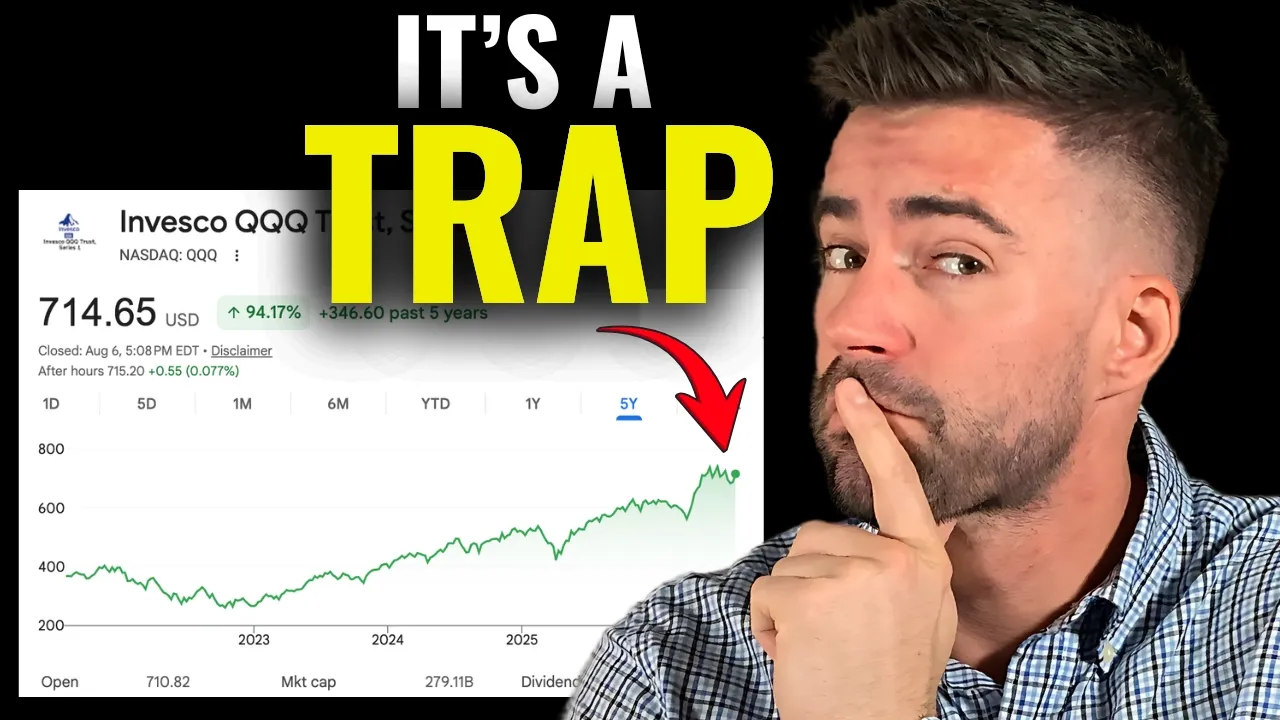
The stock market is definitely overpriced. It's not a question anymore. So, how should we invest now in late 2026 knowing this fact? In this video, I'm going to go over investing in technology for long-term wealth creation, what to hold in a Roth IRA versus a taxable account, specific investing timing questions, the possible fall of the dollar in the next decade, and which ETFs make the most sense long-term to buy and hold forever. This one's going to be packed full. So, a couple of days ago, I decided to ask my private exclusive group over on School to ask questions that they'd like answered. This group's my inner circle where I share all my buys the second I do it, and where we meet weekly with live calls. So, I wanted to see what types of topics they wanted answered. They gave me many great topics, but for today's video, I chose five questions from them, and I know you are burning to know as well. Let's get to it. My name's Nolan Gouveia. My students call me Professor G, and I made this channel to make investing simplified. Remember that all investing carries risk, so do your own research. This is not financial advice, and I'm not a financial advisor. First question, I hold QQ QM, SCHG, and VGT because I want a heavier tech tilt even though they overlap. How do you think about when that kind of overlap becomes too much, and do the expense ratios and redundancy actually become a meaningful drag over time, or is the main trade-off just higher concentration risk? This is a great question because many people just assume that overlap is terrible. I don't think that's true necessarily. But, the question that I ask myself and that I'm hoping you ask yourself is not just do these ETFs overlap, but why do they overlap? If you intentionally want to overweight technology because you believe it'll outperform over the next 10 to 20 years, then owning QQ QM, SCHG, and VGT can make perfect sense. You're making an active investment decision, not accidentally buying the same thing multiple times. The biggest trade-off isn't overlap, it's concentration risk. QQQM is already about 55% to 60% VGT is pretty much entirely technology and SCHG is heavily concentrated in the same mega cap names like Nvidia, Microsoft, Apple, Amazon, Meta, and Alphabet. When you combine those three ETFs, it's very possible that 60% to 75% of your portfolio is effectively tied to one sector. With your top 10 holdings making up a huge percentage of your investments. If AI and tech continue to lead the market though, that portfolio will do better than something that's just in the S&P 500 or something that's concentrated more with less technology. But if we get another period like the dot-com bubble or something like that where the Nasdaq 100 dropped like over 78% this type of portfolio will definitely see that same fate. Now let's talk about those expense ratios. Honestly, I think people worry about them more than they should. When we're talking about an expense ratio under 0.20, people really start nitpicking here. If an expense ratio is 0.75 or 1% or something crazy, yes, we can definitely throw those out. But these types of expense ratios are quite low. QQQM 0.15%, SCHG 0.04%, VGT 0.09%. Even if your average expense ratio is around 0.09%, that's only about $90 per year for every $100,000 invested. That's not what's going to determine whether you get wealthy. If your tech overweight outperforms by even 1% per year, that extra return completely overwhelms the tiny difference in expense ratios. The only time that I think overlap becomes a concern is when you're buying multiple ETFs that just accomplish the exact same thing and maybe you don't even know it. For example, if you own QQQM, QQQ, VGT, XLK, and FTE C, you're basically buying the same companies five different ways. At that point, I'd simplify because you're adding complexity without adding meaningful diversification. So, here's a question that I always ask myself. If I removed one of these ETFs today from my portfolio, would my actual portfolio be any different? If the answer is no, you probably don't need it. If the answer is yes, because maybe you just want that type of exposure that that ETF specifically is giving you, then the overlap isn't necessarily a bad thing. So, my bottom line is I don't lose sleep over fund overlap, but I do lose sleep over concentration risk. Overlap simply increases your exposure to companies you already own. The real question is whether you're comfortable having a large percentage of your portfolio riding on one sector continuing to outperform over the next decade. That's the decision that matters much more than a few basis points and expense ratios. Let's move on to question number two, and this has to do with Roth IRAs. This person said, "I always struggle with what to hold in my Roth versus taxable brokerage." Another person said, "A lot of people say Roth should be the last money touched in retirement, and it should be invested the most aggressively because you're going to touch it last." In general, this person had asked these questions. Should we be more aggressive in our Roth? Should we withdraw from our Roth last? And if we say withdraw from the Roth last, does that mean annually or lifetime? Now, this is one of those questions that doesn't have any one right answer, but there are some general principles that work very well for all investors. First, what should in a Roth IRA versus a taxable brokerage? In general, I like putting my highest expected return assets in the Roth because every dollar of growth is 100% tax-free forever. That usually means things like growth ETFs, technology funds, or small-cap value if that's part of your strategy. In a taxable account, I go with the name there. I'm looking for tax-efficient style investing, like broad index funds, qualified dividend ETFs like SCHD, or ETFs with very low turnover. Now, should your Roth always be your most aggressive account? Generally, yes, but that shouldn't mean that you should push it so risky that now you're past your risk tolerance for what you're looking for out of your investments. If you're invested in something that you can't emotionally handle, that's going to be an issue. And as for withdrawing from the Roth last, that's not necessarily a hard rule. The traditional advice is to preserve the Roth because it's your most tax-advantaged account. It has tax-free withdrawals, no required minimum distributions, and tax-free growth. That makes it incredibly valuable later in retirement or as an inheritance for your heirs. But there are plenty of situations where it might make sense to tap the Roth earlier. And I do have clients who are using this strategy and actually taking it from their Roth much earlier in retirement. For example, if you're retiring before Social Security or before RMDs begin, using Roth withdrawals during those lower income years can help you manage your tax brackets while you're doing Roth conversions. So when people say withdraw from your Roth last, think about over your lifetime, not literally every single year. Each year you should decide which account to withdraw from based on minimizing your lifetime taxes, not blindly avoiding the Roth. The goal isn't to die with the biggest Roth possible. The goal is to maximize after-tax wealth over your lifetime and if leaving money behind is important to you, for your heirs as well. That's why a flexible withdrawal strategy almost always beats following one rule for everyone. Now, this next question is huge and it's definitely one that I'm sure you thought of and it's one that I've thought of, especially because the stock market is overvalued. You've seen all the data, you've seen all the facts, it's definitely at all-time highs in a lot of different sectors. But then on the flip side, you'll hear people like me or other finance professionals always saying it's still good to dollar cost average, even at all-time highs. This person asked about the DCA or dollar cost averaging and the general workflow and process that I use. For instance, is it a particular day of the month or timing around macro or data trends that can influence dollar cost averaging? Maybe how to go about it for the Roth versus the taxable and how to dollar cost average into stocks versus ETFs monthly. Like for example, I know I want to invest in the three funds monthly from a monthly paycheck, but some months I would consider putting more of those investing dollars into satellites. All right, that was a lot and so let's get into each little piece because each one of those is pretty important. Let's talk about dollar cost average workflow. Is it better to do it monthly, better do it daily? There's been several studies on this and obviously as a professor, I'm going to go to the actual data. I'm not going to just give you my opinion, my the way that only I do it cuz I know everybody's different and you should be doing it different for your own portfolio. But here's what the data suggests. There's little to no meaningful difference between investing daily, weekly, or monthly into a broad market index fund over the long run. So here's the facts, especially from Vanguard. Vanguard studied dollar cost average extensively and found that the frequency of investing matters far less than simply getting money invested as soon as it's available. In fact, when investors already have a lump sum, investing it immediately has historically beaten spreading it out about 68% of the time because markets tend to rise over time. In other academic research, several back tests using decades of S&P 500 data have compared daily, weekly, bi-weekly, and monthly investing. Here's the results. Annualized return differences are usually less than 0.1 to 0.3% per year. Final portfolio value after 20 to 30 years are often within 1 to 2% of one another. The market's average return around 10% annually for the S&P 500 before inflation is so much larger than the tiny differences created by investing a few days earlier or later. Now, I will give you my opinion or my workflow, it's very, very simple. I get paid from the university and then also through my business and both of those are just like one time a month. They're at different times of the month though. So usually what I do is with my paycheck from the university a portion of that gets dollar cost average and then with the money that I make monthly for my business portion of that gets dollar cost average. So really it's like every two weeks or so that I am investing and I don't care if the market's up or down or whatever. If it's my dollar cost average core investments like the three fund portfolio, I'm investing rain or shine. The second part of that question though asked, what if I want to keep a primary DCA of core positions like the three fund portfolio, but then also some months this person would consider adding to satellites instead. And that's great. I think the main thing for you to do for anybody watching this is figure out what is your strategy. At the end of the day what's the goal? What would you like your portfolio to look like? I know for me my portfolio, I want my core ETFs to be 80 up to 90% of the portfolio. Those are the broad-based ETFs. Things that I talk about all the time. For me right now it's SCHD, SPMO, VOO, and then some growth ETFs like SCHG, QQQM. That's kind of the core of my investing. That's what I want the bulk of my portfolio to look like. My satellite positions, individual stocks that I talk about, maybe some satellite ETFs like DRAM or VGT or these types of things, they're going to be smaller portions. So no matter what, I'm dollar cost averaging into the core because that is what I need to build up. But every month I do have about 10% or 15% of that money that can go into certain types of satellites. And those aren't all always DCA'd into. Sometimes if a certain stock is down more like how Google was down a lot more year or two ago, I was putting more into that at that time. Microsoft had been down recently, but now Microsoft is up a bit and so maybe I'm not dollar cost averaging as much into that. I'm putting more into the things that are down more. but [clears throat] let's just say it's a totally neutral market and everything is kind of neutral there. First and foremost, hit the core positions, then with whatever you have left, go in order of priority. Keep in mind your risk tolerance and how risky you want to go and your overall goals and then just keep adding that money to it. Next question, I believe the three fund strategy is solid. However, it's also boring. Dang! Which is why I have more than three funds. But with multiple funds, I find myself meddling with my investment more than I should, which begs the question, should I just pick three and let it be? What say you on this matter, Professor G? Well, you kind of said it in the question. You probably already know what I'm going to say. It is my brand and honestly what I do, keep it simple. Honestly, the simpler the better for your brain, for anxiety, for your heart rate, but also for your gains. You're going to move things around less. You're going to second-guess yourself way less and not have that paralysis-analysis idea going on. But I get it. Just investing in three or four ETFs forever is pretty boring. That's why I stick to that for about 90% of the portfolio, but close to 10% is some individual stocks that I research heavily and have strong conviction in. I will tell you that the vast majority of my clients that meet with me one-on-one go from having a portfolio of 50 to 100 different stocks and ETFs that they'd accumulated all throughout their life and now they hit this retirement age and they want nothing to do with that many positions. They want to simplify. And at that point, it's quite the tax hit to be moving out of these positions and simplifying. So, if you could do that now, you could do that earlier. Even if you're close to retirement, it's better to do it today than 10 years from now when they're even bigger positions. So, of course, I'm not telling you you have to only do three ETFs or else you're doing it wrong. Honestly, I've seen a lot of portfolios with 50 different positions and their percentage gain over the last 10 years is great. Figure out what matters the most to you and I promise you being more simple is going to feel better and you can actually go focus on just life. You don't have to watch the stock market every single day. You don't have to care about that. And in retirement, I promise you that's not what you're going to want to care about. So what I explained works for me, find what works for you. This next question is a huge one, absolutely massive. For those of us with 20 plus years before retiring, how should we take into consideration Ray Dalio's thesis of the changing world order, the decline and possible fall of the dollar being the world reserve currency, the possibility of high and possible hyperinflation, and our four-fund portfolio strategy in light of these possibilities? How should we look or prepare investing long-term to navigate these waters? Now, I think Ray Dalio has brought up some very interesting points. He's a very smart individual, very, very intelligent. If you don't know who he is, look him up. History shows that world powers and reserve currencies don't last forever. We've seen it happen with the Dutch and the British Empire. So it's reasonable to think the US dollar won't be the world's reserve currency forever. The important thing to make sure and understand and actually go check is that these types of changes that have happened in these older empires happened over decades, not in years, definitely not in months. So if you're 20 plus years from retirement, I definitely don't think you should totally blow up your entire investing strategy and change based off of these couple of world events that are happening emotionally today. Instead, you're going to want to build a portfolio that's going to succeed in multiple different situations. For me, that means owning broad US index funds, having some international exposure, and maybe a small allocation to real assets like actual real estate, gold if that helps you sleep better at night. As for hyperinflation, I know inflation is a buzzword right now, especially with the Fed rate and with all the money printing and everything going on, it's highly, highly unlikely that we see real hyperinflation like they've seen in other parts of the world. Countries like Zimbabwe or Venezuela experience hyperinflation because of economic collapse and a complete loss of confidence in their currency. Could we have periods of higher inflation? Yes, but that's very different from true hyperinflation. One last point that I think gets very overlooked and that I have to debate with people all the time is about 40% of the S&P 500 revenue comes from outside the United States. So, when you buy the S&P 500, you're not just betting on the US economy, you're investing in global companies like Apple Microsoft Nvidia Amazon Alphabet, and Coca-Cola that generate revenue all over the world. As far as gold is concerned, I do think that that's a good asset. It's a great store of value, especially if you're holding long-term. It usually beats inflation. Last year, it absolutely crushed the market and this year, it's down a bit. You just need to look at it more like a store of value, kind of like the way real estate appreciates. It's not supposed to just make you rich overnight. It's not supposed to be this growth stock. And unfortunately last year, how it grew over 100%, people are looking for that out of gold this year when they're buying into it, and they're not too happy with what's happening there. If you're buying it as a hedge against possibly the dollar, a hedge against stocks and things like that, that's an okay way to look at it. It's just a safer asset, to be honest, that has had value and continued to increase in value for hundreds, if not thousands, of years. So, my takeaway is simple. I respect Ray Dalio's research, but I wouldn't try to predict geopolitical shifts by totally switching up the portfolio. I'd rather stay diversified, invest simply and consistently, and let great businesses do what they've always done because they're very incentivized to continue to make a profit. And if we're investing in those, we're going to see a portion of that profit. Now, these are the types of questions that are being asked and answered every single day and every week in our weekly live video calls over on School. I meet with everyone for 1 hour each and every week and share my thoughts on the stock market and answer questions. We also have community threads going every day and so much fun engagement with over 500 investors helping each other out. Come check out School with the link down below in the pinned first comment and get your questions answered today so that you can start investing at that next level. After that, go ahead and watch either of these two videos and remember to keep investing simplified.
Comments 0
Sign in to join the discussion.
Sign inNo comments yet. Be the first to share your thoughts!