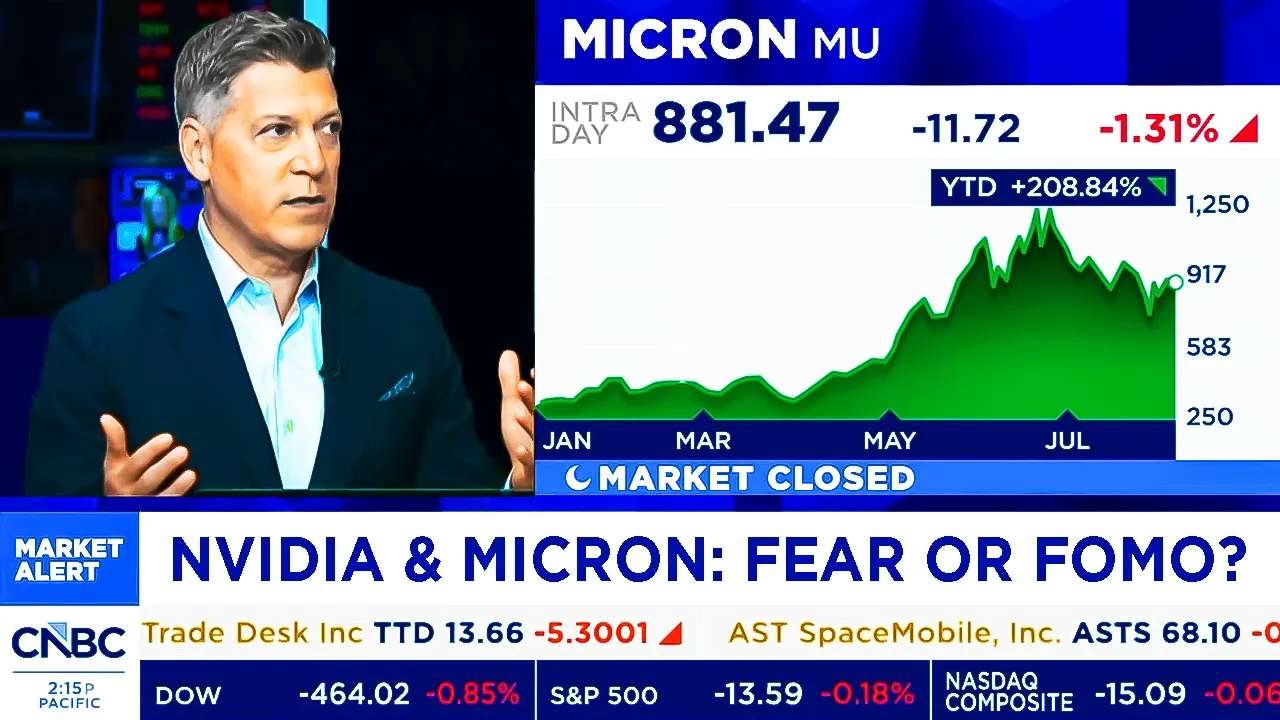
CNBC & Fox Today On NVIDIA Stock, Micron Stock, Sandisk, SK Hynix - NVDA Update

- Video return
- -0.71%
- Calls
- 2
- Buy / Sell
- 2 0
- Published
Recommendations
Entry is the asset's closing price on the publication date. Current is the last close on record.
-
Entry $1,258.58 06 Aug 2026Current $1,212.21 07 Aug 2026Result −$46.37
our SanDisk price target did go to 3K today $3,000 from 2745 ... But I think but I think having said everything, earnings are going up, share price is going up. We just don't know if earnings going to be X or Y or Z, but definitely is going higher.
-
Entry $218.99 06 Aug 2026Current $223.96 07 Aug 2026Result +$4.97
I seriously think that Nvidia still has plenty of runway ahead of it and I think this company will be worth substantially more in future years than it is today.
Full Transcript
I think we got to start right there because whether it's SanDisk or Western Digital or what we saw with AMD yesterday or a number of others, I mean, we're talking about blowout results and while the results were big, expectations from investors were bigger. >> Yeah, absolutely. And thank you for having me. I appreciate it. Um, we've definitely seen a little bit of a reversion to the mean, I think, across the the chip stocks, especially memory, um, has kind of led the way with that. But it, you know, we're not I'm not an equity analyst, but at the end of the day, it appears that, you know, investors are looking for clear beats and and guidance way outside of whatever the consensus is to to really uh turn in the right direction. But, um, yeah, you know, as long-term investors in the space, we're really just a reverence to the mean is is nothing for us. We're we're trying to keep that long-term AI super cycle perspective. Um, and we think that, you know, the chip trade is still very strong. um even if you're seeing a little bit of volatility in the near term. >> Okay. So, where do you think we are in terms of this AI super cycle? What is your perspective? >> Yeah, I think we would argue that we're probably in the first third. Honestly, it's a very uh nent technology. Um I think there's a lot of speculation around it, but at the end of the day, it's it's very transformative. Um and if you look at from an adoption standpoint, um I think we're still very uh low on the adoption side, even though we hear about it every single day. uh true users and and really the full-fledged uh ability of the technology has really not been felt yet. Um and regardless of you know who wins or where the revenues fall, I think chips at the end of the day are in compute is what's going to drive this technology forward. And you know in our eyes there's no world where you know we need less compute and we're using less AI moving forward. So at the end of the day a lot of this is is top down noise we believe. Um and there's there's a lot of opportunity still within the AI trade. I'm looking at your notes and you say investor interest tends to follow wherever the near-term constraint sits in the AI buildout. Obviously, memory is getting all the attention right now this year, but if you look out, where do you see the next sort of bottleneck? >> I think it's very hard difficult to tell, right? I I think if you're trying to, you know, play the genie, right, and and look in the crystal ball and see where that next bottleneck is. I think there's a lot of bottlenecks across the entire stack. Um, we don't think that there's really just one. Now that tends to shift depending on the news of the day or where the technology is um in the cycle. So you know from our perspective it's very difficult to track those bottlenecks and know what the next one is going to be and and approaching it in a diversified way is probably the most prudent way to do it if you believe in the technology as a whole. And that's kind of the the message that we've been trying to to convey. >> Okay. So, so I guess I I realize long-term investor, but we'll say even in in the near to medium term, then is memory still the compelling place when you think about chips or are you looking to other aspects within semiconductors or or elsewhere within this tech chain right now as compelling, especially given the downdraft we saw coming off of June? >> Yeah, sure. I think there's definitely a lot of uh merit to the conversation around memory. Um, you know, it didn't get a lot of attention for a long time because it was commoditized. Um, and there's a lot of interesting things happening that are driving the technology forward. High bandwidth memory, um, where you're stacking RAM together, and now there's the talk of high bandwidth flash, which is kind of more in the SanDisk, SanDisk conversation, right? Um, internet technology has not come to bear yet, but I think there's still a lot of interesting things happening within the memory space. Um, so I wouldn't discount it and it's not that we don't care about it, it's just that a lot of things are moving fast and there's a lot of opportunity across the board. Um, and it's very difficult to try to pinpoint that. Um, so not to say that we don't like the memory trade or that we don't believe in it or that it's not a bottleneck. Absolutely it is. Uh, but we're just trying to keep, you know, at the end of the day trying to keep that long-term perspective and not lose our heads. Uh, especially amid a amid a lot of this volatility. >> The NASDAQ higher, but gains are limited as memory stocks today like SanDisk and Western Dig are getting pummeled after reporting last night. Joining us to discuss is Roundill Investment CEO Dave Maza. Round, you might know, runs the popular memory ETF DRAM. It's good to have you back. Thanks for coming on set. >> Yeah, thanks for having me. >> Uh, what do you make of this? I mean, we've had obviously a bit of a reset. We're still in an environment though where the street is craving maybe more robust guidance than we're getting from some. >> Yeah, I think what these numbers are showing us is that just as we're seeing in software, the same with memory, beat and raise is not enough. You actually have to beat and really truly raise, right? So, uh, let's look at SanDisk. They they did beat revenue, but not by what we've seen. over the last recent quarters. And so when you have expectations as high as they are, I think what we're now seeing is investors pull back and reassess where does memory go from here, especially as they're trans trying to transition from cyclical businesses to one with these long-term agreements. >> Does that mean incrementally less demand for leveraged names or maybe on maybe more demand on the leverage shorts? >> Well, what's interesting is so there's been a ton of leverage taken out of the system. If you look at uh Korean retail investors, their margin balances, it was at 38 trillion Juan uh most recently at the peaks in June. That's actually come down to now 27 trillion, which is what the year started with. So that played a big role. And then what we're also seeing is of course the situational awareness situation uh where they uh you know that fund was long a lot of these names and so now we're beginning to see a bit of a shakeout and a repositioning of of where the actual fundamentals look relative to positioning. JP Morgan earlier in the week argued that to your point about Korean leverage that enough had been rung out to where maybe you could argue you're back to some level of normal. You go along with that? >> I I I think that's most definitely true. If you just look at the data, it was astronomical how much leverage was in that system. Um and now again we're we're beginning to reset. What's interesting though is if you look at DRAM flows actually from the peak to the trough there was 10.4 billion of inflows during that period. So investors are actually still allocating toward this sort of theme and trade more broadly while certainly kind of I think reassessing some of the individual stocks. >> I guess then the question is how do the earnings reports from these two big names change perhaps the long-term trajectory uh of memory and just storage in general? >> Well, I think again a lot of this was the expectations were so incredibly high. Uh but if we look at what the company's actually said is that there's a there there is this longer term transition happening from the the ability to have these longerterm consistencies right with floors and pricing and then perhaps some ceiling and so there's some noise as the company's transition to that. Now that said we have SanDisk investor day next week August 13th. I think the uh corporation was trying to be a little bit cautious heading into that where maybe we'll we'll begin to see if that's the next catalyst uh for the theme going forward. And then Nvidia on the 26th. They always make us wait, but it's one of the most important dates in earning season right? >> Well, Nvidia is one of the most important dates, not just for earning season, but for the market, just simply based off of it size. And what's what's interesting is we've now seen a rotation back into Nvidia uh which was a lagard uh until kind of most recently as the memory chips really kind of took all the air out of the this the semi trade. And what we're now seeing is again investors, let's have a pause. Let's have a reset and kind of see where where semis go from here. >> Malcolm, the other stock that's certainly woken up is Nvidia, right? U you know, Musk praised it on the SpaceX uh earnings call. If you take a look at uh what the stock, it's up 12% over the past five trading sessions. Don't forget it reports on August 26th. So, it's the only one of the big cap techs at this point that hasn't delivered an earnings report. This thing back. So my expectation was as the breakdown was happening in July within all the semiconductor stocks that investors were going to rotate back into the one that really should matter because Nvidia is trading now below the rest of the S&P 500 on from a Ford multiple perspective which is absolutely absurd when you consider it's the largest company in the world by market cap and also it's the it's the company that sits at the very center of all of what's going on with the AI revolution. all of the money being spent to put shovels in the dirt and then put chips into data centers, like 90% of that is flowing through Nvidia. So, it didn't make sense to me that the stock got so unloved for as long as it did. I'm not surprised to see it trading up into the print, especially since historically it always trades up into the print right before earnings. The surprise will be if it continues to go up into the right after we get the print instead of selling off. >> Baron says that it can keep going, that it finally has momentum and it it can keep going. Now maybe maybe it it hadn't moved, you know, the way it is now because there just continue to be questions about the circular deals and the the whole nature of that. Don't you think that I mean that's been kind of a constant drum beat in the background? >> But if you question that, you have to question the entire thing, right? Do do we still feel really great about SKH and Samsung or do we not? If you do, then questioning Nvidia's ability to fund its next generation of customers to separate itself from the metas and the Microsofts that are its largest purchasers at the moment. If you believe in one, you have to believe in the other. >> Malcolm's Malcolm's right. Like we can't pick and choose which aspects of the the overall AI trade. It's like pulling the wrong Jenga piece out. The whole if you the I think the the way to think about this is all right, what's the alternative? You're Jensen Wang. there are 10 NeoClouds going up uh data centers for NeoClouds where it's not Apple, it's not Alphabet and uh Amazon. They don't have their own cash flow. So, they obviously are going to be out there borrowing money. They're working with companies like Blackstone, etc. to finance these facilities. If you're Jensen, do you want Nvidia chips in there or do you want, I don't know, tranium chips? Which which would you prefer? So, it's it's it's it's one or the other. If you're the biggest player in this ecosystem, which Nvidia is, they sort of have to go where the market's going. >> They're also like the last one of the mega cap techs that's still massively free cash flow positive. So, they still have the ability to lend out dollars in the form of structured loan kinds of things. >> 48.5 billion in free cash flow. >> Who else has 22%. But let's begin with this whipssaw action in the memory names after falling 10 last night. SanDisk still down about four. Western Digital's comeback not as big, but it was down 16% earlier on. Its earnings didn't miss. The outlook didn't miss, but the Whisper numbers were a hurdle neither one could clear. Let's bring in Sescuana's Medie Hasseni for today's opening exchange. Medie, it's great to see you again. And what does the market reaction tell you? >> Well, thanks for having me on the program. I think it was a week or so ago that I was in your program. We're talking about when is a good time to uh buy memory and I think we talked about the late summer would be the the right time and this is how I'm answering your question. I think we're going through this process of normalization where margins are peaking but we don't know where margins would go looking forward. All of these memory companies are also talking about a long-term contract. We really don't know the economics of the contract. So, it's going to take us some time to better uh figure out the normalized margin, how uh earnings are going to be like looking into next year, and I think that would set up a late summer perhaps uh would would would offer a better setup for memory names. >> Well, I'll come back to that in a second. The information is out with a new report just this uh afternoon. Medie, I don't if you've seen it yet, but they're saying that >> Yeah. Well, I'll tell the audience who maybe hasn't seen it yet, but they're reporting that Nvidia is thinking about using less memory for its next generation Reuben chips. Uh, what are your thoughts? >> I'm not sure if I would agree with that. I think the next uh platform Reuben Ultra is got some technical issues. I think the data rate, the networking wall is a bigger issue. uh yes memory uh is costing more but memory wall is also very important. I think those are sort of a behavior you see from key customers because they have to deal with how uh much memory cost has increased but it doesn't really change the fact that as you look into the next generation of AI platforms it requires more memory networking becomes an issue and on top of that we're transitioning from training to inferencing and all of these uh factors would give us some time or will require some time to better understand the dynamics but but but no I'm not so much concerned about um uh dspecing uh if anything memory content is growing higher we just don't know how the margins and normalized margins would look like >> but do you think there's an Nvidia problem with the the what is it called Reuben ultra what is it called >> right Reuben and that would be you're referring to Reuben Ultra I'm not I don't cover Nvidia but I as I look at uh the the this AI platforms and as we go through the progre progression of the next platform um is very challenging to optimize them. Um if you look at companies like in in Taiwan, Foxcon, these OBMs are having a hard time uh optimizing um the at the rack level. Um and in that context uh key suppliers like Nvidia have to make adjustments. Um so those are very much been the case with each successive generation of a platform. I'm not sure if it's a memory specific and I'm not sure if HPM is the only issue. >> So you you're saying these names maybe an Nvidia a Foxcon are having a hard time optimizing at the rack level. >> Yes. >> Huh. Is that just an engineering thing? Because this is so new. They're trying to do so much. >> Exactly. You look at the token generation, you look at the power requirement, you look at uh the data rate, the speed of moving data. U it's very difficult to uh streamline and and and solve some of these engineering uh problem in a matter of weeks or months. It would require a couple of quarters. At the same time we are transitioning into next generation of a platform almost every 18 24 months. Um so so there is a um there is more uh sophistication with this platform. We haven't done this before and I think it's a very natural uh u is part of the whole evolution that would take time for optimizing at the rack level. So Medy then let me just go back to as you've said maybe the we're getting into the late summer. You were looking for another entry point. I want to mention as well your SanDisk price target did go to 3K today $3,000 from 2745 which we had shown on the graphic there of course is after their earnings. So it's not like you're pulling in your estimates. You're you're actually raising the price target. Um you said everyone's looking for what are normalized margins and that this time of this might be the time to figure that out. So, what is going to answer that question and clear the way for those names you're saying to possibly start to move higher in a decisive way again? >> Yeah, I think um it's unrealistic to expect um gross margin for like percentage to remain at 85%. And I and I also don't think it's going to go to uh 50 60. I think we're going to have to find a way where the normalized margin would be. And I say that because there is a part of the market that is very elastic. The demand elasticity associated with NA is more so than DRAM. Uh so I think the suppliers would have to make some adjustment that will lead to higher bid shipment. In that process margins may drop to 80 or 75%. Uh and that that's that's what what I call normalization. I think Sunday having their analyst day next uh Thursday would give us more insight and those are the kind of events on the horizon that would help us to fine-tune and to better understand the normalization of the margin profile. >> Okay. And just to clear correct the record, you took your SanDisk price target down to 2745 from 3,000. Is that right? >> That is not right. And I think if you look at the past couple of months, our estimates go up, our estimates come down, and our price target adjusts. we really don't know what the real earning power is. So, uh I wouldn't pay so much attention or I wouldn't pay focus so much on this periodic adjustment to earning. But I think once we figure out what's the normal margin then we could better uh identate the true earning power and that's when the price target becomes critical. But I think but I think having said everything, earnings are going up, share price is going up. We just don't know if earnings going to be X or Y or Z, but definitely is going higher. >> All right, >> let's talk a little bit more about this because this whole memories place now. These guys are getting these long-term contracts, these five-year contracts. Uh they cover a lot of things. You got for instance, Highex with 10 of them. How do you feel about that? This was supposed to smooth out the sort of the volatility in these names. >> Well, I'm glad you used this chart because this is something that I love because it's actually spelling out specifically what you just said about how this sector is moving from the cyclical nature that it historically was to locking in long-term agreements with customers which provides a floor to the pricing in some cases a ceiling but allows investors and the companies themselves to have transparent more transparency into where those revenue is going to come from. And we heard from uh last night's SanDisk again. Uh they actually locked in five more of the these agreements, >> right? I mean, this is this is what we thought the street wanted. You you mentioned Korea at the top of the show. Uh over there, the the the government officials there have a lot of digits, a lot of sorrow. They're saying, you know what, we allowed these leverage ETFs to come in too quickly. Uh we we fed a feeding frenzy. And and I want to ask you about that, the role of leverage ETFs, these single stock ETFs hit 200 billion. We had a little bit of selloff here, too. to your point, that's why some of these hot stocks got hit. What do you think? I mean, do they go too far? Can they go too far? Should we have two, three, four, five times leverage? I think the regulations that we have today sort of spell out that there were some grandfathered 3x funds and then now it's really 2x. But the bigger point, I think, is the number of single stock leverage and inverse ETFs that have come to market. It's one hand if you're amplifying exposure to the NASDAQ, S&P 500, maybe even memory stocks, because we're talking trillion dollar um market cap companies, but when we're doing single stocks on smaller companies, it can create a bit of a tail wagging the dog situation and it can amplify volatility like we've seen. So, these are tools for someone who can trade and make a decision about buying, selling, hold on a daily basis. But the number of funds out there has begun to change market structure a bit and investors need to not just think about the fundamentals but understand the positioning uh and the influence of leverage ETFs along with zerodt options uh perpetuals and other things of that nature which can influence prices in the short term. >> It feels more like gambling though to me like some of it you know what I mean or it's you see that the it's just I listen I want people to have all the options out there but I worry about them going too far. I love the way you explain it yourself. All right folks don't look now but Nvidia look at this. It's got its swagger back, right? The stock uh already gaining uh was already gaining momentum rather and then of course Elon with those provocative statements. Uh first he's talking about inference which you know which is was supposed to be a weak point uh for for Nvidia. But he says it's going to be 99% of all AI chip to man at some point and then he went on to say that Nvidia they're getting all the business because simply they're the best. Now the goal for him now is to go to 10 gawatts by the end of next year. Some think that's a bridge too far. Nevertheless, this is what it would mean for Nvidia. Each gigawak is $50 billion. So, let's bring in my next guest. He has been pounding the table in Nvidia. Uh even though even when the stock occasionally looked down for the count, let's bring in B. Riley Wealth Management, their chief market strategist, Art Hogan. All right. You know, um it's it's really interesting that you know, the stock has has been been held up maybe by the law of large numbers. Uh you know, but and so people wonder does it does it maintain this? Can it sustain this rally? You know, people always say it's harder to go from 1 trillion to two trillion, harder to go from two trillion, yada yada yada. >> Yeah, I think that's a great point, Charles. It also got held up when we rotated out of the semis and back in the software in the month of July. Nvidia sold down right to its 200 day moving average, bounced successfully on that test, and as as we can see, it's doing much better. So, I think Nvidia, you know, is in the driver's seat here, but it's in the driver seat at a very reasonable valuation. It's it's trading on a forward multiple that's less than the S&P 500, and that likely goes down after they report earnings, even on a trailing basis, only trading at 30 times. So, if you look at their closest comp, someone like AMD is trading about 65 times. So reasonable for a company that's growing its uh revenue and earnings, you know, close to 70% and throwing off gross margins that are even larger than that. So I and it's had a history of cutting edge and I think it will continue to have a history of being the cutting edge developer of AI architecture. >> You know, you you you mentioned it's cutting edge and how it's always ahead of the curve. uh uh Counterpoint Research says that their AI large language model shares over 92%. Uh you know, so just dwarfs uh uh Sarah Bruss and AMD. Any chance one day this could be one of these companies they want to break up? I don't know that that's going to be the case. You know, remember this is a company that went public in 1999, almost went out of business until they came out with Genforce 256, which was in the Xbox and the PlayStation, and then they had that major breakthrough uh 10 years later with the CUDA architecture. And that's been the beginning of GPUs. That's the beginning of the story. And they continue to roll out the H100. And every iteration, it has more demand than it has supply. >> Yeah. It's that CUDA architecture that's sort of given them this moat that some people gripe about. Speaking of which, they're preparing, right? I mean, they're always prepared. They went from Black O Reuben. They're going to go to the next series. They know where the GPUs are. They know the rack systems are going to be. And for me, what's intriguing is that each one should be more profitable than the next. So, where do you think the stock goes? >> You know, it's interesting. And that should be true, but you would also think the H100s would have a major degradation in valuation. They just haven't because people want all the compute power that they can. So each generation comes out with a higher profit margin and that slowly degrades. But even the H100, which is two generations ago, has not seen that much degradation. So I think that uh it's it's got a lot of runway in front of it. >> And to your point, even China even Chinese companies that say, "Hey, if you got any spare ones, we'll take them." Hey, before I let you go, Art, how you feeling about the overall market? >> Market feels really good. largely driven by earnings which have been spectacular. Of course, we have to look at the price of barrel of oil every day to see what direction the market may go in. But I think eventually we find an offramp to that situation, get this trade over open and the earning season has been nothing short of spectacular. >> Absolutely. >> All right, I hope you're all doing well today and staying calm in this market. Today was a slight red day in the market as the situation in the Middle East unfolds. We saw both oil and treasury yields move higher. On Thursday, the information published a story claiming that Nvidia is testing at least three variants of Ruben Ultra and considering versions of Ruben Ultra with less memory capacity than Nvidia had originally planned. I want to provide a disclaimer and mention that this has been an unreliable source in the past when it comes to Nvidia rumors and I have no idea if this story is true or not. I'm just bringing it to your attention so that you're aware of it. That said, a couple days prior, Trendforce published a piece saying that DRAMM supply will remain tight in 2027 and uncertainty persists over memory suppliers HBM4 evalidation timelines. In that same piece, they say that Nvidia has begun expanding its evaluation of Ruben Ultra's HBM configuration beyond its original 12 high HBM 4E design to include 8 high HBM4E, 12 high HBM4, and 8 high HBM4 alternatives. Going back to the information story for a moment, it's also worth mentioning that on July 29 Semi analysis reportedly claimed that Nvidia was showing customers a Reuben Ultra configuration with 192 GB of 8igh HBM4. Again, I don't know whether these rumors are true or not. I'm just bringing it to your attention so that you're aware of it. Now, let's briefly consider the implications. First, if the rumors are true, it speaks to the severity of the memory shortage and the strong negotiating leverage that the memory makers have right now. It's also important to remember that more capable models generally require more memory capacity, not less. Now, initially, this story appears to be a negative from memory makers because if it's true, then we're talking about less memory per GPU than what was originally expected. But it's actually not that simple. Think about this. The memory makaker's recent surge in earnings has been primarily driven by higher pricing, not by higher volumes. If the rumors are true, then Nvidia is considering a reduction of HBM bits per GPU. Think about what that means for the memory makers. Less HBM content per GPU would not automatically result in a higher average selling price per bit. Nvidia generally negotiates HBM pricing and volumes many months in advance. That said, if the overall HBM market remains extremely under supplied, memory makers could still maintain or potentially strengthen their pricing power per bit despite Nvidia using less memory per GPU. If HBM is the limiting factor, then reducing the amount of HBM per GPU could allow Nvidia to ship more GPUs without reducing memory makers total HBM bit shipments. Memory suppliers could therefore retain strong pricing power despite lower content per GPU. Total HBM revenue and profit could still increase if more GPU shipments and higher memory pricing were to offset the reduction in content per GPU. It's also important to consider that if the rumors are true, it's a signal of a lack of supply, not a lack of demand. Again, I don't know if these rumors are true or not. Even if they are true, I would be careful about assuming that it poses a significant risk to the memory makers pricing power because that's not guaranteed. Also, on Thursday, we learned that Alphabet was seeking to raise 20 to$25 billion in a bond sale. And then later in the day, we learned that Alphabet raised a full $25 billion after the offering drew roughly $115 billion of peak demand. In July, Alphabet raised their 2026 capex guidance to the range of 195 to $25 billion. and leadership said they expect capex to increase significantly in 2027. Also on Wednesday, I accidentally missed this piece of news. Meta announced the release of Muse code beta, which is a terminal coding agent powered by Meta's new model, MU Spark 1.2. Meta is not dropping out of the AI race anytime soon. As a reminder, Meta clarified on their recent earnings call that they do not have excess compute. They intend to use the majority of their capacity for their own uses at Meta. That said, they're also preparing to rent out a portion of their compute capacity because they can charge a very attractive premium for it due to the shortages that exist throughout the industry. As I've said before, while Meta is a hypers scale company, they're technically not a hyperscaler. They do not have a cloud business like Amazon, Microsoft, and Alphabet do. Because of that, Meta's buildout is inherently riskier than the others. I think it would be a good strategic decision for Meta to start renting out a portion of their capacity because that would help calm investors nerves and also help derisk Meta's buildout. That said, it's notable that Meta is diving into the agentic coding market with the release of Musecode beta. We've seen rapid growth in that market from the likes of OpenAI and Anthropic. Zuckerberg did say on a recent earnings call that Meta believes there will be a significantly greater margin on selling intelligence rather than selling compute directly. Looking ahead, we have Nvidia earnings later this month on Wednesday, August 26th. Now, in case you're new to the channel, I want to make sure that you have at least a basic understanding of the underlying long-term thesis. So, let's cover that. Now, I don't know what's going to happen in the short term, but from a long-term perspective, I am very confident that Nvidia will be worth much more in future years than it is today. When Jensen was on the Lex Freedman podcast not that long ago, he was very seriously raising the possibility of Nvidia becoming a $3 trillion revenue company in the near future. If that happens in the coming years, then it is very plausible that Nvidia could one day be worth tens of trillions of dollars in market cap. That might sound crazy, but that's what Jensen is implying when he raises the possibility of Nvidia becoming a $3 trillion revenue company. I guess the question at that point is what multiple the street will be willing to give Nvidia. I don't know the answer to that question, but I truly do think that Nvidia will be worth much more in future years than it is today based purely on the fundamental growth of the business. Based on everything I'm seeing, the world is still computed and I expect that to continue at least through the first half of calendar 2028. In a computed environment, developers will use whatever viable compute they can get their hands on. Today, there are no GPUs that are sitting dark due to a lack of demand. like there was fiber sitting dark due to a lack of demand at the height of the dotcom bubble. Back then, companies were laying fiber in the hopes that use cases and demand would eventually show up. Today, we are seeing the complete opposite. As I've said many times, when market participants compare this AI revolution to the dotcom bubble, they ignore the fact that the internet is already here this time. This means that mass adoption of the technology and new use case development at scale are immediately possible. We don't have to wait years for it to show up. It's already here. The world is compute constrained, which means there is not enough supply to satisfy demand. New capacity is utilized as soon as it comes online. The hyperscalers are monetizing capacity as soon as it comes online. Each of the hyperscalers spoke about being supply constrained on their most recent earnings calls. Additionally, many of the clouds are building out into contracted demand. They're not blindly building in the hopes that demand will eventually show up. No, they're building out because they have signed contracts and in some cases significant prepayments from their paying customers. This AI revolution is fundamentally different from the dotcom bubble and 2026 will be a pivotal year for the AI industry. Thanks to the rapid adoption of Agentic AI and the proliferation of Agentic systems in the world's leading enterprises, the leading AI labs revenues are surging right now. Agentic coding and the implementation of Agentic systems in large enterprises are new use cases that are increasing inference demand significantly that subsequently is increasing compute demand. The rapid adoption of Agentic AI is why we're seeing an inflection in inference demand. It's why we're seeing the leading AI labs revenue surge. I wish both Anthropic and Open AI were public so the public could see the ramp in their revenues. Anthropic ARR has surpassed 47 billion up from $9 billion just at the end of 2025. Open AAI is growing rapidly as well. I think the leading labs surging revenues may be the initial proof point that grabs market participants attention and causes them to realize that there will be a clear ROI on AI infrastructure. I think the leading labs surging revenues will also help assure investors of the longevity of Nvidia's growth since these labs revenues are directly tied to compute. If they had more compute, they would have greater revenues. It really is that simple. Demand is not the problem. The problem is a lack of supply to meet the demand. As I've said previously, I expect the world to be compute constrained at least through the first half of 2028, possibly longer. And so regardless of what happens in the short term, it's important for long-term investors to remain focused on the fundamentals, maintain a long-term perspective, and remember that we are only in the early stages of Agenic systems being adopted at scale. This will increase compute demand significantly. And after that, the next surge in compute demand will likely be fueled by physical AI. We're no longer talking about digital agents performing digital tasks. With physical AI, we're talking about physical AI agents performing physical tasks in the real world. NVIDIA CFO has called physical AI quote a multi- trillion dollar opportunity and the next leg of growth for Nvidia. This industry will fundamentally transform society and Nvidia has positioned themselves to benefit massively. NVIDIA sells the hardware for the data centers where the models are trained. They offer omniverse where the models are taught and tested and Nvidia also sells the hardware that allows ondevice real-time inference through Nvidia AGX allowing robots to have intelligent interactions with the real world even when they are not connected to a data center. Notice that Nvidia is taking a holistic platform approach to physical AI and they're embedding themselves as the underlying foundation supporting all of it. Over two million developers are already building on the Nvidia robotic stack and this is not getting enough attention. As for production ramps, Blackwell Ultra has ramped quickly and remains in high demand. Reuben is on track to launch in 2026. Then we're expecting Nvidia Gro 3 LPX in the second half of 2026. Later on, we're expecting the launch of Reuben Ultra in 2027 and Fineman after that in 2028. We have a clear data center product roadmap stretching into 2028. And Jensen believes that AI infrastructure spinning will reach 3 to4 trillion annually by the end of the decade. That means Jensen is expecting growing AI demand and an expanding total addressable market underpinning all of this. I don't think we are anywhere near any type of bubble bursting type of event. With all of this in mind, I seriously think that Nvidia still has plenty of runway ahead of it and I think this company will be worth substantially more in future years than it is today. At least that's my view of the situation. Quick note before I wrap up. All of the compilations on this channel are edited by Finn Vid with original structure and commentary. Occasionally, the same edits appear elsewhere on YouTube. If you're looking for the original version, it's always here on this channel. Thanks for watching, Finn Vid. I appreciate your support. Remember to stay calm in this market. Remember to maintain a long-term perspective and do not make any hasty or irrational decisions. With all of that being said, I hope you all have a great rest of the day. And I'm curious to hear your thoughts about Nvidia in the comments below. Please leave a like on this video so more people will see it. And while you're down there, please consider subscribing. It's free and you can always change your mind.
Comments 0
Sign in to join the discussion.
Sign inNo comments yet. Be the first to share your thoughts!