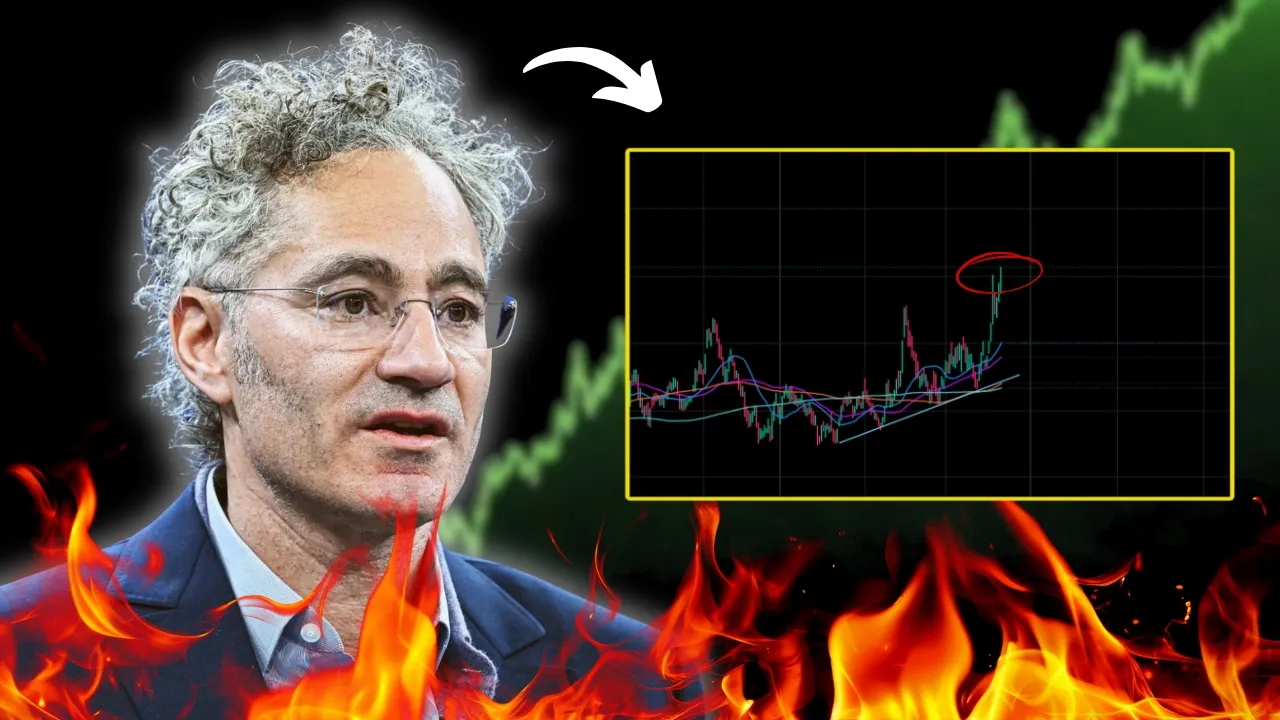
"This Stock is The Next Palantir" (20x Opportunity)

- Video return
- —
- Calls
- 4
- Buy / Sell
- 4 0
- Published
Recommendations
Entry is the asset's closing price on the publication date. Current is the last close on record.
-
Entry $29.15 11 Aug 2026Current $29.15 11 Aug 2026Result +$0.00
In my opinion, Zeta Global is by definition the next Palantir.
-
Entry $29.15 11 Aug 2026Current $29.15 11 Aug 2026Result +$0.00
I also believe Zeta Global and this other company that I have recently started buying positions, and I think I have like $30,000 in the stock at this point or close to that.
-
Entry $318.68 11 Aug 2026Current $318.68 11 Aug 2026Result +$0.00
the new stock that I just started buying that I now have about $20,000 invested in, and that is AppLovin.
-
Entry $318.68 11 Aug 2026Current $318.68 11 Aug 2026Result +$0.00
But now, at $3.18, yeah, it's compelling. And I have officially started a position in this company.
Full Transcript
Look at this headline. It says Zeta, like buying Palantir in 2020. I have made countless videos on this channel talking about Zeta Global being the next Palantir. Well, Zeta Global in the past week has reported earnings. Another blowout quarter. They are now on a 20-quarter beat and raise streak for revenue guidance. No other company on Wall Street has a streak that is 20 quarters long beating and raising on revenue. In my opinion, Zeta Global is by definition the next Palantir. And the stock is about a $6 billion market cap. This stock has a 10, 20, 30, or larger X opportunity ahead of it. In this video, I will share with you the recent developments around Zeta Global, what Zeta Global does, their earnings, and more. But, I also want to tell you guys about another stock that I've been buying that I believe also presents a massive opportunity. Now, this video is coming out at 9:00 p.m. Eastern Standard Time on a Tuesday afternoon. I also believe Zeta Global and this other company that I have recently started buying positions, and I think I have like $30,000 in the stock at this point or close to that. Maybe it's 20,000. Um just getting started with that position, by the way. I think Zeta Global and this other stock fit in the narrative perfectly of the next big AI trade. And if you guys don't know what the next big AI trade is at this point, it's not hardware. It's not AI hardware. That trade is done. That trade is over with. You shouldn't really be investing anything into AI hardware at this point, in my personal opinion. The next four pillars of the AI trade are as followed: robotics, automation, AI software, and cybersecurity. That is the next big AI trade. And if you understand that today, long before Wall Street does, you're going to beat the markets. You're going to outperform and change your financial destination. And this is what we do in the trading community. I don't like to FOMO into stocks. I like to buy them before Wall Street FOMOs into them. In the trading community, we are up 87% year-to-date. I think the Nasdaq's up like 10, maybe? Something like that. We are magnitudes outperforming the best hedge funds on Wall Street. I don't know of another fund that is up more than us. Why? Because we're beating Wall Street to the puck, and we're beating Wall Street to the goal. That's all you have to do to get insanely rich in the stock market. If you guys want to come trade and invest alongside of us, that link is down below in the description of today's episode. But, the only thing that I ask you guys to do if you're watching this video is to hit the like button for the YouTube algorithm to help push this video out to more people that need to see it, that will make money from it. And of course, keep in mind I am not a financial advisor. So, as always, come to your own conclusions before buying or selling anything. For anyone that does not understand what Zeta Global is or what they do or the moat behind Zeta Global, let me explain this to you. So, AI is only as good as the data that you have access to. Well, data is king in this new world that we live in. Zeta Global has data IDs or data profiles on 92% of the US adult population. The only other companies that have more data on you, essentially, is Amazon, Meta, and I believe Google. Those are the three. They're all multi-trillion-dollar companies. Zeta Global's $6 billion company. But, these data profiles that Zeta has on 92% of the US adult population has between 5,000 and 7,000 data sets in in it, right? They know your ethnicity. They know how old you are. They know how much many kids you have. They know how much debt you're in. They know what you're spending your money on, blah, blah, blah, 5 to 7,000 of those examples right? So, they can target advertising really well. Well, let's say Zeta onboards McDonald's as a customer. McDonald's has a lot of data on you as well, but they don't know what they don't have like Zeta level data. They have their customer data. So, McDonald's gives their data to Zeta and they they work together to target advertising to existing customers and to target advertising to new customers. That's the simplest form of what Zeta Global does today. It's very effective. Zeta Global gives their customers a 600% return on their advertising dollars. Meta's at like 400%. Zeta Global's smoking everyone else in advertising, specifically targeted advertising. Mix AI and real-time intent alongside their data pool and that is powerful. And that is why when companies sign up for Zeta, they really don't leave. Zeta Global is now transitioning into business intelligence. So, basically Zeta has a lot of data, just raw data on a bunch of people, 92% of the US adult population. Well, if a McDonald's is like, "Hey, Zeta, where should I put a new McDonald's that you know, is under serving customers that want to buy McDonald's?" Maybe it's a town in Minnesota where there's not a McDonald's for 45 minutes around and there's a lot of people that want McDonald's in that area. Well, Zeta can help McDonald's figure out where they should put their next restaurant or help, you know, Gap figure out what the next trend is, what the leading trends are with consumers. So on and so forth. There's a million examples of that, but that is external business intelligence. Palantir does internal business intelligence. They are telling companies what they should do with their already existing data. Zeta is beginning to do this on the external side. So that's why I often say on this channel Zeta and Palantir are two sides of the same coin. Completely opposites, but in the same industry group. And that is why Zeta and Palantir formed a seven-year strategic partnership about a month and a half ago. It works to both companies' benefit. So that is the crash course on what Zeta is and what they do. They have Athena, all all kinds of separate aspects, but that's really what you need to know for the sake of this video. Now, let me give you the highlights from Zeta Global's earnings. So 20th consecutive beat and raise quarter, substantially outperforming Wall Street's expectations. Revenue reached 442.8 million reflecting a massive 43.5% year-over-year growth rate and a 5.2% beat against analyst expectations. Adjusted EPS at 27 cents handily beat consensus estimates of 19 cents by nearly 40%. The company, as always, lifted guidance driven by this performance. Management cited its full year 2026 revenue guidance to 1.82 billion at the midpoint, up from its prior 1.79 billion target. The company also achieved the highly coveted rule of 64 operational milestone and recorded positive GAAP net income. They also talk about the Palantir and OpenAI alliances fueling their scale. It says Zeta's multi-year alliance with Palantir is directly yielding results. The companies are co-targeting US enterprise customers spending upwards of 1 billion on marketing blending Zeta's data cloud with Palantir's analytics software. We also seen Athena platform adoption which launched to to everyone on the Zeta platform back in March. It says that it accelerated user engagement via its Athena conversational AI platform has significantly boosted customer retention according to CFO Chris Grayner. Customers playing Zeta's AI tools are expanding their budgets four times faster than non-adopting peers. Zeta Global recently shored up its liquidity position by closing a new $1 billion credit facility allocated for long-term strategic capital deployment. The facility was leveraged to eliminate 197 million in prior restrictive debt leaving the company with near zero legacy debt encumbrances. You can also see they buy back a lot of stock. They spend about 50 to 70% of quarterly cash flows into share buybacks but the company does dilute more than that. So on net you're looking at about 2% dilution this year. On net, right? After buybacks. Which Google over the next 12 months is going to dilute their investors by about 2% as well. So it's really an afterthought. Now as far as the earnings call itself and what management said about the Palantir partnership, they said quote so when I look at their client base Palantir I started by saying why don't we just start with the 20 customers who spend 1 billion a year on marketing to consumers and the list was so much longer than 20 we had to pair it back to start going out there and getting into it. The two deals we closed were a 100% hit rate. Met with two closed two. And the following quote here underpins why Zeta has a true moat. They say quote on the earnings call this is from management of of Zeta. They say quote and to be clear, this data is owned, not rented, because nothing you rent can be a moat around your business." Now, Zeta Global reported GAAP gross margins of 59.1%. Zeta Global has one of the highest net retention rates of all software. They are operating above 120% with their advanced AI adoption cohorts running an additional 400 basis points higher. So, you know, net retention rates are pushing 130% for AI adopters at Zeta. And really what net retention rate means is at 100%, if you didn't add a single new client, your revenue would be flat next year. At 120%, even if you did not add even if Zeta did not add a single new customer, they would grow revenue 20% next year. Okay. So, it's a really good sign of how valuable the Zeta platform is, or any company, right? And Palantir has like 130% net retention rate. Zeta's in the top, you know, 1% of software net retention rates. Like it is very sticky. When people sign up, they stay. They don't leave. Now, while gross margin was 59.1%, basically unchanged from Q1 of last year, adjusted EBITDA margin was 20.7%. This was up 1.7% year over year. And it says GAAP operating margin at 3.8%, which last year in the same quarter it was -1.7%. So, across the board, Zeta Global is executing. Now, longer term, Zeta believes they will hit 30% operating margins and have 65% free cash flow conversion into EBITDA. This is even their goal by 2028. Um, but business intelligence is brand new. It just launched in the latest quarter. It's not even really adding to results yet. Over the next couple of years, this is going to really skyrocket the business fundamentally. Zeta Global believes one day they will be a $10 billion plus revenue business, which even Palantir today has not hit that goal yet. And again, Zeta Global is a $6 billion market cap. Zeta Global also has a PEG ratio around 0.77 to 0.94. Anything below one is considered undervalued. Um so depending on how you look at it, the stock is still undervalued. Um price to sales is a really good metric as well. A lot of software trades between eight and 12 times price to sales. Zeta Global's at like three and a half times price to sales. You know, Palantir's at like 40 times price to sales. So you could see a lot of um multiple expansion here with Zeta. So in the near term, I do think Zeta has a lot of momentum going for them. The RSI is at 73. Eventually, the stock will come down, but technically speaking, you're in a breakout right now, and the stock could extend into the 30s. Today, Citibank raised their Zeta Global price target from $26 to $35, and they said quote, Zeta delivered better than expected Q2 report. Athena adoption and momentum from Palantir indicate that Zeta is entering a new phase of platform expansion. And many firms are raising their allocation to Zeta. You can see here Greenvale Capital um has 18% of their portfolio in Zeta Global. Their position went up 48% in the last quarter. They now own over 4% of the overall shares. This other firm, BWCP, has 11% of their portfolio in Zeta. They up their position 42% in the latest quarter, and they own 2% of Zeta Global. And we can also see, if we look at institutional ownership just broadly for Zeta, it has been trending up into the right for a long time, but is now hitting brand new all-time highs. And you could see that here on screen. Oh, and you also have Vanguard that came out recently. This filing is from July 31st that went out and bought almost 12 million shares of Zeta, buying about 5.3% of the entire company. Zeta Global is also founder-led by David Steinberg. He owns over 10% of the shares, but he owns the preferred shares, so he has basically all of the voting power. So, maybe that's a bit of an unfortunate if you were trying to do a hostile takeover. It's impossible. Okay, yeah, so there's a lot of really exciting things happening for Zeta, but I also want to tell you guys about the new stock that I just started buying that I now have about $20,000 invested in, and that is AppLovin. Okay? AppLovin has fallen from its all-time high at $745 per share down to $319 per share right now. Back on June 1st, it was a $620 stock. It has fallen 50% since June 1st. AppLovin just put up a great quarter, 53% revenue growth. Fundamentally, the company's doing just fine. They said there was a little bit of a hiccup in their in updating their algorithms for their web portal. Now, basically, AppLovin has a monopoly on mobile gaming advertising. Highly profitable. Okay? Their gross margins are in the high 80% range, with most of it converting directly back to bottom line profitability. Highly profitable company. Like insanely profitable. Like AppLovin put up revenue of 1.92 billion. They were expected to do 1.94 billion. That was 53% year-over-year growth. So, for a tiny miss, the company got insanely punished for it. Earnings per share came in at $3.76, in line with estimates. Adjusted EBITDA at 1.61 billion. Look at that. Revenue was 1.92 billion. Adjusted EBITDA was 1.61 billion. They have an 84% gross margin. Free cash flow 863.3 million for the quarter. AppLovin's doing just fine fundamentally. But again, they have this monopoly on mobile gaming advertising. Well, AppLovin has been developing this web portal for general advertising. So, they are now going to compete with Meta and Google and companies like that. Well, basically, they had a bit of a hiccup with their algorithm. They fixed that. The company said growth re-accelerated once their algorithm was was updated. There was just a bit of a lag there. But, it wasn't captured in last quarter's numbers. So, basically, Wall Street said, "Oh my gosh, look. Look at this company. They are maybe not going to grow as fast as we thought with their web portal for general advertising. Wall Street basically said AppLovin is now a show-me company. They just grew 53% revenue growth with 84% gross margins, with a majority of that converting to free cash flow. Are you serious? Show-me story what? This company trades at about a 21 times forward price-to-earnings multiple. So, could it come down a little bit? Sure. Sentiment's a weird thing. Sentiment driving a stock is just, you know, always weird. But whenever that happens, you want to pick out the diamonds. Like during the SaaS apocalypse, all software was getting killed, even though maybe only a couple software stocks deserved it. Or maybe that's the wrong way to put it. I don't think any of them really deserve the carnage that they received a couple of months ago, but maybe some of them you could justify it more. You had Palantir and Zscaler and cybersecurity getting smoked on the SaaS apocalypse. It made no sense. We went out and bought that dip and made a ton of money. Okay? That's part of the reason our portfolio is up 88% year-to-date in the trading community portfolio. It was buying the fear of the SaaS apocalypse. Well, I see a similar scenario happening right now with AppLovin. I will be honest, I did not like the stock in the $600. I thought the risk-reward just wasn't very compelling. But now, at $3.18, yeah, it's compelling. And I have officially started a position in this company. Now, management believes they are going to grow revenue per year 30%. So, 30% compound revenue growth for 10 years. Even if they're wrong and it's only 20% compound revenue growth, as long as margins hold up, you're going to you're going to do very well in AppLovin. And I believe it if if I remember correctly, this is the first miss AppLovin has ever had in their publicly traded history. So, that's kind of why uh the stock took it a little harder on the chin as well. They've just never missed before. This was the first the first time. And management believes they will one be a $70 billion revenue business per year, which if you take the numbers and where the company is today, just type into like ChatGPT or whatever, or Grok or or Claude, what will AppLovin stock price be if they do 70 billion in revenue with current margins and you know, uh keep the share buyback the same, right? Don't even add that into the equation. The stock's a 10x from here. When does that happen? How long does that take? Who knows? But, I have a a lot of confidence that AppLovin is going to do well over time. This is emotions. This is fear. Which I love buying irrational fear. That's That's kind of my forte. So, yeah, let me know your thoughts on all of this down below in the comment section. Hit the like button as well as subscribe to the channel if you guys have not done so already. Have a fantastic rest of your day, and I will see you in the next one.
Comments 0
Sign in to join the discussion.
Sign inNo comments yet. Be the first to share your thoughts!