The $2.6 Trillion AI Spending Spree Hiding in the Footnotes

- Video return
- —
- Calls
- 1
- Buy / Sell
- 1 0
- Published
Recommendations
Entry is the asset's closing price on the publication date. Current is the last close on record.
-
Entry $594.97 13 Aug 2026Current $594.97 13 Aug 2026Result +$0.00
Meta, which is one that I like because of the underlying business there.
Context “But look, Meta, which is one that I like because of the underlying business there.”
Full Transcript
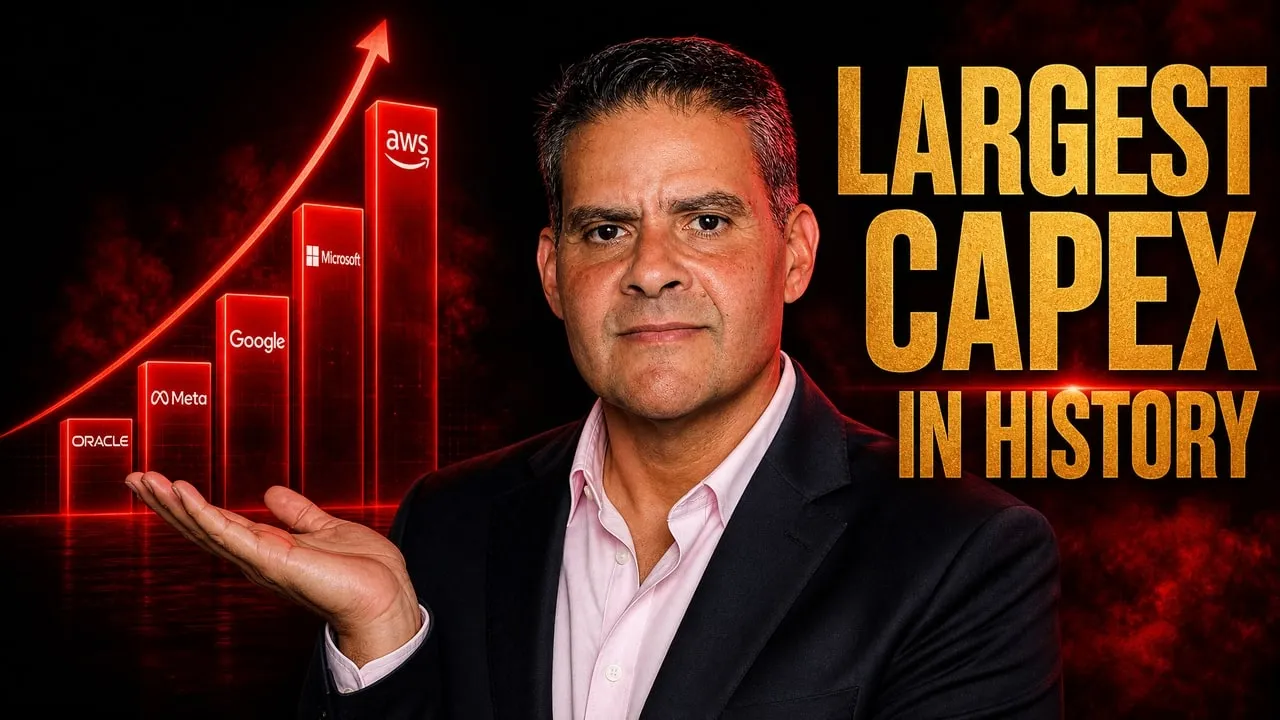
Good morning. This is Dylan Jovine with Behind the Markets. Happy Thursday. Today is Thursday, August 13th. Today, I'd like to talk about the size of the CapEx spending and outline a little bit more of the return side of the equation. If there's any one big thing I'd like you to get from this channel after all these years is the constant need to focus on return on investment. Return on investment. Whether you are focusing on your stock market operations, your investing operations, whether you're comparing investing in a bond, $100,000 in a bond that gives you 3% to 4% a year versus an equity. What gives you the best risk-adjusted rate of return on your investment? Whether you're comparing two stocks or whether you run your own business and you have a bunch of young people coming to you with all these great ideas and you need to figure out a way to filter them, a framework for making that decision. You want to think about every decision in terms of return on investment. And one of the big question marks with AI is that we've been talking about the big, big spending. Where is the spending gonna go? What will the return on investment actually be for these companies? And just to give you an idea of the size and scale, this is probably the largest CapEx spending spree in history. I'm talking about even the railroad boom, electricity, coal, all the things I've mentioned in prior conversations. Hyperscalers have committed a record $2.6 trillion in future spending across data center leases and equipment purchases. And, you know, this includes leases for data centers, power infrastructure that have not even been commenced yet. A lot of these obligations don't even appear on the balance sheets, by the way. This is another thing I try to drive home to the young people that work with me, is that you really got to look at the footnotes to the financial statements. It's like that old expression about the military. You know, amateurs study battles, professionals study logistics. Amateurs just look at these income statements and balance sheets. Professionals look at the footnotes. So anyway, I have some numbers here, and I thought it was important to go over them with you. Alphabet has the largest at $811 billion in purchase commitments, and $85 billion in leases not yet commenced, which brings its combined obligations to almost $900 billion. By contrast, Oracle has committed $32 billion to purchases, but $260 billion has been committed to leases that have not yet commenced, which is the largest lease obligation among the group, and the group includes Alphabet, Meta, Microsoft, Amazon, and Oracle. Just some other numbers. Meta is $349 billion, although $279 billion shows up on its sheet. Microsoft is $228 billion, $329 billion in leases not yet commenced. Amazon's $130, $130, and Oracle's even bigger. So why are they spending all this money? Well, we've seen so far that for Alphabet, for companies that serve corporate customers, whether it's Microsoft, Meta, Amazon, they're already seeing a return on their investment. They're actually building out based on demand from their corporate customers. They're just showing me the beef, you know. Where's the beef? They're showing the beef. Companies that have not done so well yet are the ones that have not translated it into actual revenue yet, and I would put Oracle in that category. They're just spending more than they're showing. And of course, Meta, which is one that I like because of the underlying business there. But again, if you're a consumer-facing company, you're spending almost as much as the big dogs, but you have not figured out how to monetize that yet, which is the problem with Meta, which is why it's trading the way it's been trading. But look, a new forecast out from Bloomberg shows why the spending is so outrageous. Generative AI is expected to be a $2.3 trillion a year market by 2035, and it is expected to account for 22% of all tech spending across hardware, software, services, you name it. So just by 2032, this is expected to be a $2.3 trillion a year market. So that's what they see. What they see is we have $2.3, $2.4 trillion in spending commitments, because by 2032, we expect this to be a $2.3 trillion a year market, which over ten years, if it just stayed at that rate, is $23 trillion. So from their perspective, they're investing $2.3 trillion to make $23 trillion or, you know, I'm just using simple math, over the next few years. That number has increased and what we're actually seeing here is the generative AI market has reached an inflection point where inference, not training, is becoming the dominant real factor. It's the dominant revenue driver. And what does that mean? AI training is when you have this heavy learning phase where a model is actually learning to analyze massive amounts of data and kind of adjust its internal weights, where by contrast, AI inference is the active deployment of that model. You know, imagine that model has taken everything that it has learned and actually goes off, it jumps out of the nest and starts to fly. It actually processes the information it has, real world data. And that distinction is very, very important because think about what Elon Musk is betting his entire life on, business career on. He's betting it on the inference side of the business, right? He's betting it on actually, robotaxis. It's not AI training, it's inference. It's already a trained AI, and it's inferring what it can do in a real world scenario. So we're talking about agentic AI. We're talking about robots. We're talking about robotaxis, robo spaceships. That is where the future of this is going. And you know, that not only portends well for companies that are really well-positioned in that. We talk about this, a lot of these inference chips, CPUs are very important. We've done a report on that. We talk about the EI era, you know, embodied intelligence. This is a code word in a lot of ways for embodied intelligence. Again, that robot taxi, robo-taxi, this automated self-driving car that has to process tons of information instantaneously so it doesn't hit the mother and the child walking in the crosswalk in front of it, right? That's inference, making those real-world decisions. And a lot of the positions that we have are really focused on that part of the puzzle because, you know, actually Wall Street isn't even caught up to this yet. The smartest group of the party is, but it's still very, very early in this game. We are in the second, maybe third inning of this development cycle, maybe the fourth inning. But, you know, it's very interesting how clear it's becoming where this is going and all of the amazing opportunities that are still in front of us. Anyway, that's all I have. Have a wonderful day.
Comments 0
Sign in to join the discussion.
Sign inNo comments yet. Be the first to share your thoughts!