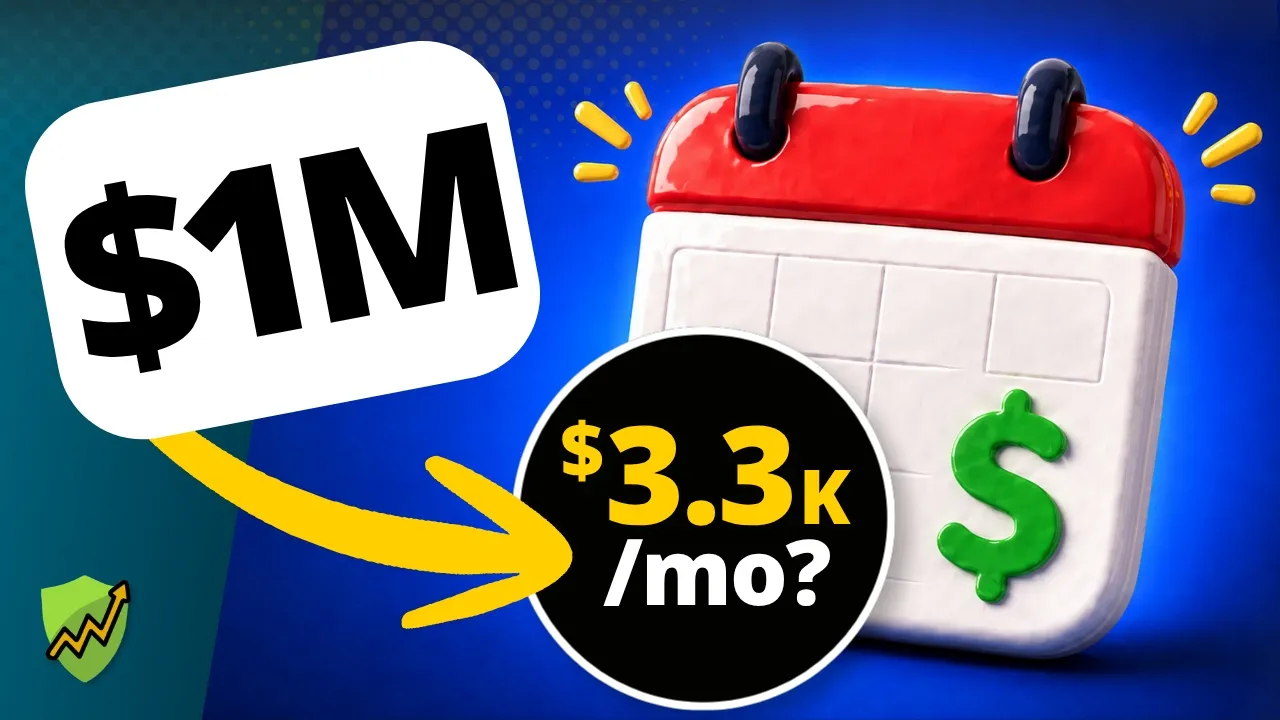
What a $1M Dividend Portfolio Pays Each Month (Realistic Example)

- Video return
- —
- Calls
- 1
- Buy / Sell
- 1 0
- Published
Recommendations
Entry is the asset's closing price on the publication date. Current is the last close on record.
-
Entry $46.00 14 Aug 2026Current $46.00 14 Aug 2026Result +$0.00
The pandemic would have been a great time to buy this stock.
Context “The pandemic would have been a great time to buy this stock. Same with after rates came up in 2022.”
Full Transcript
If you had $1 million invested for dividends today, how much could you realistically expect to collect each month without taking on too much risk? Well, at a 3% yield, that's $2,500 every month. At 5%, we're talking over four grand. And if you push the yield even higher, the income starts to look really attractive, but that's also where things can get dangerous. So, in this video, I'm going to build a realistic $1 million dividend portfolio. I'll show you what it could actually pay each month, and I'll explain the key tradeoffs to think about if that money needs to last through a long retirement. Before we start building this portfolio, I think it's worth explaining why dividends appeal to so many retirees in the first place. Now, of course, there's no perfect retirement strategy. Cash gives you stability. You're not going to risk your principal, but its income changes with short-term rates, which can fluctuate significantly over a full cycle, and its lack of growth means that inflation will erode your purchasing power over time. Now, bonds can provide more predictable income that you lock in over a longer period, but that income is usually fixed, so again, no growth. So, it's unlikely to keep up with your living costs rising, either. Now, a stock and bond portfolio following something like the 4% withdrawal rule can work well, but your sustainable spending still depends on things you can't know in advance, like future returns, inflation, how long your retirement lasts, and when the bad market years are going to show up. Now, dividend stocks have risks, too. Prices can fall, and dividends can be cut, but they also offer an unusual combination of current regular income, the potential for that income to grow over time, protecting your purchasing power, and less reliance on deciding what to sell whenever you need cash, which can help a lot behaviorally. After spending decades building a nest egg, some retirees simply find it easier to spend the cash their investments distribute, rather than gradually selling down their portfolio. One of our members at Simply Safe Dividends told me he used to live and die with the market's daily swings. Now, he mostly focuses on the dividends coming in. Of course, dividends aren't free money. The stock price will adjust for the payout when it's made, but people aren't robots, at least not yet. If a dependable income stream helps you stay invested and worry less about when or what to sell and what the market's doing, that can be really valuable. So, what should we actually look for in a dividend stock if we're trying to maximize current income while still protecting our capital, keeping the dividend safe, and growing our income stream faster than inflation over time? To answer that question, I'll be using our website Simply Safe Dividends to screen for ideas and then build and review the full $1 million portfolio. If you're not already a member, but want to evaluate your own portfolio and find safe dividends, there's a free trial link in the description below, no credit card required. To build this portfolio, I'm starting with a fairly demanding screen. I want companies that are yielding at least 3%, but I don't want to get that income by sacrificing too much quality. So, I'm also requiring a safe or very safe dividend safety score from us to reduce risk of a dividend cut. I'm demanding an investment-grade credit rating from S&P. I'm looking only at stocks that have raised their dividends annually for at least 10 plus years, and I want average dividend growth of at least 5% over the last 5 years, keeping ahead of inflation. That results in 35 matches today. I went through these stocks here to pick out ones for our portfolio, and this group is going to form really the core of that portfolio. But, I also look at two other buckets. Outside of this core group, I have a growth bucket where I'm screening for somewhat lower yields with faster dividend growth. Uh these types of stocks are the ones that can really help support the portfolio's long-term income growth over time, and it's worth sacrificing a little bit of yield to get these in the portfolio in my opinion. I also have an income bucket that I'll draw from. Uh these stocks here have a yield of at least 5%. The trade-off is much slower growth. So, these stocks can be more sensitive to changes in interest rates. They can behave a a bit more like bonds. Sometimes you are willing to sacrifice a little bit of quality to get a higher yield in the portfolio to support the portfolio's current income. So, these names will make up a portion of the portfolio as well. NNN is a good example of the type of stock I'm looking for. It yields over 5%. Its dividend was raised by around 3% in July. That's keeping pace with inflation, has a BBB+ credit rating from S&P. We give it a safe dividend safety score of 80. Very reliable dividend payer for a long time. Over 35 consecutive years of dividend growth. Keeping that pace of growth around 3% annually. The valuation today looks pretty reasonable. This blue band here shows where the stock would trade if it was within 10% above or below its 5-year average dividend yields here. The pandemic would have been a great time to buy this stock. Same with after rates came up in 2022. Today it's right in the middle of that blue band, so pretty reasonably valued. We can see that reflected here in the price to AFFO ratio here, similar to the P ratio for REITs, and the dividend yield. Both are in line with their 5-year averages. We can see here that cash flow continues to cover the dividend. NNN's AFFO payout ratio sits just below 70%. Cash flow per share has grown very steadily over the past decade outside of the pandemic here, and is expected to grow another 4% in the year ahead. So, steady as she goes. Let's see how all these different stocks come together now to form our $1 million portfolio. So, here it is, our $1 million dividend portfolio. It generates just over $40,000 of annual income, good for a 4% dividend yield. If you're trying to build a conservative, well-diversified portfolio, I think it's hard to significantly beat that yield in today's market environment. We'll talk more about that soon, but let's take a look at that income stream, how it comes in. So, throughout the year you're getting between 3 and 3 and 1/2 thousand dollars of dividends every single month. That's coming from our 25 holdings, which we'll also take a closer look at soon. But the portfolio itself is very well built. Despite only having 25 holdings, it's well diversified. No sector exceeds 20% of the portfolio's overall value. It looks very different from the AI-driven S&P 500, which has 40% in tech. This portfolio just 10% in tech. And it also has exposure to some areas of the market like financials and industrials that can do better when rates rise. So, a lot of high-income portfolios will be overly exposed to things like REITs, telecom, utilities, areas that are very rate sensitive. This portfolio has a nice mix. The income stream is also well diversified. Enterprise Products Partners is our biggest contributor at 6.5% of the portfolio's dividend stream, followed by Verizon and NNN REIT. So, if anything were to surprise us and one of these companies ended up reducing its dividend, it would be far from disastrous for the portfolio's overall income stream, especially because the base dividends are growing at a healthy clip. You can see this portfolio's dividend growth rate has averaged close to 6% over the past decade and is up over 5% this year alone. Uh that's just the organic dividend growth from each of the holdings. There's no dividend reinvestments in that number. So, a very solid pace that's been beating inflation. That'll help protect our purchasing power over time. Uh if we look at that dividend growth rate we've had of about 6% per year, that 40K today would turn into $70,000 10 years from now and continue to exponentially grow from there. Even if you shave off a few points for inflation, maybe our real growth rate is closer to 3%. That 40K today would be worth close to $54,000 in a decade of real purchasing power. So, uh very nice positioning there. That's again without any dividend reinvestments and no additional contributions to the portfolio, just the organic dividend growth coming from those companies as they become more profitable and raise their dividends along the way. I also want to point out that this portfolio's beta is just 0.66. That means that over the last 5 years on average, these 25 holdings have been around 35% less volatile than the broader market. So, a portfolio like this you would hope to hold up a lot better if there is a big downturn in the markets. It's lack of tech exposure there could also play a role if we see some wind come out of the AI trade eventually. Dividend safety is obviously a very important point in retirement here. If you're unfamiliar with our dividend safety scores, since 2015 we've been rating companies for dividend safety. Scores range from 0 to 100. Investors who stuck with companies that maintained at least a safe dividend safety score would have avoided at least 97% of the more than 900 dividend cuts we've seen during that time. We have a public track record here showing all of the cuts, what our safety score was before the cut was announced, showing their predictive value. So, I like to keep a portfolio focused primarily on securities that earn safe and very safe scores, which make up 86% of this portfolio's income stream. There is a portion that's rated borderline safe, 14% of our income. We expect at least 2/3 of companies with this rating to maintain their dividends over a full economic cycle. You'll also notice that I have two covered call ETFs in this portfolio, including JEPI. Now their uh income streams are going to be more volatile um more variable rather. In JEPI's case, we can see its 12-month payout here moves. It's very highly correlated with the S&P 500 volatility index. When volatility is high, the option premiums it generates move up. When volatility reduces, the same thing is true and distributions will fall. So, you expect some volatility over a full cycle, but we expect JEPI's yield to kind of be in that 6 to 8% range over time. What's nice about owning something like JEPI is that when the tide does go out, like say 2022, volatility rises and that can lift JEPI's income stream and offset any surprise cuts in a portfolio potentially. JEPI's also done a nice job of preserving its net asset value or NAV over time. That's because the fund's total returns have exceeded its average payouts since inception. So, it's not a big position. JEPI's about 5% of this portfolio's income and I think it's only about a a 2% weight in the portfolio. Let's see here. Yeah, there's JEPI, 2 and 1/2%. So, we're not going crazy with these covered call ETFs because they lack growth. No stock exceeds 5% of the portfolio's value. You can see that a lot of these companies here have very strong credit ratings. I think when I counted, I think 14 of these stocks had BBB+ or higher credit rating. So, again, very strong balance sheets here. Dividend yields range from, call it, 5.7, even a 12% yield or here, not a big position, on the high end to sub-3% on the low end. These lower yielding names are giving you much faster dividend growth to kind of help balance those current income plays. So, overall, you're going to see names in here, a lot of which are pretty popular in dividend growth portfolios. Abbott Laboratories, Enterprise Product Partners, which I mentioned earlier. McDonald's is in this portfolio, NextEra Energy. So, we're not doing anything wild here. We're focusing on blue-chip businesses that have been around a long time. Many of these companies have very long dividend growth streaks as well. And they have just very durable businesses. They're providing essential products and services. They generate great cash. They're conservative with managing their financial position. So, these are companies that I would hope to hold a very, very long time in my own portfolios here. We have three in our newsletter, three model portfolios. I average about one to two trades per year. And when you own companies like these that are typically in slow changing industries and good financial shape, you really don't have to do much trading with this type of portfolio. And if anything does ever change, we'll send you an email anytime a dividend gets changed. We'll publish research on these companies as well and send emails out to anyone who owns the stock. And if we ever see a change in their dividend safety profile, we'll also publish a research note explaining why we're changing their score. So, it's very easy to stay on top of the things that matter most for your portfolio if you're concerned with generating safe income, preserving capital, and just really keeping your portfolio between the guardrails. If you want to check this out for your own portfolio, I encourage you to try a free trial of Simply Safe Dividends. There's a link in the description below. You can research different dividend stocks, see how your own dividend safety pie chart looks here, and just make sure you're on track with your goals. I thank you for watching this video, and I hope to catch you in the next one.
Comments 0
Sign in to join the discussion.
Sign inNo comments yet. Be the first to share your thoughts!