This "Black Swan Event" could Crash Stocks... (HURRY)

- Video return
- -1.11%
- Calls
- 9
- Buy / Sell
- 9 0
- Published
Recommendations
Entry is the asset's closing price on the publication date. Current is the last close on record.
-
Entry $339.30 17 Aug 2026Current $336.87 18 Aug 2026Result −$2.43
something like Tesla, right?
-
Entry $28.83 17 Aug 2026Current $28.23 18 Aug 2026Result −$0.60
something like Zeta Global or Rubric or Palenteer, right?
-
Entry $101.02 17 Aug 2026Current $100.36 18 Aug 2026Result −$0.66
something like Zeta Global or Rubric or Palenteer, right?
-
Entry $172.55 17 Aug 2026Current $171.54 18 Aug 2026Result −$1.01
something like Zeta Global or Rubric or Palenteer, right?
-
Entry $117.70 17 Aug 2026Current $119.49 18 Aug 2026Result +$1.79
Uh Service Now, there's a lot of examples of this automation
-
Entry $444.60 17 Aug 2026Current $433.67 18 Aug 2026Result −$10.93
Rockwell Automation, Symbiotic, Zebra Technologies, UiPath.
-
Entry $42.35 17 Aug 2026Current $40.46 18 Aug 2026Result −$1.89
Rockwell Automation, Symbiotic, Zebra Technologies, UiPath.
-
Entry $371.26 17 Aug 2026Current $366.42 18 Aug 2026Result −$4.84
Rockwell Automation, Symbiotic, Zebra Technologies, UiPath.
-
Entry $15.99 17 Aug 2026Current $15.58 18 Aug 2026Result −$0.41
Rockwell Automation, Symbiotic, Zebra Technologies, UiPath.
Full Transcript
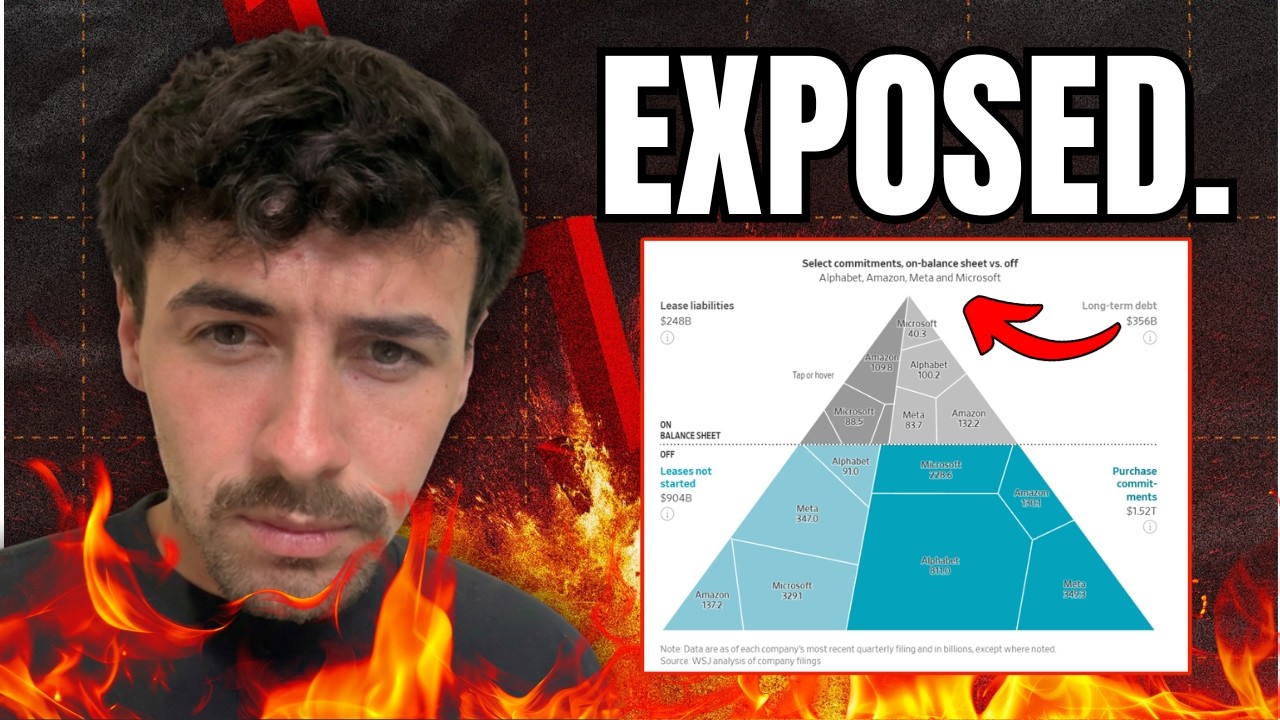
Something happened today that changes everything for the AI trade. The Wall Street Journal today reported that there is actually $3 trillion of additional debt from Amazon, Meta, Alphabet, and Microsoft that is not being accounted for on their balance sheets. Now, we all knew this was happening, but I think Wall Street was caught off sides today by just how large this number is. Even Tom Lee in his video out today says, quote, "Is the $3 trillion AI buildout hiding real risk?" Now, look, we're going to play the clip from Tom Lee, but I just want to tell you right now, it is very misleading. Like, one of the most misleading clips I have seen from Tom Lee ever. And I genu genuinely like the guy, but he made a fatal mistake in how he explained this. And I'll clarify it in this video. So, ladies and gentlemen, if you cannot tell, we have an absolute banger to get into today. I don't want to waste your time at all. The only thing that I ask you to do is hit the like button for the YouTube algorithm to help push this video out to more people that need to see it. Okay, so this stuff gets a little complicated. I want to keep it quite simple at first so we can all understand what is going on. So, if you take a look at Alphabet, Amazon, Meta, and Microsoft, their long-term debt stands at $356 billion total. Okay, for all of them, right? Lease liabilities at $248 billion. That is the debt that we know of. And you could see that in gray here. Okay, Amazon 132.2 billion, Meta 83.7 billion, Microsoft 88.5 billion, Amazon 109.8 8 billion and Alphabet at 100.2 billion and Microsoft at uh you know 40.3 billion at plus 88.5 billion. So that's what we kind of know about at this point. So this is the difficult part to kind of conceptualize to to make sense of and I'll do my best to explain it here. The 1.52 trillion in purchase commitments and 94 billion worth of leases that are not yet started are not on the balance sheet yet, but are coming on the balance sheet. So, think about it like if you have a wife and you're like, "Hey wife, uh, I'm going to buy this truck, right?" and you guys share a bank account and maybe she's thinking you're going to buy like a used truck that's like $5,000$10,000 but you go out and buy a freaking Denali or Cyber Truck that's like a h 100,000 she's like whoa that's a lot more debt than we thought we were going to have right it's one of those things where a lot of people are looking at the balance sheet of Microsoft and they're like okay 40 billion plus you know 120 billion worth of debt not too But in reality, there's 329.1 billion worth of additional debt that's going to hit the balance sheet in the next, you know, 1 to two years on top of whatever else they issue in the open market. So you could have a situation where Microsoft two years from now has 700800 billion worth of onbalance sheet debt a year or two from now. So, it's not on the balance sheet yet, but it's already committed to becoming. Does that make sense? And this circles back to like operating expenses, right? So, if Microsoft has $120 billion worth of debt they're making payments on it, let's say 5%. That's like a 89 billion yearly pitfall to their operating income, right? To their free cash flow. Well, if Microsoft has $700 billion worth of debt a couple, you know, two years from now, what is that? That's five times seven. That's $35 billion worth of a hit to their operating income two years from now. It will grow exponentially and pressure profitability if AI investments do not pay off quick enough. doing this is because it's like if you went out and got 10 credit cards and went and maxed all of them out. Your credit score is going to take a massive hit. Well, businesses at the size and scale of hyperscalers, they don't really have a credit score. They have credit ratings. So, every time Google wants to go out and raise $20 billion worth of debt, what happens is the credit agencies, they look at, you know, Google's balance sheet. They say, "Oh, looks good. You're doing great. Things are going great. We'll give you the $20 billion at a double A rating, right? They get a great rating so they can offer that debt at low interest rates." Well, now that it looks like, whoa, Google, you have uh almost a trillion dollars worth of debt, your credit score is is is worse off. So I think the risk is at this point and the reason why hyperscalers have been doing a lot of this offbalance sheet financing is to protect their credit ratings to be able to raise debt at lower interest rates. Well, now that everyone kind of knows the cat's out the bag here, the credit ratings could be at risk. And that is a fear point in this market that could be quite problematic. And we'll talk about that later into today's video. But that's why they're doing it. And that's kind of what the consequence could be. Briefly before we move on here, I do want to kind of explain how this is legal, right? Because this is legal. They're not breaking any laws. What what's happening here is Meta, they're only taking like 20% of the actual commitment to let's say build the data centers, right? But what they're doing is they're the ones that are operating the data centers. the Meta, as you can see here on on screen, they're actually operating the data centers, putting the chips in the data centers, leasing the data centers, but just, you know, 80% of the initial investment that was put up by Blue Owl in this case, they're getting the payment, right? So Blue Owl's getting a massive payment from basically financing the a chunk of the initial cost of the data center while Meta is actually putting all the in the data center. Right? So Meta operates the data center. They make money from it. They make massive payments to Blue Owl and to the bond holders. So that is why this is actually legal to not report this off debt off balance sheet debt is because Meta's maybe only taking 20% of the initial investment into the data center and then they're just putting the chips in, right? So they're not the ones that are taking on the vast majority of the quote unquote risk when in all reality they actually are. Because if what do you think happens if the data center fails? If AI were to flop tomorrow, it's Meta and private credit, private capital funds that are up shits creek. Meta doesn't walk away scot-free. Not at all. Now, Tom Lee actually came out on uh CNBC today to talk about this, and Tom Lee made a fatal mistake in how he explained this. Tom Lee basically put it in a sense that these contracts could just be cancelled, right? If you know things don't go well or whatever, you could just cancel the contracts. Like this is not the end of the world. This is not another Enron situation. But you can't cancel these contracts without the whole AI trade falling apart. This is locked in debt. This is real debt, right? Whether or not there's too much debt or it's unsustainable or not, that's a different question in which unfortunately Tom Lee did not paint it in that light. He basically made it seem like, yeah, not a big deal. And maybe it's not a big deal. Maybe, you know, if you're a $4 trillion company, having a trillion dollars worth of debt isn't that big of a deal. I could get behind that potentially, but it does put a lot on the line. And you can see that here. If hyperscalers were to back out of these offbalance sheet agreements, the entire artificial intelligence ecosystem would experience a systemic liquidity event, it would basically trigger a depression overnight. There's no getting out of this. And as I said at the start of this video, there is a silver lining. There is a really positive takeaway from this as well. You do not want to miss it. Now, it says there would be a private credit and neocloud collapse. A massive portion of these unstarted leases is financed by private credit funds backing Neocloud providers like Coreweee or Lam Lambda Labs. If Microsoft or Amazon cancel their usage leases, these specialized data center operators instantly default on their debt obligations. Again, I don't think this is going to happen, but it's the risk if it did happen, right? hardware demand liquidation the 1.52 trillion in purchase commitments primarily secured as advanced chips like Nvidia GPUs that house of cards would come crashing down the real issue is for the hyperscalers that these offbalance sheet commitments and this debt it it comes in the form of operating income. it hurts operating income down the line. Whereas right now the the offbalance sheet um debt essentially is not affecting operating income today. But as these data centers finish finish construction, they migrate above the line onto the balance sheet automatically triggering mandatory payment schedules. So the amount of debt at these hyperscalers is going to balloon a lot faster than they even go out and like raise debt in like in in front of you, right? Like Google's debt could go up $300 billion in the next year, let's say, when data centers begin to actually operate, but maybe they only raise a hundred billion dollars. the debt's going to grow exponentially and that's when you will start to see the hit on operating expenses. So basically operating income will be reduced as more debt goes onto the balance sheet over the next one to three years. You're going to see this balloon. It's kind of like the government, right? The government borrows a ton of debt, $40 trillion in debt. Well, their interest payments continue to go up quickly and a lot in the last couple of years. That's what's going to happen with hyperscalers. So, if AI doesn't actually produce great returns quickly in the next couple of years, you're going to see the the debt payments really erode profitability at hyperscalers. But that is more of a longer term risk, right? That's that's more of a risk in the next two to five years. I don't think that's something that we have to be super concerned with today. I think the biggest problem from a market's perspective that this um revelation could have is from the credit agencies, right? The credit agencies are now like, "Oh my gosh, Google's got almost a trillion dollars worth of offbalance sheet debt. Uh should they have a whatever AAA rating or a A rating, whatever they have? I'm not exactly sure, but I know it's it's up there right? That would be a problem if some of those ratings begin to come down because even then a lot of firms cannot give you money unless you are a certain rating, right? Like Oracle does not have the same kind of liquidity pool that Apple has. Certain investors and banks can only lend a certain amount of money to certain rated firms. Like if you're Apple, basically you can get money from everyone, right? If you're some of these hyperscalers, you can get money from everyone. Do you think a small cap biofarma can get money from everyone? No. Do you think a you know random company out there name the company has as much access to capital as Apple does? No. It's based on credit ratings. And with AI and the expected, you know, 350400 billion worth of onbalance sheet debt that will need to be raised over the next 12 months. If literally the the pool of available money shrinks if credit ratings come down, that's going to make it difficult to raise enough money to actually cause AI stocks to go up, which in turn hurts the markets. So yeah, I know that part gets a little confusing, but basically you can again think about it like this. Over the next two to five years, the debt on balance sheet is going to balloon from Google, the hyperscalers, not because of future debt raises that are coming, but because of the debt they're already obligated to spend. On top of that, over the next 12 months, hyperscalers are going to have to issue hundreds of billions of dollars worth of debt. Now that this problem is in front of everyone via this Wall Street Journal report this morning, it could put pressure on credit rating agencies to lower some of their credit ratings. And yeah, that can happen at even some of the highest quality, most, you know, valuable companies. If that happens, the available pool of money to to raise debt from shrinks because not everyone can just give money to anyone, right? There's a lot of stipulations. Some companies can only lend to A-rated companies. So, it makes it harder for the AI trade to be sustainable, let's say, three, four, five years from now. if credit agencies downgrade these companies, if there's more nervousness around the offbalance sheet debt. And that's really the long story short version. And look, maybe this just blows over. Maybe people don't care. That's I it wouldn't surprise me, right? It's something you should keep your eyes on at this point. Be vigilant about, but I don't think it's time to panic. I think it reinforces the same narrative that I've said on this channel for a while now that look, I don't like AI hardware stocks. I don't really like the hyperscalers either until they start spending in a more reasonable sustainable way. I think there are much better opportunities out there and I think we are heading into the new AI trade which is robotics, automation, AI software and cyber security. And that is actually the silver lining that I wanted to share with you in this video. All of this $3 trillion worth worth of total debt out there, this onbalance sheet, offbalance sheet debt, and future debt that is coming, which is going to be insane over the next couple of years. Here's the silver lining. Look, a lot of AI has come from you and me, right? chat GPT users and single development teams or or maybe a couple people in development teams using Claude, right? We haven't even hit enterprise AI adoption yet for $3 trillion worth of debt to actually pay off. These companies are betting that robotics, automation, AI software, and cyber security is in massive demand in the future. That's the silver lining that I get out of this that if they're really willing to like bet their whole company on this to some extent they kind of are at this point they're betting that some of these projects that we are investing in right now are going to be much bigger in the future. You know cloud's not going to dominate the markets. some of these AI software companies like a service now. This is great news for Service Now because it means look service now is probably going to have more, you know, need to use AI products and need to use more compute for serving their customers with AI needs, right? This is a great sign for Rubric, right? This is a sign that AI usage is projected to grow exponentially from here with no sign of stopping anytime soon. If Max 7's correct and they're spending $3 trillion for the future, you bet your ass you better have AI software a massive success. You better have cyber security needs explode. You better have robotics and automation just take off. If not, the spending's futile because where do you think the AWS leases are coming from? They're coming from AI demand, which is coming from robotics, automation, AI software, cyber security, things like that. Now, I do want to share this clip with you from Tom Lee. Again, it is titled, "Is the $3 trillion AI buildout hiding real risk?" I don't think Tom Lee put his best foot forward in this and kind of explaining it, kind of downplayed it a lot. And again, it might not be a big problem. I think the biggest near-term problem is with the credit rating agencies kind of highlighting how much debt that is out there. Any kind of, you know, deratings would not be great. And we are in a seasonal weakness period right before the midterms. But this is something that again there's silver linings for this means that the stocks that we're investing in like in the trading community linked down below in the description of today's episode, Google's basically betting their whole company on some of those companies being wildly successful with AI, you know. Um, so there is a massive silver lining assuming things go well. If things don't go well, you're basically guaranteed to have a depression at this point. Like there there's no other way to put it. So I think Tom Lee kind of downplayed the risk a little bit. Take a listen. >> Thoughts on on a mag seven type of big tech I don't like the word hyperscalers but um are these companies that you own or have been avoiding just so we get a sense for how the these commitments might factor into your your >> short answer is yes we own them. Uh and for a long time I've been saying by chips on dips uh because we think that this is this is just the infrastructure build out of AI and so when we look at all these large numbers we're recognizing we're going through a transformation for our economy that's is as big as a transcontinental railroad. We're spending about two and a half% of our total GDP on on the AI buildout maybe a little bit more. Well, that's about what we spent on the transcontinental railroad from 1850. >> Refresh my memory. Which were the right railroad stocks to have been on during that? >> Not all of them. >> Not all of them. And that's true. Not everybody is going to knock the cover off the ball. But you have this insatiable desire for being in front of what's really important. I mean, it only matters if it increases labor productivity. If AI doesn't increase labor productivity, it's >> in other words, you don't care if it's 600 billion here or whatever trillion in the future. As long as they're spending on the railroad boom, you're okay owning these stocks. >> We're we're spending on the AI boom and and we're spending we're going to in 207, we're going to spend more on AI and that boom than we do on the Department of Defense. Here's the thing that uh Tom I wonder about the Wall Street Journal article because when I see all that offbalance sheet financing I start to remember Enron and all the offbalance sheet financing and it's on top of that you've got these structures with private credit funds that have a holding company that's in the JV and then there's a third company that actually is issuing the bonds. So in the end who's holding the bag and is that more offiscation than actual good business and should we be worried about what seems to be a lack of transparency in terms of who's really lending the money and who's going to be stuck with it in the end? Um it's a great question because I was a tech analyst during the dotcom and fiber boom of the 90s and uh the people investing capital at that time were not of the same ilk and caliber of the Mac 7. You know these were companies that were digging up railroad lines and uh doing those IUs, you know, which was actually >> what's an IRU? >> It was a uh revenue swap between fiber companies. So you could create hundreds of billions of dollars of uh contractual revenue. And um today we have companies with fairly sizable moes and some of the highest profit margins and return on capital history and as the Bezos metric have delivered trillions of dollars of shareholder return that are now directing their investment on building uh a new moat around AI. So I have a lot more confidence that these are high level board wellreasoned companies investing but they're eyepopping numbers but the reality >> why not do it on balance sheet? Well, one uh they could do it on balance sheet, but if they did, they would be taking up all the capital of the world and all the risk and therefore actually make it harder for any I would argue that that would make it harder for to democratize. >> Can I ask an accounting question? We're we were calling off I [laughter] did I got to see. So, I need to ask all of you to make sure I'm understanding this. They have off balance sheet commitments because they're future commitments. Is that right? These are they're not hiding anything. They're not on the balance sheet because they don't flow through the balance sheet until the building actually begins. So, in other words, are they this is just a different way to look at if they say, "Okay, we're going to spend whatever amount in 2027." Can you explain to me exactly what these commitments are and why they're not on the balance sheet when they will be? >> Yeah. Um, well, I think maybe a good place to start is I think that the revelations uh from the journal article are actually helpful, but they're giving people an incomplete picture of how financial systems work because if you do, uh, you know, the gross obligations of the financial system, it's multiple times the underlying assets >> always or just today. >> Always. In fact, that's why Warren Buffett used to call credit derivatives, you know, the weapons of mass destruction. Are these credit derivatives that we're talking about though or these are just future spend commitments? >> It's the same arguably it's not that different because if you did like gross exposure of uh swaps or options like look at in any day options contracts are multiples of cash underlying. So if someone says oh there's a hidden offbalance sheet risk that retail investors have 20 times the size of the stock market in bets we'd be like well there's an offset. So I I would say when we look at these numbers uh it's giving a distorted view of the actual risk. >> Let me just press this analogy one more. In other words, do you think that the spending is representing multiple possibilities of spend that's only going to manifest in one way? >> I think to me um none of these contracts like are going to lead to criminal liability. Like in other words, like a company can decide to cut spending in the future and the contract should be weak. So like the three trillion isn't like you know people have to like sign over their kidneys to meet the house. >> See that was the part that Tom Le was kind of misleading about. Let me uh play that again for you in case you missed it here. >> Decide to cut spending in the future and the contracts would be weak. So like the three trillion isn't like you know people have to like sign over their kidneys to to how should investors think about this? I mean should they be worried? >> Yeah. Um nah can't really cut spending. uh the whole everyone's numbers are dependent on the spending happening like it is going to happen [laughter] right um question is more so about what's what's thereafter and maybe that's where the bigger problem comes about if you know uh Amazon did want to cut spending or Google did want to cut spending that's where like the whole house of cards would come down right because if you tell this company, look, we're going to build this data center with you. And then all of a sudden, the data center is halfway built and Google's like, yeah, uh, demand's drying up. We don't have the capital to continue to commit to that. The whole house of cards comes down. All the chips that were expected to go in there, like everyone everyone's numbers get hurt on that. So, I don't think you can really stop the spending at this point. uh the the train is moving but again I think the silver lining is these hyperscalers are literally betting their businesses on other businesses also being successful with AI not just themselves but others like another way to put this if if you sat Google's CEO down and said you know what are your thoughts about robotics automation AI software cyber security and future AI projects they're going to say so much demand they're going to be off the charts Why? Because they have to be if you're building all the data centers to power that to to to provide the compute for that, right? It's not all going to come from just chatbt and you know retail usage of AI. You need mass enterprise deep embedded adoption of AI at the end of the day. And uh I think that's a much better place to be investing at this point. So let me know your thoughts on this down below in the comment section. That is something like Tesla, right? something like Zeta Global or Rubric or Palenteer, right? Uh Service Now, there's a lot of examples of this automation, Rockwell Automation, Symbiotic, Zebra Technologies, UiPath. There's so many examples of winners from this that again have a silver lining here. Let me know your thoughts on this down below in the comments section. Hit the like button as well as subscribe to the channel if you guys have not done so already. Have a fantastic rest of your day and I will see you in the next
Comments 0
Sign in to join the discussion.
Sign inNo comments yet. Be the first to share your thoughts!