We remain allin. The cycle is elongated, supporting far greater duration than the market currently thinks.
Context
CJ Muse of Canford showed is bullish on Nvidia going into next week's earnings writing, "We remain allin. The cycle is elongated, supporting far greater duration than the market currently thinks."
I seriously think that Nvidia still has plenty of runway ahead of it and I think this company will be worth substantially more in future years than it is today.
Context
With all of this in mind, I seriously think that Nvidia still has plenty of runway ahead of it and I think this company will be worth substantially more in future years than it is today.
I would buy Cisco right here because of their negativity and I don't think Caterpillar cyclical all these days.
Context
These are the same people who would never buy Caterpillar. They would say I told you so when Cisco reported and give that weaker guidance rather than thinking about what a buying opportunity which is how I feel. I would buy Cisco right here because of their negativity and I don't think Caterpillar cyclical all these days.
Full Transcript
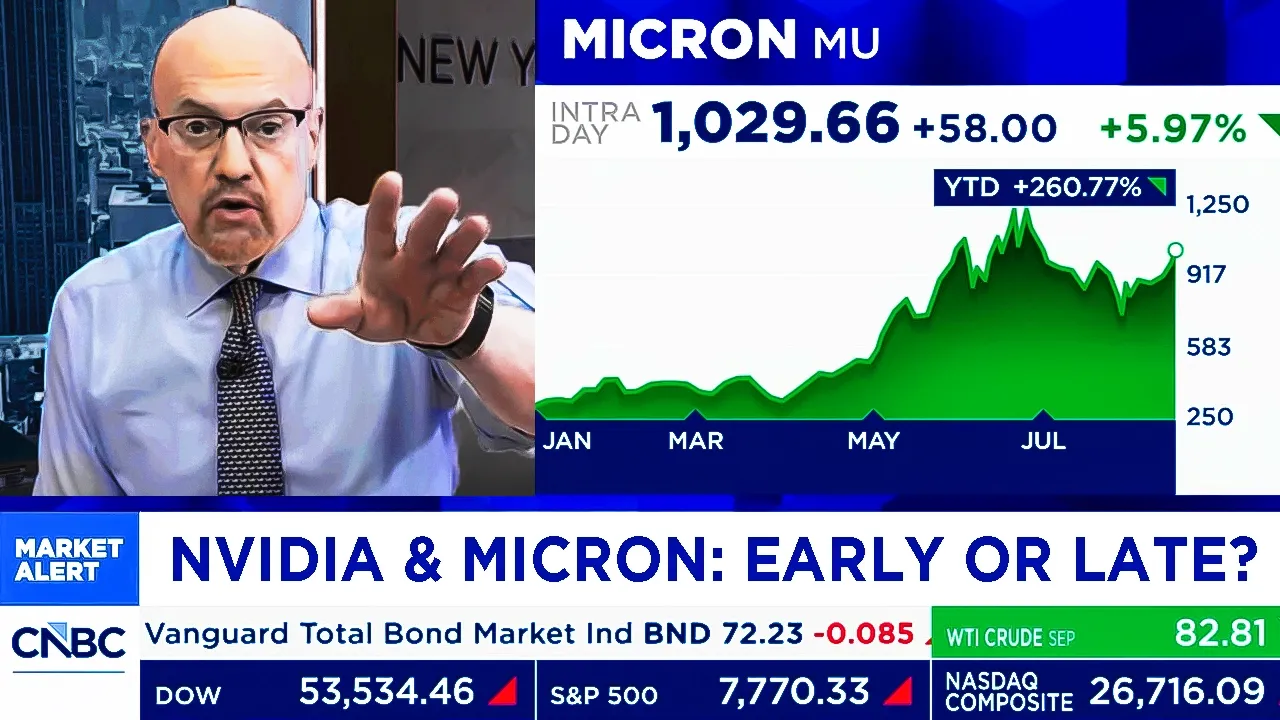
Hyper scatter capex fueling optimism in the chip sector. CJ Muse of Canford showed is bullish on Nvidia going into next week's earnings writing, "We remain allin. The cycle is elongated, supporting far greater duration than the market currently thinks." CJ joins us now for more. CJ, if you can build on that a little bit more because I think this is important. What do you think the market's missing about the longevity of this cycle? >> Yeah, good morning. Yeah, thanks for having me. Um, I think that is uh that is the key. I mean the the fears around Nvidia have been circularity around financing and also to the earlier uh comments around uh competition from custom silicon but I think if you take a step back computer sold out um TSMC is by far the biggest bottleneck. uh that in my mind leads to uh an elongated cycle where uh we are sold out already all of 27 backlog building 28 and I would dare say 29 uh and I think that you know from an Nvidia stock perspective the shares really haven't done anything this year um and they're going to earn $15 $16 next year so you're paying 15 times today uh for the leader in AI uh that just seems way too cheap in my mind and I think the catalyst or one of the catalysts will be the understanding that this cycle has legs. >> CJ, you're alluding to it. Ultimately, you're giving me what you think, but why do you think the stock has done very little in the face of massive spending plans? We've seen only increase from these companies. And even as they go negative free cash flow, the willingness to borrow in the debt market is skyhigh. In fact, it's insatiable. Even if there is a little bit of push back, they keep on coming in, keep on coming in, and those companies going to keep on spending, keep on buying chips from the likes of Nvidia. Why is the stock doing nothing in response to that? >> Yeah, it's a great question. I think there's a couple themes to think about. Number one, the multiples for compute and memory uh in aggregate are are quite low. So, it's not just Nvidia, you know, it's Broadcom, it's Micron, it's SanDisk, etc. Um point two specific to Nvidia you [snorts] know I think that um you are seeing increased competition from internal custom silicon. So Google and Amazon are the two largest there and and I think that worries around their market share for inference um silicon going forward um is a concern. Now I think very importantly around um financing the GPU market uh and the announcement from Nvidia and the likes of Black Rockck Apollo etc. you know are highlighting a new competitive moat um for Nvidia where they are going to create a financing platform to offer the lowest cost of financing uh and essentially make uh the financing of the GPU fungeible make it more like an asset back class security uh and you know I think that they're going to make this a multi-t trillion dollar financing vehicle and so when you go with Nvidia you're going to get the lowest cost per token per watt and I think going forward you're going to get the lowest cost of financing in the debt markets. Uh and that will be another competitive advantage for them that I don't think the market is giving them credit for yet today. >> CJ, there's not just competition in the United States. We actually have seen as well Chinese domestic alternatives really ramping up in terms of how quickly they are scaling. Are you concerned about Nvidia, which still sells some chips in China, losing some of that market share? >> Well, I think there's two parts to that question. The first one is that um you know, China internally uh is telling uh you know, their chip companies to buy locally. Uh and so I think unfortunately, you know, the the the the ship has sailed a bit in terms of positioning of US chip makers inside China. I I think the more important point on the technology front is that the solutions made inside China are are are just not anywhere near uh what Nvidia what AMD creates from the GPU perspective. It's more of a top- down edict you need to buy locally as opposed to a truly competitive solution. What did you make of Jensen Wong basically telling some of the com richest companies in the world that they need to pull their money for this $500 billion financing pool? >> I think from Jensen's perspective, he has a view that the compute necessary to bring AI to bear is more significant than really any other sort of investment cycle that we've seen. And because of that, all of the markets are going to need to get together uh to build the capacity to support this buildout. And I think, you know, Jensen with with all of the investments that they make throughout the entire ecosystem offers the great greatest seat in terms of visibility to what's happening in the market. And so I think he's seeing the the breath of compute that the market is going to need. And and I think that's what's driving his commentary. CJ, appreciate it. Still all in going into earnings next week. CJ moves there of counter Fitzgerald. >> You start off with those big moves in the memory names. The Round Hill DRAM [music] ETF jumping over 5% hitting its highest level in more than a month. SanDisk among the biggest winners up almost 9% its sixth straight day of gains. US listed shares of SKHEX posted their highest close since July 21st. The latest rally coming after a report. US Commerce Secretary Howard Lutnik is urging Apple not to buy chips from China. But will the demand be enough to drive these names back to new highs? It's amazing. It's like go back to the memory names. Go back to the memory. Nothing shakes the investor. >> No. But in a straight line, I think the answer to that question is no. I think there listen absolutely there's a chance that they all make new highs, but it's not going to be a straight line there. And this is now going on two and a half for three months. All these names, Micron, Sandis, Western Digs, you pick eight to 10 percent moves two or three times a week up and down has been the norm. So I think if you think it's just going to continue on this trajectory higher unabated for what did you say 5 days? I just think that's wrong. >> I mean it's amazing that in theory the leverage has been taken out at least on the South Korea exchanges, you making you're sort of joking but I think not joking really since [clears throat] you're the ambassador that every morning you check the Cosby first. >> None of that's funny to me. Mel, don't even joke about Korea. My goodness. Um, yeah. I I mean, I think it's important. Absolutely. And I have some fresh Korea stats. I mean, in other words, the Cosby rallied again, 2 and a half%. And so, you know, you you've you've put in about a 33% bounce off of uh where a lot of this stuff bounced back on July 29th. And and I I'll leave it to the the all the really talented chart people we have on this show, but the fundamentals um are are are challenging for me even in a world where I believe the demand is there. I don't think there's any disputing the man the demand. And I understand we we've elongated the cycle, but I I just don't know that in another year, that cycle that requires the 28 and the 29 purchases that have been already and the deals that have been cut, I don't know we're going to have the same demand on memory. I I that's part of what it is for me. It's certainly not the part of the trade that I would be chasing. I would be chasing uh places within chasing I I don't ever chase Dan. Um, but I mean, you know, it it's a it's a case where I think you have places within semiconductors that look a lot more interesting to me than memory. >> Thank you. >> Yeah. Um, I'm going to chase this, Tim. I'm going to chase this commentary. You know, a couple things here, right? And I think like the point that you made is really [clears throat] important. We know what the backlogs look like. We know what the RPO the the idea that they're going to expand dramatically is probably not great from these levels. Now, they can continue to beat upside in the near term. And I think that's one of the reasons why that stock went up a thousand% in such a short period of time, but it also got cut in half, right? And so when you think about this bounce right here, I don't think it is incorporating the potential for double triple ordering. I know that, you know, a lot of folks think that if you have these contracts, you take them to the bank, that sort of thing. We've seen in past tech cycles, especially in very cyclical things, that's not exactly how it always goes, right? So um I think when you look at this name and you look at Micron and you look at the access to whether it's high bandwidth memory or some of this stuff I mean at the end of the day what is it pricing right here and the idea of it going back to those prior highs it certainly can get there but make no mistake about it is likely to get cut in half again at some point and we talk about this all the time where if you were buying this on that last kind of push up for that last month and then you start averaging down because you think it's just a pullback and then you find yourself with it down 50% % you probably make some mistakes puking it out at some point. So this is just a really hard name right now. I think it's a hard space in general. I think there's probably other ways to express this view. And I think Tim's point is there probably are some semis that have more durable visibility than some of these memory names. So I think it's just a lack of assets that people want to buy. So they go from software to hardware to semis to memory and now memory is the dour name. When I look at it technically, 1254 is the high, recent high. The low is 737. So the 50% retracement is basically a thousand. We're right there. So I would not be a buyer here unless that level holds. >> More interesting than memory like what? >> Well, I I think Taiwan Semi is is very interesting. And I think Taiwan Semi really, forget all these deals that are getting cut in a circular fashion. Taiwan Semi is essentially the white label for some of the most important chip companies in the world and for some of some of the companies. And again, that chart is one, as I stare at it here, it is one that essentially you've had a 50% retracement and you're kind of back around that 50. Um, but I I I think and I like Nvidia here and I understand that there's a dynamic that is very concerning. Is Nvidia now a holding company? Does it trade at a discount? I mean, these are things that I think you have to think about. Even though I I I I'm comfortable with Nvidia here. >> Nvidia is not the Nvidia of a year ago. No, it's it's cheaper than it was a year ago. I don't know what to say about you, guy. >> Well, each day [laughter] I'm not the same person. The same people we are a year ago. [clears throat] Tim is right. Think about that for a second. >> I'm just talking about in terms of the financing aspect and you know like all the the loans that it's extended, the investments it's made. It's a different company. >> And you know that interview that Becky did, I think it was last whenever it was a week ago or so ago. I mean, that to me was either very encouraging thing or a little bit of a scary thing in terms of the amount of people there sort of retelling a story. Not retelling a story, but just adding a chapter to a story we've heard about for a long time. So, I'm somewhat on the fence, but to your point, Nvidia is cheaper, but it is morphed into a different company. Tim talks about that all the time, and I think he through his lens, it's probably a better company than it was a year ago. >> Just quickly to go back to you, do you think Nvidia looks like a better company today than it did a year ago? Uh, I think it is less tethered to, you know, GPUs and and at a time when we're not sure that GPUs are the way to the future. I don't love the fact that they have their fortunes riding on three companies that we're not so sure about. Front and center, the companies that make memory and data storage products that go into the data center, SanDisk, it's up 653% year to date. Seagate has galloped 261%. Micron's up 254% and Western Digital's up 211%. [music] These moves are all kind of incredible and definitely crazy. These memory names have become risky. They had been risky boom and bust stocks for decades. There'd be periods of spectacular growth followed by horrendous swoons that would wipe away all of your gains and then some. I always regarded the management teams in this business as financially suicidal because they'd overbuilt when times were good, sewing the seeds of their own destruction when things got bad. I was always reluctant to recommend them to you because of these wild boom bust cycles. Then along comes the data center and the world simply changed for them. The demand for memory ships has now become seemingly endless. These companies have all learned their collective lesson. They're not over building this time. They want the shortage to last. Memory is in such short supply that Elon Musk has taken to X to talk about how it's become the key bottleneck to data center growth. Meanwhile, the memory makers, they they've adopted this new business models with long-term agreements that lock in huge gross margins for multiple years out with their customers. They're basically building only to suit. They've raised prices to the point that Apple has complained that they're driving up the cost of your new phone. Can we trust these companies and their stocks? Now, three of them are buying back huge amounts of stock in their open market. Sandis has a $15.5 billion buyback. Seaggate side by working it way through a $5 billion buyback announced last year. Western Digital put a $4 billion in repurchase authorization early this year. They're taking that money and sending to you the shareholder. Rather than investing in new capacity only Micron has no buyback quizzical. These used to be smaller capitalization stocks, but in the two years since the data center buildout started in earnest, everything has changed. I want you to listen to these spectacular gains. When Sandis was spun out of Western Digital 18 months ago, it was a $7 billion company. Now it's a $262 billion company. Segates market cap was going from $21 billion to 225 billion in the same period. >> House of Pleasure. >> Western Washington was 17 billion. It's now 185 billion. Only Micro was sizable at 106 billion, but now it's a trillionaire. [music] >> That was easy. And you wonder why I think you should own some individual stocks side by side with your index funds. And you might think these memory stocks have all run too much. That's the consensus that I hear from. But their margins, which are immense, have largely been locked in for years out now with these agreements. CX gross margin came in at 52% it last quarter. A record. Last year it was 37%. Western Digital's gross margin was 54% up from 41% a year ago. This is incredible stuff, people. Sanders Quest Martin 26% to 85% one year Micron hit 85% up from 39%. These are monumental numbers. Eyepopping unheard of I remember when if Intel could ever get to 64 gross margin that would be amazing. Now listen to what these guys are doing now. People have a hard time getting their heads around this endless demand for memory. They don't believe the agreements with customers will hold up. The biggest fear they think that Samsung will break ranks and put up factories to flood the market with supply. Sure, that could happen, but not anytime soon. takes so long to build the factories. And look, that's why Micron sells for just seven times its fiscal year 2027 earnings uh estimates. Sandis trades at eight times. Now, if you look at fiscal 2028, Western Digital is at 16, Seagates at 17. In general, these stocks are cheaper than the market because no one believes no one. Well, maybe some, but people are making a fortune. Last week, we bought a position in Micron for the travel trust because I truly believe this industry has changed for the better. That said, I admit to being uncomfortable buying a stock that's moved up this much. Fortunately, we bought it at a big discount as it was trading with the prices at that moment of the Koreans, Samsung and SKHEX, not Seagate West Digital and Sanders. Timing was exquisite. Club members have to be happy. Although at the time I thought it was taking my life into my hands and I did, you know, concern that it could keep going down, of course. See, I don't really know a soul who's really comfortable buying stocks this high. I consider Micron more of a growth stock than the others. So, I console myself with the idea that maybe it's just not just restricting output that has made this thing go higher. But at some point, we all know this memory shortage has to end, doesn't it? I don't deny that. However, I do question the timing of any downturn. I think Micron can double again before the boom comes to an end, assuming there's no data center slowdown. I know that's a risky statement, but these long-term agreements are spectacular for Micron's margins. Of course, we know that there's now a lot of push back to building sites. Uh there could be some crimping memory stocks. I think there are plenty of towns that want them though. Those stories are too positive. They don't fit the negative narrative. Believe me, the media loves reporting negativity because that's what attracts eyeballs or at least they think it does when I see their numbers. I have to question it, but I'm an outlier. I am also concerned about this about something that uh Michael Intrader, CEO of Core We've said when I interviewed him last week that there was just no way we wouldn't overbuild. Double negative. Sorry. How will we know when to stop when the demand is so great? Why should we even think about that right now? Again though, I can't see the overbought happening anytime soon. So why not own one of the memory stocks? As I said at our investing club meeting last Thursday, you ought to go play the uh replay. The gray boards always tell you this time is different is the most dangerous statement because nothing ever really changes. And that's why see digital sanders and micro won't be able to change your strikes. Yet that attitude has scared you away from some of the most incredible gains I've seen in my career. These are the same people who would never buy Caterpillar. They would say I told you so when Cisco reported and give that weaker guidance rather than thinking about what a buying opportunity which is how I feel. I would buy Cisco right here because of their negativity and I don't think Caterpillar cyclical all these days. Now their takeaway by the way this is again these graveyards of situational awareness crash you know that one with the crazy hedge fun not crazy over lever hedge fun manager that they say he was not over lever they just said he was in the wrong stocks. I say that you have to free yourself of these constraints and understand that sometimes it really is different. Sometimes the opportunity is too great and you can't afford not to take it. No, it's not as stupid as something like oh sell in May and go away. That's real clever. But this whole data center move has created a gold rush that will turn many formerly cyclical stocks into secular growth winners. That's a very rare metamorphosis. But it's happening. The data centers, as we know from Amazon, can be huge profit centers. The opportunities for these companies are too stupendous to even think about holding their expansion. Too too much money on the line and that means they need these components. Ask anthropic about that. Best of all, with the exception of Nvidia and perhaps maybe AMD, these memory chips makers are perhaps the most indispensable of the entire buildout. Musk is right. Memory has become the bottleneck and these four companies. Well, you know what? It's pretty good if it stays that way. Certainly not their fault that the products in such demand. The bottom line, I say own. We pick Micron for the travel trust because of its growth. But the others have less risk because they just keep returning that money to shareholders through buybacks. In the end though, these moves are real. And while I acknowledge that I'm not early, I actually don't think I'm that late either. All right, I hope you're all doing well today and staying calm in this market. Monday was a red day throughout much of the market as hopes for a compromise in the Middle East faded and tensions showed no signs of abating. Oil and yields both moved higher as fears about inflation and a potential Fed rate hike increased. That said, when looking at a heat map of the NASDAQ 100, we can see that there was some positive action in some AI hardware stocks, especially in memory stocks for reasons that I'm going to address in a moment. On Monday, Nvidia announced they are partnering with SoftBank's SB Energy to secure land power and shell capacity at the ports Pike technology campus in Portsouth, Ohio to host Nvidia Compute. Open AI will be the tenant. In the blog post, Nvidia points out that cloud service providers have balanced sheets, infrastructure expertise, and long-term contracts to secure land power and shell independently. However, Frontier AI labs are different. These labs have extraordinary demand for training and inference compute, but many of them are growing faster than their balance sheets and long-term credit profiles can support. They may have strong customer demand and rapidly growing revenue, yet still lack the decadesl long infrastructure contracts and investment grade financing capacity needed to secure the AI factory infrastructure independently. Their growth is constrained by the availability of compute. If they had more compute, they would have greater revenues. And that brings us to the ports pie campus in Ohio. The initial deployment is expected to provide 4.25 two 5 gawatts of AI factory capacity. The AI factory will use Nvidia's DSX AI factory platform, including GPU, CPUs, networking, and software. Each generation of Nvidia systems deployed at ports Pike could represent approximately 1.5 million NVIDIA GPUs or approximately 150 to$200 billion in Nvidia revenue. Over 20 years, the site can support multiple upgrade cycles. It's important to note that the land power and shell commitment secures a long lived AI factory site while the NVIDIA compute inside can be upgraded repeatedly. Each new generation can deliver greater production and better economics. NVIDIA may also choose to extend the arrangement at Portspike beyond the initial 4.25 gawatt to secure the site's remaining 3.75 gawatts of capacity. More broadly, OpenAI has committed to substantial deployments of NVIDIA AI infrastructure through 2030. OpenAI's existing and planned commitments represent approximately 12 gawatts of Nvidia compute with an opportunity to expand to approximately 16 gawatt if Nvidia extends the portsike arrangement beyond the initial 4.25 gawatt. At these levels, the opportunity represents roughly $600 billion of Nvidia compute through 2030. Put simply, Nvidia is supporting the land power and shell infrastructure at Portspike for about 4 gawatt over a 20-year term. The site is exclusive to Nvidia compute. NVIDIA support is limited to defined portions of lease and power payments along with a specified residual value commitment, not the full cost of the site or all of the tenants obligations. The guarantee will become effective in phases as data centers are placed in service between 2028 and 2030. As OpenAI makes lease payments and capacity comes online, Nvidia's remaining exposure declines. Nvidia answered a few questions in the press release. First, Nvidia points out that they're guaranteeing land power and shell at Portspike because land power and shell has become a critical bottleneck. That's one of the main reasons why I'm bullish on Iron. By the way, on the question of circular financing, Nvidia says this is not circular financing and that Open AI will pay the lease. What Nvidia is doing here with Open AI is similar to what Nvidia does with their supply chain management when there are known bottlenecks and clear visibility into customer demand. And on the question of what happens if Open AI is not the site's tenant in the future, Nvidia points out that Nvidia Compute is versatile, fungeible, and broadly adopted. Nvidia has the largest install base globally. Therefore, if something were to happen to Open AI, the capacity can be resold to another qualified tenant across Nvidia's global ecosystem. I think it's worth mentioning something I've said in the past. AI demand is not solely coming from OpenAI and Anthropic. They're a big part of it, don't get me wrong, but there are many, many other companies in the ecosystem in addition to those two. And on the question of how much land power and shell Nvidia will secure, Nvidia says it will be strategic and disciplined. Nvidia will focus selectively on exceptional sites where visible, durable demand can support multiple generations of NVIDIA compute. As a reminder, this is the same Ohio site that the Wall Street Journal reported about back in July when they said Nvidia was in talks to provide a roughly $250 billion back stop to help OpenAI lease a 10 gawatt site in Ohio. Then this past Friday night, the Wall Street Journal reported in another piece that Nvidia's guarantee have been revised from $250 billion down to less than $120 billion. The Wall Street Journal says the change was made to address investors concerns about Nvidia's risk exposure. And then we got the official announcement from Nvidia on Monday. I checked Nvidia's 8K filing and it says, quote, "Nvidia's aggregate payment obligation is cumulatively capped at $15 billion for its initial commitment under the agreements. That is a credit backs stop that would be triggered if Open AI were to default. That is not money that Nvidia has to hand over today." It's also worth mentioning that Nvidia will invest $1.5 billion in SB Energy. The FT says that it will take until 2032 for the campus to be fully completed. That said, as is the case with most data center buildouts, I expect the campus will gradually come online in multiple phases rather than all at once. Based on the text of Nvidia 8K, it appears that the first phase is likely to be operational in 2028. That said, the FT is saying that it will take until 2032 for the entire campus to be fully built out. Also, the Wall Street Journal initially reported that the site is 10 gawatt, while Nvidia said the deployment will be up to 8 gawatt of AI capacity. I think that likely has to do with the site's pee. I don't know the pee of the site, but I assume that the site is 10 gawatt in total, which will power 8 gawatts of IT load. Based on Nvidia's comments, that would appear to indicate that the site has a pee of 1.25. So that's probably the reason for the discrepancy. 8 gawatts of AI factory capacity, while the other 2 gawatts power the infrastructure necessary to support that capacity. Now, since we're talking about Open AI, I want to address a story we got last week. Last week, Bloomberg reported that Open AI is on track to generate more than $40 billion in annualized revenue based on its current performance. I mentioned that story last week. After that, I noticed Tea Kim, author of the NVIDIA and founder of the key context Substack, said that Bloomberg's report way underestimates OpenAI's current ARR, according to three sources familiar with the matter. As I've said before, I wish both open AAI and Anthropic Republic so we could see the ramps in their revenues. Also, last week, the Financial Times published a piece saying that Anthropics ARR is expected to reach about 100 to$120 billion by the end of 2026. That range reportedly came from anthropic investors. As a reminder, Anthropics ARR was roughly $9 billion at the end of 2025. Then they announced in May that their ARR surpassed $47 billion. And since then, Nick Dorsey, formerly of Apple Global Sourcing, posted online saying that Anthropics ARR was $80 billion in mid July, according to a trusted source. Separately, Reuters published a piece on Friday claiming that according to two people familiar with Anthropics Financials, the company is projecting 2028 revenue of roughly 190 to $200 billion. And then Monday afternoon, Bloomberg published a piece saying that according to an update Anthropic shared with investors, the company's ARR surpassed $65 billion as of the end of July. If correct, that is more than 7x Anthropics ARR at the end of 2025. Of course, we need to wait for official confirmation on all of these numbers from the companies themselves. Hopefully, we will get more clarity soon as both OpenAI and Anthropic prepare to go public. I'm just trying to keep you updated on what media outlets and certain industry professionals are saying, but ultimately we need to hear from the companies themselves to know for sure what's going on. We also have some important memory news. On Friday night, the Wall Street Journal reported that Commerce Secretary Lutnik urged Apple not to purchase Chinese memory as the administration does not want Apple to source memory from Chinese manufacturers. According to the Wall Street Journal, Apple may do so anyway. As a reminder, the Wall Street Journal previously reported that Apple was seeking approval from the administration to purchase memory from China, but executives from Micron were also lobbying the White House to prevent Apple from purchasing Chinese memory, arguing that it would hurt domestic memory production in the US. I think the Wall Street Journal story Friday night about the administration urging Apple not to purchase Chinese memory is a big reason why memory stocks traded higher on Monday. Regardless of what happens with this situation, it's important to consider that CXMT cannot fully satisfy memory demand in China, let alone the rest of the globe, as demand far outpaces supply. Not that long ago, Reuters reported that CXMT is even charging some customers more than Samsung and SKH. CXMT would not be charging higher prices if there was a surplus of supply. In other news, Trend Force published a market bulletin on Monday in which they point out that memory makers are pushing substantial 2027 HBM price increases. The bulletin mentions that 2027 HBM supply negotiations have remained unresolved since Q2 and SK highix negotiations point to a higher 2027 HBM for price target while Samsung and Micron are negotiating even steeper price increases. Trendforce mentions that attempts to reduce or spec adjust memory requirements provide only limited relief to supply tightness and that HBM demand will continue crowding conventional DRAM supply in 2027. I also noticed that Bank of America published a new long-term bullish piece on Micron earnings and free cash flow. In that piece, analyst VC Arya applies some of the structural assumptions highlighted at SanDisk's recent investor day to Micron. Bank of America sees a scenario in which Micron earns roughly $200 to $250 per share in fiscal 2030 versus Street expectations that earnings will peak earlier and then decline. Bank of America also estimates more than $640 billion of cumulative free cash flow through fiscal 2030 under the scenario. The piece argues that AI customer agreements and better supply discipline could make memory much less cyclical than investors assume. Looking ahead, we have Nvidia earnings on Wednesday, August 26th. Last I checked, consensus expectation for the quarter were revenue of roughly $91.1 billion, EPS of $28, and gross margins of 75%. As for next quarter revenue guidance, it appears that the consensus is $14 billion, but I've noticed that multiple analysts are expecting Q3 revenue guidance closer to the range of 107 to 108 billion. Q3 gross margin guidance is expected to be in the mid70% range. Keep in mind that those are the expectations the last time I checked, so things could have changed since then. Now, I'll be completely honest with you. I expect results and guidance to be strong, but I don't know for certain how the stock will react. It's very common for Nvidia to trade higher ahead of earnings in anticipation and then to trade lower after earnings. So, that's definitely a possibility and we've seen it happen many times before and the stock has been trading higher ahead of earnings, which raises the bar even higher. That said, the stock is arguably cheap versus the company's future growth. Regardless of how market participants react in the short term, I expect this earnings report and earnings call to reaffirm that the long-term thesis is intact. I'll be very interested to hear what leadership have to say on the earnings call regarding rumors about reduced memory content per GPU. Frontier model company's profitability, China sales, and the rollout of Vera Rubin among other topics. I'll try to provide a recap of the highlights from Nvidia's earnings and earnings call on this channel on the night of Wednesday, August 26th. So, be on the lookout for that. That video will probably be posted either late Wednesday night or early Thursday morning, depending on how long it takes to make the video. I'm expecting that video will probably take 8 hours or more to make. So, please bear with me on that. Now, in case you're new to the channel, I want to make sure that you have at least a basic understanding of the underlying long-term thesis. So, let's cover that. Now, I don't know what's going to happen in the short term, but from a long-term perspective, I am very confident that Nvidia will be worth much more in future years than it is today. When Jensen was on the Lex Freedman podcast not that long ago, he was very seriously raising the possibility of Nvidia becoming a $3 trillion revenue company in the near future. If that happens in the coming years, then it is very plausible that Nvidia could one day be worth tens of trillions of dollars in market cap. That might sound crazy, but that's what Jensen is implying when he raises the possibility of Nvidia becoming a $3 trillion revenue company. I guess the question at that point is what multiple the street will be willing to give Nvidia. I don't know the answer to that question, but I truly do think that Nvidia will be worth much more in future years than it is today based purely on the fundamental growth of the business. Based on everything I'm seeing, the world is still computed and I expect that to continue at least through the first half of calendar 2028. In a computed environment, developers will use whatever viable compute they can get their hands on. Today, there are no GPUs that are sitting dark due to a lack of demand. Like there was fiber sitting dark due to a lack of demand at the height of the dotcom bubble. Back then, companies were laying fiber in the hopes that use cases and demand would eventually show up. Today, we are seeing the complete opposite. As I've said many times, when market participants compare this AI revolution to the dot bubble, they ignore the fact that the internet is already here this time. This means that mass adoption of the technology and new use case development at scale are immediately possible. We don't have to wait years for it to show up. It's already here. The world is compute constrained which means there is not enough supply to satisfy demand. New capacity is utilized as soon as it comes online. The hyperscalers are monetizing capacity as soon as it comes online. Each of the hyperscalers spoke about being supply constrained on their most recent earnings calls. Additionally, many of the clouds are building out into contracted demand. They're not blindly building in the hopes that demand will eventually show up. No, they're building out because they have signed contracts and in some cases significant prepayments from their paying customers. This AI revolution is fundamentally different from the do-com bubble and 2026 will be a pivotal year for the AI industry thanks to the rapid adoption of agentic AI and the proliferation of agentic systems in the world's leading enterprises. The leading AI labs revenues are surging right now. Agentic coding and the implementation of agentic systems in large enterprises are new use cases that are increasing inference demand significantly that subsequently is increasing compute demand. The rapid adoption of agentic AI is why we're seeing an inflection in inference demand. It's why we're seeing the leading AI labs revenue surge. I wish both Anthropic and Open AI were public so the public could see the ramp in their revenues. Anthropics ARR has surpassed 47 billion up from $9 billion just at the end of 2025. Open AI is growing rapidly as well. I think the leading labs surging revenues may be the initial proof point that grabs market participants attention and causes them to realize that there will be a clear ROI on AI infrastructure. I think the leading labs surging revenues will also help assure investors of the longevity of Nvidia's growth since these labs revenues are directly tied to compute. If they had more compute, they would have greater revenues. It really is that simple. Demand is not the problem. The problem is a lack of supply to meet the demand. As I've said previously, I expect the world to be compute constrained at least through the first half of 2028, possibly longer. And so regardless of what happens in the short term, it's important for long-term investors to remain focused on the fundamentals, maintain a long-term perspective, and remember that we are only in the early stages of aic systems being adopted at scale. This will increase compute demand significantly. And after that, the next surge in compute demand will likely be fueled by physical AI. We're no longer talking about digital agents performing digital tasks. With physical AI, we're talking about physical AI agents performing physical tasks in the real world. NVIDIA CFO has called physical AI quote a multi-t trillion dollar opportunity and the next leg of growth for NVIDIA. This industry will fundamentally transform society and NVIDIA has positioned themselves to benefit massively. NVIDIA sells the hardware for the data centers where the models are trained. They offer omniverse where the models are taught and tested and Nvidia also sells the hardware that allows ondevice real-time inference through NVIDIA AGX allowing robots to have intelligent interactions with the real world even when they are not connected to a data center. Notice that Nvidia is taking a holistic platform approach to physical AI and they're embedding themselves as the underlying foundation supporting all of it. Over 2 million developers are already building on the Nvidia robotic stack and this is not getting enough attention. As for production ramps, Blackwell Ultra has ramped quickly and remains in high demand. Reuben is on track to launch in 2026. Then we're expecting Nvidia Gro 3 LPX in the second half of 2026. Later on, we're expecting the launch of Reuben Ultra in 2027 and Fineman after that in 2028. We have a clear data center product roadmap stretching into 2028. And Jensen believes that AI infrastructure spending will reach 3 to 4 trillion annually by the end of the decade. That means Jensen is expecting growing AI demand and an expanding total addressable market underpinning all of this. I don't think we are anywhere near any type of bubble bursting type of event. With all of this in mind, I seriously think that Nvidia still has plenty of runway ahead of it and I think this company will be worth substantially more in future years than it is today. At least that's my view of the situation. Quick note before I wrap up. All of the compilations on this channel are edited by Finn Vid with original structure and commentary. Occasionally, the same edits appear elsewhere on YouTube. If you're looking for the original version, it's always here on this channel. Thanks for watching, Finn Vid. I appreciate your support. Remember to stay calm in this market. Remember to maintain a long-term perspective and do not make any hasty or irrational decisions. With all of that being said, I hope you all have a great rest of the day. And I'm curious to hear your thoughts about Nvidia in the comments below. Please leave a like on this video so more people will see it. And while you're down there, please consider subscribing. It's free and you can always change your mind.

Comments 0
Sign in to join the discussion.
Sign inNo comments yet. Be the first to share your thoughts!