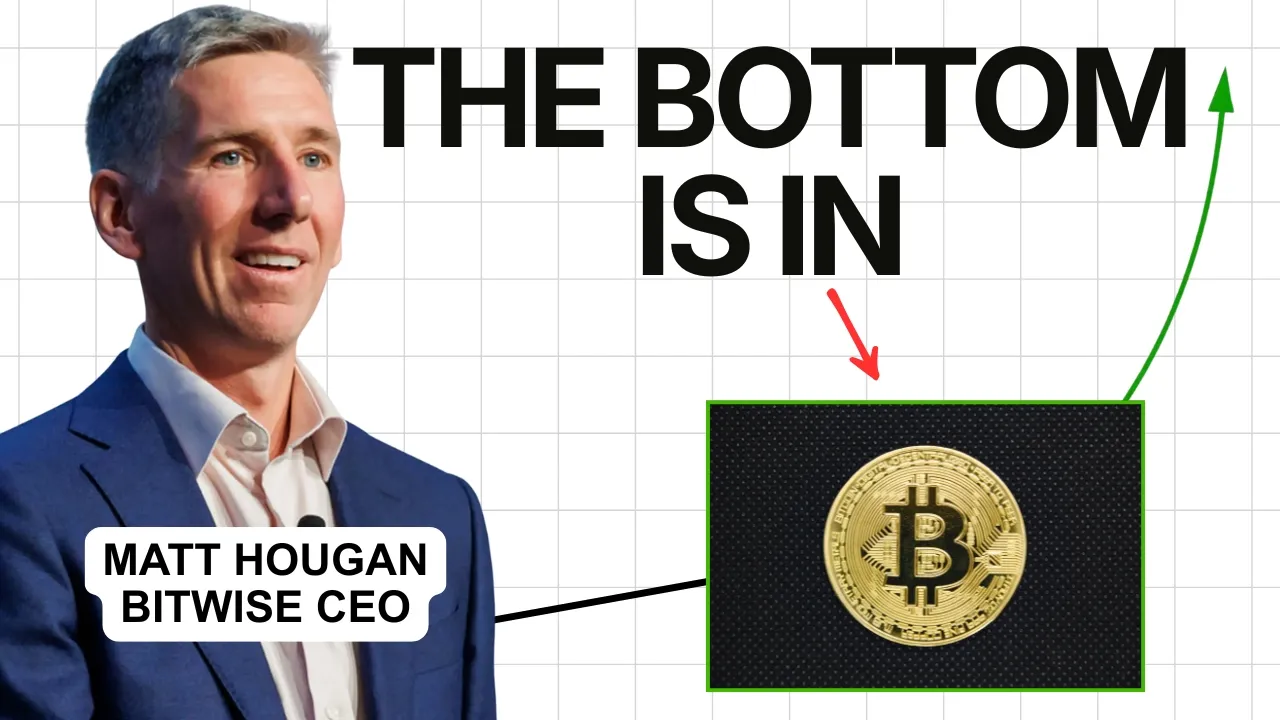
The Case for Bitcoin at $1.3 Million (ft. Matt Hougan, Bitwise CEO)

- Video return
- +1.39%
- Calls
- 2
- Buy / Sell
- 2 0
- Published
Recommendations
Entry is the asset's closing price on the publication date. Current is the last close on record.
-
Entry $77,263.00 21 Aug 2026Current $78,340.00 22 Aug 2026Result +$1,077.00
By the end of the year, we'll all be pretty happy if we had bought Bitcoin today is my guess.
Context “By the end of the year” comment near the middle of the interview, when discussing whether Bitcoin is near a bottom.
-
Entry $77,263.00 21 Aug 2026Current $78,340.00 22 Aug 2026Result +$1,077.00
if you don't think the top is in, which I don't, then whether you buy at 64 or 62 or 68 or 59.
Context Later in the interview, when he says investors should ask whether the top is in.
Full Transcript
Welcome back to the Wolf Financial channel. My name is Gav Blackburg. I'm the CEO at Wolf and your host for today. And joining me for an exciting episode around Bitcoin is Bit Y CIO Matt Hogan. Super excited to have you on. A wealth of knowledge in the space. Thanks for joining the show. >> Yeah, thanks for having me. I'm excited to be here. >> Me too, especially with Bitcoin doing what it's doing right now. So, let's take a look in real time. We are here on Tuesday, August 18th, and Bitcoin is trading at $64,739. nice little gap up from 64,000 earlier this morning. And it's been an eventful year. Over the last 52 weeks, Bitcoin is down 44.9%. In the last month, it's essentially flat. 3 months down at 16%, but it really has started to traverse a lot in the last two to three months. Have we sat around this 60 to 65k level? And I think what people are looking for is, okay, we've clearly had a bearish market here. We came from all-time highs. We got chopped in half, but where are we looking for a potential bottom? or can we look to build off this and move back up? Because that's what I want to talk about today and kind of starting out with that are signals. You know, some people talk about havingss and other items. I'm curious for you when you're looking at Bitcoin. What's the ultimate signal to you that we're potentially ready to make a bottom and move out from there? >> Yeah, it's it's a Bitcoin or any other asset. It's the moment when the asset stops responding to bad news. In a deep bare market, if you get even a sliver of bad news, the bottom just falls out and you cascade down. That's the world we were in in Q4 of last year. It was the world we were in in Q1 and Q2. Interestingly, that's not the world we're in in Q3, right? We've seen Michael Sailor start to sell Bitcoin and Bitcoin hasn't cared. We've seen the odds of the Clarity Act pass go from 40% to 14% before bouncing a little. Uh, Bitcoin didn't care. We saw the cold storage hacks. Bitcoin doesn't care. To me, the best signal that you're near a bottom is where bad news stops affecting you. It means all the sellers are out, the sellers are exhausted, and then you just have to wait for a little bit of demand to get the upside price. I think that's where we are. That doesn't mean we don't go down to 58 or whatever. It just means we're generally around the bottom. I think it's probably more up from here. By the end of the year, we'll all be pretty happy if we had bought Bitcoin today is my guess. >> What about when you look at the underlying metrics? I'm curious if you do look at them whether maybe it's you know number of holders time length of people holding uh Bitcoin strength compared to other cryptos or SEC pieces like that. Do you factor any of those in or is it for you more about the new side? >> No 100%. We definitely factor those things in. Let's actually start with the big dog in the room which is momentum. The only academic factor that's been proven to sort of accurately forecast Bitcoin or other crypto assets direction is momentum, which is not surprising, right, Gav? If I told you Bitcoin is a momentum driven asset, you'd say, "Yeah, duh, Matt." But actually, the academic literature proves that. So, we look at both short and long-term momentum. My favorite short-term momentum indicator, which right now is sort of neutral, is the 10day moving average versus the 20-day moving average. My favorite long-term momentum indicator is the one everyone uses, which is the 200 week moving average. You want, if you have both of those working in your favor, that's a pretty good sign. On the fundamental side, we really like to look at long-term holders. Are they selling or are they accumulating? That's historically been a good tell on the supply side of the market, right? The price of Bitcoin is set by supply and demand. The unknowable factors are will existing holders sell and will new buyers buy. Will the existing holders sell is really best captured in my view from that long-term holder accumulation or deumulation statistic. Right now that's in a pretty good place. And then net new demand. We look at all sorts of things. We look at ETF demand. Uh you can look at overall volume and activity. Maybe from my view ETF demand is the best statistic. So, stack rank them news flow and how it responds, momentum indicators, and then look at both supply and demand side. Supply from the long day holder accumulation, demand from ETF flows. I think if you put those signals all together, you have a pretty good dashboard. U there are other ones, but those are the ones that I primarily focus on. >> I definitely want to dig into the ETF side a little bit more as we get further in. But taking just kind of a step back for a second, we're talking about the asset and what could make it move up or down. But what is, you know, in your eyes the base case for even owning that asset regardless of where it sits price-wise? >> Yeah, look, I think Bitcoin provides a service that the world wants. The service it provides is the ability to store wealth in a digital format without a government or a bank. Gold provides the same service in a physical format. Kevin War says, you know, if you're under 40, Bitcoin is your gold. I think that's true. And so the case for owning it is if even a small fraction of the world decides they want to hold some wealth in a digital format without a government or a bank, the price of Bitcoin has a long roam to run on the upside. At Bitwise, we think it gets to about 1.3 million by 2035. I can walk through the math if you're interested, but I think that's the base case. Look, we live in a world where we just crossed $40 trillion in debt. The US added more debt in the last year than we did in the first 211. We printed more money in the last quarter than we did in the global financial crisis. It's sort of crazy. A small portion allocation to Bitcoin, I think makes a lot of sense. And as I mentioned, I think there's a huge amount of upside still left in this asset. Yeah, the case that you mentioned in terms of monetary printing, devaluing of the dollar, that seems to be a big thing that a lot of us grasp on to as the bull case here. When you talked about the ETFs though, there's sometimes people point out, is all this demand in ETFs, people actually buying Bitcoin or is there some artificial inflation here? How do you look at it? Well, the there I don't think there's paper Bitcoin in the sense of look, every Bitcoin ETF owns the Bitcoin that it says it does. We publish addistations. Other people don't necessarily do that, but I do believe it's the case that they own the physical Bitcoin. But you can't look at the absolute number because there are two things that complicate it. The first, and we've seen this a lot recently with the cold storage hacks, is sometimes people take held away Bitcoin and move it into a Bitcoin ETF. You can do that in many cases without tax. And so, you can imagine some people who had it in cold storage, feel a little uncomfortable today with the series of hacks. You're seeing some of those people move it into Bitcoin. That looks like inflows, but it's not net buying, right? It's just Bitcoin transferring from one thing to the other. The other false signal is depending on the time in the market, somewhere between zero and 20 or 30% of Bitcoin ETFs is used for the basis trade. That's where people buy the Bitcoin ETF and sell Bitcoin futures because the Bitcoin futures are trading at a premium. That's not net demand for the ETF. That's actually satisfying net demand in the futures contract. But make no mistake, by and large, when you see money going into Bitcoin ETFs, that tells you a picture that over time people are accumulating. You can get too precise on any one day. It's not that precise. In fact, even reporting can be multiple days off. It drives me nuts when people report things on a one-day basis. Like, look at a week. But mostly, it is real net new demand. It's mostly coming from net new investors who have never touched Bitcoin again before. And I think you're going to see a lot of ETF flows over the next year. >> How do you think about someone holding their Bitcoin in cold storage versus via an ETF just as you know in a general concept? >> I love them both. Uh and I think many people should do both. Um look, cold storage is the original way to own Bitcoin. It's core part of the philosophy. It's really important that we all have the capability to step outside the system and custody our own wealth. I think that's important. You're taking on significant risks. You're taking on risks, as we learned recently, about product quality of those cold storage offerings. You're taking on risk of losing your password. It's not easy to pass down. Uh you're taking on some personal physical wrench attack style risk. So, there are risks. ETFs, you're working with the largest institutional custodians in the world. Many have insurance in place. You have audits from big four auditors. They fit into brokerage accounts. You give up a few things. You're not self-custodying. You don't have access to trade on the weekends, but you get a lot of protections from it. Again, I think for many people, the ETF is the easiest choice, and I think it's a great choice. For some people, cold storage is a reasonable choice. They're both better than the thing in the middle, which is trusting a centralized exchange with an omnibus wallet. I think that's where the biggest risks historically in crypto have been. And I know cold storage risks have been getting a lot of headlines, but there's been more Bitcoin lost in sort of that middle unusual bucket. I like either institutional storage from ETFs or cold storage if you have good security hygiene or a mix of both is a is a good idea for both for a lot of people. >> Yeah, well said. And obviously you guys have some some products. I don't I mean how much you can talk to them, but I'd love to hear like what are in Bitwise's world the products that you would point people towards as great options here. >> Yeah, I mean we have a Bitcoin ETF BITB. It's priced at 20 basis points a year. So the annual fee is 2%. That's 25% cheaper than the offerings from big firms like Black Rockck and Fidelity. We think it's a great offering. We're proud that we also donate 10% of the proceeds from that ETF to Bitcoin core developers. That doesn't that comes out of our share of the profits of that ETF. So that's included in that 20 basis point fee. You know, you're supporting the network that's supporting the asset that you're hoping will acrue value in the future. So I think that's a great offering. But we have 20 30 ETFs in the US and Europe. We have index funds that hold not just Bitcoin, but the top 10 assets. That's a ticker called BITW. We have single asset funds covering uh some of the assets that are most popular right now like Hyperlid and Salana. uh chain link etc. So we're we aim to be a fullervice shop for people who want to allocate to the space. >> Makes sense. A lot of people talk about mining of Bitcoin and how majority of Bitcoin is going to be mined by 2040. There's that last hundred years very small amount. Do you think that these next kind of 13-ish years are pretty pivotal for Bitcoin? >> Look, I think every year is pretty pivotal piv pivotal for Bitcoin. We're we're new into this moment, but we're already at the point where, you know, 95% plus 98 a huge percentage of all the Bitcoin that will ever exist is already owned by someone. Uh so like the easy era of accumulating Bitcoin is behind us. Now you're buying it from someone else who made a decision to buy it previously. Um I think that's a pretty good supply demand setup. So, uh, you know, it is we're we're still in a fast growth period in Bitcoin. It's still important that we see institutional adoption. Um, but it's doing really well. I I think the case for Bitcoin being on the path to being a legit competitor to gold, a global digital alternative asset. I think it's checking every box along the way. I think it's in good shape. >> Well said. I want to talk about leverage here and kind of the leverage reset that happened. So you I believe made a comparison that I was reading about of the STRC unwind to the collapse of some of the Grayscale premium after last cycle and what a late cycle deleveraging looks like versus a real structural damage and I think that that's one thing that people are paying attention to. A lot of people still looking at MSTR and some of these other names which have obviously gone down a lot more than Bitcoin has uh within these pieces. Just kind of curious your thoughts on the leverage and some of the products have been built around Bitcoin and how they affect it. >> Yeah, sure. Yeah, that that analogy jumped out to me. You know, in any major cyclical industry, what you see is a bull market start and then you get leverage buildup and then what causes the bare market retracement is the leverage gets over its skis. There's a catalytic event that causes a sell-off. It feeds upon itself and you crash down to market lows. That's not just a crypto phenomenon. Again, every cyclical industry, but we've certainly seen it in crypto. The thing I was pointing out with uh like GBTC was often in cryptos past, it's happened because of these financialized products and you can sort of feel it by looking at how they're trading. So GBTC was trading at a huge premium during the bull market run. It switched to a discount. It got to a really extreme discount. When it got to an extreme discount, that was serious signal that the leverage was squeezed out of the system. Right? There was no more demand for this financialized asset. uh STRC had the same thing. You know, it was trading at a sort of perfect par. It would issue a dividend, recover basically to perfect par. You had Micro Strategy trading at a premium to its Bitcoin, which in a long run perspective maybe didn't make any sense. Um but now what you see is that's normalized. We saw Stretch go through a distressed period. That was the market squeezing out liquidity, uh squeezing out leverage. Uh we see Micro Strategy trading closer to the value of its Bitcoin. that looks more normal. I think when you're when you're looking, no one can call, everyone wants to call a precise Vbottom. No one can do it. The reason you see people claim they do it on Twitter is that there are a million people on Twitter. They all make calls and statistically a few of them will be right and then they celebrate in retrospect. So, you can't call a perfect bottom. What you can do is stack indicators. And the fact that we have seen Micro Strategy trade back toward NAV and is no longer at this like artificial premium is another indicator along with that long-term holder thing and ETF flows and not responding to news and I just get more confidence that we're near the bottom the more of those indicators I can stack on top of each other. >> Do you pay attention much to some of these having cycles and other areas? I did a podcast with Ben Con earlier this year who a lot of his audience looks in for Bitcoin and he mentioned that October, November, you know, was the area where he would consider buying. He really wasn't interested necessarily until then. He thought we would continue to go down and that was based on some of the cycle pieces. >> Yeah. You know, it's funny. Uh look, I think early in Bitcoin's journey, the having really mattered like from a fundamental supply demand dynamic because it was reducing a lot of supply coming into the market. At this point, the effect is more psychological than physical, right? Because the amount of Bitcoin coming into the market is just not that big. We could cut it in half and from a supply demand perspective, it wouldn't matter that much. So, I don't think it has a a physical impact, but it clearly has a psychological impact. We saw people in our business trimming their Bitcoin position in 2025 ahead of the four-year cycle because they didn't want to live through another draw down and they look very preient today. I think when I think of and I've heard a lot of people mention this October, November time frame, which is when the calendar rolls over and it would hit the historical point where it the only thing I would say is that may be right. Um, one thing we did notice with this four-year cycle is we sort of front ran it a little bit because it's so much talked about. I wonder a little bit if so many people are talking about October that maybe it comes a little bit earlier, but who knows? Uh, I do think we're close to that turning point. And I think it's another indication the bottom is in. I think actually a better question investors to ask themselves is is the top in. Uh if you don't think the top is in, which I don't, then whether you buy at 64 or 62 or 68 or 59. Um I don't know. It matters, but it doesn't matter that much. If you go back in time, I've been at Bitwise for eight years. You could have bought at 5,000 in early 2018, or you could have downticked it at 3500 in late 2018. But either way, you're up more than 10x today. And I think that's a little bit where we are in the market. I know people will still try to time the bottom. I don't blame them. I would love to, too. But I I think I think keeping that sort of analog in mind is probably a good idea for many people. >> Do you factor in technical analysis much when it comes to Bitcoin? >> Again, on a short-term basis, we look at uh we look at those momentum characteristics, which are one element of technicals. Um, I uh draw simple lines on charts, but I don't get into the more abstract uh you won't see me using a Fibonacci retracement. Um, it's not to say it doesn't work. It's just not what I'm good at. So, I'll leave that to the people who are good at it. Got it. Let's shift back to the institutional conversation and the ETF conversation. A lot of people over the last couple of years have pointed to this as the bullcase for Bitcoin, right? You have mass adoption of the public through ETFs. You had some of the most successful ETFs in history uh as they rolled out exposure to Bitcoin and there's billions of dollars right across the ecosystem now that is funneled into those. You also have uh for the first time uh larger firms like Fidelity and others that are giving people you know opportunities for exposure. You have financial adviserss that have, you know, historically, I think, almost been restricted from being able to offer some of these things unless the client directly asks for it that are now starting to say, "Hey, maybe this is something where it's a 1 to 5% position in your portfolio." So, this seems to be something that's driving forward a lot more demand than we've seen before, even though it hasn't necessarily materialized, you know, 100% into the charts. So, how do you focus on it and where do you think we go from here? >> Yeah, I'll actually push back on one thing you said. I think it has materialized in the charts. I think the reason we're down 50 and not 75 is explicitly because we've had all this buying from financial advisors. You take a hundred billion dollars of Bitcoin ETF assets out of the market and this crash could look more like 2018 or 2022. So I do think it's materialized. It's just not the only force in the market. This is a very real phenomenon. Even recently amidst the bare market, you've seen large wealth management platforms turn increasingly towards crypto. Right? You saw Morgan Stanley launching ETFs into the bare market. That's not from FOMO. That's cuz they're making a long-term bet in this direction. You're seeing Wells Fargo consider adding Bitcoin to model portfolios. We're doing more meetings with national account platforms than we have in the past. I think that money is still going to flow. It's a 10-year trend, though. Institutions are not like retail investors. They're oil tankers, not speedboats. And so, they slowly orient around. And then when we get behind something, they allocate over a very long period of time. And you've seen that in other asset classes. You saw that in previous commodity booms. You saw that in the private loan boom. It takes a while, but once they start going, they go for a while. I think that's the case. So I do think there's going to be, you know, another hundred billion dollars of demand from this group in the next few years. And I do think that's going to be maybe the the primary driver of Bitcoin's upside in this next cycle. Uh we'll get to institutions and sovereigns eventually. Those are the next sort of legs. But I think right now it's uh prime time for wealth managers and financial adviserss and family offices. >> Do you talk with a lot of these people? >> So much uh we we we do we do like 15,000 meetings a year with financial adviserss. I'm chuckling because uh one of the mistakes I made last year was I thought the four-year cycle wouldn't necessarily repeat. The reason was I spent so much time with these adviserss who are just bullish on Bitcoin, right? They're at zero and they're going to not zero and they're giving us flows. And so I thought, look, the market is more bullish than people expect. I forgot to factor in the retail investors who I think were the people who were selling uh in the in this in this pullback. Uh but yeah, we talk to them uh every day uh every week, every month, and um I think they're they're going to be huge buyers of this asset for years to come. >> Yeah, it's really interesting. I I am curious. You know, we're looking a little bit more future-looking. When you look back over the last five years, there's opportunity costs, right? And for somebody that's been holding Bitcoin for 5 years, they're up 37.8% at this point. If you've held S&P 500 during that time period, you're probably up closer to 80 to 90%. So, how do you think about opportunity costs of Bitcoin versus other assets? >> Yeah, I think that's right. I think that's one of the reasons we've we we've struggled a little bit. I mean, of course, with between those, there was an opportunity to get in and be up a huge a huge multiple, but it's absolutely true um that particularly with the recent AI trade, that's been the easiest trade uh in the world, the most crowded trade I would argue, and that's sucked a lot of the attention away from Bitcoin. I think the the good news is over a long time it's fundamentally driven. Uh and the fundamentals in my view are in favor of Bitcoin. I know people wonder what those fundamentals are. It's sort of Bitcoin against fiat currency. It's Bitcoin against M2. It's access to Bitcoin. Those things are all sort of on the up and up. Um but I do think we we've suffered from the fact that other assets have done so well. Uh anyone who says that we haven't I I think is just uh is just wrong. >> Got it. Got it. And then just because we're on the AI topic, there's I feel like it's calmed down, but there were some concerns around quantum computing uh in terms of hacking and pieces like that. Did you ever look much into that? >> Yeah, for sure. Look, quantum is a a threat to Bitcoin if it's not observed and dealt with, right? It's kind of like a disease that you want to catch early and treat. And if you do, then the patient will be okay. And if you don't, then the patient will be challenged. The single best sort of factual statistic I have, the reason I'm not acutely worried about quantum is that the the share of quantum related messaging on leading Bitcoin developer platforms has gone from roughly zero to north of 50% of all messages over the last couple of years. Uh that tells me it's being focused on there are good solutions. So, look, I think the the response you saw, sort of the autoimmune response you saw from investors freaking out about Quantum and Bitcoin was the fact that the community hadn't taken it seriously. Now, the community is taking it seriously and that's why it sort of faded from the conversation. >> Yeah, that makes sense to me. All right. And one other topic which you kind of mentioned earlier around the Clarity Act, but this is a big thing is regulation and how it affects it. So there was a few things I think maybe the Genius Act and a couple other pieces that have come through. Can you just kind of lay out like all of the different legislation that's been happening around Bitcoin and crypto and how it could affect things? >> Yeah, sure. I mean the place to start is before the current SEC. So under the Gensler SEC, what we had was lawsuits against every major crypto platform. Uh a threat of every asset being called a security. um we had uh no clear regulations governing it and a lot of confusion uh and a lot of legal risk. So that was the state we were in. Um now we've made huge progress. So those lawsuits have been reversed. Debbanking has stopped. Uh we have the Genius Act which covers the stable coin space. There's efforts to pass the Clarity Act which would provide broader coverage from a regulatory perspective. The SEC itself is moving ahead with what it calls project crypto which is to provide its own regulations around the space. There's a lot of uh discussion. The way to distill it, the way to know that we're making real progress is look at the large firms that are coming into crypto. You have the Black Rockcks and the Goldman's, the NASDAQs and the Nazis. Uh you have CME, you have Bitwise, you have others moving into crypto. That's like an easy way to distill the idea that we've gone from a place where large institutions couldn't touch it to large institutions are comfortable with it, right? That's why Morgan Stanley and others are are accessing this space now. It's gotten better. Is it perfect? No. Would it be better if they passed the Clarity Act? Yes. But are we moving in a positive direction? We absolutely are. And that's why crypto is going from something that was outside of the institutional community to inside the institutional community. And I suspect that that regulatory progress will continue. I actually expect it will continue regardless of what happens in elections. Um I think it's on a sort of positive trajectory. And the primary proof point again is those large firms coming into this space. >> Yeah, it's like big tobacco, right? Once the money's in there, a lot can be accomplished. It's it's you know the this is the way sometimes um progress happens is the regulators are slow uh but when the industry is moving in it and they they see the opportunity they can push things in a positive direction. >> Yeah, that makes sense to me. Uh two more kind of topics here to touch on. One, we've talked a lot about Bitcoin, but the main counterpart that people seem to look at usually is Ethereum. That's one of the other largest. And there's a lot of reasons I think people are bullish on Ethereum, specifically smart contracts and stable coins being built on top of it. How do you view Bitcoin versus Ethereum? >> Yeah, the most important thing for people to get across is it's not like the dollar versus the euro, right? Because these are cryptocurrencies, people often think of them as like competing currencies and Bitcoin is really currency like um they're more like different software companies doing completely different things. I mean, Google was an internet company and Amazon was an internet company and Salesforce was an internet company. They all use the internet, but for very different purposes. That's true here, too. So, Bitcoin is using blockchain to deliver digital gold. Ethereum is using blockchain to help move financial assets around the world. You mentioned stable coins, those primarily move over Ethereum. Tokenized assets primarily issued on Ethereum. So, the bet you're making with Ethereum is you think more of the world's money is going to move over stable coins and Ethereum will win a big share. More of the world's assets are going to be tokenized and Ethereum will win a big share. If it succeeds at that, then it's probably going to do well. I would suspect going forward that Bitcoin and Ethereum will have a lower correlation than they have in the past. In the past, investors often traded crypto the way they traded the internet in the9s. But now it's going to look more like Google, Amazon, Salesforce, Netflix, all internet companies just going after different markets. Bitcoin, Ethereum Salana Hyperlquid Chain Link, all crypto, but all going after very different market verticals and succeeding at different rates. That's that's what I expect over the next like cycle, the next few years. I love them both. Yeah, I love all my children. Um, no, I do. Look, I'm very bullish on Bitcoin. As I mentioned, I think it could be north of a million dollars of coin within a decade. I'm very bullish on tokenization. The one difference between those two bets is Bitcoin, I think, has a lock on the market it's going after. I don't think there is a competitor to Bitcoin for digital gold that's going to matter. Ethereum has less of a lock. So, I wouldn't just own Ethereum. I would own Ethereum and I would own Salana and I would own Canton. I would own that space um because I have less certainty over who the winner will be. In Bitcoin space, I think it's pretty clear who the winner is. So maybe you can have a solo bet. Um but again, in this in this broader tokenization stable coin space, it's less clear. So maybe you need more diversification. Uh unless you're smarter than me and you can pick the winner, in which case, god bless. >> Is there a good ETF for that? doesn't have Bitcoin but has >> ETF. Yeah, we we have we have an ETF called uh BITW that holds Bitcoin and the other 10 assets. >> So, that solves it all in once. I'm actually not aware. We have a private fund, but I'm not aware if there's an ETF that starts with Ethereum and goes down. Um, but it's a it's a good idea. It would be an interesting product for sure. >> Absolutely. All right. I want to talk a few price predictions. We've talked about uh potentially a million in a decade. First off, what would need to happen for that to happen? >> Yeah, sure. So, if you think of Bitcoin as going after the the same market as gold, the store of value market, that today is a 30 trillion market, but it's been growing at 12% a year for the last 20 years. So, if it grows at 12% a year for the next 20 years, next 10 years, that becomes a $90 trillion market, right? So, if you just assume the store value market keeps doing what it's been doing for the last two decades, it's $90 trillion. If Bitcoin takes 25% of that, it's worth $1.3 million a coin. It's maybe 4ish% of gold right now. So, it's, you know, 4 to 25 is a big leap. So, maybe you think I'm over optimistic. Maybe it gets to 12, then it's half a million dollars a coin, right? But that I think the the the the error people make is they take the current gold market without recognizing that it's grown so much. You and I, you know, work in and around ETFs a lot. When the gold ETF came out, the whole gold market, the whole thing was $2 and a half trillion dollars, not that much bigger than Bitcoin today. It's just that it's grown so much over the last 20 plus years. And I think it's going to continue to grow as we print more debt. And so that's what Bitcoin needs to do. It needs to take a quarter of the store value market in the next decade. >> Got it. What about one year from now in five years for Bitcoin? >> Yeah. Look, I'm I'm optimistic in a year that will be significantly higher than we are today with the caveat that um bull markets tend to round. They don't tend to V. And so you need some time to build momentum. So um you know, will will we be north of $100,000 if things break in Bitcoin's way over the next year? I absolutely think so. But are we going to like frontr run our way to $1.3 million? I would be surprised. um within five years. I mean, it really depends. It depends on the scale of institutional adoption. Um and I think it's just a it's it's sort of hard to hard to predict at that cadence, but on that way, I wouldn't be surprised to see Bitcoin at multiple hundreds of thousands of dollars. Uh one thing I would expect for what it's worth is Bitcoin to do sort of um phase jumps. So you might note that in the last cycle we sort of got stuck at 100K. I don't think that was an accident. 100K is a round number. A bunch of people were willing to sell. And so one thing you can think about when you say something like 5 years is what number do we get stuck on? Is it 250K? Is it 500K? Where's the next point that investors are willing to sell Bitcoin? It's probably one of those two. So those are those are price targets that stick out in my head. >> Got it. Ethereum unlike Bitcoin which is still up over the last five years is down actually 42% over the last five years with down 57% this year and it's trading currently at $1,912. Where do you see that from a price perspective going in the next 1 510? Yeah, I think Ethereum is a really challenging one to forecast because the community within Ethereum wants it to be money and they're going after that market and if it succeeds at that uh the price will be substantially higher. Um I suspect it's actually more like a service uh like Salana for moving other assets will be revenue driven and so in the short term look I think it will go up over the next year because there's so much growth in stable coins and tokenization but we're actually working through what our price target is on Ethereum. I think it's I think it's amongst the most challenging assets to forecast at the moment because it's it's uh because there is some internal debate about why it will have value in the future that's not fully resolved. >> Got it. Got it. All right. Really great conversation here around Bitcoin and crypto. But in addition to being the CIO at Bitwise, you are also the co-founder of Future Proof. And Future Proof's coming up. It is less than a month away. One of the best conferences in the world. happens twice a year, once in Huntington Beach, once in Miami. I know there's other side pieces that happen as well. There's some virtual stuff that goes on, but those are the ones that I attend. What are you looking forward to for Future Proof? >> Yeah, I mean, first of all, for people who haven't been, it's a conference, but it's outside on the beach. So, I would be remiss if I didn't say that just such a relief to meet people uh in an outdoor casual setting. That's maybe the number one thing that I'm looking forward to. There's something different about meeting people in a suit in a dark conference room versus meeting people in shorts and a uh you know a shirt outside on the beach that leads to more casual conversations. I want to talk to advisers obviously about where they are visav crypto. I'm also interested in how advisers are adapting AI into their own practice because I'm interested in the advisor space. So those are the two themes that I'm really going to be focused on. But more than anything, just being outside with some uh forward thinking people is really the secret sauce at at Future Proof. >> Yeah. I've heard from a couple people. They said somehow we we don't have time when we're in New York to talk to each other even though we're down the street and then we get to Future Proof and suddenly everyone has time to chat. >> That's exactly right. Yeah. And the setting couldn't be better right there on the beach. So, it'll it'll be a great event. Really looking forward to it. >> 100%. Super fun time. Any speakers you're looking forward to hearing from? >> Oh, that's a good question. And I'd have to go back to the speaker lineup. Uh there's so there's so many um I don't know to me it's really the audience. I know that sounds crazy and we spend a lot of time on the agenda, but it is really the audience that that makes Future Proof special. So um that's what I'm looking forward to most. >> Yeah. And then last year there's also this new AI arena that was kind of happening in the middle of things with tons of companies showing their activations. There's the breakout sessions. How many breakout sessions are there going to be this year? Was it 30,000 last year? something like that. Yeah, it's it'll it'll be up again. Those are one-on-one conversations. It's absolutely incredible. Um just huge energy. Uh there'll be a little ETF area. There's going to be a lot of exciting things are future proof. >> Very cool. I'm super excited for it, Matt. It's been a pleasure having you on. Any final comments for the Bitcoin and crypto audience as they look forward to hopefully a resurgence in the end of the year? Yeah, I think just keep that thing I thing said in mind uh earlier which is is it responding to bad news in a negative way. I really do think that that is a special signal in the crypto market. I've seen it through multiple market cycles. Doesn't guarantee we're going to go straight back up, but it does suggest that there is seller exhaustion. Um I'm really excited. I think I think we can see clearly ahead the bull market that's coming driven by tokenization, stable coins, and desire for Bitcoin and wealth management portfolios. And um I know the market has been challenging, but I've actually uh never been more excited than I am right now. >> I love it. I like the spirit. You're a great speaker. I appreciate you coming on and sharing the time with us and our audience. To everybody, I encourage you to go ahead and give Matt a follow on social media. It's matt_hogan as well. So you can check them out there. Make sure you're checking out the full suite from Bitwise. If people have any questions or thoughts like that, I'm sure that they can reach out uh to to the firm, ask any questions that they have, get more information, but exciting conversation. Thank you. Thank you so much for taking the time and looking forward to the next one. Thanks for watching today's video. If you enjoyed it, go check out the Wool Financial Newsletter. Did you know that we make a ton of content? We host 60 plus hours of Twitter spaces and live streams every single week. We're posting on the timeline over and over and over. We put up YouTube videos and one of our prime gems is our newsletter and it's free into your inbox multiple times a week. We mix it up. We give stock picks, market headlines, research info. It's a great way for you to stay in touch with the stock market and your portfolio without having to spend eight hours a day staring at your brokerage screen. So again, link is below. It is free to grab and you're going to love the content in
Comments 0
Sign in to join the discussion.
Sign inNo comments yet. Be the first to share your thoughts!