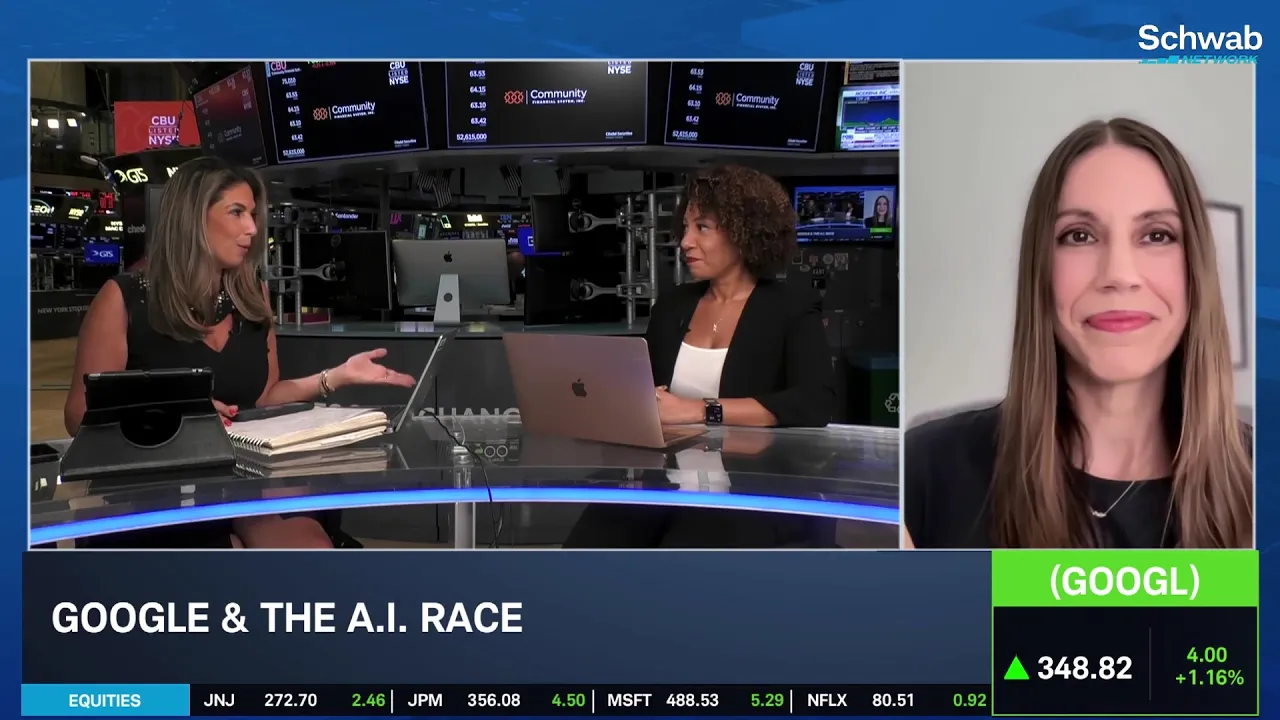
Costs of AI Leadership: GOOGL Strong Growth Comes with Negative Cash Flow

- Video return
- —
- Calls
- 1
- Buy / Sell
- 1 0
- Published
Recommendations
Entry is the asset's closing price on the publication date. Current is the last close on record.
-
Entry $348.06 24 Aug 2026Current $348.06 24 Aug 2026Result +$0.00
I definitely like Google as a stock and an ecosystem
Context "I definitely like Google as a stock and an ecosystem, but know what you own, right?"
Full Transcript
the strengths and weaknesses in its ability to lead in AI? Stephanie Walter, practice leader for AI Stack Software at Hyper Frame Research, and Tiffany McGee is CEO, CIO, Pivotal Advisors, here with me on set. So Tiffany, I'll start with you. I mean, we think about Google. Is it a leader? Can it be a leader in the AI race? Some of your thoughts. Yeah, absolutely. You know, I think that like everyone else, when we think about these other companies are kind of renting picks and shovels. But the way I think about it is Google owns the mine, the shovel factory and the store, right? And so when we think about the fact that alphabet is the only player that owns every single layer, its chips, its own models with Gemini Cloud and its own distribution. And we think about, you know, search, Android Chrome YouTube workspace, everyone else rents at least one of those from somebody. And we also, you know, I also kind of think about the fact that anthropic contracted for access of up to 1 million TPUs. Meta's renting Google's Ironwood TPUs, and Google is really selling TPUs to outside customers for their own data centers. So when your competitors start to buy your chips, I think it's it goes kind of pushes past a compelling narrative. And Stephanie, you talked about that, how Google has a bit of everything. And at the same time, there was some concern about overlapping those on a customer's journey. So I'd like to hear your thoughts, but do mention that maybe this could be a headwind in the AI leadership possibilities for Google or not. You tell me. Yeah. So, you know, as Tiffany said, anthropic really has significant developer momentum. Open AI sort of has this great consumer brand identity. Nvidia dominates AI compute, but Google's strength is really its breadth breadth. So I completely agree there. No other company quite brings together as much of the AI stack. Now, that being said, you know, this this, this might sound a little strange, but Google's biggest AI weakness really seems to be product management, as boring as that sounds. So, I mean, if you think about Gemini, it can mean a model. It can mean a consumer app, it can mean a workspace. Assistant developers encounter AI studio, anti-gravity, multiple agent services. So Google has nearly every capability that their customers need. But the entry points and the usability make it a little bit harder to understand than it should be. So its biggest weakness isn't its technology. I mean, Google has proven that it can produce competitive, substantial AI and AI technology, but it's not necessarily turning those assets into one coherent customer journey. And I think until Google can do that, we're going to see other players at different levels of the stack really, really shine where Google could could actually be more competitive. Yeah. So you talk about the, the difficulty for a customer who's using all of these things to have that overlapping or where the entry point is, but that they do have the capabilities. At the same time, they continue to spell spend on their own technology and the build out. And that's something that you're both well versed in. Let's speak with you here, Tiffany, some of your thoughts here on what they're doing right when they're building out, but it's going to cost a lot as well. It is going to cost. And I think, you know, after a great quarter, my thoughts go to when a company with $242 billion in cash starts to sell stock to fund a data center. We really have to look at what the real cost is right. So alphabet holds again 242 billion in cash and securities. And it still raised roughly $50 billion in equity and 25 billion in debt in one quarter. And it still ended with negative free cash flow. Right. And so you know what that's telling me is the cost of competing has grown so large that the strongest, one of the strongest balance sheets in the world is reaching for outside capital. And so, okay, so that tells us something, right? So they're digging in, they're sort of selling their own funds here, selling stock to, to make this possible for them to make the moves. At the same time, you look at Beyond Gemini at this point, Stephanie, you're looking at all the other things that Google can really utilize, monetize. Tell me more about that because you said the, the AI advantage may not just be Gemini, maybe something else. I mean, if you look at the ecosystem surrounding Gemini, I mean, there's search, there's YouTube, there's Android, there's Chrome workspace maps. I mean, Google can ground AI in all of this information. They have billions of users. They can connect AI recommendations to real world actions and transactions. I mean that that's huge. That is a huge ecosystem that competitors can't really can't, can't really compete with at least right away. And so, you know, replicating Google's data and distribution for competitors is going to be much harder. And I think about people's portfolios. And Tiffany is chief investment officer. Should people have Google, should they hold tech? Is AI real? Is Google something that you recommend as people are making their portfolios now? Yeah. So so for the most part, our clients are foundations, endowments, family offices. And I think about the fact that most of these types of entities own are making AI bets in 3 in 3 places, and they may not be really aware of it. So first, of course, is an S&P 500 index fund. They think that they might own 500 companies. But really, you know, the seven largest companies really represent about $0.32 for every dollar of that position, right. So it's not really diversified. And the place to was like on venture funds, right? So if you are ultra high net worth individual or family and you have access to private funds, you know, those managers, those venture managers have really been putting money into AI at extraordinary rates. Right? So you think about the fact that OpenAI and anthropic reportedly took about 43% of venture dollars last quarter. So those are bets that the entity that that client in our case may not have been making itself, but those managers are making that right. And then the third one is private credit that a lot of people don't talk about, you know, private credit, I think a lot of times has been sold as a diversifier, but data centers, but data centers are very, very expensive. And what they've been doing, technology companies have started building them through separate entities, right? So like joint ventures, special purpose vehicles. And so they've really borrowed from private credit funds and insurance companies, right. And so the tech company that signs the long term commitment to rent that capacity, you know, in some cases really, you know, guarantees the debt. So that's like that third exposure that I think a lot of investors, if they have access to private markets, are not really thinking about that concentration. So don't load up because you're already loaded up. Know what you want. The point is that the point? I definitely like Google as a stock and an ecosystem, but know what you own, right? Good point there. And right. The S&P, we call it the tech heavy S&P. We said the tech heavy Nasdaq. It's the tech heavy Nasdaq at this point. Let's talk about the search function that we thought would be left behind. And so where do we stand on something like that. Stephanie is search still. We think about the ad dollars and the other things. Engagement, trust. You talked about a few things with this. Tell us more. Right. So with AI, it's really moving search from lists of links. You know, you type in your query and you get some results back for some websites, boards, conversations recommendations and actions, especially as we go into more autonomous AI. So, you know, Google and Search and its ad business, they really need to figure out how to lead that transition. So how are people going to be using search and AI in the future? And they need to figure that out without weakening the advertising engine that's financing its AI investments right now. So Google has distribution. They have data, they have the advertiser relationships to succeed, but it has to crack the code and prove that AI powered search can still preserve trust. User engagement and advertising economics. And it has to find a way to make its search more compelling than just asking any old LM for results. Great to speak with you both, Stephanie. Tiffany. Thank
Comments 0
Sign in to join the discussion.
Sign inNo comments yet. Be the first to share your thoughts!