I think the stock is going to start to compound earnings growth from here because the you know multiples already gone down I think as much as it's going to
The reason to own Micron is because it wants to innovate and bring out the best semis even if it costs a great deal of money.
Full Transcript
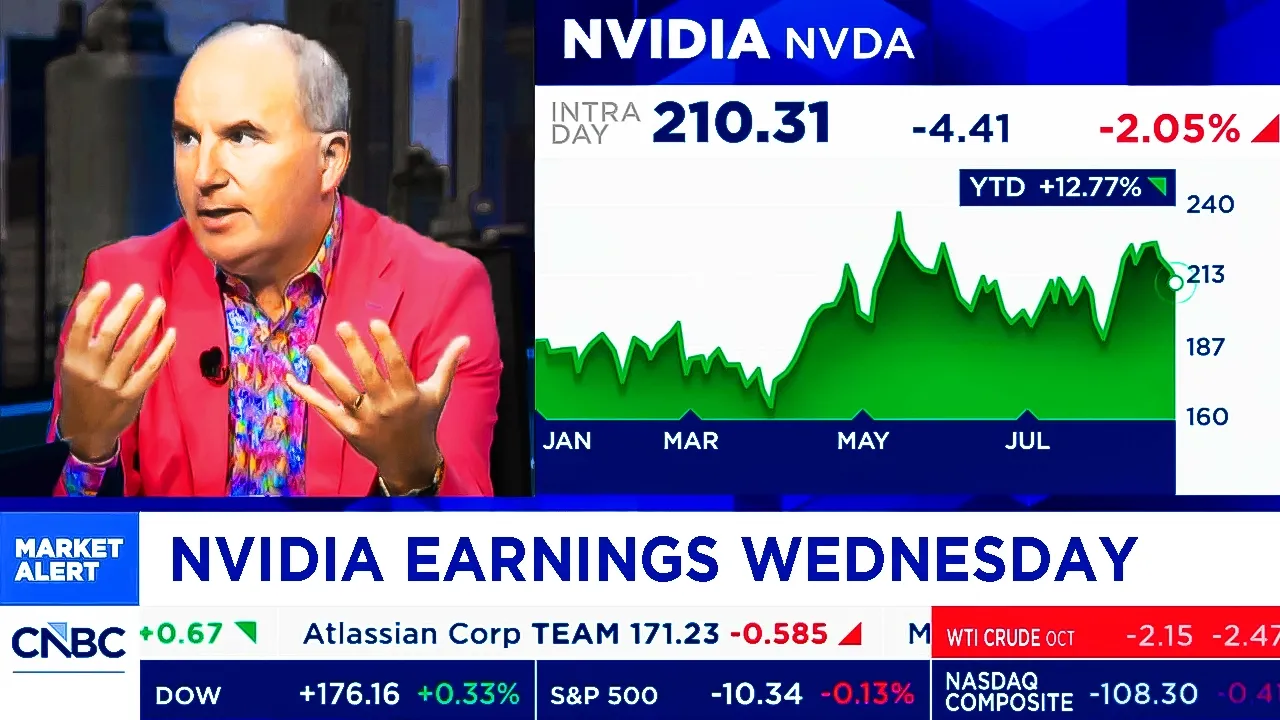
few days away. Looking out for that. Let's talk about Nvidia posting its longest losing streak in four years going into earnings on Wednesday. The chipmaker now telling its biggest customers AI chip costs are set to climb more than 15%. Dan Ives of York for lives writing, "We expect robust results from Nvidia, which will be key to the tech trade, going higher into year end." Dan joins us now for more. Dan, good morning. >> Great to be here. >> What's getting more expensive? >> Look, memory. I mean, look, the reality is is that we're seeing a memory super cycle take place. And I think that's the word all around Korea. And that's why Nvidia, they're going to need to pass some of this to their customers. But but that's not that's not slowing down because the reality today demand the supply for chips is upwards of 15 to1. And I think that's that's what not just Nvidia but ultimately their end users. >> Who needs to eat the higher costs right now? Who's eating it? >> Now through the supply chain, you'll see some of that eaten, but then ultimately it's the end user. It's the customers, it's enterprises, it's tokenization. As that all plays out, then the question will be, okay, when do you hit some sort of equilibrium? I mean, we don't think you hit core equilibrium probably till middle to late 2028. And I think that right now is a quagmire whether it's Nvidia, whether it's the memory players, Micron, everyone else because the hyperscalers, you know, just like as Lisa talked about as they'll continue to raise capital and capbacks will continue to increase the AI revolution still in the third inning. I think you'll hear that more from Nvidia later this week. Then it comes down to like memory and Apple obviously seen that front and center. Those costs are going to continue to go up. >> They're going to look for other costs to go down though. And I was looking, for example, at the story over the weekend of Nvidia potentially telling some of its customers like Microsoft and Alphabet uh and Oracle that their costs are going to go up about 15% tied to data centers because of the memory chip and how much the price is going up. And you start wondering, is this part of the reason why they're cutting back on Frontier models? Is this part of the reason why they're looking for efficiencies from say open-sourced uh AI models coming from China? >> Yeah. And that's why when you look at Apple and they looked at chips potentially from China because they're looking across the board and say okay where do we cut cost because on one side of the ledger costs are going up but it speaks to our view that you you until you really hit scale costs are going to continue to go higher. I think with the hyperscalers and with the chip players and from Nvidia what everyone's dealing with is you cannot take the foot off the gas right now because of the demand cycle and to your point when it comes to like the debt raises despite what we're seeing that's going to accelerate. I mean, you talked about it going to 220. You go to next year, it's probably double from that, you know, in terms of as it's going to continue to increase given the capex that's needed in terms of what I'll view it is building. It's building Vegas strip 1955 type moment. >> I was looking at Nvidia's earnings and just the the returns that you've seen in their shares. So far this year, the shares are up 15%. Last year, they were up 38%. The year before they were up more than 100%, the year before up more than 200%. It's been a rapid deceleration in the equity returns as multiples have gone higher and higher. At what point have they just reached a pinnacle of what multiples can look like and even if they deliver amazing results, they're not going to get that kind of pop in the stock? >> I think that's the debate. But then to some extent, they've almost funded the AI party. I if you think about the memory play, look, think about Korea. Cosby is not where it is without Nvidia. You know, there is only one chip in the world fueling the AI revolution. That is Nvidia. And I think the point here is that as you see with numbers as it plays out, there's no one that has a better perch than them. And that's why I think you'll hear from Jensen because the question is is it as enterprise accelerate and we think accelerating probably 20 25% even over the last few months as that runs through the system. It's investors ultimately recognizing that because I still it's my view investors are still underestimating the scale and scope of the AI revolution. Now, it goes back to like the bond market. You're going to need to take out more debt and then where is there a patience sort of a tugof-war that goes on, but from a demand perspective, it's accelerated, not decelerated. >> Earnings look great. Are they as good as they look? Lisa's asked this question before. Blimbo subscriber wrote in just moments ago and asked the following question whether this is just about accounting tricks. The question directly is someone's capex which gets depreciated over many years falls straight into someone else's top line recognized instantly. No one predicted this earnings boost because no one thought this through. Not one single Southside analyst. What's your response to that? >> I my response would be look at Palunteer earnings as a good example of just purely just forget capbacks enterprises signing on the dotted line to ultimately accelerate their AI initiatives. If you look at Microsoft's quarter that was a perfect example of what's happening to that. Just forget capex for a second. What are their install base, their enterprises saying? What they're basically saying is bright green light to go down the AI path. So when you go down to the capbacks and the circular financing and you know they're investing in there and and everyone needs everyone else to to ultimately be positive in terms of open AI and anthropic. I think it gets away from just the core demand and also for every dollar of capex there's a $56 multiply that the earnings aren't there. They're not that great. I'm just implying that they're not as good as people might be saying they are. Is that fair? >> I look I would say six, nine months from now, they have to continue to execute and prove themselves out. And if they don't, then the stocks reflect that. But I think right now, that's why every it look a Jenga puzzle from Palunteer to Nvidia to Microsoft to open athropic you got to put it together to understand what's ultimately happening. What I would just say is from an Asia perspective and what you've seen with demand, demand's accelerating, that's why price are going higher and that's something that's bullish for the overall tech trade. >> MQ of PSP growth writing Nvidia sits in the center of the AI super cycle. It is seen as a report card on the entire sector. Simply beating earnings will not be enough to move up its market cap. Mame joins us now for more. Mame, welcome. We often say this, it comes so late in the reporting cycle that there's little left to really know after we've heard from their biggest customers. What are you waiting to find out in a few days time? >> Hello, good morning. Nvidia has a pretty tough job this week. So, if you think about it, not only do they have to defend the incredible business that they have today, but more and more they have to tell the investor world that they will continue to be the AI platform of tomorrow. Nvidia has beaten earnings nine straight quarters. If you think about their data center revenue, it's still growing at nearly 100% year-over-year growth, which is pretty remarkable at their scale. But yet, as we've seen, it has not been enough. The stock has struggled to rally after each of these earnings. And we're left thinking, what more can they do in order to prove out that they can move their stock prices up? Some of the things that I think we'll be paying attention to and you saw some of this news come out over the weekend and over the last week is Nvidia is expanding into other areas of the AI stack. They're licensing six billion licensing agreement with poolside is their method of reaching into the model layer. They are um thinking more about how do we reach into the end customer with a rumored investment into perplexity. This is their answer and I would expect to hear more around Reuben platforms, potential robotics in order to tell to tell the market not only are we still performing really strong fundamentally in our core business, but will continue to evolve and become relevant in the future. >> They have to confront the politics as well, Mame. And I wonder if that's becoming a big story for them too, that the data centers that house the things that they sell, there's a public backlash in this country at the moment, Mame. could that trim growth in the near term, in the medium term for this corporation. >> I believe that will contribute to some of the volatility. I think that's an issue that will need to be solved and need to have more conversations around. As you know, PSP is backed by former Secretary of Commerce Penny Pritsker. She is one of the chairs of an initiative called raise us that's actually tackling the issue of how do we ensure that workers are prepared the public is prepared for this AI wave because as we've seen some of the backlash is really real and one of the reasons is this is all happening so fast if AI is the industrial revolution that we can claim it to be all past industrial revolutions has a longer adjustment period for the population for the workers I think the productivity will come but it's really hard to bridge that gap right now between the increasing spend the increasing datas the the increasing spend the increasing capex with the population that's still adjusting to what does this mean for me and what does this mean for for my job >> well may how much focus is there going to be on Nvidia's investment portfolio how much they continue to plan to finance the entire ecosystem because that has been at the backbone of so much of the AI buildout out. >> I think there's another piece of evidence that this buildout is still not as mature as people think. As you saw, they're their way of investing into open AI is essentially funding the whole ecosystem and their customers while the AI curve matures and enterprise adoption actually happens. I I don't think Nvidia is the only one doing this. you see Google making a significant investment into anthropic 40 billion even when they have Gemini as their own as their own model. So this shows to me that while there is this enthusiasm for the AI buildout, people are also hedging their bets because they don't know which model or which infrastructure or which part of the stack the value will eventually acrew to. So they are placing bets across multiple parts of the ecosystem in order to propel the overall market but also so they have different bets along the diff along different parts of the AI ecosystem. >> Let's get more on the report. The Nvidia systems could see a price hike of 15%. Simon Leopold, managing director of data infrastructure at Raymond James joins us now. This reporting is based on the OEMs, the server makers going to customers and saying this is what we see happening in the new new year. 15% hike in some cases on on Blackwell and Reuben systems. Just to start your reaction to that? >> Yeah, I I'm not surprised by it. It's it's been very clear that the cost of memory has been increasing. uh we have observed and heard the large hypers scale operators forecasting higher capital spending budgets and the biggest driver for that has been the cost of memory. So there really should be very little surprise. As a matter of fact, given the percentage increase in the cost of memory and the amount of memory required in these AI platforms, uh 15% really doesn't seem all that demanding when we consider the amount of spending. >> Each Blackwell and Rubin GPU has eight corresponding HBM stacks, which in turn are 12 layers of of DRAM, 15%. Could you see that going higher, Simon, with that in mind? Well, I think it's possible. Uh the the challenge is is we don't know what Nvidia built into the prior pricing. So, there's a lot we don't know at this point. Recall that that Jen Sinwang has said repeatedly that they predicted that the amount of memory they'd need two years ago. So, they've been working on locking in supply. They've formed these long-term agreements with the multiple suppliers of memory. So there's a significant amount of detail we simply don't know. The other factor you have to consider here is >> the published prices may go up by 15%. But that doesn't mean contracted prices are reflecting that same amount. >> What remains is that demand is running ahead of industry's ability to supply, right? And I think back to your note on August 11th, that was in response to the deal Nvidia did with those six Wall Street firms to be conduits to third party capital. Inevitably, Gentleman's going to get questions on circular financing, right? Just your current thinking about inevitably the your current thinking of the underpinnings of what's paying for all of this. Yeah, I I have to be clear on this point because this is among the bigger concerns for investors is this concept of circular financing or vendor financing. And so the consortium that was announced with groups like Black uh Blackstone, BlackRock, Apollo, KKR uh it shifts the risk. It shifts it off of Nvidia's balance sheet elsewhere and that is most appropriate. But to be clear, I don't love circular financing. But let's look through this in the eyes of Nvidia. Nvidia is generating roughly a billion dollars of free cash flow every 2 days. They have a responsibility to put the cash on their balance sheet to work. And if they're big believers in AI, like we are, and I'm sure they are, why not invest in the AI opportunities? So, sort of the classic eating your own dog food. I think the optics of circular financing, that is putting money into your customers to buy your product. It's not a great look. I I totally get that. But Nvidia has to put its cash to work. I think what would soften the blow for investors and make the the investment community feel better is to see Nvidia being more aggressive in buying back its own stock. And you expect them to do that? >> I do. >> I want to talk about the distinction between depreciation and the economic lifetime of a GPU because right now what I see is lots of Nvidia executives posting on social media about Vera Rubin being in full production. At the same time like that KKR Black Rockck deal. They're trying to sell that this is a highly utilized cash flow generating asset for many years to come on older obsolete generations. How can both of those things be true at the same time? >> I think they can be true because of the way the market evolves that the most leading edge applications the most demanding will require the newest generation of accelerator. And in order to be efficient, in order to have the best profitability, one wants to utilize the most leading edge tool because it will be more efficient. Basically, fewer tokens pulled. Uh however, we've seen that the older generations, the ampers, the hoppers are still being used. And so what what we're observing is the market's broadening in that the most leading edge applications, the most demanding applications will require the newest generation, >> but the older uh GPUs, the older accelerators have useful lives that could extend many years. So I mean, many of your industry colleagues, including our team at Bloomberg Intelligence, expect to hear something about China. Does it matter to you if Nvidia can sell some kind of GPU into the Chinese market? >> Honestly, not not really because even if there is uh incremental sales into China, I think we'll look through it and it's the idea that well next quarter they could be shut down and cut off. So it's not a predictable stream of revenue. So I think it will be discounted. It's not a bad thing, but because of the unpredictability of ongoing China business, it will be discounted by analysts. >> But despite the recent weakness, some on Wall Street are going into the report feeling pretty bullish. Let's bring in Tim Aruri. He is head of AI semiconductor research at UBS. Tim, uh, great to have you on. Um, just I guess what what, uh, in the report on Wednesday is is going to be most relevant to you? Uh, what are you going to look for first? Yeah, I mean I I would say there's the numbers and then there's the narrative. And numbers wise, I think they're going to be very good. We have this new Vera CPU that's a very strong uh you know driver going forward. Vera Rubin is beginning to ramp in the October quarter and more significantly in the January quarter. That all looks great. Uh there's some questions around whether they can maintain gross margins as this new product ramps. I think they're going to address that. They've sounded pretty confident about that. narrative on the other hand is a little murkier for people and and I'm you know personally hoping that the company can provide some context around this you know recent flurry of deals uh setting up these financing vehicles they're you know getting more involved in the procurement of you know land powered shell they're kind of greasing the skid so they can keep uh you know revenue growing and they're also getting much more involved in the at the um model layer as well >> what would be a kind of beneficial way that Nvidia can characterize all those activities uh that would reassure the market. >> I think the fact is that Jensen is the only one who can really make sure to be ahead of all these perceived bottlenecks and the first order of business was to really go out and make a bunch of purchase commitments to the supply chain for stuff like memory and optical components. And now he's moving up to the data center level. He's setting up these, you know, financing vehicles and he's the only one that's he's he's always staying ahead. So I think he can make the point that he's the one who's going to stay ahead of these bottlenecks and he's the one who's innovating the fastest here. >> You mentioned there's some attention on gross margins and that the company will likely address that. I mean is the the the price increases that we heard reported about today part of that story? >> I think so. I mean obviously you know memory prices have gone up so that's a headwind that they have to overcome. So the fact that you know pricing is going up I I you know personally I'm I'm fine with margins. I think that that they'll be just fine but yes I think that they are you know pricing up a little bit to kind of get out in front of these memory uh and you know other component uh you know cost inflation. Yes >> because the company has been uh I mean just earning such a huge uh amount of of everybody else's spend free cash flow is has been massive. I guess there's some question in terms of when the valuation compression might end if it's going to end and maybe they'll, you know, return capital to investors. That's one way to to unlock. Maybe they have to reassure uh everybody about, you know, the the frequency of future chip generations. What would you most want to hear? I >> mean, look, the stock is trading at 13 times my earnings number next year. 13 times. Um, so I'm not sure that the multiple can really compress much more. And to me the stock is going to start to compound earnings growth from here because the you know multiples already gone down I think as much as it's going to and I think in terms of the share repo they are generating basically a billion dollars a day next year uh in in you know free cash flow. So I think I don't think you're going to hear much new in terms of capital return on this call because they already said last call that they're planning to return 50% of their cash flow. So I'm not really sure that you're going to get something new on this call. But I think as you go into next year, I think they will set up what their longer term capital return plan is. And I think the, you know, fact is that they're the ones making all the money. And so I think that they can stay on a very consistent capital return plan here. They can really jack up the uh, you know, repo, but again, I think that would be more next year than it would be this year, >> right? Um, yeah, it's very analogous to to Apple after the the iPhone bonanza. We'll see how everyone navigates it. Uh, Tim, thanks very much. Which brings me to Micron where I visited last week. Now, Micron's making a killing right now. It has a gross margin more than 80%. That's huge. One of the greatest in the entire market. Because Micron took money from the chips act to help build semiconductors here in America, though it prohibited, they're prohibited from doing a large buyback until December 9th. What will the company do once it can start repurchasing stock in size again? Everything's on the table. Uh Sanjay Moroch didn't really answer my question in a way that would satisfy shareholders who want a Sanders approach. Keep in mind Vikra is spending a fortune on semi-ductor plants to build build up our domestic capacity, take share from the Korean competitors. What's the most responsible thing to do? All right. To me, it's exactly what Mro is doing. He's spending big to make sure Micron's the biggest and the best. However, I think some shareholders view that as a huge mistake. They prefer a big buyback that shrinks the flow like you got from Sanders. Less building, lower capex. I'm glad I don't have to make this decision. Micro's committed to investing $250 billion dollars in the US through 2035, which would allow it to produce 40% of its DRMs domestically. That could create 90,000 direct and indirect jobs. It could bring back whole towns like Clay, New York, where where Micron's building out this hundred billion fab complex, the largest private investment ever in New York. There's some troubled history here. G built a television design and production site there uh in the 40s after the war. Thousands of workers toiled over multiple years. 1993, Loheed Martin took over the site. Loheed Martin's still there, but it's no longer the locus of big manufacturing jobs. Plus, neighboring Syracuse is one of the poorest midsize cities in the country. Carrier, another big employer, used to manufacture container refrigeration products, a huge blue collar operation that's gone now, although carrier still maintains a big research facility. Together, this idle workforce formed these companies well could be it could be different for Micron and for the uh their families, too. Uh now that we're committed to bringing back manufacturing for critical materials, I applaud that. But this is mad money. So we need to ask, is it good for the shareholders? Is it good for you? Is it what you want? Now some shareholders don't want growth. They want return. I think that like SKH, the largest company in the memory space, that's a Korean company. Micron can do both. These guys have a long history of building things in the US in Boise and Clay New York. Wow. It's part of their DNA. They aren't going to return capital if there's big money being made expanding. So if you own Micron hoping for a sandlike return of capital, you're probably not going to get it. The reason to own Micron is because it wants to innovate and bring out the best semis even if it costs a great deal of money. I support Micron strategy not just because it's good for American manufacturing, but more importantly because it's good FOR THE STOCK. IT'S UP 220%. IT'S THE FOURTH BEST STOCK IN the S&P 500 year to date. Not bad for a big spender. >> All right, I hope you're all doing well today and staying calm in this market. Monday was a red day for much of tech hardware. We got more back and forth over tariffs and the situation in the Middle East continues. That's how we did see oil move lower on Monday. We have multiple pieces of Nvidia and memory news. But before I cover those, let me briefly clarify the Samsung buyback situation because there appears to be some confusion. Last week, Samsung said shareholder returns for 2026 could reach up to roughly $79.5 billion. That includes a third quarter dividend of roughly $21.7 billion. The remaining 43 to 58 billion worth of 2026 shareholder returns are to be determined in late January and will consist of some combination of dividends and share repurchases/cancellations. Now, what caused some confusion is that Samsung separately announced a roughly $10.8 billion share repurchase that started on Monday and that share repurchase is meant for employee stockbased compensation. That is separate from Samsung's roughly $79.5 billion 2026 shareholder returns. After we learned of the $10.8 $8 billion buyback meant for employee stockbased compensation. It appears that some people incorrectly assume that all the shares that Samsung repurchases will go toward employee stockbased compensation, but that's not necessarily the case. Again, the $10.8 billion buyback that started on Monday is separate from the roughly $79.5 billion in shareholder returns for 2026. Anyway, that whole situation plus the lack of specific details surrounding Samsung's buyback plans and the resulting confusion seems to have weighed on Samsung and SKH Heinix overnight in South Korea, which also put some pressure on tech hardware stocks in the US like Micron. It also appears that many investors wanted Samsung to return even more cash to shareholders. It's worth mentioning that SKH Highix was much more direct about its buyback plans last week when they announced they would buy back and cancel roughly 3.3% of total shares issued over the course of 3 months. That was much more specific than Samsung's announcement. It's worth bearing in mind that starting this December, restrictions on Micron's ability to conduct typical share repurchases related to the chips act will ease. After that, Micron will be able to return a considerable amount of cash to shareholders. Now, let's cover today's Nvidia news and then I'll cover some important memory news after that. On Monday, Nvidia announced that Nvidia Gro 3 LPX is in full production. Gro 3 LPX delivers a major boost in AI inference by enabling ultra fast token generation for highly responsive agentic systems. This is important for providing premium user experiences for context heavy workloads so agents can act at extreme speeds. Brock 3 LPX delivered a record 3,400 output tokens per second in artificial analysis benchmarking running Gemma 431b an open source agentic model with a 100,000 token context critical for aic systems. The fastest performance ever recorded for the model. Gro 3 LPX enables agentic tasks such as coding in minutes versus hours providing 4x faster responsiveness for agents and latency sensitive workloads than the nearest alternative platform. This is very important as it should lead to greater levels of usage particularly in high value latency sensitive workloads such as agent decoding. This is very important because we're talking about companies such as SpaceX, OpenAI, Anthropic and others being able to serve more of a premium offering and charge notably more than they do for other users. Nvidia Gro 3 LPX is more important than many people realize. Also, as a reminder, back at GTC, Jensen shared that Nvidia sees $1 trillion in cumulative revenue from Blackwell and Reuben in 2025 through 2027. Later, at a financial analyst Q&A, Jensen said that if all Nvidia's customers adopted Grock 3 LPX, that could add another 25% on top of the $1 trillion forecast. So, it's important to Nvidia in that context. But again, it's also very important to the profitability of the frontier model companies because this will enable them to serve a more premium offering and charge substantially more per user when it comes to high value latency sensitive workloads. So, it's very important for Nvidia and it's also very important for Nvidia's customers. Inference is where monetization occurs and we're talking about low latency inference for high-v value workloads. Also, on Monday, Nvidia announced that SpaceX AI will deploy Nvidia's Vera CPUs to accelerate its next generation of aenici applications. SpaceX plans to expand its AI infrastructure behind Grock on Nvidia's Vera Rubin platform while extending an optimized Vera Rubin NVL72 into space with its first generation Starmine satellite. As Elon recently said on the SpaceX earnings call, they will be building exclusively on Nvidia's platform moving forward. And now their first generation Starmind AI satellite will be based on an optimized Nvidia Vera Rubin NVL72 system. With all of the public push back against data center construction in the US, orbital compute is looking much more promising as a long-term solution. Also on Monday, Nvidia shared that new measure performance data shows Nvidia Vera Ruben NVL72 systems deliver up to 30x higher throughput per megawatt and 35x lower token cost than Nvidia GB 300 NVL72 on agentic workloads. The 30x result used semi- analysis agent X workload. And Nvidia says the measurements are still pending semi- analysis review. As I've said many times before, Nvidia benefits from lower token costs as that drives greater usage throughout the ecosystem. Whether you're generating an open- source token or a closed source frontier token, you need infrastructure to generate the token. Nvidia sells that infrastructure and there's a fundamental reason why Nvidia is driving token cost lower. It increases usage which results in greater compute demand and it also directly impacts the bottom lines of Nvidia's customers. We should see both hyperscaler and frontier model companies margins gradually improve with each new generation architecture from Nvidia. As I've said many times, I expect the Frontier Labs margins will gradually improve over time, and I think a lot of the fears surrounding their spending commitments are overblown and miss the larger long-term picture. Lower token costs are not a reason to be bearish on Nvidia. Lower token costs will speed up the unlock of new valuable use cases that will drive even greater demand for tokens and compute. I want to clarify something I said in a recent video on this topic. Previously, I said that the number of use cases for AI is substantially greater than the number of use cases for railroads or oil. I said, quote, "You can only use oil for so many things." Now, I should have been more specific when I said that. If we're just talking about oil by itself without comparing it to AI, then sure, there are many use cases. However, when we compare the number of use cases for oil to the number of use cases for AI, it's not even close. With AI, there are already thousands of meaningful use cases with potentially millions of task level applications. So, when we're comparing the number of use cases for oil with the number of use cases for AI, it's not even close. I want you to understand that there are far more use cases for AI. And so while during the shale revolution there were some investors who said that lower oil prices would lead to greater demand. The truth is that there are only so many use cases for oil. And so the expected increase in demand as a result of lower commodity pricing was very limited. On the other hand, there are far far more use cases for AI. Put simply, tokens equal intelligence. There is a much larger TAM for intelligence than there is for oil. Lower token costs will lead to the unlock of new valuable use cases. Unlocking new valuable use cases results in greater demand for tokens and compute. What we saw earlier this year with agent decoding is a great example of that. And so in this particular technology shift, lower token costs actually do catalyze greater usage and demand throughout the ecosystem. And while oil is relatively limited in the number of new use cases that can be unlocked by producing more oil, AI is not the same in that regard because there are so many more use cases for AI and those new use cases will be unlocked as token costs come down. So to put it simply, there are far more use cases for AI. New use cases will be unlocked much faster than in previous economic booms, and those new use cases will drive even greater demand. Comparing this AI revolution to the shale revolution or the railroad boom is like comparing apples to oranges. There are some similarities, but there are also fundamental differences with major implications. Also, over the weekend, The Information published a story claiming that Nvidia is in talks to invest in Perplexity as part of an equity funding round that would value Perplexity at more than $30 billion. The report claims that Perplexity's annualized revenue has risen from less than $250 million at the start of the year to now more than $750 million. So roughly a 3x in annualized revenue year to date if the report is correct. Also over the weekend, Bloomberg reported that some of Nvidia's largest customers have been told by server makers that prices for servers containing Nvidia chips will rise by more than 15% in many cases beginning with systems shipped in early 2027. The amount of the price increases will depend on GPU generation and memory configuration. This pertains to Grace Blackwell and Vera Rubin Systems. Server manufacturers site higher memory costs as being the main driver behind the price increase. That bodess well from memory makers. According to Bloomberg, Nvidia declined to comment. As I've mentioned before, I think Nvidia has much more pricing power than what the market gives them credit for. If Nvidia needed to raise prices in order to maintain their margins, I'm confident they would be able to do so given the strong demand for their products. All right, now let's cover some more memory news. Over the weekend, a post from a leaker that goes by the name Mobile Chip Expert got a lot of attention. The post implies that Apple may be allowed to purchase Chinese memory from CXMT and YMTC after Presidents Trump and she meet in September. The post implies that Apple being allowed to purchase Chinese memory will be presented by Trump to Shei as a gift after the two leaders meet. This is likely the main reason why memory stocks traded lower on Monday. As a reminder, Apple has reportedly been lobbying the administration to allow Apple to purchase Chinese memory. and executives from Micron have reportedly been lobbying the White House to prevent Apple from purchasing Chinese memory, arguing that it would threaten domestic memory manufacturing in the US. It's important to consider that CXMT cannot fully meet the demand in China, much less the rest of the globe, as demand far exceed supply. Not that long ago, it was reported that CXMT is charging some customers higher prices than Samsung and SKH. They would not be charging higher prices if there was a surplus of supply. Also Friday night, it was reported that Amazon has raised prices for multiple consumer devices due to significant increases in memory costs. According to Fortune, an Amazon spokeswoman said that the consumer electronics industry is quote facing significant increases in memory and storage component costs. After absorbing these increases for as long as we could, we recently adjusted pricing across our product lines. Looking ahead, we have Nvidia earnings on Wednesday, August 26th. Last I checked, consensus expectations for the quarter were revenue of $92.06 06 billion, EPS of $29, and gross margins of 75%. As for next quarter revenue guidance, it appears that the consensus is $14 billion, but I've noticed that multiple analysts are expecting Q3 revenue guidance closer to the range of 107 to 108 billion. Q3 gross margin guidance is expected to be in the mid70% range. Keep in mind that those are the expectations the last time I checked, so things could have changed since then. Now, I'll be completely honest with you. I expect results and guidance to be strong, but I don't know for certain how the stock will react. It's very common for Nvidia to trade higher ahead of earnings in anticipation and then to trade lower after earnings. So, that's definitely a possibility and we've seen it happen many times before. That said, the stock is arguably cheap versus the company's future growth. Regardless of how market participants react in the short term, I expect this earnings report and earnings call to reaffirm that the long-term thesis is intact. I'll be very interested to hear what leadership have to say on the earnings call regarding rumors about reduced memory content per GPU, Frontier model company's profitability, China sales, and the rollout of Vera Rubin among other topics. I'll try to provide a recap of the highlights from Nvidia's earnings and earnings call on this channel on the night of Wednesday, August 26th. So, be on the lookout for that. That video will probably be posted either late Wednesday night or early Thursday morning, depending on how long it takes to make the video. I'm expecting that video will probably take 8 hours or more to make. So, please bear with me on that. Now, in case you're new to the channel, I want to make sure that you have at least a basic understanding of the underlying long-term thesis. So, let's cover that. Now, I don't know what's going to happen in the short term, but from a long-term perspective, I am very confident that Nvidia will be worth much more in future years than it is today. When Jensen was on the Lex Freedman podcast not that long ago, he was very seriously raising the possibility of Nvidia becoming a $3 trillion revenue company in the near future. If that happens in the coming years, then it is very plausible that Nvidia could one day be worth tens of trillions of dollars in market cap. That might sound crazy, but that's what Jensen is implying when he raises the possibility of Nvidia becoming a $3 trillion revenue company. I guess the question at that point is what multiple the street will be willing to give Nvidia. I don't know the answer to that question, but I truly do think that Nvidia will be worth much more in future years than it is today based purely on the fundamental growth of the business. Based on everything I'm seeing, the world is still computed and I expect that to continue at least through the first half of calendar 2028. In a computed environment, developers will use whatever viable compute they can get their hands on. Today, there are no GPUs that are sitting dark due to a lack of demand. like there was fiber sitting dark due to a lack of demand at the height of the dotcom bubble. Back then, companies were laying fiber in the hopes that use cases and demand would eventually show up. Today, we are seeing the complete opposite. As I've said many times, when market participants compare this AI revolution to the dot bubble, they ignore the fact that the internet is already here this time. This means that mass adoption of the technology and new use case development at scale are immediately possible. We don't have to wait years for it to show up. It's already here. The world is computed, which means there is not enough supply to satisfy demand. New capacity is utilized as soon as it comes online. The hyperscalers are monetizing capacity as soon as it comes online. Each of the hyperscalers spoke about being supply constrained on their most recent earnings calls. Additionally, many of the clouds are building out into contracted demand. They're not blindly building in the hopes that demand will eventually show up. No, they're building out because they have signed contracts and in some cases significant prepayments from their paying customers. This AI revolution is fundamentally different from the dotcom bubble and 2026 will be a pivotal year for the AI industry thanks to the rapid adoption of agentic AI and the proliferation of agentic systems in the world's leading enterprises. The leading AI labs revenues are surging right now. Agentic coding and the implementation of agentic systems in large enterprises are new use cases that are increasing inference demand significantly that subsequently is increasing compute demand. The rapid adoption of agentic AI is why we're seeing an inflection in inference demand. It's why we're seeing the leading AI labs revenues surge. I wish both Anthropic and Open AI were public so the public could see the ramp in their revenues. I think the leading labs surging revenues may be the initial proof point that grabs market participants attention and causes them to realize that there will be a clear ROI on AI infrastructure. I think the leading labs surging revenues will also help assure investors of the longevity of Nvidia's growth since these labs revenues are directly tied to compute. If they had more compute, they would have greater revenues. It really is that simple. Demand is not the problem. The problem is a lack of supply to meet the demand. As I've said previously, I expect the world to be compute constrained at least through the first half of 2028, possibly longer. And so, regardless of what happens in the short term, it's important for long-term investors to remain focused on the fundamentals, maintain a long-term perspective, and remember that we are only in the early stages of aic systems being adopted at scale. This will increase compute demand significantly, and after that, the next surge in compute demand will likely be fueled by physical AI. We're no longer talking about digital agents performing digital tasks. With physical AI, we're talking about physical AI agents performing physical tasks in the real world. NVIDIA CFO has called physical AI quote a multi- trillion dollar opportunity and the next leg of growth for NVIDIA. This industry will fundamentally transform society and Nvidia has positioned themselves to benefit massively. NVIDIA sells the hardware for the data centers where the models are trained. They offer omniverse where the models are taught and tested. And Nvidia also sells the hardware that allows ondevice real-time inference through NVIDIA AGX, allowing robots to have intelligent interactions with the real world, even when they are not connected to a data center. Notice that Nvidia is taking a holistic platform approach to physical AI, and they're embedding themselves as the underlying foundation supporting all of it. Over 2 million developers are already building on the NVIDIA robotic stack, and this is not getting enough attention. As for production ramps, Blackwell Ultra has ramped quickly and remains in high demand. Reuben is on track to launch in 2026. Then we're expecting Nvidia Gro 3 LPX in the second half of 2026. Later on, we're expecting the launch of Reuben Ultra in 2027 and Fineman after that in 2028. We have a clear data center product roadmap stretching into 2028. And Jensen believes that AI infrastructure spinning will reach 3 to4 trillion annually by the end of the decade. That means Jensen is expecting growing AI demand and an expanding total addressable market underpinning all of this. I don't think we are anywhere near any type of bubble bursting type of event. With all of this in mind, I seriously think that Nvidia still has plenty of runway ahead of it, and I think this company will be worth substantially more in future years than it is today. At least that's my view of the situation. Quick note before I wrap up, all of the compilations on this channel are edited by Finn Vid with original structure and commentary. Occasionally, the same edits appear elsewhere on YouTube. If you're looking for the original version, it's always here on this channel. Thanks for watching, Finn Vid. I appreciate your support. Remember to stay calm in this market. Remember to maintain a long-term perspective and do not make any hasty or irrational decisions. With all of that being said, I hope you all have a great rest of the day and I'm curious to hear your thoughts about Nvidia in the comments below. Please leave a like on this video so more people will see it. And while you're down there, please consider subscribing. It's free and you can always change your mind. Thanks for watching and hopefully I'll see you in the next

Comments 0
Sign in to join the discussion.
Sign inNo comments yet. Be the first to share your thoughts!