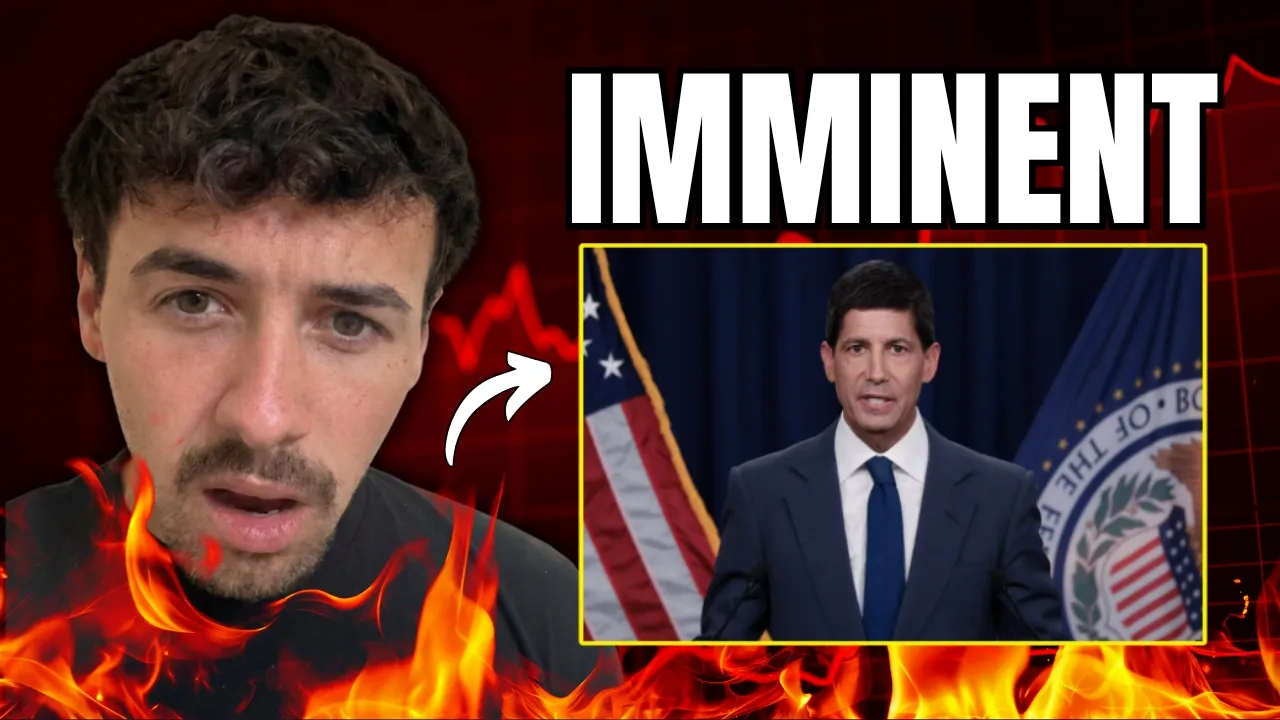
The Stock Market is About to EXPLODE.. (HURRY)

- Video return
- -3.28%
- Calls
- 3
- Buy / Sell
- 3 0
- Published
Recommendations
Entry is the asset's closing price on the publication date. Current is the last close on record.
-
Entry $476.67 27 Aug 2026Current $470.14 28 Aug 2026Result −$6.54
there are some, you know, select hardware stocks I do like, AMD, Marvell, Qualcomm, just to name three of them.
-
Entry $241.45 27 Aug 2026Current $222.93 28 Aug 2026Result −$18.52
there are some, you know, select hardware stocks I do like, AMD, Marvell, Qualcomm, just to name three of them.
-
Entry $164.78 27 Aug 2026Current $163.47 28 Aug 2026Result −$1.31
there are some, you know, select hardware stocks I do like, AMD, Marvell, Qualcomm, just to name three of them.
Full Transcript
I'm just going to shoot it to you straight right here and right now. The stock market is most likely going to rip higher tomorrow morning. And this really just has to do with the Kevin Warsh speech at Jackson Hole tomorrow and something known or I like to call event risk hedging. In this video, I will break down exactly why the stock market most likely will rip higher tomorrow morning. Now, we also have another big catalyst tomorrow morning as well. That is your annual non-farm payroll's report. Well, specifically the revisions. Now, the last year revisions were almost a million negative jobs. We were actually negative jobs last year. What will it do for markets in different outcomes? We will talk about that as well in today's video. I also want to discuss the current state of the hardware and the software trade today as that was really the only area of the stock market that did well today. And if I'm correct and stocks rip higher tomorrow, what areas are most likely going to benefit from that? So, if you can't tell, ladies and gentlemen, we have a banger for you today. Do me a quick favor and hit that like button for the YouTube algorithm so more people can see this and hopefully make money from it. Now, if you guys also want to come spot opportunity before Wall Street does and come trade and invest alongside of us, there is a link down below in the description of today's episode to do just that. We are up 103% year-to-date. This is not a recommendation, not financial advice. I'm just documenting what I'm doing, how I'm finding opportunities, where the opportunities are, and well, documenting that. So, that link is down below if you guys would like to come join us. Oh, yeah, and by the way, this is not like options trading. These are stocks that I buy and hold for many months or years. These are long-term picks. Well, long-term, 1 to 3 years. We want five, 10 baggers in the next 1 to three years. If they don't meet those qualifications or possibilities, we most likely don't own them. Okay, so getting into the meat and bones of this video. Why are stocks going to rip higher? Well, if you're a newer investor or you haven't been around a long time in the markets, then this is going to totally catch you by surprise, but it works almost every time. So, it's something I like to call event risk hedging. There might be a more proper terminology for this, but this is what I like to use. It's straight to the point and explains kind of everything. Well, event risk hedging is a defensive trading strategy where institutional investors buy options contracts like put options or short futures to protect their portfolios against the sudden violent drop in asset prices triggered by a highly anticipated catalyst. So, as a general rule of thumb in the stock market, not always, and there's a big clear example of this, but as a general rule of thumb, whenever there's some kind of catalyst that people are super negative about, that are they're talking about it for weeks before it happens, like this Jackson Hole speech from Kevin Warsh, nine times out of 10, you want to buy whatever weakness occurs before that catalyst. Because hedge funds and institutions, what do they do? They see a big catalyst. They don't know what's going to happen. They're like, "Oh my gosh, could Kevin Warsh all of a sudden turn out to be a hawk tomorrow?" In the event that Kevin Warsh is a hawk and surprises us with negative news, stocks would fall a lot, right? So, what does Wall Street do? They go out and they hedge their portfolios in the event that the catalyst is worse than expected. Well, nine times out of 10, the the level of fear and hedging heading into an event risk catalyst is always greater than the reality of the catalyst itself. So, let me put it to you like this. There's one moment in recent history that event hedge event event risk hedging actually paid off. You know what that is? I'm I'm I'm sure I'm sure you guys some of you guys are going to get this. It was liberation day, April 2nd. Okay? There was event risk hedging heading into that. People were nervous heading into that. But the actual catalyst was far worse than anyone had thought. So, if you were event hedge risking heading into April 2nd, you protected your portfolio. You made the right move, right? You spent a little bit of money to hedge your portfolio, and you were rewarded for that. But most of your other moments, whether it's a jobs report or a Fed meeting or Nvidia earnings for for an example, all of those are event risk catalyst, the event risk hedging, like hedging your portfolio before the event, usually does not pay off. Now, I'm expecting Kevin Warsh to be the same guy he was at the last press conference. So, I don't think you're going to hear anything new. I think we're going to get the same-o same-o Kevin Warsh. Now, again, I have my own opinions, you have your own opinions, but I don't think there's any like data that would logically move the needle for Kevin Warsh and what he's going to say tomorrow. But beyond that, I think Kevin Warsh is secretly a dove. I don't think Trump appointed a hawk to the Fed. But he's the new guy on the block. He has to sound kind of hawkish. So, if you're heading into tomorrow expecting some kind of super dovish Kevin Warsh, you're also going to be disappointed. But when you're dealing with a catalyst this big, and when there's this much, you know, fear and event risk hedging happening, you don't need a dovish like event right? You just need something that's not worse than feared. So, I think we have probably a 80 to 90% chance of rallying hard. I mean, aggressively after tomorrow morning. So, I'm just going to read this to you guys as well to give you the Google version of all of this. It says here, "Because tomorrow morning's keynote speech by Federal Reserve Chairman Kevin Warsh carries an immense amount of uncertainty with core PCE sticky at 3.3% to 3. to 3.7% and friction brewing between the Fed and the Treasury, Wall Street has spent the last week aggressively paying a premium to hedge this exact event. Should Warsh simply deliver a balanced status quo speech that avoids major hawkish surprises, this heavy defensive positioning could trigger a mechanical market phenomenon known as a volatility crush, rapidly exploding stock prices higher through three interconnected market dynamics. The Vanna rally, okay? So, this is when institutions and hedge funds, they go out, they short the markets. They go out, they buy puts, right? They go out and they short futures. That's most likely. Some of them are probably shorting stocks as well, but they go out and they short these leverage products. So, what happens? Every time a hedge fund shorts an at-the-money put what happens or a put that's in the money is what they do a lot of the time, so you get dollar for dollar, market makers, they have to go out and they have to short basically 100 shares of the underlying asset or security. So, a lot of puts equals a lot of shorting by market makers, so their books stay neutral. Market makers are not in the game of losing money. They go out hand for hand, short or buy based on option activity, right? This is a gamma squeeze. A lot of you guys might know what that is. When a stock begins to move higher, people rush into call options. Well, the market makers have to go out and buy the stock to hedge for the event those options, you know, continue to go higher and the stock continues to go higher. Some of you are probably familiar with a gamma squeeze. It works in the opposite direction. When there's a lot of, you know, nervousness heading into a catalyst, Wall Street, they go out, they short those those options, they go buy those options, right? Maybe I should say they go buy like put contracts. So, market makers have to go out and start shorting. If the catalyst is not that bad, well, what are hedge funds going to do? They're going to get rid of those put positions, and then those market makers go out and buy the stock back that they shorted almost instantaneously. It happens in milliseconds. Now, it says the the unwinding of the tail risk premium. This is something that I talked about as well, um, recently on this channel. I actually still have it open here. Tail risks are exogenous events that have to get priced in. Like, specifically with economic D-Day. I I I said, "Look, the tail risks have gotten more likely on both sides, right? Because the Treasury threatening to sanction China. What if China responds to that and we have a trade war or something like that?" That is a exogenous event that would be very negative for the markets. That's a tail risk. Low probability, high potential impact negatively or positively to the markets. Well, funny enough, after economic D-Day, the probabilities of a positive tail risk event and a negative tail risk event actually went up. If China retaliates, well, that's a negative tail risk event, the odds of that went up versus a month ago. Well, the odds that Iran actually comes to the table and ends the war actually went up as well following economic D-Day. So, that's a tail risk event, something with a low probability that Wall Street has to hedge for. Again, like April 2nd, liberation day of 2025. That was a tail risk event. That was a um something that was a low probability that actually happened. That had a caused a 20% decline in the market. So, it says here, "Markets hate a lack of direction more than they hate bad news." Leading up to tomorrow, the bond and stock markets have been on edge because Warsh has maintained a notably tight-lipped less is more communication style. If he proves even the slightest bit of clarity regarding how the Fed views long-term bond yields or the Treasury's recent debt buyback interventions, that clarity removes the worst-case {quote} fear factor. Once the catastrophic tail risk is off the table, fund managers who move to cash or defensive sectors will rush to redeploy capital back into risk assets triggering a classic relief rally. Now, again, forced short squeezes in yield-sensitive sectors. So, basically, high beta risk-on stocks, they are the ones that are typically going to rally more, especially in the bond market. So, what you'll probably see tomorrow is a lot of those bets coming off of the bond market. So, bond yields, 10, 20, 30-year bonds in the past couple of weeks have skyrocketed. That's been the talk of the town on CNBC for weeks now. Part of that is because of this Kevin Warsh event. So, what is Wall Street doing right now? They're going out, they're shorting the bonds. They're buying derivatives on the bonds to play a downside price and upside yield move. It's inverse. So, you can think about the bond market like a dividend stock, right? If Coca-Cola pays you $5 a year and the dividend stock and and their stock price is $100 per year, that's a 5% yielding dividend stock. Well, when bond yields go up, it's like if a dividend stock's yield went up. Instead, the government never raises the amount they pay on bonds. The price fluctuates. So, if Coca-Cola still continues to pay a $5 dividend per year, but now their stock is $50, that is now a 10% yielding dividend stock, in this case Coca-Cola. Same works here for Treasury. So, when yields are going up on Treasuries, the bond prices are falling. So, there's a lot of bets right now that bond prices will fall even more or hedging for that after Kevin Warsh. Well, if Kevin Warsh is not super hawkish, doesn't really give you a surprise, a lot of those bets that bond prices will continue to fall are going to come off the market. Bond yields are going to fall dramatically because price will go up. Okay? That's That's the complicated version trying to make it short and sweet for you guys. I know, if you're a newer investor, it's going to take a while to understand these dynamics, but you are most likely going to see bond yields fall a lot tomorrow as long as Kevin Warsh does not deliver some kind of massive surprise. So, the pre-event setup, which is today, you have high volatility, high implied volatility, and heavy put option buying. Market makers are shorting stocks to hedge those puts. Macro funds are aggressively shorting rate-sensitive equities. The post-event catalyst, tomorrow morning, Warsh avoids an overly aggressive hawkish tone. The worst-case unknown risk disappears, and long-term bond yields stabilize or move lower. This likely causes a short squeeze, forced buying, and a volatility crush. Now, again, I'm not a financial financial advisor. I don't have a crystal ball here. I can tell you the probabilities and how these things work in in in principle, right? How they should work. But, it's all determined what Kevin Warsh says. If he comes out and says, "Yep, we're probably going to need to raise rates." Something like that. Uh yeah. Stocks are going to fall, right? It's going to be like April 2nd liberation day. If you get a bigger surprise than what the markets are expecting, which honestly a rate hike wouldn't be the end of the world. Like we're kind of already pricing that in in the next 6 [snorts] months. But if you get something like Kevin Warsh is like, "Yep, we might need a series of rate hikes. We don't care what happens with the economy." Something like that, which I think is uh like less than 1% probability. That's when you would get like a market crash from that. I just don't think we're going to get anything from Kevin Warsh. Like he's going to be very much we're data dependent. We're going to see what happens. Blah, blah, blah. So that brings us to the heat map today of the S&P. So you can see most of the markets sold off today. The only areas that really did well were hardware stocks today and software stocks today. And look, there were a lot of good software earnings last night. Like basically every software stock went up 10 to 20% after they reported earnings. That's great. Hardware stocks, Nvidia had really good earnings. So Nvidia went up last night. Gave you really good guidance. To some extent, like the AI trade hardware and software is kind of independent to what's going on with rates, right? Software's business to business. Um you know, it it it it's just who cares if the 10-year yield is 6% or 7%? Software is going to continue to do well and benefit from AI. Same is true for hardware. Now, with that said, software very high beta. So if tomorrow bond yields do come down, I would expect software to outperform hardware. I do expect software to continue to do well. I think the how the markets are viewing software is changing. Now the Anthropic CEO said we're not trying to destroy software. Like we're going to partner with software, not destroy them. I think I think Wall Street's really underweight to software. And that's a trade that could keep on giving. Tomorrow, though, if the markets do respond positively from Kevin Warsh and what he delivers, I don't think software is going to be an outperformer like today. It could be pretty in line with the rest of the markets. Hardware, it's really hard to tell what happens with that because that's really independent of what's going on with the Fed and bonds and all of that. Um So, it's a little hard to gamify this to tell you exactly what's going to happen. But, the areas that are really red today are probably going to be pretty damn green tomorrow. The areas that are really green today are going to be a smaller green tomorrow. Okay? [laughter] Um kind of going to see things flip-flop a little bit, if I were to guess. Now, maybe everything skyrockets tomorrow. Maybe everything crashes tomorrow. At the end of the day, we'll see what happens. That would be my take, my expectation for this event. I will also say that event risk hedging is a short-term thing. So, it's going to be like a one-day thing. It's for tomorrow. Coming by Monday, people are going to be right-sized again, getting ready for the next catalyst. So, it's just a Friday one-day kind of thing. Now, if Kevin Warsh gives us some kind of surprise that's positive or negative, for that matter, it could last a couple of days. Like, we could rally for a couple of days on good news. Could could crash for a couple days on bad news. But, it's typically not going to be something that we're react that we are reacting to for multiple weeks. It's a short-term thing. Market makers repositioning themselves. And I do think you want to be positioning right now into the new AI trade, which is robotics, automation, AI software, and cybersecurity. Those are the areas that are going to go up the most, I believe, in the next 12 to 18 months. But, there are some, you know, select hardware stocks I do like, AMD, Marvell, Qualcomm, just to name three of them. I also think cyclicals, industrials, things tied to interest rates and the real economy also look quite well right now. They also will benefit from AI down the line as more and more of them actually implement the technology. And for the most part, I do think you still want to stay away from AI hardware stocks. Again, some of them can do well, but I just don't think there's a good risk-reward there. I mean, in the trading community, my objective is to find opportunity before Wall Street does. And specifically, when there is emotional periods, when Wall Street is super bearish, let's say, I love taking advantage of that because the fact is, in the near term, stocks move based on emotions like fear, every time. Doesn't matter. If the markets are crashing, basically everything's going to crash, no matter what the fundamental story looks like or the valuation. In the longer-term sense, 3, 6, 9, 12 months, markets are going to trade on fundamentals and stocks are going to trade on their own specific fundamentals. And I just think cyclicals industrials non-AI financials, software, AI software, robotics automation cybersecurity I still think they are not pricing in that much good news. There's still a lot of people that are short these areas. For example, software used to be about 15% of the S&P. Today, it's like 5%. Wall Street has really gotten away from the software trade. And I think software is going to be some of the biggest winners from AI, which is quite paradoxical. And that's why I still think we are very early in that opportunity, but same goes for robotics, like something like a Tesla, right? Same goes for automation. Some software stocks are also automation. You can also have like pure more pure play automation stocks like a Zebra Technologies. And then obviously cyber just benefits from more AI in general. Now, I will also tell you that tomorrow morning you have the non-farm payrolls, the annual revisions. Last year we were negative 911,000. Look, uh as long as there's no like crazy number here, I don't think we're going to get much of a reaction. Like if non-farm payrolls get revised up a million or if they fall a million, like that that can have an impact on the markets, but I really think it's just Kevin Warsh tomorrow that matters. And that event from Kevin Warsh, that speech is at 10:00 in the morning. So, keep that in mind. And you might start to see some of the hedges come off like at 9:30, right? Because Wall Street, they tend to know things before we do. So, if if you notice the market's moving higher into Kevin Warsh, it's probably a good sign. Somebody already knows that Warsh is not going to surprise us with bad news. You also get Chicago PMIs tomorrow at 9:45 in the morning, but again, it's not really going to matter. Our bigger catalyst is Kevin Warsh. So, I do think the stock market is likely to explode higher tomorrow. Let me know your thoughts on this down below in the comments section. Hit the like button as well. Subscribe to the channel if you guys have not done so already. Again, if you guys want to come trade and invest alongside of us, that link is down below in the description of today's episode. Have a fantastic rest of your day, and I will see you in the next one.
Comments 0
Sign in to join the discussion.
Sign inNo comments yet. Be the first to share your thoughts!