Number one, Apploven. This one's clear. Apploven is growing their their total adjustable market by 6x. ... Apploving they've down they're down about 50% in the past month and a half. It's an asymmetrical opportunity at this point.
Number two, Zebra Technologies. Have you ever went to a hospital and got that that ban, that barcode, they scan it every time they give you something? Well, that's Zebra. Okay. ... This is an AI automation company for the real economy with I believe multiple years ahead of Tailwinds from AI adoption. This is a 5 to 10x opportunity.
Context
Number two, Zebra Technologies. ... This is an AI automation company for the real economy with I believe multiple years ahead of Tailwinds from AI adoption. This is a 5 to 10x opportunity.
UPath is stock number three. This is a 5 to 30x opportunity depending on if their maestro platform, their automation platform is utilized in like humanoids and real world applications as well.
Number four is Rubric. Okay, Rubric is a 5 to 10x opportunity within cyber. ... Rubric, yes, it's expensive. All cyber is expensive for a reason. There is growth for many, many years to come.
Number five is Zeta Global. ... If there's a correction in the markets and you get a discount on this one, I think personally I would be interested in buying that.
Number six is Tesla. ... I do think Tesla's $1,000 stock by next year that's roughly a 3x from here longer term it's a 5 to 20x opportunity within robotics.
Another high-risisk, highreward one is Amprius Technologies. It's about a $1.5 billion market cap. Again, I put this as like a 5 to 30x.
Full Transcript
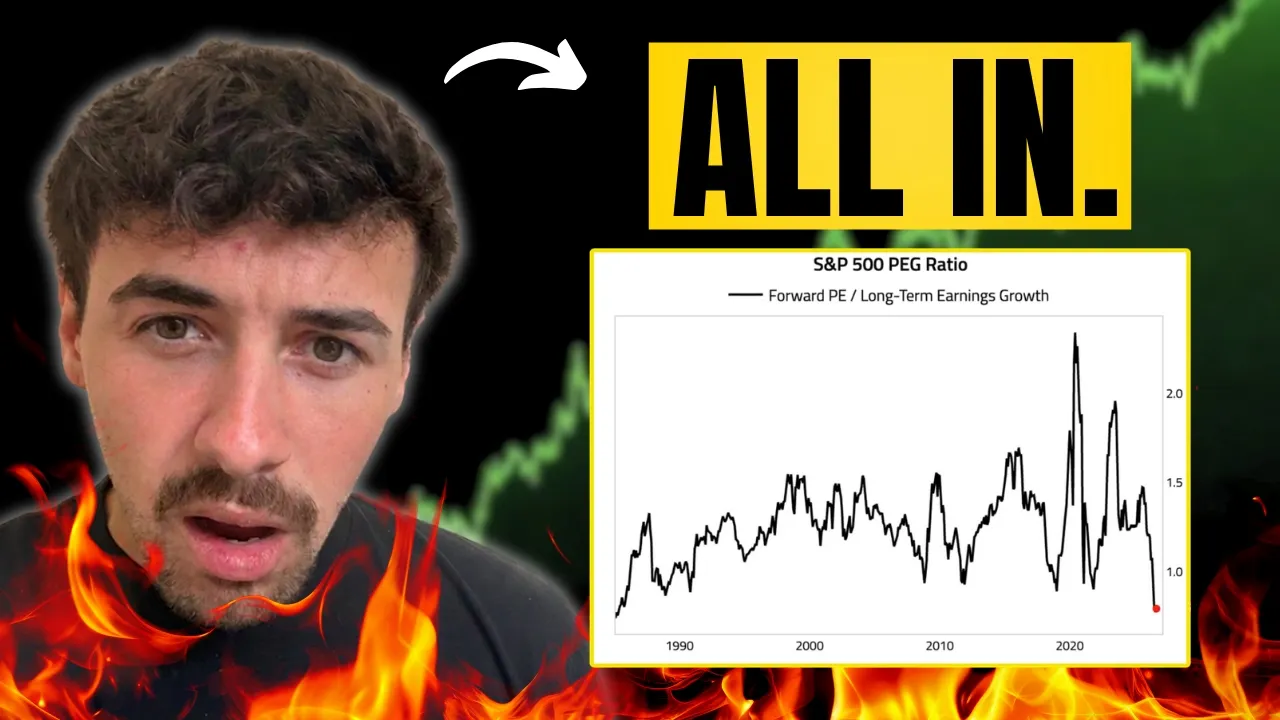
As we talked about in the last video, Tom Lee is expecting some kind of correction in the month of September. And this has to do with the midterm elections and the pressure around the AI buildout and data centers with new moratoriums and restrictions being put on different states. And also in the last video, I shared with you why mathematically this could pressure the markets. For an example, this year for the headline S&P, you're expecting 24.7% EPS growth for the full year. Those are crazy numbers. If you strip out only Nvidia and Micron, you drop down to 16.8%. If you drop out other names like Goldman Sachs and Morgan Stanley that are benefiting from underwriting the debt and if you strip out like a GE Veronova and an Eaton, these are some of your AI industrials, you're actually only growing EPS at 12%. Which is 50% lower than the headline SNP earnings growth figure of 24.7%. Now, the good news is 12% earnings growth is still freaking insane. So, the average company out there earnings are accelerating. But a lot of this fear has really started following Texas's governor, Greg Abbott, that issued a sweeping statewide pause on new data center approvals. This has people nervous heading into the midterms that if Democrats win the Senate, it's only a matter of time before the AI buildout becomes restricted and thus would pressure EPS growth from an index level of this market. And that's probably one reason why PEG ratios of the S&P price earnings and growth. When you look at the sum of the parts and how expensive markets are incorporating growth of earnings, you're actually trading at levels you have not seen in the past 30 or 40 years. And this is a big reason why the S&P 500 PEG ratio is below one. You are at 40-year lows right now. Anytime historically the PEG ratio is below one, you are in a recession or deep bare market. The markets are fundamentally undervalued right now. Why? Well, a PEG ratio, in case you don't know, is price earnings divided by the growth rate. So, it's the most accurate measure to actually figure out which company is cheaper. Right? You could have two companies both with a forward PE of 20, but if one's growing earnings at 30% and the other is growing earnings at 10%, the one growing earnings at 30% is much cheaper. Well, what this chart is showing you is Wall Street, they are kind of expecting earnings growth to slow down. Well, this argument could really ramp up if Democrats win the Senate and if we are forecasting that throughout the month of September and October. Now, as I said in the last video, I don't subscribe to the view that if we do see more pressure on the AI hardware trade, that that has to crash the markets. I think the downstream AI stocks could actually benefit in that environment. If you take away the hardware stocks, but the AI trade, the technology is still alive and well, you you're left with the downstream longer term winners that are going to benefit from that. Now, ladies and gentlemen, in this video, I'm going to share with you 10 stocks that I plan on buying in September if the markets do go through a broad correction. If we do see kind of everything sell off, it's a big if, but if it happens, these are 10 stocks I will be buying. These 10 stocks, I believe, represent asymmetrical opportunity. What does that mean? I think fundamentally Wall Street is more bearish on these companies than the results that they will put up over the next 12, 24, and 36 months. I think there is a disconnect here between expectations and reality. A lot of these stocks are downstream AI winners. They're not the stocks that are the first winners from AI like the hardware stocks. And in the event that we do have a correction in September, it could pull all of these stocks lower. But again, I still would expect most of the pain to be concentrated in the headline indexes andor some of your AI hardware stocks. kind of like the correction that we had from June through late July. The NASDAQ fell 11 12% during this period and this was really so the last couple of months, the last 3 months or so. Well, our portfolio in the trading community is actually up 80% in the past 3 months. We really did not see a decline at all. Even though the index for the NASDAQ had fallen 11 12% and a correction in September could look pretty similar to that. You don't have to see everything sell off. Even though if you did see everything sell off, that's where the real opportunity is. Ladies and gentlemen, before we get into these 10 stocks, which we're going to do here in about 30 seconds, hit that like button for the YouTube algorithm to help push this video out to more people that need to see it that hopefully will benefit from it. Keep in mind, this is not a recommendation. This is not financial advice. This is not a solicit solicitation to buy, sell, trade anything. These are just stocks that I think hold opportunity and it is up to you to do the deep research and to come to your own conclusions. So, I'm not going to sugarcoat this for you. I have the stocks listed on screen now. We will run through each of them with a brief description of what they do and why I think there is an asymmetrical opportunity in them. Number one, Apploven. This one's clear. Apploven is growing their their total adjustable market by 6x. They are a mobile advertising behemoth. They basically have an they have a monopoly like 85% market share. Well, they are opening up their technology, their advertising portal to the open web. This puts them in direct competition with Meta and Google. It is going to raise their total adjustable market. This company is highly profitable. It's in the top 1% of profitability. They have a 64% net margin. That's what they pay tax on. 64%. It's 8 percentage points better, 9 percentage points better than Micron. It's insane. Okay. Apploving they've down they're down about 50% in the past month and a half. It's an asymmetrical opportunity at this point. Number two, Zebra Technologies. Have you ever went to a hospital and got that that ban, that barcode, they scan it every time they give you something? Well, that's Zebra. Okay. They do that in warehouses, health care, industrial applications, your normal economy kind of stuff. Well, they have their physical barcode scanners and all of that, but it's really the software and automation data behind it that is the exciting part. That's where the margin story is going to come in. This is an AI automation company for the real economy with I believe multiple years ahead of Tailwinds from AI adoption. This is a 5 to 10x opportunity. I also view app loving I should say as a 5 to 10x opportunity. UPath is stock number three. This is a 5 to 30x opportunity depending on if their maestro platform, their automation platform is utilized in like humanoids and real world applications as well. This is AI software and automation. The fact of the matter is companies cannot deploy AI agents without secure guard rails in place without being able to provide human oversight. You can't just let AI agents start running wild in your business. You have to have orchestration platforms. And yeah, there are a couple of orchestration platforms out there, but UiPath has the the broadest one, right? Any company can sign up for UiPath and deploy AI agents, whereas other companies like a service now, they're going to have their orchestration platforms that are more tailored to their specific niche. UPath is a big winner from the adoption of AI agents over time. And I think if there's a correction in the markets, that is an opportunity. Number four is Rubric. Okay, Rubric is a 5 to 10x opportunity within cyber. And this one goes without speaking. More AI agents, more technology within AI means more vulnerabilities, which means a need for rubric. Rubric is no longer an option. It is a requirement in an AI world. rubric can go into the millisecond a cyber attack happened. Remove those bad files and bad actors back up your business so you're continuously operating even though you may be getting cyber attacked at the same time. It is no longer an option. Rubric, yes, it's expensive. All cyber is expensive for a reason. There is growth for many, many years to come. Number five is Zeta Global. They have 92% of the US adult population in their data graph. Okay, what does that mean? If you're watching this video, there's a 92% chance you have a data profile with Zeta. They are the fourth largest firstparty proprietary data set in existence. The only companies with more data would be, I believe it's, don't quote me on this, Meta, Google, and Amazon. Don't quote me on that, but all of the the other companies are multi-trillion dollar companies. Zeta Global with the kind of data that they have is able to target advertising very effectively. As you could probably tell, these data profiles, if you're watching this video, you have 5 to 7,000 different data points on you in the Zeta Global platform. They know what you spend your money on, what you eat, when you sleep. Yeah, I know. Creepy, huh? But that's how they target advertising so well. They give their customers a 600% return on investment with plans to grow that to a,000%. You give Zeta Global $10, they give you $60 in return on that on average. They are the best ROI on advertising dollars spent out of everyone. They beat Meta, they beat Google, they beat Amazon or even Apploven, right? They are the best out there. $7 billion market cap. They are also entering into business intelligence. When you have 92% of the US adult population in your data graph and they know all of this stuff about you, you can help other businesses make better decisions. That's what they are now getting into with their 7-year partnership with Palanteer. 5 to 25x opportunity from here easily in the next couple of years. If there's a correction in the markets and you get a discount on this one, I think personally I would be interested in buying that. Number six is Tesla. I think this one is very obvious. It's all about robo taxi. It's all about Optimus. But they also have the Tesla Semi and Cyber Caps coming which are going to be cheaper and improve the economics of the robo taxi network. But it's really all about Optimus at this point. The Optimus market potential is between 10 and hundred trillion. You really can't put a number on infinite labor. There's no other company that's in a position to compete with Tesla unless Apple, Google, Amazon, some of these well- capitalized companies tried to do humanoids, which they're not at this point. That's when you could say, "Oh my gosh, there's some competition here." But nobody can really compete with Tesla from a manufacturing perspective. Like, do you think Apple or Amazon could compete with Tesla from a manufacturing point of view? Absolutely not. manufacturing cars at scale is one of the most difficult manufacturing tasks be besides semiconductors that you could even do right so for a lot of reasons here Tesla's very likely to be successful in robotics the question is execution and timing we're expecting optimist by the end of this year if that does not happen or that is delayed Tesla's stock will not work I do think Tesla's $1,000 stock by next year that's roughly a 3x from here longer term it's a 5 to 20x opportunity within robotics. Number seven is Back Blaze. 5 to 50x opportunity. Very high risk. It's about a billion dollar market cap. What they do is instead of buying Dell server racks for like $5,000, they build their own server racks for $200 to $300. They only put in there what they need. They go out and they buy thousands of 20 to 26 terabyte hard drives from Western Digital and you know some of these a lot of them from Western Digital but from other companies as well. What they do they plug them in. So with their racks they're not building data centers. So they call up older data centers with the power and infrastructure and they say look hey we want to put in you know 60 50 server racks. What's the lease going to cost us? So, because they're not building data centers, they're not buying expensive racks, they only charge about $7 per terabyte of data in and I believe $10 per terowatt or terabyte of data out of their cloud solutions. You know, Amazon charges like $24 for a terabyte in and like $50 for a terabyte out. They are dramatically undercutting their competition. Why? because they're not building data centers and and they're not buying expensive racks. Back Blaze will actually benefit when memory prices fall and it's the market's treated as something that's connected to memory prices. Back Blaze trades with the AI hardware trades, but it's really a software data storage company. There's a big disconnect there. Obviously, high risk because it's a low market cap and things can happen. But I do like it and I think it's asymmetrical if it does decline during some kind of market correction. First, solar is an interesting one. I think the only way to actually get more energy in the near term that most people would support is solar. It has to be packaged correctly. Look, if if you told people we you were going to put solar panels on top of all of those gas station car things that like protect your car on the top of the roofs of gas stations, I think people would support that. If you were talking about building solar panels in Walmart parking lots as kind of like gas stations, right, the overhang thing, people would support that. People don't support putting solar panels in corn fields, of course, but packaged the right way, I think solar could be a solution to the energy problem. Well, first solar with their proprietary thin layer technology, they have a backlog through 2028 right now. But as there is a greater need over the next couple of years to provide energy quickly in a sustainable way, I think first solar could be a big winner from that. If first solar does get punished during a correction, I think that would be an asymmetrical opportunity to play the next iteration of energy for data centers. Nuclear is great, but it takes too long. So solar is likely going to be something that wins, especially as more, you know, political backlash continues to happen from energy bills related to data centers. First solar clear winner as that argument grows, right? It it it it helps out the solar trade. Not to mention, if Democrats win the win the Senate, you know, that's just good for green energy all around. Number nine is Amplitude. Okay. Now, Amplitude is AI software and data analytics. Um, this stock is up a lot recently. So, especially during a correction, it would be interesting. This company's has about 450 million in ARR. It's about a $ 1.8 billion market cap. They basically do data analytics. They they help companies figure out, you know, what they should do, right? It's kind of business intelligence to a certain extent, but it's a small company. I think they will be benefiting from adoption of AI in a you know more mass way right like a lot of companies they've experimented with AI they haven't actually adopt it yet I think Amplitude is set up to do well in the actual adoption phase of enterprise AI now again high risk high reward I would view this as a 5 to 10x opportunity but again they're growing revenue at about 22% they're not that expensive But it's execution, right? If they can hold up their 71% gross margins or raise that, that's where the story gets even more interesting as their revenue grows over time. Uh smaller company, very interesting. I think uh at least 5 to 10x opportunity here for f for uh first solar I should say. Um because I don't have the you know the opportunity here. I really think this is like a three to 10x just depending on again what happens. It's it's not a guarantee that solar is going to do well if we need more energy, but I think it is highly likely it does. First solar is a $22 billion market cap. It is by far the leader in solar technology, especially with the hyperscalers. So they're going to be the first point of you know solution to solve the energy problem. Okay. So first solar interesting 3 to 10x opportunity. I don't think there's as much risk in first solar and I think that's why it's a 3x opportunity at the low point. Again, they have a soldout backlog between now and 2028. So, you know, a lot of these companies, they're not in that position. Another high-risisk, highreward one is Amprius Technologies. It's about a $1.5 billion market cap. Again, I put this as like a 5 to 30x. Very high risk. They're basically building batteries and there's rumors of an Elon SpaceX deal for their battery technology in orbital data centers. I think in the near term, if that were to be confirmed, there would be a lot of hype over that. The company's actually projecting revenue of $200 million this year, which is actually kind of wild for a battery company that just came like public, that just started operations in the last 3 to four years. So, their technology is obviously winning in the marketplace. And again, it's about a $ 1.5 billion market cap with $200 million of revenue. It's not that expensive for a hyperrowth battery company in the day and age of AI. They grew revenue at like 80% year-over-year in their latest quarter. So, it's it's actually not that expensive. For those of you guys that made it to the end of this video, I do have uh five extra stocks as well that are very interesting during any kind of correction. Reddit, MongoDB, Palenteer, Data Dog, and Snowflake. But I think out of all of these, I think Reddit's probably one of the more interesting riskreward opportunities right now. Now, if you guys want to fast forward through all of that, come trade and invest alongside of us. Again, never a recommendation, but spotting and identifying opportunity before Wall Street does. That link is down below in the description of today's episode. Ladies and gentlemen, let me know what stocks you are eyeing if we do have a correction in the month of September. Have a fantastic rest of your day and I will see you in the next

Comments 0
Sign in to join the discussion.
Sign inNo comments yet. Be the first to share your thoughts!