I also do like the energy theme and the battery theme just with AI. Even if AI hardware falls out of favor, there's still going to be massive demand and needs for batteries and more energy infrastructure, which for that I like First Solar and Amicus Technologies. I think the risk reward looks pretty attractive on those two names.
I also will add Reddit, MongoDB, Palantir Datadog Snowflake and Zscaler to this list as well, but again, it's all about the price you're paying for these companies.
I also will add Reddit, MongoDB, Palantir Datadog Snowflake and Zscaler to this list as well, but again, it's all about the price you're paying for these companies.
I also will add Reddit, MongoDB, Palantir Datadog Snowflake and Zscaler to this list as well, but again, it's all about the price you're paying for these companies.
I also will add Reddit, MongoDB, Palantir Datadog Snowflake and Zscaler to this list as well, but again, it's all about the price you're paying for these companies.
I also will add Reddit, MongoDB, Palantir Datadog Snowflake and Zscaler to this list as well, but again, it's all about the price you're paying for these companies.
I also will add Reddit, MongoDB, Palantir Datadog Snowflake and Zscaler to this list as well, but again, it's all about the price you're paying for these companies.
Royal Caribbean, Norwegian Cruise Line, Celsius, Bloomin' Brands, which owns um uh, what is that? Texas Road, uh, Logan's, one of your major steak houses that that that you guys would would know.
Royal Caribbean, Norwegian Cruise Line, Celsius, Bloomin' Brands, which owns um uh, what is that? Texas Road, uh, Logan's, one of your major steak houses that that that you guys would would know.
Royal Caribbean, Norwegian Cruise Line, Celsius, Bloomin' Brands, which owns um uh, what is that? Texas Road, uh, Logan's, one of your major steak houses that that that you guys would would know.
Royal Caribbean, Norwegian Cruise Line, Celsius, Bloomin' Brands, which owns um uh, what is that? Texas Road, uh, Logan's, one of your major steak houses that that that you guys would would know.
A lot of your major banks, like a JP Morgan or even, um, especially like Morgan Stanley or Goldman Sachs, they are massively benefiting from underwriting the debt that is happening around AI hardware, this AI cycle. Once that slows down or begins to slow down, those are stocks that are not going to do well, probably for years.
A lot of your major banks, like a JP Morgan or even, um, especially like Morgan Stanley or Goldman Sachs, they are massively benefiting from underwriting the debt that is happening around AI hardware, this AI cycle. Once that slows down or begins to slow down, those are stocks that are not going to do well, probably for years.
A lot of your major banks, like a JP Morgan or even, um, especially like Morgan Stanley or Goldman Sachs, they are massively benefiting from underwriting the debt that is happening around AI hardware, this AI cycle. Once that slows down or begins to slow down, those are stocks that are not going to do well, probably for years.
Full Transcript
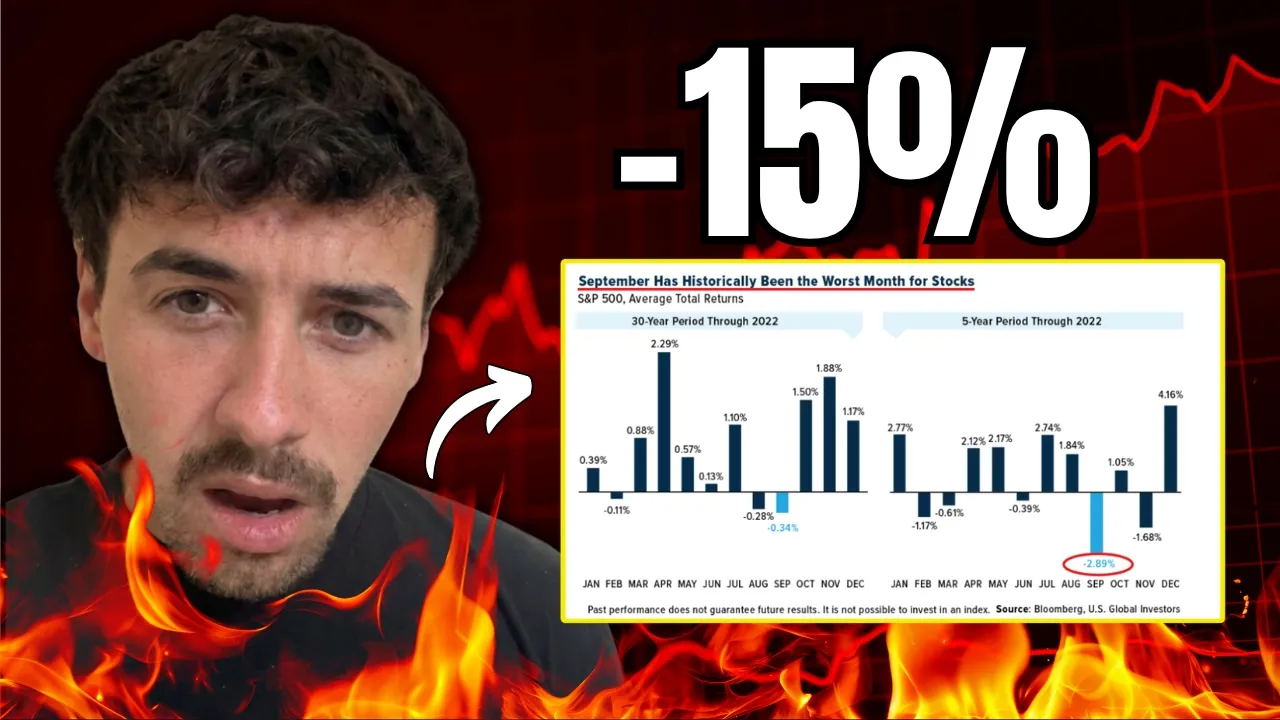
Is the stock market about to go through a crash or correction in the month of September? That's what we are going to talk about in this video. What could cause a correction or crash? What could avoid this? And actually give us a really good September. I will share with you the areas of opportunity that you want to be taking advantage of if if we do have a crash or correction in the month of September. These are 1 to 3-year themes. They're not something you want to buy and sell in a month, but buy and hold for the next 1 to 3 years potentially. Again, keep in mind I am not a financial advisor. This is not a recommendation or solicitation to buy, sell, or trade anything. I'm just going to give you the facts and share the truth in this video. And quickly before we begin, the only thing that I ask you to do on this channel is to hit the like button for the YouTube algorithm to help push this video out to more people that need to see it. I'm just going to give it to you straight though in this video. We're going to start off with the meat and bones of this. Are we going to have a crash or correction in September? And the truth is, ever since 1930, the month of September before a midterm election, the average decline is about 2% on the S&P. But I feel like most of you guys would agree with what I'm going to say next. This time around, there's a lot of different moving parts within this market right now. You have AI hardware stocks that have come under a lot of pressure. You have a broadening trade that is happening. We have 25% year-over-year earnings growth. There are a lot of things that are going right, but there's also some massive risks, including the Fed. The Fed just on Friday said inflation doesn't make progress, we're going to have to raise rates. That's essentially what Kevin Warsh said. Now, we're going to have another CPI report before September 16th, but smack-dab in the middle of September, you have a Fed meeting in which the markets are pricing in about a 65% chance of a rate hike coming September. We also have an Iran war, which is not really a kinetic war anymore. It's an economic war, and at this point we're just waiting to see what the next headline looks like. As far as we know, the US is reviewing the prior MOU to see if they want to sign up for that again, or if this is just going to be another forever war. The point is nobody really knows what is happening with the Iranian conflict, and this is such a massive potential catalyst for the markets. At this point, I kind of view it like the damage is done. We're not fighting kinetically. The Strait of Hormuz is closed. There's nothing happening. I don't view it as likely to get worse from here. The Again, the damage is already done. But, it could be a big positive catalyst if the war did end, or if the Strait of Hormuz did open. That would basically avert any possibility of a Fed rate hike in the middle of September. Now, predicting what's going to happen from now until September 16th, before the Fed meeting, with this Iranian conflict, is impossible to do so. It could end by then, or it could be the same as it is today. So, I want you guys to keep in mind throughout this video that if the war with Iran did come to an end, you're not going to get a correction, or whatever correction we're potentially in by then is likely to be over quickly because oil would fall, the odds of rate hikes would plummet, inflation expectations would plummet, and Wall Street would take off a lot of their hedges in the market. There's a lot of event risk hedging around the Strait of Hormuz being closed and the Iranian conflict because of the volatility that the markets experience every time we have good or bad headlines. And honestly, like I've said before, about 80% of the market's problem right now is the Iran war. That is the the culprit of the Fed being hawkish, right? Or more hawkish than than we would like. That is the culprit of higher inflation and putting pressure on the consumer. If the the Iran war ends, things get pretty good overnight for the markets. At that point, the only real problem we have is what's happening with AI stocks and AI hardware. And we will talk about AI hardware here in just a moment because that's another big part of what's happening in this market right now. We do have big earnings this week from Broadcom and Dell, as we talked about in the last video. And those two companies are going to move the index a lot. But, the long story short is the economic data that we get this week. You have JOLTS job openings, you have the jobs report, you have Challenger job cuts, you have ISM services PMIs and manufacturing PMIs. Specifically, prices paid are going to be very important. But, the economic data we get probably won't be bad enough to avoid a rate hike. Now, CPI will be coming out as well, not this week, but next week. Maybe CPI is really low and that avoids that avoids a rate hike. But, if CPI is not really low and we did get a good jobs report, it's not going to be enough to not give you a rate hike. And kind of the way that I look at it is there's 65% odds of a rate hike right now. Well, jobs report's probably going to come in okay. It's probably not going to be terrible. If it is terrible, great news for the stock market, but it's probably going to be okay. So, the odds are probably not going to move all too much. You're probably going to stay about 50% probability of a rate hike or more, depending on what the economic data looks like. And it it's going to be a coin toss heading into September 16th and then we'll see what the Fed does. But, the markets are not going to respond well if it looks like a coin toss whether or not we get a rate hike heading into September 16th. That would be the fuel for a correction in the markets. Of course, unless the Iran war ends. If the Iran war ends, the stock market will rip because you're not going to get a rate hike on September 16th. So, I know this is a very weird situation. If the Iran war ended on September 14th, you're not going to get a rate hike, right? But, the markets might have already sold off heading into the Fed meeting expecting a rate hike. So, you want to be nimble here in how you're approaching this market. You have to understand that one positive headline out of this Iran war and the Strait of Hormuz opening could [snorts] completely cancel any kind of crash or correction that you think is coming in September. Now, let's talk about the AI hardware trade because I'm sure if you're watching this video, you are probably exposed to the AI hardware trade at this point. You either have some strong opinions about it, you're nervous about it. I'm I'm just going to lay it out there for you guys what's happening. So, Anthropic and OpenAI came out with bad numbers like 2 weeks ago. They weren't like bad um in reality, but they were a lot lower than what Wall Street was expecting. So, they're bad although they're some of the fastest growth rates we've ever seen in a company, period. Hardware stocks have priced that in, right? So, it was a disappointment when we heard Well, this means they need to raise a lot of debt to finance the current and future obligations they have for data center contracts. And the markets do not like this. You can see across the board from Nvidia and hyperscalers and and basically everyone that their CDSs, their credit default swaps are exploding. The markets are now pricing in like a 1 to 2% chance for most of your hyperscalers and companies like Nvidia to default on their debt within the next 3 to 10 years. That's kind of insane for multi-trillion-dollar companies. These CDS's were less than a half of 1% 2 months ago. So, there's definitely some growing concern and risk being priced into these stock stocks. Um so, it's basically raising the risk of the AI hardware trade ending because if OpenAI is unable to IPO and they have to raise money and then they're unable to, let's say, the AI trade is is is over, right? The hardware trade is over. Literally, OpenAI would go bankrupt. It would be insolvent. It'd be a bad situation. Now, I don't think that's going to happen, but with poor revenue numbers and losses growing, it means you are a lot more reliant on other people giving you money. And that's a slippery slope because if the funding stops, then everything stops. Now, Nvidia and all these hyperscalers, like they would give the money. I I I'm not super concerned about that at this moment, but that's the risk, right? And simply put, the math is no longer mathing, right? Um the OpenAI and Anthropic, they are signing like 50% of the data center contracts with revenue that does not exist. Okay? The math is not mathing. That's that's the simple part. Number two, the AI hardware trade is attributing about 50% of the year-over-year S&P 500 EPS growth. Circular financing, the companies within industrials and financials that are benefiting from this, it's attributing about 50% of the year-over-year EPS growth, which is sitting at about 25% year-over-year right now. Without the AI hardware trade, S&P EPS growth would be about 12%. So, this is why nervousness around the AI hardware trade is bad for the headline indexes and bad for hardware stocks. Because imagine the AI trade ended tomorrow, EPS growth on the S&P would be half of what it is today. And this is one reason why if you look at S&P 500 PEG ratios, they are at some of the lowest levels you've seen in the last 40 years. Anytime PEG ratios are below one on the S&P, you are typically in a bear market or some kind of like recession, right? Whether it's '08, '09 here, or whether it's like COVID or 2022 right here. You're all the way down here. Why are PEG ratios so low? Because people are like, "Okay, AI trade's going to end at some point. The EPS growth for the S&P is going to slow down." And as we are seeing these problems with Anthropic and OpenAI, the probabilities of that are going up. The silver lining is 12% earnings growth for the S&P is still really strong historically. And this is why you're seeing a broadening trade. As people get more concerned about the hardware trade, they are moving money into other areas. And this is an early warning sign for the AI trade. Sure, could everyone be wrong in the AI trade last many more years? Of course. But it is a red flag and a warning sign from my opinion that people are starting to allocate money to other areas. I will also tell you though, the AI hardware trade doesn't have to end in some spectacular blow-up. And I think this is where a lot of people are maybe getting this wrong. If you look at something like Supermicro, right? Supermicro back in 2023 and 2024 was that one of the hottest AI stocks around. The stock it went from $12 to 100 you know, $22 and I I know they've done some stock splits and stuff, but I mean, this was the hottest stock around. They've done nothing for years. It's kind of faded out in the distance. It's like not even relevant anymore. Nobody cares about what happens to SMCI anymore. They could go bankrupt and people wouldn't care. Okay? It wouldn't really affect the AI hardware trade at this point. This is what happens over time when sectors and groups go into favor and out of favor. You don't have to see hardware companies blow up in some kind of nuclear fashion. You could just see them start to fade into being less and less relevant for the markets. And I think that is more or less what we are heading into. Just AI hardware stocks are going to be less relevant. This is kind of like 2022. >> [snorts] >> Back during 2022 before anything AI happened. You know what the company was that saved the markets? Apple. Yeah, Apple every quarter was like, "Oh my gosh, if Apple drops the ball, if Apple misses, it's over for the markets." Well, Apple saved the day, but these days like is the market really going to care if Apple has a problem? Maybe a little bit, but it's not going to destroy the markets anymore like it would have in 2022. We're just kind of leaving the the the time period where AI hardware stocks are literally the thing supporting the markets. And I will also kind of point out here that AI hardware stocks they've dominated investor attention. These areas of the markets have been ignored that we're going to talk about here in just a moment, like what you've seen through 1995 through 2000, right? When there's one hot area of the markets, other areas get ignored, and this is opening up what I think is a massive, once-in-a-lifetime opportunity in the markets. But again, unlike 2000, when you had a massive implosion of tech stocks, and then other boring, old economy, as they used to call it, areas of the markets actually did well, like Berkshire Hathaway, right? Berkshire Hathaway fell like 40, 50% from 1995 through 2000 because nobody wanted to own that. They wanted to own internet stocks. Once the internet bubble popped, Berkshire Hathaway went up like 80% in 2 years, right? People are like, "Oh my gosh, we just ignored this great company." And and and they all go rushing back into it. You don't have You don't have to have some kind of epic collapse for AI hardware to see the attention transition to other areas. So, before we talk about the stocks and sectors that I really like and want to be a buyer of and take advantage of any volatility we get in September, these are areas I believe are going to be outperforming for the next 1 to 3 years. A lot of that has to do with AI in one way, shape, or form. I want to answer the question, "Are we going to have a crash or correction in September?" And it's as simple as this. If the Iran war ends, no. September's going to be a really good month. And we're going to start the midterm rally early. If the Iran war does not end, you're probably going to get a rate hike. And we're probably going to have a correction at bare minimum. Because the problem is historically, if the Fed hikes once, they tend to hike about three to four times. So, it's not going to be a one-and-done. It would most likely be a series of rate hikes. And if there's one thing that investors learned in the past couple of years, when the Fed begins to hike, sell stocks. >> [laughter] >> Right? Like, 2021 and 2022, people tried to gamify how much the Fed was going to hike. And then we realized it was a lot worse. I don't think that's going to happen this time around, but I think people are going to be nervous about that and potentially get a little skittish if we do get a rate hike. Even though, like, what is a rate hike actually going to do for the economy or for the markets? Probably not a whole lot. So, these are themes and areas of the markets that I like for the next 1 to 3 years. I I like to focus on 1 to 3 years because I think I think, you know, looking out 10 years, while that's great and if you're a long-term investor, awesome, um which I do call myself a long-term investor. I think looking out 1 to 3 years gives you a better um time horizon to actually capitalize on near-term market opportunities. We can all say that, you know, AI healthcare is going to, you know, dramatically in in in, you know, get better and there's going to be some big winners there, but that's like 10 years away. You can invest in that now, sure, but you might miss the next big trade of right now, which I think is AI applications. I think as hardware goes out of favor, the applications of AI are going to go into favor. What are these? Software, cyber, automation, and robotics. This is the top trade right now in in my view. These are companies I think 6 months from now, Wall Street is going to be, you know, like CNBC, that's all they're going to be talking about 6 months from now. Software, cyber, automation, robotics. These are companies like Applovin and Zebra Technologies UiPath Rubrik Zeta Global Tesla. Okay? Amplitude. I also do like the energy theme and the battery theme just with AI. Even if AI hardware falls out of favor, there's still going to be massive demand and needs for batteries and more energy infrastructure, which for that I like First Solar and Amicus Technologies. I think the risk reward looks pretty attractive on those two names. I also will add Reddit, MongoDB, Palantir Datadog Snowflake and Zscaler to this list as well, but again, it's all about the price you're paying for these companies. I also really like the cyclicals theme, specifically travel cyclicals. I think COVID fundamentally changed the way that people look at life, and I think people want to travel. I think people want to spend money on experiences and entertainment. So, I have within cyclicals specifically travel, restaurants, entertainment. If the economy gets stronger, if the war with Iran ends and gas prices fall, and we don't have a rate hike, naturally, I believe over time here the consumer will get stronger. Real estate will begin to pick up again, and that's a big problem for the consumer because a lot of people have record amounts of home equity in their homes, but they can't afford to sell their home and buy a new home. Eventually, treasury yields are going to come down in my view. Eventually, you're going to see the real estate market pick up again, and that's going to give people a lot more extra money. And a big place that's going to go is entertainment and travel and restaurants. I also like cyclicals, specifically the travel theme, but I like others as well. Royal Caribbean, Norwegian Cruise Line, Celsius, Bloomin' Brands, which owns um uh, what is that? Texas Road, uh, Logan's, one of your major steak houses that that that you guys would would know. I I forget. There's There's a couple notable ones. I like ELF at the right price. I like Sweetgreen. Specifically like an Airbnb, Hilton, Las Vegas Sands, something like Uber. I think these are going to be themes that have a lot of demand and a secular tailwind towards them. Again, related to travel and people wanting to spend money to do things. I also like non-AI financials. And a lot of people are confused by this. A lot of your major banks, like a JP Morgan or even, um, especially like Morgan Stanley or Goldman Sachs, they are massively benefiting from underwriting the debt that is happening around AI hardware, this AI cycle. Once that slows down or begins to slow down, those are stocks that are not going to do well, probably for years. I like the ones that are more catered to the real economy. Wells Fargo, Robinhood, SoFi, Fiserv, a Root, maybe a Lemonade, maybe an Oscar, right? Some of these intertwine with healthcare and insurance, but you get the idea. These are kind of middle America kind of things. Add regional banks to this, right? Like a Huntington. They're not underwriting AI debt. They are a middle America bank. These are the ones that'll benefit from a stronger consumer and easier lending market. So, non-AI financials, regional banks and fintech. I also like healthcare. You have to be a little careful because healthcare has rallied a lot just like software, um, at least in the near term. And this is why I think if we did have some kind of volatility or correction in the month of September, that, you know, that would also be an attractive area to take on some positioning. Now, I I will also tell you this is rated um from like how much risk and how much reward you're going to see. Like, for an example, AI applications software cyber automation robotics this category is going to go off more than healthcare. But, there's different levels of risk associated with this. Okay? Cyclicals might be a sweet spot for a lot of people. Maybe travel, restaurants, entertainment. That's not going to go up as much as software, cyber, automation, or or robotics, but there's going to be less inherent risk in this area, right? Same for financials, regional banks and fintechs. And then healthcare, I think is the most stable one that could actually benefit a lot. Not necessarily because AI is going to cure all diseases anytime soon. That's a longer-term theme, but I do think in the near-term just AI hardware falling out of favor is a positive for healthcare because healthcare has been kind of overlooked for a long time. I remember heading into, I believe it was 2025, healthcare was the most um like Wall Street was the most bearish on healthcare. And um I think healthcare has went through a lot of hurdles, and you're on the other side of the rainbow, per se. Now, if we do go through a correction, okay? Or maybe not. If we do, here's what you need to be watching for, your moving averages. If you do not have your 20, 50, 100, 200-day moving averages pulled up on your charting platform, you need to, okay? On the S&P or on the Nasdaq QQQ's, you are below your 20-day moving average right now, above the 50-day moving average. If you break below 712.04 on the triple Q's, which is about $4, um it'd be a drop of of about $4 from here, then you're going to fall to that 100-day moving average at about $700. From peak-to-trough decline um on the triple Qs, that would be a decline of about 6.3%. You already fell 11 and 1/2%. And you bottomed out in late July. So, you don't have to have a correction here. But, if you do start to get some weakness from here, it could snowball quickly in the month of uh September. To get to your 50-day moving average from from here would be a drop of about a half of 1%. Your 200-day moving average would only be a drop of about 2%. Below that 100-day moving average, your 200-day moving average, the next level of like real, you know, support would be like an 8 and 1/2% decline from here. So, again, if the Iran war does not end and we're looking at a rate hike, that's where we're going to end up. For the S&P, things look more constructive. You are currently above your 20-day moving average, sitting right there at support. If you do not hold that, then you're likely to going to find support at that 50-day moving average. That would be about a 2% decline from here. Your 100-day moving average would be a decline of about 4% from here. And your 200-day moving average would be a decline of about 8% from here. That's where you should bottom if you uh did go through some kind of correction. That would really put you back to here, uh where you were like late April of 2026, coming out of the SASpocalypse and the war with Iran when it first started. So, you'd basically erase all of your gains for the last four, five months or so. And kind of let me put it to you like this before we wrap up this video. I think if the Iran war was not happening, um you wouldn't be in this situation to begin with. You wouldn't have this rate hike threat in front of us, right? I don't think we would probably have a correction in September. At the same time, if the Iran war ends, you're not going to have a correction, right? That's most of the market's problem right now, and it could end at a moment's notice. No warning at all. So, it's really hard to say what is going to happen. I do think you want to be nimble. This is not the environment you want to be leveraging [snorts] your portfolio or going all in on options in one direction or the other. You want to survive right now so you can participate in the post-midterm rally, where you're historically going to go through a 9-to-10-month pretty vertical move higher in the market. So, if we do get a correction in September, it is an opportunity, I believe, to add exposure and to get ready for this post-midterm rally, which you'd hope by then the Iran war would be over with. Hopefully, inflation continues to come down. Hopefully, treasury yields come down. We can all be hopeful. We'll see what happens at the end of the day, but there could be a pretty constructive setup for a strong 2027. So, these are my thoughts right now. Let me know your thoughts on all of this down below in the comments section. Are you bullish? Are you bearish? Where do you plan on buying the dip in the markets if we do come down in the month of September, which, honestly, at this point is kind of a coin toss, which is very high. Okay? When I say a coin toss, like, okay, 50% chance of a correction in September, I'm never going to say that outside of like this moment, right? Usually, the probability of a correction in 30 days is a lot lower than 50%. So, that's actually really high. So, let me know your thoughts on this down below in the comments section. If you guys want to come trade and invest alongside of us, we make the most money during volatility. I'll just tell you that. That link is down below in the description of today's episode, where we are the best performing, if we were a hedge fund or institution on Wall Street, we are up 99% year to date. We'll see where things go from here, but we're like outperforming the next best hedge fund by about 20% this year, which is kind of insane. Maybe we should start a hedge fund. We'll see. Have a great rest of your day, and I will see you in the next one.

Comments 0
Sign in to join the discussion.
Sign inNo comments yet. Be the first to share your thoughts!