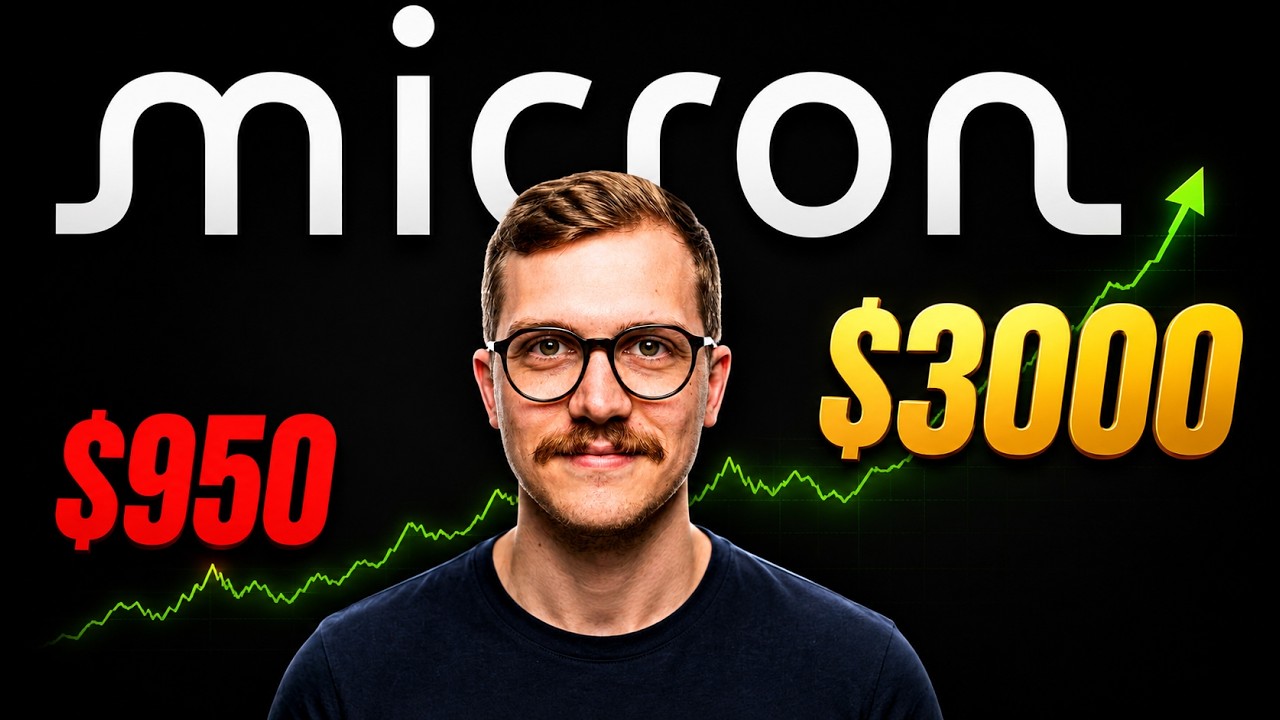
Think It’s Too Late to Buy Micron Stock? Watch This

- Video return
- —
- Calls
- 4
- Buy / Sell
- 4 0
- Published
Recommendations
Entry is the asset's closing price on the publication date. Current is the last close on record.
-
Entry $958.73 31 Aug 2026Current $958.73 31 Aug 2026Result +$0.00
My bullcase for Micron has changed and I now believe that there's a realistic path to this stock eventually reaching $3,000 per share.
-
Entry $958.73 31 Aug 2026Current $958.73 31 Aug 2026Result +$0.00
Micron is back on the menu. This is my belief.
-
Entry $958.73 31 Aug 2026Current $958.73 31 Aug 2026Result +$0.00
I will be reinvesting a lot of the new capital that ends up either being generated via covered calls or new money that I'm putting into my portfolio into Micron while we stay under this $1,000 price.
-
Entry $958.73 31 Aug 2026Current $958.73 31 Aug 2026Result +$0.00
I think Micron's definitely going to two, probably even $3,000. That's my real core bet is three grand, but I'll say two grand to be conservative for now
Full Transcript
My bullcase for Micron has changed and I now believe that there's a realistic path to this stock eventually reaching $3,000 per share. Now, that number obviously sounds extreme, but this isn't based on Micron simply getting a higher valuation. Nvidia has substantially increased its purchase commitments. Micron is signing new long-term agreements with major customers, and the latest pricing data suggests that memory market continues to remain extremely strong for much longer than investors had expected. In this video, I'm going to break down all of those developments, update my earnings estimates, and show you the valuation behind the $3,000 bullc case. Because if Micron's earnings power is permanently changing, this may no longer be the same cyclical memory company that the market believes it to be. But let's jump in. Micron is back on the menu. This is my belief. Now, I know a lot of people initially whenever they think of the micron trade, they think of extremely high risk, something that's only going to last for the next year and a half until capacity starts coming online at the end of 2027 or into 2028, and then that's the end of the trade. If we end up going through the numbers, which is what we're exactly going to do here, I want to point to some evidence that might actually suggest that this might last a lot longer and be much more volatile of an upswing before we start to see a kick back down in terms of regulating that growth rate. As people are aware, the DRAM allocation per GPU is increasing massively. Now, there is some speculation that maybe the Reuben Ultras or even the Rosa Fineman models might end up coming in a little bit less than the 10X that was shown off a while back from Cotu Management. That said, Nvidia is still growing at roughly 106% for which all of their chips need both NAND and DRAM, high bandwidth memory as well. And so a lot of this is still going to be seeing an uptick in the overall amount of sales for Micron regardless of if the systems are taking on more memory or not. Yet Nvidia did say very clearly that supply capacity purchase agreements are exploding. We went from 119 billion last quarter to 279 billion this quarter. Just quarter over quarter. It ended up going up a massive amount year-over-year. About 510% is how high it increased. And that growth rate is skyrocketing. This was specifically, as you can see here, our commitments increased from 119 billion last quarter to $279 billion primarily related to the procurement of memory. And the orders are not just for 2027 and 2028, but also an additional $88 billion going in 2029. As the years progress, they might end up signing even longer deals than that. As Colette says, as you are already aware, we are experiencing extreme pricing conditions in memory. The magnitude of the price increase has exceeded our prior expectations and are headed even higher into next year. As a result, we are resetting expectations today. For Q3, we expect gap in non-GAAP gross margins to be 74% plus or minus 50 basis points, which is a 1% hit on margins. Now, there's a very important part here that I want to address. The magnitude of the price increase has exceeded our prior expectations. Those prior expectations were highlighted by Jensen Wong on recent interviews as early as this year where he talked about how a set bottleneck usually only lasts at most 3 years. Now, they're potentially realizing that this is going to last longer and that they are going to have to adjust both their near-term and medium-term guidances, which they did do, bringing down gap gross margins next quarter to 73%. So, even lowering it due to the procurement of memory and the cost there. Yet, after Colette at Nvidia said this, Micron stock did not budge. The price of this company has stayed relatively flat over the last three months and has not allowed uh for the appreciation even though earnings came in higher than expected and commitments came in way higher than expected. That being said, even if we look at Micron's own numbers, they beat their own guidance by 23% and beat Wall Street's expectations by 18.5% bringing in 41.5 billion of revenue. This was way higher than anyone had expected. On the gross margin on that revenue, we saw $35 billion. This is after their cost of goods sold. That means that they brought in an 84.5% gross margin, some of the highest in the entire world of any industry, let alone in the hardware and semiconductor space. This also ended up showing off that while they are bringing up their expenses as they grow their business and bringing new supply online all the time. R&D did not increase as a percentage of revenue. SGNA or sales general and administrative and stockbased compensation are all falling which is leading to operating profit hitting new highs of $ 33.3 billion or at an 80% operating profit. Once again, a metric that you'll never hear of from any other business. And then if you continue on going down the line after paying for taxes, after doing all those additional fees, what you end up seeing is that consolidated net income came in at $28 billion extremely high margins coming upwards of 70%. This alone, because they're not adding on to their overall outstanding share count, beat guidance from an EPS perspective or earnings per share perspective by 28.8%. Wall Street ended up being wrong by over 22%. these types of numbers 18.5% on uh revenue 24% on EPS and this is adjusted gap EPS this doesn't happen this is extremely extremely rare and yet whenever you go ahead and you take a look at what's happening next quarter they're expecting similar levels of outstanding growth $50 billion now last quarter they were off by roughly 20% their Q3 expected growth well Q4 is expected to be 50 to 51 1 billion gross margin expected to be higher than any of the quarters that we've seen previously and flowing all the way down to diluted EPS per share. We're at $31 plus or minus $1. This growth is expected to continue to stay extremely strong. And yet, Wall Street is expecting that they are going to be within that guidance 50.8 billion, which is the plus or minus 1 billion on that side. Yet, even though previous quarters we've seen them beat by 18%, 24%, 6%, 1%, 5%. But the big constraints, the big bottlenecks are happening up here at the top. Let's imagine that some of these constraints are starting to loosen or that Wall Street is getting a better idea of predicting future revenues and EPS. Let's imagine that the surprise is 10%. Much lower than where we've seen before. that $50 billion outlook turns into 55 billion much much higher than what Wall Street is expecting. A lot of that's going to flow into higher pricing on memory which then bleeds into EPS. So the fact that they are not improving their overall guidance and assuming what Micron is telling you which is their conservative outlook is just mind-blowing to me. Yet even whenever you look out further ahead, this is Wall Street's numbers. They expect 56 billion next quarter, 60.6 6 billion the next quarter, 64 billion the next quarter, and 67.5 billion. By the way, I had compared this after earnings last time to where we are now. These have also increased over time. So, Wall Street is slowly getting more and more bullish, but it's not like we're expecting some sudden spike up in earnings to then fall later on. This growth is expecting to stay high. It's just they believe that the actual growth rate will slow, but not that the overall number, the amount of revenue will fall over time. EPS exact same thing looking to go from this quarter at $2467 to five quarters from now essentially being roughly double at $42.50 getting pretty close to double. That's in a year and one quarter. Elon Musk, I think, highlights probably the most substantial quote that you're going to see in this entire video. If there's anything to take away from this, it's this. Look at the rate at which logic and memory is being produced. One must always consider the limiting factor here. The limiting factor currently is memory. The memory output is increasing by around 20% per year. Now, normally that would be fantastically fast and amazing for any large mature industry. Ask yourself, is the demand increasing by 20%. No, the demand is increasing by 200% per year, maybe higher. If you have got demand increasing much faster than supply, economics 101 would suggest that the price increases, it does not decrease. So while we are imagining that fabrications are coming online in the second half of 2027 into 2028 and that new fabrications are going to bring on new capacity, Elon saying they're projected to do 20% per year. There's no guidance in anything that is artificial intelligence that's guiding for a 20% increase. We're talking about doubling, tripling the industry per year. What is 20% online new per year even going to change? Nothing. Catrini Research just posted that in August, as we're starting to see the newest numbers here, we are actually seeing a way way higher increase of DRAM prices. This is after Micron ended up showing off their recent earnings going all the way to NAND export prices in August. We are seeing massive massive acceleration in overall prices which is skyrocketing the amount that people are having to pay for NAND and DRAM prices way higher than where we were before. So if you were to talk about where Micron and where SanDisk and where all of these companies have been projecting growth at the end of their latest quarter to then look at the prices that have started to increase parabolically. This is after they ended up giving off guidance numbers. BFA just launched a Frontier AI tracker as well. They did this to launch and essentially model out intelligence, overall usage, token pricing, GPU rental and memory prices across the entire AI stack. What they found is that across the entire board, both Frontier and Open source, AI token prices are down 9% month- over-month as that mix and overall open AI offering decreased pricing is actually affecting the amount of tokens that different businesses are able to create. So that's down 9% per month. The B200s, the Blackwell 200 GPU rental prices actually fell 2%. Well, DRAM prices rose 8% month overmonth. Well, everything is looking like it's headed in the right direction, which is both very bullish. DRAM prices are headed into larger and larger constraints. This was as of August 17th, 2026. As Mike Ron also said, the next generation of DRAM and NAN nodes are also progressing well and are on track to begin volume production in the second half of calendar 2027. We are leveraging our leadership DRAM and NAN nodes which are going to be affected by the Korean export prices as we need more and more of this. Not only is Micron going to benefit from what they're very well known for which is DRAM but also NAND. They do have a major product portfolio there. And they also said that HBM 4 volume ramp is tracking twice as fast as their HBM 3 ramp that they saw which they've already shipped over a billion dollars of HBM which is looking at another product mix. Not only that, this product mix that is increasing that they're also selling more of is finding newer and newer customers to then sell into. Elon said during his Tesla earnings call separately from his SpaceX earnings call. I'd also like to thank Micron for giving us a memory allocation. They've got to make some very tough decisions on memory allocation. We really appreciate that Micron's making room for Tesla in the years to come and giving us actually a very significant allocation on reasonable terms given pretty insane pricing of memory these days. Tesla is saying, "We are signing long-term commitments. They are willing to give us really great pricing because we're signing these multi-year deals, but also a very significant allocation which could lead to longer bottlenecks for the customers that are trying to buy Spot." Today, I want to talk about what has actually happened in terms of the EPS upgrades that we've seen since earnings and since Nvidia has shown off their earnings. So, we're looking at Micron's earnings and Nvidia's how that's actually affecting Micron's EPS. First off, back in May 29th, what we ended up seeing is a list of overall their EPS expectations per year from 2026 all the way to 2030. Today, that has significantly increased. Now, to say that it's significantly increased is one thing, but I did do the math on this. What we've ended up seeing is that even in the year that we're in, we just over the course of this single quarter had brought up EPS expectations. This is Wall Street's expectations, which I also believe are being extremely conservative on their EPS outlook because not only do they believe that revenue is going to come in at the exact same level that Micron just told them that it would, that 50 billion, which is likely to be conservative, but they are also adjusting their EPS numbers based on those revenue outlooks. That being said, 25% increase for this year. Next year they increased it by 47%. The year after 74%. The year after that in 2029 they still expect that the cap for overall revenue in or sorry EPS caps out in 2028. It starts to lower in 2029. But even 2029 they expected this drop off to be from $98 to 33. They don't expect that drop off to be that strong. They expect it to go from 170 to 121. an increase of 262% and then still continuing all the way into August of 2030 that that EPS would continue to increase by 65% although it is dropping off. We're going from 121 down to 48 which is that current bottleneck. But bringing in $48 of long-term EPS like sustained levels is way higher than what Wall Street had it at even a couple quarters ago. You look at where we are for 2030 at $48. You compare that to where we were back in June of 2025, we were barely past a few dollars. Same thing for revenue. The leading indicator to actually bring in this profit needs to be increasing. Now, one of the things that I've also noticed here is that Wall Street had more consensus going all the way out to 2031, not just 2030. What we ended up seeing is that that increased drastically quarter over-arter. So, what we ended up seeing is for this year up 17.8%. Next year 37%. the quarter after that 57% 181% 190 and then 226% even though they do believe that some of these constraints will fall off by 2031. We'll have to see. But even those numbers that we've ended up seeing grow still went up by hundred billion. This was quarter over quarter. Put that into perspective. Originally they thought they were going to do in 2031 47 billion. They saw one three-month period go by and they said, "Oh, actually we're probably going to see somewhere closer to $154 billion." That was the increase. They tripled the number of what they expected for full year of 2031. It's an unbelievable increase in a 3-month period where the 2031 number is going to be by the time that we've actually gotten through 2026 or 2027 when we have more visibility. This brings me to valuation because any business whether you're strong and growing extremely quickly can still be overvalued. But the valuation on Micron is the most surprising. That drop off in EPS by 2030 or 2031 is leading investors to be extremely cautious on this name. Forward price to earnings is still sitting at 6.5 times, which we've seen that be as high as 14 15 times and as low as just under two times forward price to earnings. Price to free cash flow is really dropping off a cliff here sitting at just over nine times price to free cash flow which is quite significant because that's the cash that they are actually able to generate which is going to allow them to buy back more shares or start to offer special dividends which obviously cash is being generated here. As you can see quarter over quarter we've went from $14.5 billion of outstanding cash to 26 billion. This has been a significant increase over the last two quarters. And on top of that, a lot of their cash that they've ended up generating has been going towards paying off debts. We've brought down debt from a high of May of 2025 at $16 billion all the way down to 6 billion. We also have capex that's going in the amount of $7.8 billion to build out future fabs, bring in new jobs to the United States. A lot of these things are also very significant, which I'll talk about here in a second. But free cash flow as well, another company high. Previously, we also saw two other company records, $3 billion and $5.5 billion. Those were also record-breaking. But this quarter, $17.5 billion. It's hard to put into perspective that it's more than triple the last quarter's record results. UBS also said Micron could repurchase more than 40% of its outstanding shares by the end of 2028. Currently, they're not able to because they have a buyback restriction that expires on December 9th of 2026. The company could potentially use this cash that they're looking to generate over $40 billion in free cash flow to repurchase more than 40% of their outstanding shares. They said that back in July. UBS is like a third-party analyst. So, this is just their opinion. But then we ended up hearing it from Micron's own CFO. We intend to increase our capital return over time. We expect to return 100% of our excess cash back to shareholders. So you're saying 100% will go back to shareholders. I assume the vast majority of that is in buybacks. Well, we'll hold what we believe is an appropriate amount of excess cash. We're also said that we intend to grow our dividend over time, which you've seen us do an increase of 30% recently, but the principal capital return will have to be share repurchases. That happened on August 21st. Currently, Wall Street has this stock showing an upside of roughly 66%, $1,555 per share. Not a single cell rating analyst, one person with a hold rating. Everyone else has their prices in roughly the thousands, if not thousand plus. This is the exact same thing, by the way, that Leo pulled Ashen Brener, which he got burnt based on timing, not on bad picks. The picks didn't necessarily spoil in his portfolio, but they did have large contractions in the portfolio. He'd be down roughly 30% if it wasn't for overall the use of leverage. But he was betting really the high high majority of his 20 to4 billion portfolio on two names SanDisk and Micron the exact same play DRAM and NAND as of Q2 of 2026. And yet a lot of this has actually ended up selling off. Now one of the core principles and I don't talk about this often enough is don't bet against the administration. I don't talk a lot of politics here, but if there's one thing that I find very easily to do in my portfolio is whenever the new administration that's coming into power says that they are antisolar and they are positive American jobs and they will sign executive orders and they will bring on as much of their power to help the companies that are helping the United States. Those are the companies that I'm betting on. And Donald J. Trump is an extreme fan of Micron because they are not only donating to the Trump accounts. They're not only bringing research labs, they're not only bringing fabrications, they are investing everything that they have into the United States. And so Donald Trump is going to give them the permits that allows them to essentially set up those fabrications faster, sign new deals, potentially do M&A, not step in the way and give them a whole lot of red tape. So while Donald Trump is extremely positive with Micron and continues to be in power, I'm going to be a significant beneficiary by betting on Micron and believing that obviously some of the more powerful people in the world can help companies advance and Micron is definitely going to be one of those businesses. So, I will be reinvesting a lot of the new capital that ends up either being generated via covered calls or new money that I'm putting into my portfolio into Micron while we stay under this $1,000 price. I think the hard thing for me to do is every share that I buy of Micron is significantly increasing my cost base because my average share price right now is $370. I don't want to have to do that. But while the market is disrespecting probably one of the strongest bottlenecks ever seen in capitalism, I think that there's money to be made in those types of opportunities. And if I told you my real price target for where I think that this is going, some of you guys might hate me. So, I'll just say it. I think Micron's definitely going to two, probably even $3,000. That's my real core bet is three grand, but I'll say two grand to be conservative for now [laughter] until it actually happens. Ladies and gentlemen, thank you all so much for watching.
Comments 0
Sign in to join the discussion.
Sign inNo comments yet. Be the first to share your thoughts!