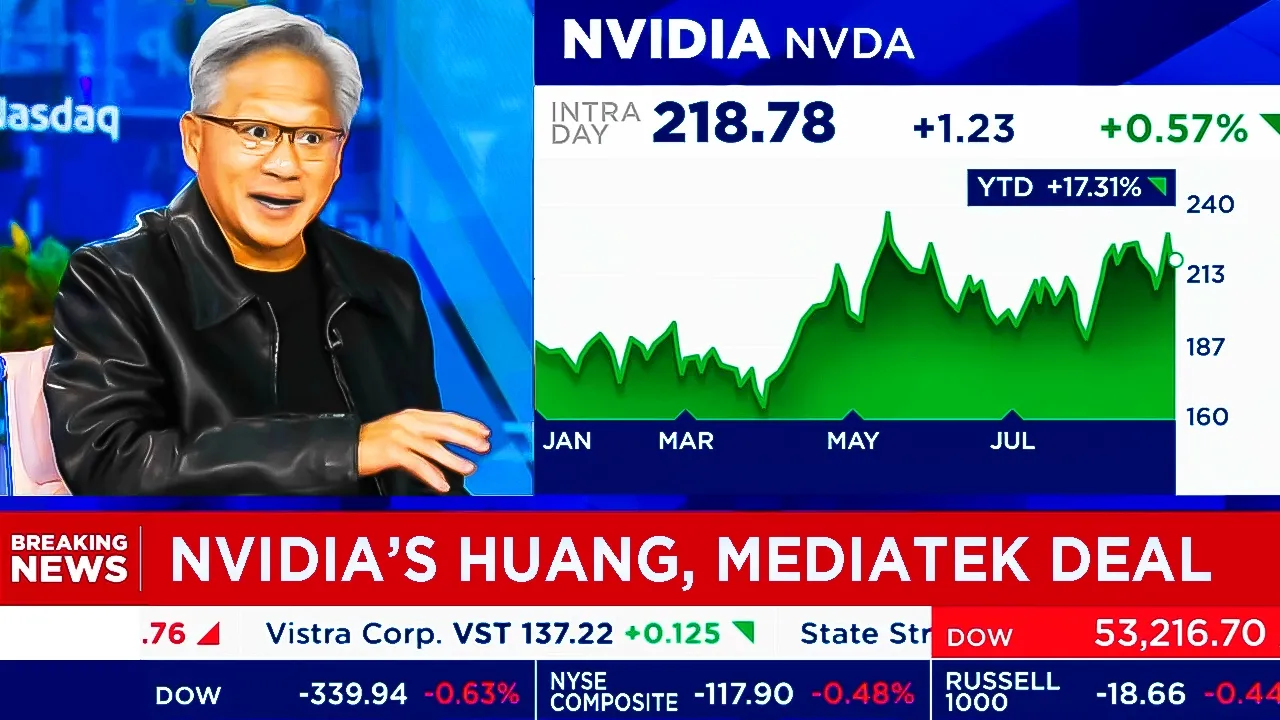
NVIDIA's Jensen Huang On NVIDIA, MediaTek, Memory, NVIDIA Stock, Bottlenecks - NVDA Update

- Video return
- —
- Calls
- 2
- Buy / Sell
- 2 0
- Published
Recommendations
Entry is the asset's closing price on the publication date. Current is the last close on record.
-
Entry $217.44 01 Sep 2026Current $217.44 01 Sep 2026Result +$0.00vs. index +0.0% SPY +0.0% over the same days
I seriously think that Nvidia still has plenty of runway ahead of it and I think this company will be worth substantially more in future years than it is today.
-
Entry $217.44 01 Sep 2026Current $217.44 01 Sep 2026Result +$0.00vs. index +0.0% SPY +0.0% over the same days
I truly do think that Nvidia will be worth much more in future years than it is today based purely on the fundamental growth of the business.
Context When market participants compare this AI revolution to the dotcom bubble, they ignore the fact that the internet is already here this time. ... I truly do think that Nvidia will be worth much more in future years than it is today based purely on the fundamental growth of the business.
Full Transcript
We are joined by Nvidia CEO Jensen Juan, Nvidia Tech CEO Rick Zai who joins us from Taiwan late in his evening. The idea is you can take custom silicon right XPU and just plug it into any GPU based architecture, share the memory, the networking. Jensen, could we start with you please and just ask you to explain the technology agreement here? >> Today we're announcing a big partnership. We've already had a big partnership with MediaTek where today we're going to make it a lot bigger. It started with us working on recognizing that MediaTek makes the world's best SOC's and we integrated the NVIDIA MVL link chiptochip interface to this so that to MediaTek so that whenever there's an SOC for MediaTek we can connect it to Nvidia's GPU and what came out of that first endeavor is this project called DGX Spark. This is this this little computer is an incredible computer is one pedaflops allows you to run and advance a gentic AI right on your desk and instead of having to run it in the cloud. Well, today what we're going to do is we're going to expand our partnership so that we do multiple generations of this. This processor is going to also be the foundation of the revolutionary new computer that's coming from Microsoft and ourselves. A reinvention of the Windows PC for the age of agents. Now the second thing that we're doing is that MediaTek is incredibly successful building XPUs and we're going to connect our MVLink fusion MVLink system so that Nvidia's scale up MVLink system which is revolutionized AI and our Spectrum X switches our entire networking franchise chassis system chassis to MediaTek. So when they when they win projects, we it brings along NVIDIA networking. However, you also know that Nvidia is already in every cloud and every data center. And so whenever there's an Mediate Techch XPU, we'll be able to connect it right into that data center in a really seamless way. And then of course, we're partnering in robotic systems like autonomous vehicles. So we're, you know, you know that AI has revolutionized how we do computing and we're going to work with MediaTek in all of these different areas. When they win, we have an opportunity to sell a lot more. When we win, they have an opportunity to sell a lot more. >> Rick, the ASIC customer builds their own accelerator. They don't need to reinvent the rest of the architecture. But from MediaTek's perspective, Rick, I think it's worth saying what is the pitch to your ASIC customers on the value of doing this with with Nvidia through MVLink? I think I add thank you for the uh for the opportunity and I also want to really thank uh Nvidia and Jensen for [clears throat] having the confidence in media tech and for us I believe uh if you look at the whole AI uh computing stack all the way from the very top of the uh [groaning] uh while the ASIC from the hyperscalers to the mid end of the uh enterprise data centers and new cars to the what Jenzen just described to the desktop supercomputers for the AI uh applications. You see, I think the collaboration, the partnership we are having with Nvidia with our XPU capability, Nvidia's MVLink fusion will enable throughout this computing stack customers. The important thing for this era of AI is it's incredibly fast changing. So it's absolutely critical that we can together we can enable the customers throughout the stack to build the data center to scale with high speed well as Jensen always like to say speed of light and we work with them our customers with tremendous flexibility. So that's part I think the essence of the collaboration partnership with Nvidia. >> Rick, you had said that your AI chip business would be about $2 billion this year but would accelerate to get about 15% of an addressable market of $80 billion next year. Does this arrangement with Jensen and Nvidia help you accelerate the growth in that business? Uh we certainly expect that to happen but it would take a little time because we're now uh getting started uh building I think building Jensen's latest uh Envy link version into that chassis that he just mentioned with the uh I I think that chassis will provide the customer potential customers with tremendous vehicle to enable a fast time to market and that's a key for today's world. Fast time to market. >> Jensen, you're making a $3.5 billion investment in MediaTek through the purchase of of convertible bonds. Why? >> Well, this is one of the largest partnerships we have. Um, we're building, as as I mentioned, multiple generations of edge AI and PC chips. And our chips are GPUs and they're connected to die to die with MediaTek SOC's. And so they're working with us in multiple generations of SOC's so that we can connect our GPUs to them. Uh this new product line we call DGX Spark and then RTX Spark for PCs is a major investment for us. We have a major commitment to the entire PC industry and so this partnership expands upon that. This partnership, this investment also formalizes the the uh the partnership that we have in AI in building AI factories. As you know, today's AI factories is not just the GPU. It's GPUs and scale up switches and scale out switches. The amount of networking necessary there are five different types of networking necessary to build out an entire factory, not to mention the Nvidia Vera CPUs. And so this partnership allows MediaTek to plug directly into that entire AI factory platform. Um, and so wherever we have, uh, Nvidia in the cloud already, which we're in just about every cloud, uh, we now have the opportunity using exactly the same AI factory architecture to plug in MediaTek XPUs. So this is a massive engineering alignment between our two companies. I I'm you know just we've been working with MediaTek for a long time. I've known Rick for 25 years. Uh this is a relationship that is really deeply grounded on trust but we have so much confidence in this partnership that we really wanted to make an investment uh into MediaTek that of course MediaTek is already immensely profitable and they're incredibly successful already. So that the opportunity to make be able to make this investment is a great pleasure for us. Jensen, you've already fielded some questions about circular financing and you and Colette, your CFO on the call were pretty clear that you see it differently to how the world interprets. In this case, you know, you are making investment into a partner as opposed to to a direct customer. Why is this or is this not circular financing? Well, this is not circular because obviously they do their own business and we do our own business and and MediaTek is already incredibly profitable, incredibly successful. They are one they are the world's best SOC maker. They make more SOC's than any company in the world. Uh it's a great pleasure for us to invest in a technology company in Taiwan. It's a great pleasure for us to invest in MediaTek. uh this is going to turn out of course the investment is grounded on a deep partnership that's going to be multiple years. This is a this is a part the roadmap that we're we're executing on right now is a it's not one or two years it's a decade long and so this partnership is extremely important to us and we want to make sure that we have we demonstrate every opportunity every take every opportunity to demonstrate the importance of it the seriousness by which we take it the confidence we have in the partnership and that the investment that we're making here demonstrates that. But ultimately, this is going to be a phenomenal investment for us and it's going to generate incredible returns. I have every confidence. >> Rick, in July, MediaTek said that it would use its uh bond program, $5 billion of dollar bonds, basically to to support and grow supply chain. Um earlier in our conversation, you talked about, you know, the benefit of of working with Nvidia on MVLink Fusion is speed to market. What do you plan to do with with the proceeds? And and when you talk about supply chain, do you need to do more on Taiwanese suppliers or or US suppliers in the context of this relationship? >> I think the uh certainly well back in uh end of July uh we would not uh we were not able to discuss the strategic investment part of the bond. So uh but the proceeds I think will be for multiple purposes. Supply chain definitely being one of them and the supply chain is a global I mean wherever needed to enhance and enable the customers. Uh but on the other hand, I think uh as Jensen said so uh so eloquently uh the investment that MediaTek is a tech company is a very strong tech company and we will definitely invest if if anything more into the technology in the our capability to design in our capability to make the ASIC chip in in the IPS for interconnects [clears throat] in advanced packaging. I think the uh the key here is really the collaboration agreements that we have built and expanded with Avidia as described in our press release. Those are the key things and the proceeds will basically go to make those things happen better and further. Jensen on the earnings call last week you talked about with confidence right that the GPU based architecture has superior economics. You were talking about that in the context of the Frontier Labs largely because you were asked about custom silicon. You know the the simple terms of it is that MVLink Fusion just makes it easy to take XPU and and just drop it into the data center. That would show that you know Nvidia does see XPU coming into the market. just the difference of your thinking this week to to what you outlined last week. >> I see XPUs in the market. It's not coming into the market. It's in the market. Um look, an XPU is a specialized chip. Nvidia's GPU is a general purpose accelerator. We accelerate we accelerate the entire life cycle of AI from data processing which data processing to pre-training to post-training to agentic AI inferencing. We accelerate uh every single AI model in the world from closed models every closed model every open model uh video models and language models biological models and physics models and robotics models. We literally accelerate every single area of AI. Um, that explains why it is that we are the most funible and the most durable and therefore the most rentable GPU, the most rentable computer infrastructure in the world. We're in every cloud. We're onrem. We're at the edge. And so we're able to address markets that frankly nobody else can because of the architecture of our company and the entire full stack AI factory platform that we have. However, there are customers and they're very important partners of mine as well. Customers of of Ricks and partners of mine. Uh these are incredibly important to us. if they would like to put a specialized XPU into a data center, um why not make it easier for them to connect it to the NVIDIA infrastructure. And so this way if they would like to build us something, uh we make it easier for them to build it and we benefit as well. It makes it easier for everybody involved. And so it's not a it's not a question about about if one or the other. There's no question Nvidia's footprint is the largest. There's no question we're growing share uh in closed models and open models. We're growing share uh across the entire AI opportunity. Um and so we're not we're not uh we're not uh uh in intimidated by this. We're uh in fact welcoming it and opening our platform so that they could connect XPUs into it. You >> know, Rick, I I I I guess that the answer is no. But is there a case study of an ASIC customer that you can take us through and how you think the ASIC customer is going to respond to this announcement this morning? How they might move uh in reaction to the idea that MV link fusion provides an opportunity for them to move faster? I think uh we are engaging with some customers that we are actually a kind of a co- go to market with our partners uh Nvidia and uh I think the announcement today will further strengthen their confidence in the relationship with this strong bond between Nvidia and a media tax. So they have they know they they can count on us if they go for this uh envinkling fusion business model. You look as Jensen said just now I mean there are different uh need from different customers uh and the AI market computer market is enormous enormous. So there are different customer needing obvious smaller amount of uh computing power and uh but they do they do want to have some uh differentiation in their own offering and so I think this envelope go to market capability and that will be beneficial for them for Nvidia and for media tech. Jen, what I find really interesting >> and in a lot of ways in a lot of ways Ed this whole this whole thing started because of customer requests as you know there are already customers that have committed to Envy Link Fusion um building the XPU is very very hard and there's no question about that and and with the partnership with MediaTek MediaTek can help customers build amazing XPUs however inside an AI factory it includes five different types of networking technology of course the CPU you and we now make it possible for all of that to come together really easily. And so a lot of a lot of customers are asking for this and they want to access the MVLink uh technology because it's completely revolutionary and it's incredibly hard to do. We're in our sixth generation of doing so. And so this is really really driven by customer request and and um and I think it makes a lot of sense and it's great for both of us. Jensen, the part that we haven't talked about is is MVHBM. You know, you were pretty clear that that the bottleneck is still in memory pricing and supply. Um MVHBM, what what's the pitch there on what that allows an XPU based architecture to do? A lot of the specialized inference platforms might be SRAM based for example. And and I just want to throw this in Jensen as I may because no one's asked you for quite some time. What's the sort of percentage or proportion of content of the server design Nvidia is now pushing on its latest Vera Rubin generation platform and how that that kind of changes in this XPU case study where you have a hybrid AI factory essentially. >> Well, inside a gigawatt if we were just to extrapolate in a gigawatt Hopper was about $18 billion of economics for Nvidia per gigawatt. uh Grace Blackwell is about 25 and the Vera Rubin uh generation it's about 40 plus billion dollars per gawatt of of total Nvidia compute economics and um and the reason for that is because we we've been expanding beyond the GPU to uh one type of switch after another type of networking and now the amount of chips there's like seven different types of Nvidia chips that has to go into an AI factory. An XPU would be a replacement of one of those. You know, my sense is that we're continue to be in every single cloud will continue to be in every single AI factory. Some of those racks might be augmented with XPUs. And so in those cases, Nvidia's networking, Nvidia switching, Nvidia CPUs would also uh have an opportunity to participate. And we make it easier for the customers to be able to extend out their AI factory using exactly the same system architecture and networking architecture. In the case of MediaTek, it allows MediaTek to offer an endto-end solution that is complete that XPU otherwise would have to go and solve MVLink switching problems, a whole bunch of Nix problems, a whole bunch of, you know, Ethernet switching, scale outs, scale up, um, scale across, scale in. There's so many different types of networking technologies that have to come to bear. And we offer the entire thing. So between us and and MediaTek, if a customer wants to build XPUs, they now have an entire solution as well. And so our opportunity will uh continue to grow in these AI factories. >> Rick, very quickly, what's the biggest bottleneck for MediaTek right now? Uh I think supply chain does uh present uh challenges uh you know uh not just HPM go down to uh substay etc. But the uh but again being in Taiwan uh in the almost like a center of the AI infrastructure uh ecosystem really helps and uh and we also work closely with Nvidia with our customer too. But it's tough and I think uh I don't I I really see blue skies uh in the future. Now, Nvidia's networking ecosystem is now part of MediaTek's e supply chain and and and and Mediateex uh XPU is part of our supply chain. And so, in a lot of ways, both of us expanded our supply chain in this partnership and I I and all that. It's early for me. Here we are. I forgot to answer your your MVHBM question. Um, our next generation HBM is a custom HBM and the the HBM stacks are built on a NVIDIA custom uh base layer and that base layer we've extended to our partners MVLink fusion partners and the reason for that is because that that MVHBM has to be stacked with the XPU die into a co-ass package and that co-ass package and the MV HBMs are incred incredibly complex and so we've extended that to MediaTek. We've extended it to um uh to Amazon as well and they're one of the first customers and partners building it with us. And so uh this allows us to aggregate all of our supply chains into something that is much more uh if you will standard and um uh they'll be able to benefit from our large install base and our large uh supply chain and we'll be able to benefit from theirs. Nvidia CEO Jensen Wong alongside MediaTek CEO Rick Zai. Nvidia making a $3.5 billion investment into MediaTek and sharing on the data center architecture. Thank you both very much in particular to you Rick late in Taiwan. All right, I hope you're all doing well today and staying calm in this market. Today was a red day throughout much of the market as tensions in the Middle East rise. Oil moved higher while stocks move lower. That said some AI hardware names were slightly positive on the day. I want to cover three things in this video. First, I'm going to cover today's Nvidia news. I'll share an interesting experiment we learned of this past weekend regarding token costs, and then I'll cover memory news after that. On Monday, Nvidia announced an expanded partnership with MediaTek to expand collaboration across multigenerational AI factories, local AI computing and automotive. Under the expanded partnership, MediaTek is to adopt Nvidia's Envy Fusion, allowing customers to more easily integrate their custom XPUs with Nvidia systems. By adopting the NVLink fusion platform, MediaTek will provide hyperscalers CSPs and Frontier model companies with a pre-validated path to develop custom XPUs and bring them into Nvidia Envy link connected rack scale AI factories. This is a big deal. Also, as part of the deal, Nvidia has invested $3.5 billion in convertible bonds issued by MediaTek. The companies will also continue to collaborate on multiple generations of NVIDIA RTX Spark and DGX Spark PC chips. And they will also develop platforms for AI powered softwaredefined vehicles in the era of physical AI. By far the biggest piece of news from this announcement is that MediaTek will adopt NVLink Fusion. As a reminder, with Envink Fusion, companies can integrate their custom accelerators with Nvidia systems and remain customers within the Nvidia ecosystem. That way, even if a customer develops a chip that's better for specific workloads in Nvidia's GPUs, they can simply integrate those accelerators with Nvidia systems via Envy Link Fusion and remain in the Nvidia ecosystem. Now, this announcement from Nvidia and MediaTek is especially interesting because MediaTek is involved with Google's eighth generation TPU program. We already know that Amazon's Tranium 4 will adopt NVLink Fusion. And as I said many months ago, I would not be surprised if we eventually see Google TPUs integrated with Nvidia systems via NVLink Fusion. The fears about Nvidia losing market share are very overblown and completely missed the point. As I've said repeatedly, this is not the time for Nvidia investors to worry about market share. And on the topic of Google, Alphabet also participated in MediaTek's bond offering along with Nvidia. MediaTek's adoption of Envy Link Fusion is very interesting as we could eventually see a situation in which Nvidia benefits from the success of Google's TPUs as well. Again, if a company wants to use their own accelerator, that's fine. Nvidia can still sell them the surrounding infrastructure. To be clear, at the time I'm making this video, we don't have confirmation of Google's TPUs integrating with Invalink Fusion, but Monday's announcement from Nvidia and MediaTek makes that possibility much more viable both technologically and commercially than it was before. And again, I think we may eventually see TPUs integrated with Nvidia systems via Envink Fusion. Also on Monday, CrowdStrike launched Falcon IQ to operationalize Project Quilt Works at machine speed. Project Quilt Works is powered by Frontier models from OpenAI and Anthropic as well as Open Neatron models from Nvidia. Nvidia's open neatron models power the agentic engine at the heart of Falcon IQ to validate and prioritize code vulnerabilities then remediate them in runtime at machine speed. Falcon IQ uses more than 50 agents to automate the most time-intensive workflows in assessment, prioritization, and remediation while giving partners the flexibility to build and tune custom agents for the unique needs of every customer they serve. Cyber security represents another major valuable use case for agentic AI. And I think we will see notable growth in this area moving forward. It's very interesting because with cyber security, we're talking about agentic systems running continuously. Think about what that means. We're essentially talking about a workload that is likely to drive persistent 24/7 inference demand. A large number of agents working persistently around the clock driving inference demand. Think about the implications it has for compute demand in Nvidia. And I don't see a situation in which that demand decreases over time. I actually see it increasing over time as threats become more numerous and complex. I would keep an eye on cyber security as another valuable use case that drives a considerable amount of token demand. Speaking of token demand, I noticed this post from Open Router over the weekend. On July 27th, Open Router started a 50% off promotion on GPT 5.6 Terra and 5.6 Luna. Then a couple days later, Open AAI shared efficiency improvements on GPT 5.6. And then one day later on July 30th, OpenAI decided to pass savings along to customers and cut its list prices for Terra by 20% and Luna by 80%. So from that point onward with a combined price cut from OpenAI and the promo from Open Router, Terra was effectively 60% cheaper than its launch price while Luna was effectively 90% cheaper. Following the change in prices, Terra token usage rose 5.6x while daily Luna token usage jumped 13.8x. During that time, the price of GPT 5.6ole remained unchanged and as you can see from the yellow line on the chart, Soul usage remained essentially flat. Soul is essentially the control in this experiment. And then on August 17th, Open Router gave Soul its own 50% discount and usage immediately shot upward. There are a few interesting details we can glean from this experiment. First, as I've said repeatedly on this channel, lower token costs will result in greater usage. That's undeniable based on this experiment. And whether you're generating open- source tokens or closed source frontier tokens, you need infrastructure to generate the tokens. That's where Nvidia comes in. Greater usage results in greater compute demand, not less. Put simply, as token costs come down, usage increases. and as a result compute demand increases. Secondly, something else we can learn from this experiment is that the substantial discounting of the less capable models did not result in any meaningful decrease in usage of the leading frontier model. Look closely at the yellow line on the chart and notice what happened when Luna and Terry usage skyrocketed. During that time, sole usage remained relatively stable. Keep this in mind when you hear talk and headlines about lower token costs and cheaper models. As I've said previously, I think there will always be demand for leading Frontier Intelligence, even if there are cheaper models available. And thirdly, something else we can glean from this experiment is that Soul's usage remained flat throughout the experiment, but then jumped notably near the end of the chart when Soul received its own discount on August 17th. The fact that Soul usage was flat throughout the experiment and then jumped notably at the end when Soul received its own discount reaffirms the thesis that lower token costs will lead to an increase in usage. There's a fundamental reason why Nvidia is driving token costs lower by X factors with each new generation architecture, as well as driving token costs lower via software optimizations. Nvidia benefits from high token costs as that drives greater demand for Nvidia's latest systems. Nvidia's latest systems drive token costs lower. Lower token costs result in greater usage throughout the ecosystem resulting in greater inference demand. Greater inference demand ultimately results in greater compute demand. And of course, Nvidia sells the compute. Nvidia has positioned themselves to benefit from both high token costs and lower token costs. And Nvidia is intentionally driving token costs lower because they will benefit from it. Token costs are not a logical reason to be bearish on Nvidia. As a side note, this is fundamentally different from oil during the shale revolution. Back then, there were some investors who argued that lower oil prices would result in greater demand. That ultimately did not work out well for many of those investors. But AI is fundamentally different. There are far more use cases for AI than there are for oil. With AI, there are thousands of use cases and potentially millions of endpoint applications. Think of it like this. There are not many new use cases that could be unlocked as a result of increasing oil production. However, there are many new use cases that can be unlocked as a result of bringing down token costs and increasing token generation. And some of those use cases are very valuable. When valuable new use cases are unlocked, like what we saw earlier this year with a coding, usage skyrockets, inference demand inlects higher, and that ultimately results in greater compute demand. And in this AI revolution, new use cases are going to be unlocked much faster than in previous economic booms because this is all digital. And contrary to the internet bubble, new use case development at scale and mass adoption of the technology are both immediately possible because the internet is already here this time. Digital demand grows exponentially. Physical infrastructure simply cannot keep up and it likely won't be able to catch up for multiple years. So to summarize, lower token costs drive greater usage. Greater usage leads to the unlock of new use cases. Valuable new use cases cause token demand to increase further. Greater token demand ultimately results in greater compute demand. Now let's cover some memory news. The information published a story claiming that China's CXMT has begun small volume production of HBM3e with Alibaba and Cambercon both testing the product. Yields remain an issue and CXMT is still several years behind the big three memory makers at the leading edge, but this is a meaningful step toward a domestic Chinese HBM supply chain. I want to provide a disclaimer and say that this has been an unreliable source in the past regarding Nvidia China rumors. And so I have no idea if this story is true or not. I'm just bringing it to your attention so that you're aware of it. We also have some rumors that are relevant to both Nvidia and Memory Makers. A well-known technology supply chain analyst from TF International Securities posted on X saying that it appears Nvidia has revived plans for Reuben CPX based on their industry survey. You may remember that Nvidia essentially stopped talking about Reuben CPX after they struck a deal with Grock and announced Nvidia Gro 3 LPX at GTC. Reuben CPX was originally supposed to launch at the end of 2026, but it essentially got brushed aside after Grock 3 LPX was announced. Anyway, according to the post, Nvidia has revived Reubin's CPX efforts, changed the design, and production is to begin in the first quarter of 2027. Now, what's notable as it relates to memory makers is that the new version of CPX reportedly has upgraded memory. 168 GB of HBM 4 versus the original CPX's 128 GB of GDDR7. According to the post, CPX must be paired with Vera Rubin NVL72, and Nvidia recommends a 1:1 ratio of CPX to Rubin. CPX handles prefill and KV cache creation, then passes the data to Reuben via Ethernet RDMMA for decode generation. The idea is that this would be the highest cost performance solution for long context pre-fill. We'll have to keep an eye on this one to see if we get confirmation from Nvidia. The next GTC keynote is scheduled for October 21st, so maybe we'll get details then. In other news, Soul Economic Daily is reporting that Samsung's memory business division has allocated about 70% of its production capacity through 2031 to long-term agreement volumes, according to industry sources. We also learned that both Samsung and SKH Heinix are pursuing capacity expansion since it appears that the memory shortage is unlikely to be resolved quickly. SKH Highix is weighing the possibility of setting up a joint venture plant in Japan with a local partner. And Samsung is reviewing a plan to convert the only foundry line at its Pong campus into memory facilities as early as next year. Now, by the time you're watching this video, there's a good chance South Korea's export data for the month of August has already been released overnight. That data should give us another read through on memory pricing, especially since both Samsung and SKH Heinix are based in South Korea. I just want to give you a heads up because unfortunately the data isn't available yet at the time I'm making this video and because of how long it takes to make these videos, I'm not going to be able to cover that in this video. But the August export data could have an impact on how memory stocks trade on Tuesday. So, I wanted to make sure it's on your radar. Looking ahead, Jensen is scheduled to speak at the Goldman Sachs Communicopia and Technology Conference on September 10th. and then Jensen is scheduled to speak again at GTC Berlin on October 21st. Now, in case you're new to the channel, I want to make sure that you have at least a basic understanding of the underlying long-term thesis. So, let's cover that. Now, I don't know what's going to happen in the short term, but from a long-term perspective, I am very confident that Nvidia will be worth much more in future years than it is today. When Jensen was on the Lex Freedman podcast not that long ago, he was very seriously raising the possibility of Nvidia becoming a $3 trillion revenue company in the near future. If that happens in the coming years, then it is very plausible that Nvidia could one day be worth tens of trillions of dollars in market cap. That might sound crazy, but that's what Jensen is implying when he raises the possibility of Nvidia becoming a $3 trillion revenue company. I guess the question at that point is what multiple the street will be willing to give Nvidia. I don't know the answer to that question, but I truly do think that Nvidia will be worth much more in future years than it is today based purely on the fundamental growth of the business. Based on everything I'm seeing, the world is still compute constrained and I expect that to continue at least through the first half of calendar 2028. In a computed environment, developers will use whatever viable compute they can get their hands on. Today, there are no GPUs that are sitting dark due to a lack of demand, like there was fiber sitting dark due to a lack of demand at the height of the.com bubble. Back then, companies were laying fiber in the hopes that use cases and demand would eventually show up. Today, we are seeing the complete opposite. As I've said many times, when market participants compare this AI revolution to the dotcom bubble, they ignore the fact that the internet is already here this time. This means that mass adoption of the technology and new use case development at scale are immediately possible. We don't have to wait years for it to show up. It's already here. The world is compute constrained, which means there is not enough supply to satisfy demand. New capacity is utilized as soon as it comes online. The hyperscalers are monetizing capacity as soon as it comes online. Each of the hyperscalers spoke about being supply constrained on their most recent earnings calls. Additionally, many of the clouds are building out into contracted demand. They're not blindly building in the hopes that demand will eventually show up. No, they're building out because they have signed contracts and in some cases significant prepayments from their paying customers. This AI revolution is fundamentally different from the do-com bubble. And 2026 will be a pivotal year for the AI industry thanks to the rapid adoption of Agentic AI and the proliferation of agentic systems in the world's leading enterprises. The leading AI labs revenues are surging right now. Agentic coding and the implementation of Agentic systems in large enterprises are new use cases that are increasing inference demand significantly. That subsequently is increasing compute demand. The rapid adoption of Agentic AI is why we're seeing an inflection in inference demand. It's why we're seeing the leading AI labs revenues surge. I wish both anthropic and open AI were public so the public could see the ramp in their revenues. I think the leading labs surging revenues may be the initial proof point that grabs market participants attention and causes them to realize that there will be a clear ROI on AI infrastructure. I think the leading labs surging revenues will also help assure investors of the longevity of Nvidia's growth since these labs revenues are directly tied to compute. If they had more compute, they would have greater revenues. It really is that simple. Demand is not the problem. The problem is a lack of supply to meet the demand. As I've said previously, I expect the world to be computed at least through the first half of 2028, possibly longer. And so regardless of what happens in the short term, it's important for long-term investors to remain focused on the fundamentals, maintain a long-term perspective, and remember that we are only in the early stages of aic systems being adopted at scale. This will increase compute demand significantly. And after that, the next surge in compute demand will likely be fueled by physical AI. We're no longer talking about digital agents performing digital tasks. With physical AI, we're talking about physical AI agents performing physical tasks in the real world. NVIDIA CFO has called physical AI quote a multi- trillion dollar opportunity and the next leg of growth for Nvidia. This industry will fundamentally transform society and Nvidia has positioned themselves to benefit massively. NVIDIA sells the hardware for the data centers where the models are trained. They offer omniverse where the models are taught and tested and Nvidia also sells the hardware that allows ondevice real-time inference through NVIDIA AGX allowing robots to have intelligent interactions with the real world even when they are not connected to a data center. Notice that Nvidia is taking a holistic platform approach to physical AI and they're embedding themselves as the underlying foundation supporting all of it. Over 3 million developers are already building on the NVIDIA robotic stack and this is not getting enough attention. As for production ramps, Blackwell Ultra has ramped and remains in high demand. Vera Rubin is rolling out to customers. Nvidia Gro 3 LPX is in full production. Later on, we're expecting the launch of Reuben Ultra in 2027 and finement after that in 2028. We have a clear data center product roadmap stretching into 2028. And Jensen believes that AI infrastructure spending will reach three to$4 trillion annually by the end of the decade. That means Jensen is expecting growing AI demand and an expanding total addressable market underpinning all of this. I don't think we are anywhere near any type of bubble bursting type of event. With all of this in mind, I seriously think that Nvidia still has plenty of runway ahead of it and I think this company will be worth substantially more in future years than it is today. At least that's my view of the situation. Quick note before I wrap up. All of the compilations on this channel are edited by Finn Vid with original structure and commentary. Occasionally, the same edits appear elsewhere on YouTube. If you're looking for the original version, it's always here on this channel. Thanks for watching, Finn Vid. I appreciate your support. Remember to stay calm in this market. Remember to maintain a long-term perspective and do not make any hasty or irrational decisions. With all of that being said, I hope you all have a great rest of the day. And I'm curious to hear your thoughts about Nvidia in the comments below. Please leave a like on this video so more people will see it. And while you're down there, please consider subscribing. It's free and you can always change your mind.
Comments 0
Sign in to join the discussion.
Sign inNo comments yet. Be the first to share your thoughts!