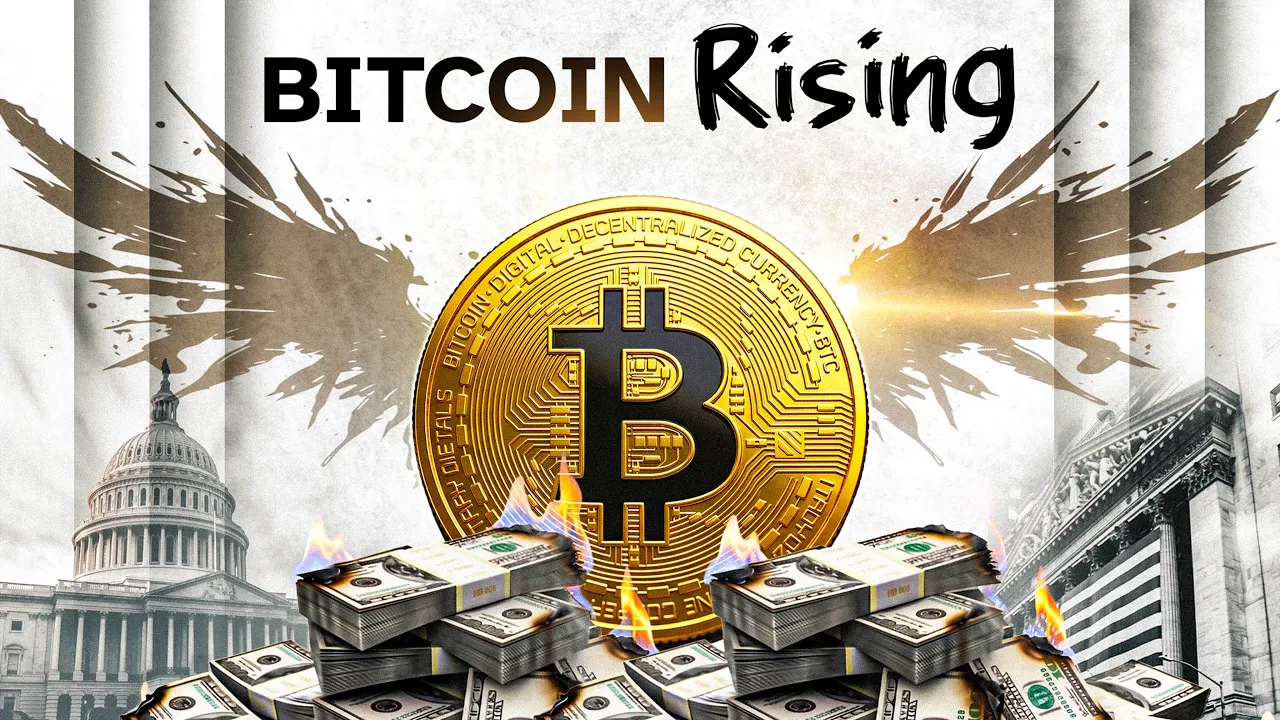
How Bitcoin Went From Nerd Money To A GLOBAL Movement
- Video return
- -0.83%
- Calls
- 1
- Buy / Sell
- 0 1
- Published
Recommendations
Entry is the asset's closing price on the publication date. Current is the last close on record.
-
Entry $80,720.00 03 Sep 2026Current $81,391.00 04 Sep 2026Result −$671.00vs. index — BTC is the benchmark here — there is no excess to measure
You could sell those on Bitcoin market for $41 right now.
Context “one of the replies said, quote, ‘10,000? That’s quite a bit. You could sell those on Bitcoin market for $41 right now. Good luck on getting your free pizza.’”
Full Transcript
What is Bitcoin? What does Bitcoin do? Is
it perfect? It's anonymous and untraceable. Criminals can trade drugs and guns online with
Bitcoin. The whole Bitcoin market is about a billion dollars that the US government would
shut it down. Hello, Bitcoiners. It's good to be with you. I paid with Bitcoin Cash using my
Bitcoin.com wallet here in a giant supermarket. Bitcoin. When I say Bitcoin, you say what? Pizza. Hello and welcome to part two in our series on
Bitcoin and the fight for the future of money. In the last episode, we explored the decadesl
long buildup to Bitcoin's creation and left off during its infancy. At that point, most of the
world had never heard of Bitcoin and only a small group of cryptography nerds were experimenting
to see if it could actually work. And that is where we pick up from today. We'll be looking at
this small group of enthusiasts and exploring the strange and sometimes controversial early years
that ultimately helped bring Bitcoin to a wider audience. Now, you'll recall that one of the first
people involved with Bitcoin was Hal Finny. Before Bitcoin's release, Finny regularly chatted with
Satoshi Nakamoto on the early Bitcoin forums. When Satoshi first announced Bitcoin on those early
forums, people were skeptical. They'd seen similar experiments fail before. But Finey was fascinated
by the idea. So when Satoshi released the Bitcoin client software on the 9th of January 2009, Finny
downloaded it almost immediately. In a March 2013 blog post called quote Bitcoin and me, Finny said
he was probably the first person besides Satoshi too downloaded. Over the following days, Finny
reported bugs while Satoshi fixed them. Then on the 12th of January 2009, just 3 days after the
software launched, Satoshi sent Phiney 10 BTC, marking the first Bitcoin transaction between two
people. Now 10 BTC is a lot of money today, but at the time they had no recognized dollar value. They
were effectively worthless. The point was simply to test whether the system worked. Of course,
for Bitcoin to become more than just a twoperson experiment, it needed others running the software
and a small group of enthusiasts beside Finny downloaded it. But throughout 2009, the Bitcoin
community remained tiny. In November that year, Satoshi launched a dedicated Bitcoin forum and
it became the place where users reported bugs, proposed changes, debated mining, and asked
basic questions about how Bitcoin should work. It effectively turned Bitcoin into a small
open-source project being built in public. But even with only a handful of nerds keeping
nodes online, fixing code, mining coins, and debating what Bitcoin might become, one thing
was clear. It could survive beyond its creator. And this is where Bitcoin takes its first weird
turn. You see, Satoshi had poured his efforts into creating Bitcoin and stabilizing its code
so the network could grow. But in December 2010, just over two years after publishing the
white paper, he made his last known public post on the Bitcoin forum before stepping
away from Bitcoin entirely. The last known interaction with Satoshi came in April 2011 when
he emailed fellow developer Mike Hearn saying, quote, "I've moved on to other things. It's
in safe hands with Gavin and everyone." He then emailed Gavin Anderson a few days
later to hand the project over. After that, Satoshi disappeared forever. With more than 1
million mind BTC to his name, he is technically the richest person in crypto and indeed one of
the richest people on Earth. Yet to this day, nobody knows who he is. And not a single
Bitcoin from that fortune has moved. Now, in Bitcoin's earliest days, it could still be
mined on a normal computer. The original block reward was 50 BTC and competition was minimal.
Enthusiasts could simply download the software, leave their computer running, and generate BTC.
It was only when people began experimenting with graphics cards that Bitcoin mining became
increasingly competitive over time. And today, if you tried mining Bitcoin on a normal computer, it
would probably catch fire. But in the beginning, there was no industry around Bitcoin mining or
around Bitcoin itself. And what's more, Bitcoin had a problem. Nobody knew what one BTC was worth.
One of the first attempts to give Bitcoin an economic value came from an anonymous user called
New Liberty Standard. On the 5th of October 2009, the site valued $1 at exactly 1,39 BTC and three
sats. That meant one BTC was worth around 0.076, not dollars, cents. But where did this valuation
come from? Well, New Liberty Standard used a cost of production formula. Take the average annual
electricity cost of running a computer with a good CPU. Divide it by 12 for the monthly cost.
Then divide that by the number of BTC mined over the previous 30 days. This marked the first time
Bitcoin was given a real dollar value. But that wasn't new Liberty Standards only milestone. One
week later on the 12th of October, they bought 5,050 BTC from Marty Malme for $52 via PayPal.
This is the first known transaction to exchange Bitcoin for fiat currency. Oh, and Marty Malme
wasn't just some random nerd on the internet. He became Bitcoin's first developer after Satoshi.
At just 20 years old, he first got in touch with Satoshi in May 2009, offering to help. Mami went
on to exchange roughly 260 emails with Satoshi more than anyone else in the Bitcoin community,
and he also set up the bitcoin.org website and the original Bitcoin forum, which later became
Bitcoin Talk. But back to Bitcoin's monetary value. Even though each BTC was worth less than a
tenth of a cent, the fact that someone was willing to exchange dollars for bitcoins meant something
hugely important. Those coins now had measurable value outside the software itself. Someone
somewhere was willing to give up something valuable for it. Bitcoin was no longer just an
idea. It was an asset people could buy, sell, and transact with. From there, the milestones kept
coming. By early 2010, users were trying to build a proper market. A forum member called DW Dollar
announced Bitcoin Market, describing it as quote, "a real market where people will be able to
buy and sell bitcoins with each other. Trading began in March 2010, making it the first ever
cryptocurrency exchange. People who had never mined a block could now buy coins, while miners
finally had somewhere to sell what they produced. And then came one of the most iconic moments
in Bitcoin's history. On the 18th of May 2010, programmer Llo Hex posted the following
message on the Bitcoin forum. Quote, "I'll pay 10,000 bitcoins for a couple of pizzas,
like maybe two large ones so I have some left over for the next day. I like having leftover pizza
to nibble on later. Now, what's funny is that one of the replies said, quote, "10,000? That's
quite a bit. You could sell those on Bitcoin market for $41 right now. Good luck on getting
your free pizza." Well, as it happens, luck was indeed on Lazlo's side. On the 22nd of May, 4 days
after posting the request, another user arranged for two Papa John's pizzas to be delivered to
Lazlo's house. Lazlo posted back, quote, I just want to report that I successfully traded 10,000
bitcoins for pizza and attached a photo as proof. This transaction became so iconic that the 22nd of
May is now Bitcoin Pizza Day. An anniversary that can be celebrated by anyone who loves Bitcoin,
pizza, or both. But the transaction went down in the history books for a few reasons. First, it's
utterly insane that somebody ordered food through a Bitcoin forum. Second, it marked the first known
purchase of a realworld item using BTC. And third, those 10,000 BTC are worth hundreds of millions
of dollars today, making those two Papa John's the most expensive pizzas ever. To be fair, they
looked delicious. And Lazlo says he doesn't regret a thing. He's just glad to have made history. And
you've got to respect that. The point, though, is that a digital token created by strangers on
the internet had now been accepted in exchange for something real. Bitcoin was starting to
behave like money. So, Bitcoin now had a price and had been used as a medium of exchange
for the first time ever. The next step was for these weird internet money nerds to create
a digital economy where Bitcoin could function. But before we dive into that, I need to tell
you about the Coin Bureau's weekly newsletter. That's where our research team breaks down the
biggest stories shaping the crypto market and highlights the key catalysts for the week ahead.
It's completely free. So, what are you waiting for? Sign up using the link below or scan this
QR code. And now back to Bitcoin's new internet economy. The Bitcoin forum had become the town
square for the project. People posted software updates and mining experiments, but also bought
and sold things. In January 2010, the pseudonmous New Liberty Standard I mentioned earlier started
a thread simply titled Marketplace. There, users discussed exchanging bitcoins for everything
from household supplies to movies, software, and MP3s. Some ideas were more sensible than
others, but all of them were experimental. With no company deciding what Bitcoin was for,
users were effectively inventing the economy as they went. Deciding on how to use Bitcoin was one
challenge. Getting BTC into newcomers hands though was another. So in June 2010, developer Gavin
Anderson, the same Gavin I mentioned earlier, came up with a brilliant, albeit slightly ridiculous
solution, a Bitcoin foret. Users could visit, complete a simple capture, and receive five BTC
for their efforts. Anderson stocked the forcet with,00 of his own BTC, believing that people
needed coins to experiment with. Satoshi loved the idea and said he'd planned something similar.
Now, of course, giving away five BTC sounds insane today, but back then it was a practical way
to get people to try this obscure internet money. Bitcoin's culture became increasingly
grassroots and chaotic. From there, developers built primitive wallets and trading tools, while
miners shared new hardware and more efficient ways to generate BTC. Users created price trackers,
merchant directories, and Bitcoin services. Slowly, an improvised industry formed around it,
run by small teams and individual programmers. These developments made Bitcoin easier to use, but
also created a problem that would become serious later. Although the protocol removed the need for
intermediaries, users were voluntarily handing coins to unregulated websites simply because they
were more convenient. Meanwhile, the range of people interested in Bitcoin was growing. Some
were driven by cipher punk values while others simply thought it was clever. But a growing group
saw an opportunity to build businesses around it or integrate it into existing ones. And just like
that, real infrastructure started forming around this internet funny money. Now, while Bitcoin
was still searching for a use case, it found one that would reshape both its growth and its
reputation. In early 2011, an online marketplace called Silk Road appeared on the dark web, which
was basically a marketplace for drugs and other illegal goods and services. Ross Olrich, who ran
Silk Road under the name Dread Pirate Roberts, built the site around Bitcoin payments.
Buyers could deposit BTC into their Silk Road accounts and use it to purchase their uh goods.
Because Bitcoin was designed to operate outside the traditional financial system, it became a
natural fit for all the dodgy dealings going on there. After all, credit card companies can block
payments and banks can close accounts. But Bitcoin can be sent directly from person to person without
either institution getting involved. Notably, Silk Road tried to make users harder to identify
through tour and its own transaction mixing system. Bitcoin itself was never truly anonymous
since transactions are permanently recorded on a public blockchain. Still, Silk Road gave users a
way to move value online without revealing their identity. And before long, the Bitcoin economy
exploded. US prosecutors later said Silk Road generated more than 9.5 million BTC in sales
during roughly 2 and 1/2 years of operation while collecting over 600,000 BTC in commissions.
But while lots of BTC was moving through the site, it would be wrong to say Silk Road alone created
Bitcoin's market. What it did do, for better or for worse, was to display Bitcoin's realworld
use case. Not because people could buy drugs, but because Bitcoin could be used in an online
marketplace. Still, Bitcoin was now connected to criminal activity and dark web marketplaces.
And that connection dragged Bitcoin into the public spotlight. In June 2011, Gawker published
an article about Silk Road and the article was shared far and wide. A broader audience suddenly
became aware of Bitcoin's use in the drugs trade, causing traffic on Silk Road to rise. Within
a week of that article being published, BTC's price more than tripled to around $27.
Politicians were starting to notice, too. and US Senator Chuck Schumer publicly called for action
against Silk Road, appealing to authorities like the DEA and the DOJ. It wasn't until October 2013,
though, that the Silk Road website was shut down by the FBI. Anyway, Bitcoin had become associated
with criminal activity and dark web marketplaces, a reputation that would follow it for years.
But Silk Road also demonstrated the power of permissionless digital money, albeit in
perhaps the messiest possible way. Strip away the nefarious stuff and you're left with a digital
currency that allows legitimate users to transact without a financial gatekeeper. Now, Silk Road
could only grow because another part of Bitcoin's economy was growing alongside it, exchanges.
As you'll recall, Bitcoin Market.com became the first crypto exchange in March 2010. But another
exchange launched that same year and quickly came to dominate the space. That exchange was Mount
Gaus. Now, originally, Mount Gox had absolutely nothing to do with crypto. It started as a website
for users to trade Magic the Gathering cards online. In fact, Mount Gaus, Mtox, is actually an
acronym for Magic the Gathering online exchange. The domain for the website was originally acquired
by programmer Jed MB in 2007. However, he later sensed an opportunity and repurposed Mount Gox as
a Bitcoin exchange in July 2010. Around 7 months later, Maleb handed over the exchange to Mark
Carpellis where it became the center of Bitcoin trading. For ordinary users, exchanges changed
Bitcoin completely. Mining required technical knowledge and increasingly powerful software.
But an exchange let someone create an account, deposit fiat, and buy BTC from another user. Mount
Gox held customer balances internally, allowing trades to happen quickly without requiring both
sides to settle every transaction manually on the blockchain. That convenience helped Mount Gaus
to grow remarkably fast. By mid 2011, it handled around 90% of Bitcoin exchange transactions. By
2013, it had almost 1.1 million active accounts across 239 different countries. Bitcoin had become
something people could speculate on. Thousands of buyers and sellers could see its market price
moving in real time, and people began buying it because they expected the price to rise. And
for some of Bitcoin's earliest adopters, the once worthless coins they'd accumulated and held
on to were suddenly worth an absolute fortune. A famous example was an early Bitcoin miner known
as Nightmb MB, who'd accumulated a massive 371,000 BTC. After the Silk Road article was published
and BTC hit $27, that stash was worth around $10 million. Let that sink in. A programmer holding a
pile of obscure digital coins had suddenly become a multi-millionaire. But there was a catch in
this new exchange economy. Bitcoin itself was decentralized, but the exchanges built around it
were anything but. That centralization created concentrated points of failure, making them
easier targets for attackers. And in June 2011, Mount Gaus suffered a major security breach. A
compromised account was used to trigger a violent sell-off, sending Bitcoin's displayed price
from around $17 to just pennies before trading was halted. Other users treated it as a fire sale
and bought BTC on mass, pushing the price back up. But the damage was done. Thousands of users
quickly learned that owning a decentralized currency didn't mean every service built around
it was decentralized or indeed safe. And that lesson would become painfully important later
in Bitcoin's history. Now, exchanges also gave Bitcoin something it had never experienced before,
proper boom and bust cycles. Through much of 2010, one BTC was worth less than 14. By early November
though, it had reached around 36 cents. And from there, BTC's price went crazy. In February 2011,
BTC crossed the $1 mark. That might sound trivial now, but at the time it was huge. BTC now had
more value than one US dollar, the world's reserve currency. Before long, more people noticed and
started buying Bitcoin, accelerating the feedback loop. In early April 2011, one BTC was worth just
86. By the end of May, it had surged to $8.89. 89. Then after Silk Road gained publicity that June,
Bitcoin rocketed to roughly $32 per coin. But every boom has its bust and eventually the rally
collapsed. The initial drop was brutal, followed by a long decline that took BTC to around $2 by
November 2011. Anyone who bought near the top was sitting on paper losses of more than 90%. To
outsiders, it looked like the speculative bubble had burst and the Bitcoin would simply disappear.
But it didn't. BTC recovered throughout 2012, and in 2013, things really went crazy. Bitcoin
started the year at around $13, but by April, frantic demand had pushed its price on Mount Gaus
as high as $266. The exchange struggled with the influx of new users, causing trading to lag badly.
And then in one chaotic session, BTC plunged as low as $15. Again, headlines emerged asking
whether the bubble had finally burst. And again, Bitcoin just kept on trading. Each crash shook out
some short-term speculators, while a larger group of people who had now heard of Bitcoin stuck
around. The back end of 2013 was insane. BTC traded at around $215 at the start of November,
but by the 27th of November, it had crossed $1,000 for the first time. A few weeks later,
prices fell sharply after Chinese restrictions hit the market with Mount Gox quotes dropping
to around $572 after trading near $1,200. Now, this volatility became one of Bitcoin's defining
features. Huge rallies attracted newcomers convinced they discovered the future. Stories
spread of people spending just a few hundred dollars on BTC only to become Lamborghini driving
millionaires in their early 20s. Those stories drew even more people in, pushing BTC's price
yet higher. The crash that followed convinced plenty of outsiders that the whole thing was
finished. And ironically, this pattern still plays out today. Every bull market puts Bitcoin
on the map. And in every bare market, commentators say it's dead. There's even a website tracking
how many times someone has written Bitcoin's obituary since 2010. As I record this, Bitcoin has
been declared dead 475 times. And yet, 475 times, those declarations have been proven dead wrong.
Now, in 2013, Bitcoin had caught the eye of governments who could no longer dismiss it as a
hobby for nerds. The first major US regulatory framework arrived in March 2013 when the Financial
Crimes Enforcement Network or Fininsen issued guidance on how existing anti-moneylaundering
rules applied to digital currencies. This was a major shift. Bitcoin had suddenly entered a
world of financial rules that early hobbyist services had barely considered. Mount Gaus soon
learned what that meant in practice. In May 2013, US authorities seized funds from an account linked
to its American subsidiary while investigating whether the business was transmitting money
without the required registration. But here's where that matters. Nobody could send agents to
Bitcoin HQ because there is no Bitcoin HQ. But exchanges were different. They had companies,
bank accounts, and identifiable operators. The more they became a bridge between BTC and
conventional money, the more exposed they were to regulators. And then came the biggest collision
yet. On the 1st of October 2013, the FBI arrested Ross Ulrich and shut down Silk Road. Prosecutors
later seized almost $174,000 BTC worth more than $33 million at the time. Bri was later sentenced
to two life terms plus an additional 40 years without the possibility of parole. Now, that
sentence was highly controversial. Critics argued it was far harsher than sentences given to violent
cartel leaders or major financiers of criminal or terrorist organizations. Many also argued that
Olrich was punished like a direct distributor when really he only hosted the website. Whatever
the case, Silk Road was gone. Bitcoin, however, certainly wasn't. Law enforcement had successfully
shut down a centralized marketplace and seized a large stash of BTC, but it hadn't infiltrated
Bitcoin itself because, well, Bitcoin simply can't be infiltrated. Anyway, the following month,
Bitcoin was being discussed in the US Senate. Congressional committees held the first public
hearings on virtual currencies with officials from Fininsen, the Justice Department, the Secret
Service, and the Bitcoin industry giving evidence. Notably, lawmakers openly discussed criminal
risks alongside legitimate use cases. Now, those hearings arguably gave Bitcoin a degree
of legitimacy, even as officials discussed all the illicit activity. Either way, Bitcoin had
gone from an obscure mailing list project to a genuine topic of federal financial policy all
in less than 5 years. The state had noticed and there was no going back. Now, at the same time
as regulators were trying to understand Bitcoin, its supporters were building institutions of
their own. In September 2012, developers and entrepreneurs launched the Bitcoin Foundation
with a mission to quote standardize, protect, and promote Bitcoin. To be clear, the foundation
wasn't created to control the network. That was never possible. But its existence meant
Bitcoin now had developers maintaining software, companies building services, and advocates
explaining the technology to policymakers. Businesses were also appearing far beyond the
original forum community. By November 2012, WordPress had begun accepting Bitcoin for paid
upgrades, marking the first time a well-known company accepted BTC as payment. Bitcoin payment
processors were also emerging, helping other merchants to accept BTC. By September 2013,
payment processor Bitay said more than 10,000 businesses across 164 countries were using its
services to accept BTC. By the end of that year, the company said it had processed over $100
million in Bitcoin payments that year. Even while Silk Road dominated the headlines, perfectly
legal commercial activity was expanding. Bitcoin was becoming useful to people with no interest in
dark web markets or cipher punk ideology. To many, it was simply a cool new form of digital money.
And serious investment money was flowing into it, too. In December 2013, US crypto exchange Coinbase
announced a $25 million funding round led by Andre Horowitz. At the same time, it was the largest
investment in a Bitcoin company to date. The people surrounding Bitcoin now included venture
capitalists and startup founders alongside miners, programmers, and ideological believers. Some
wanted a new form of money. Others saw a payment system and others an investment opportunity.
But they didn't need to agree on Bitcoin's purpose. The more people swarm towards it, the
harder it became to ignore. By the end of 2013, Bitcoin was still tiny. And honestly, its
reputation was a total mess. But crucially, it had survived. The question now would
be whether it could actually survive long term. And that is what we'll be covering in part
three. So, thank you for watching and stay tuned.
Comments 0
Sign in to join the discussion.
Sign inNo comments yet. Be the first to share your thoughts!