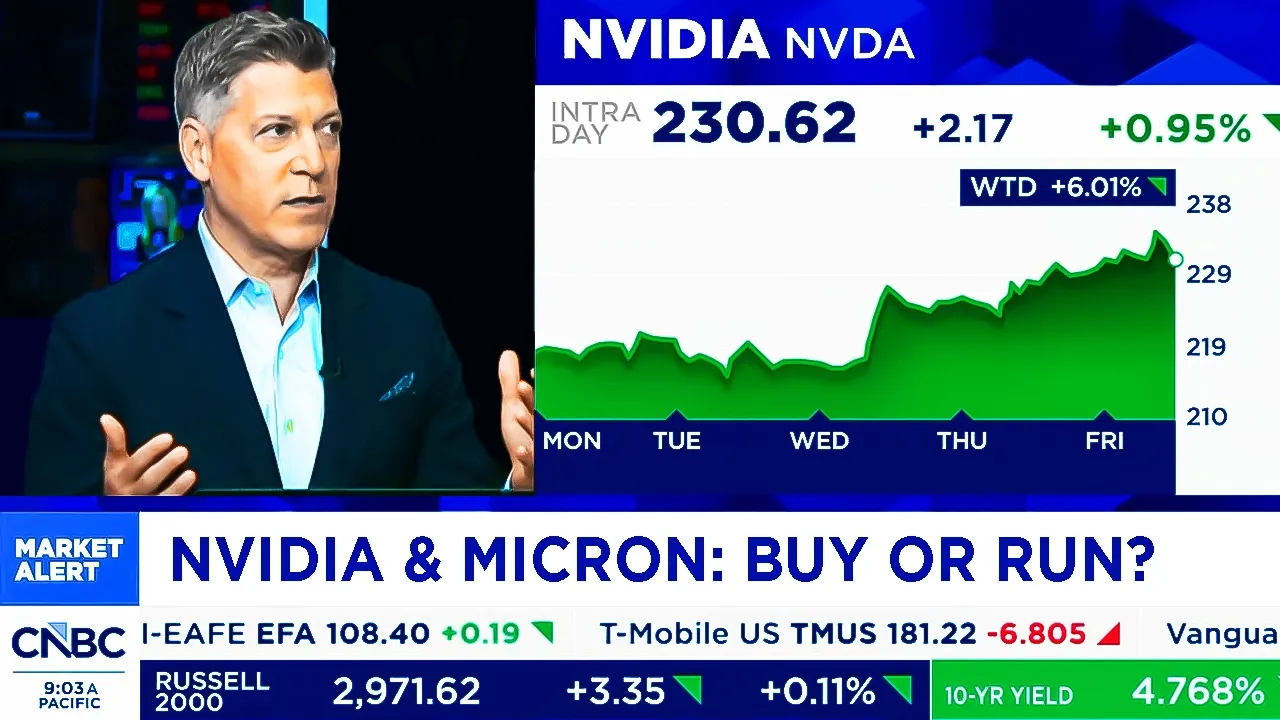
The News Today On NVIDIA Stock, Micron Stock, SK Hynix Stock - NVDA Update

- Video return
- —
- Calls
- 2
- Buy / Sell
- 2 0
- Published
Recommendations
Entry is the asset's closing price on the publication date. Current is the last close on record.
-
Entry $230.36 04 Sep 2026Current $230.36 04 Sep 2026Result +$0.00vs. index +0.0% SPY +0.0% over the same days
I think Nvidia is a buy here.
Context "I think Nvidia is a buy here. I think we got uh the kind of reaffirming reaffirmation, excuse me, of the story, but a a a chance to actually see where growth was that really outperformed."
-
Entry $477.57 04 Sep 2026Current $477.57 04 Sep 2026Result +$0.00vs. index +0.0% SPY +0.0% over the same days
I really like AMD here.
Context "I really like AMD here. I think they're doing phenomenal things to catch up and and you know kind of solidify second position which can be very lucrative."
Full Transcript
where investors should look for opportunity. >> Yeah, I think there's a lot of really interesting segments that you look you look at in the market. One that we tend to look at quite frequently because we have um large positions in is memory. Um we we still think that there's a lot of misconceptions around memory, specifically around high bandwidth memory. There was some architecture decisions by Nvidia on their Reuben Ultra to reduce the stack height from 12 to 8. Now, if you read the headline, it's oh wow, 33% less high bandwidth memory. Um there's going to be less memory sold. But in reality, the total number of bits are actually the amount of memory stays the same as what it's sold. Um and and the way that you can look at it is the bits are fixed, but Nvidia can sell more GPUs. So for SKHEX, it's un relatively unchanged. But I think the piece that's underappreciated with that is it's actually really really hard to stack memory 12 high. So when you reduce it to eight, you actually get better yield. Um so the fixed number of bits is relatively the same, but the memory providers may actually end up with with better yield and a little bit of a price increase um for what they can sell for their for their bits. >> So let me ask you this. Um you're also focused on networking as part of of the AI stack and where there's opportunity there. I'm curious to know your thoughts on that and if you have thought on cyber security. >> Yeah, definitely. When you think of again a lot of these slices and dices of of the AI trade, people tend to view them a little bit as as zero sum. And there are some aspects where you make architecture changes. There are some winners and there are some losers. And one of them that ends up being in that bucket is memory and networking. >> When you look at those two side by side, we again we think memory is very important, but when you have less locally to store the data, you end up having to move the data. So when you look at what's really important for the next phase, it's making sure that the movement of that data is as fast as possible. But not only that, it's the highest integrity as possible. And that's very important because it's almost like the weak the slowest link in a GPU cluster holds back the entire task when you're moving data, which is very expensive cuz you've already purchased all the equipment. The compute's expensive. So you want to make sure that the highest the GPUs are orchestrating in the most seamless way possible. And that's why data integrity is really really important if you're going to reduce the memory count. And we've seen some interesting names um have come up that we're very passionate about like SEC is one of them. Again, they're kind of in that analog IC component that really helps when you're moving um data as fast as possible. Keep it as high integrity as possible, which is very important. >> Let's talk about Nvidia. It's it's buying hugging face for $13 billion. Jensen Wong, you never want to sell him short. What What does he think this is going to bring to the company? How is he going to use first of all, what is Hugging Face and how is he going to use it? >> Hey, good morning, David. Yeah, Hugging Face opens up the world of developers, even more so to Nvidia, about 18 million of them working across 500 million models and 200,000 different enterprises. That now Nvidia becomes the distribution layer of open source. And the thing Jensen's gotten right over the last year is that the frontier labs uh anthropic and um open AI are very important, but open source bringing the cost of correct AI down as close to zero. Literally bringing that cost down is going to exponentially grow the utilization of AI by enterprises. So Jensen wants to bet on both these frontier labs with the leading intelligence, but he also understands that open-source openweight models are going to be the future as enterprises are going to want to grow their use of AI, but they want to do it responsibly to deliver the ROI that the market is looking for. >> But hugging face is kind of a gateway that a lot of other companies and and individual consumers are going to have to use. It's it's it's almost like a like some kind of meta gateway that they're they can make a lot of money on in the future. No. >> Well, they can make money, but they also become the critical distribution and they become the front door. >> And if you think about how that opens up more opportunity for Nvidia to grow its entire portfolio of systems and and and technologies, it's a it's a benefit and it also helps bring the distribution of open source. So, we have more than just those couple of labs in the in the industry. All right, let me quickly get into the AI cell narratives. We've heard so many of them over the past couple of years. They've most of them, if not all of them, have proven wrong. The data center for me is is the latest of the AI, you got to sell it now because nobody's going to want a data center that's going to kill them. What do you think of that? >> Yeah, I mean, look, if you can hold your nose and buy the fear, these have all provided opportunities. It was sell software because AI will replace it. It was sell security because anthropic mythos will replace it. It was cell memory because they're going to build around it. And now it's cell data centers because no one's going to use it. Look, this technology is transformative. It's going to revolutionize the world. We're going to bring the costs down and these data centers will be built, but there could be some some short-term chop and and and sometimes investors don't like that. >> Your second pick, Tim, is Nvidia had its blockbuster earnings. It finally bucked its multi-quarter trend of moving lower post earnings. We've hung on to that momentum. were up close to 10% over the last month. How are you looking at Nvidia right now? uh you know, Nvidia, you know, between this uh virtual inference router, you know, I know I get a little nerdy sometimes on these, but um they announced that this week where uh they're building this router where again, whether it be DJX Sparks and and also Mac hardware kind of ties back to the Apple pick, you can basically set up this array of hardware uh and use this router to basically turn all of those nodes codes into one uh you know basically one combined computer. So very exciting that Hugging Face acquisition. Absolutely love that. I mean I get pretty much all my models from Hugging Face. I think it was genius what Nvidia is doing to bring those local models especially to the US. I mean Quinn and Kimmy and all of these that are China based. I use them but I would much rather use a USbased. So, between those two, plus the fact that I also made a point to wear my Lululemon in honor of Michael Bur. Keep adding to that, loser, Michael. But anyway, between the shorts, getting smoked, hugging face, and Neotron and what Nvidia is doing. Again, I know I've brought this idea week after week after week, but I love it more now than I did a year ago. But as we look at the setup here for Nvidia, obviously moving higher post earnings. The street really liked them, accepted them, was happy with the numbers we got. What are the technicals telling us going forward? Uh Rick, sorry. >> Sure. And and of course, hugging face is basically GitLab for AI assets here, an online community where users can share and and store uh this type of information here. So we can see here an old high 23654 was the the high water mark that we've seen so far. Another high that came in a bit short was around 232. So once again uh before today it looked like perhaps we were maybe not going to make it above that level here. We kind of topped out near 231. For now though we have made intraday highs that came in between our two resistance areas here. Uh so kind of an interesting situation where we breached the the second to best high but we haven't really taken out that old one just yet here. So uh we can also see now overall pattern is a rising wedge type shape here where our two boundary lines are converging toward each other both pointing upward a steeper slope going along the lows. So uh some notable horizontal levels once again to the downside. Uh probably the gap forming right here near about 213 214 would be a significant one. We've had such a strong rally recently. There's not too many other notable downside areas to watch until you get to that point. But another extreme low comes in near about 207. So, uh, in this case, moving averages are showing that there's no sign of the trend weakening here. We're still pretty firmly to the upside. You can see our moving averages are all diverging farther apart. They're in order from fastest to slowest. The closest one is our 5day EMA in dark blue right here coming in around 226. So, that would be the uh first uh line of support potentially here. If we do start to breach it, it could be an early warning sign of trend change. So RSI not quite cooperating just yet either. We have not really broken above our red trend line here. We also haven't really made a strong new relative high. So uh those would be some things that many technical traders would be on the lookout for to add further credence to any possible breakout. So volume profile, we don't have a lot of distinct nodes in the these upper areas here. kind of the best we can do in the shorter picture here is 218 to 223. There's a bit of extra activity and then another uh pocket of activity here between 206 to 212. >> All right. Right now we're looking at Nvidia higher on the session up more than a percent and a half so far today at 23207. >> Because I think it's meaningful to the market. >> I think it is too. And you know where I look in the Mag 7, Scott, is particularly at Nvidia. Um I really think to me that's where the turnaround in the Mag 7 came. Now, we talked last week about how good Nvidia's earnings were. We liked the stock response, but that it hadn't flown through. At least last week, it didn't flow through immediately uh to the rest of tech space. I think that was just a delayed reaction. And I'm also happy to say that it's not just chips. In fact, it's things like Microsoft. It's things like Meta. Um so, I I to me it was really Nvidia the clearing event. That was the term that we used um that tells us that the AI capex is going to continue that it's profitable which by the way to Mike's points about earnings. That's what we heard in the earnings season is that all of this capex is profitable. Andrew Jasse, CEO of Amazon saying things like it takes less than 3 years to recoup the cost of a new data center. Uh excuse me, Alphabet growing its uh web services at 80%, Microsoft Azure at 40%. There are fundamental earnings-based reasons why the Mag 7 is performing. And on top of that, the valuations are not too hard to justify. >> Nvidia is up seven. Well, well, now it's 6%. It's peeled back a little bit off of where it was when we started. It was up as much as 7 12% this week. They did the hugging face deal. Uh their investments are growing. I I'm wondering how you see I I just think that what Mike took a look at as sort of he usually does he has really just great insight into what's really happening underneath the surface. If this is going to be the case if the MAG 7 has now reasserted itself, what does that mean for where we go from here in a month that has historically been unkind? >> So I'm less concerned about the timeliness of the market. This being September, one month has to be the worst month, Scott. It just happens to fall in September. So, I trend I tend not to trade around the tarot cards or the farmers almanac. But what I liked about the opening from both of you is you didn't talk about the mag 7 as an acronym. You both talked about Nvidia. So, what we're doing is we're isolating the winners within the Mag 7, but the reason that they're performing well collectively is exactly what you said. It has to do with earnings and to me more importantly, it had to do with the guidance. So, we're looking at companies that are improving returns. Yes, they're spending a lot, but we're starting to see a return on that investment. And most importantly to me, we're seeing the valuations from the fundamentals from the PE ratios. We're seeing them stay within range. So, the stocks are moving higher, but in essence, they're getting a little bit cheaper. >> Yeah, Nvidia ticking higher today. Uh Andy, you've got fresh sentiment data. Walk us through what it looks like at a headline level. And happy Friday to you. >> Yeah, happy Friday. Nvidia's just cranking on all cylinders. probably the best company in the world. Uh if not that, it's one of the best by far. Um you know, when we look at Nvidia, we like to look at it from the from the mix versus competitors because Nvidia got out to such an incredible head start in the AI race versus everybody else. They kind of caught everybody else off guard. Uh this wave that came in, they took advantage of flawlessly. They were perfectly positioned and executed really well. But when we look now at the landscape, uh things have changed a little bit. You know, Nvidia is not the only player in town. The competition is getting more competent. And while Nvidia's, you know, growth story is incredible and it remains extremely strong. We're starting to see some competitors outpace it in terms of in terms of growth rate. You know, specifically, I really like AMD here. I think they're doing phenomenal things to catch up and and you know kind of solidify second position which can be very lucrative. And so um you know when we think about Nvidia we think best company in the world priced to perfection delivering above perfection over and over again. But what else in the AI space? What else in the in the compute space is starting to compete? There are some other winners bubbling up there. But I think the big story here is that the AI buildout, data center buildout, etc. that story is not cooling off. I I see absolutely no signs that this is a bubble. In fact, what we're seeing is more and more adoption, broader and broader uh implementation, more and more developers, and more and more businesses getting into the game, which is different than web. you know, the the the web uh 1.0 bubble. It not everybody was participating. Not everybody was building into the same ecosystem like they are with this. So, I think uh we're just in inning two of the AI and data center buildout. If anything, it's accelerating. Nvidia's perfectly positioned. They've shown competence beyond belief in executing in taking advantage of those types of ways. We see no reason why that would stop here, but we also see uh the bubbling up of some competent competition that will also benefit. >> Uh yeah, Andy uh you know, we've seen Nvidia, you know, on a forward valuation basis. It's cheap compared to a lot of its competitors uh that you mentioned just uh AMD, Intel even uh at that point. Uh and maybe it's a law of large numbers, but the 6% gains this week, we've seen a resurgence in the shares after their great earnings last week. My question for you is when you look at that d AI data center market where it's what 472 billion in 2026 two trillion by 2032 do you guys see any signs that hey things are going to become more efficient hyperscalers aren't going to have to spend as much uh maybe chip design gets innovated where you know costs have to come down because the exhaustion level about the amount of spend. Do you guys see any data that says that there might be cracks in maybe some of those estimates? >> Yeah, I think the biggest crack, you know, that you could put on Nvidia is that the margins almost have to come down because of the the competence of the competition and the efficiencies that you talk about, but we actually see, you know, in terms of um those efficiencies, we see that as a positive feedback loop for the industry. um the the models of today will be half the price or onetenth the price a year from now and the new models that keep coming out from these uh you know from Claude from Grock from GPT the open-source models keep getting better and better and what that does is it brings more people into the ecosystem as developers as consumers as implementers and it makes it an arms race that could seemingly never end and so we see it as an acceleration mechanism the efficiencies. We see it you know also going to to test and pressure the the profit margins and the gross profit margins of individual competitors like Nvidia. But the whole pie uh we think continues to grow at an accelerating almost exponential rate well into the future because of what these uh these data centers, these chips and these AI technologies unlock for businesses and individuals around the world just keeps getting more and more powerful and drawing more and more people in. >> So let me ask you this Andy. So then I guess then you one shouldn't make too much of that chart where AMD is little above uh Nvidia in terms of what demand looks like. It's just the pie is growing. Is that how we should look at that? >> Yeah, the pie is growing and Nvidia was coming off of such an enormous lead and such an enormous uh you know baseline number that even the plus 24% year-over-year is an incredible feat. uh considering where they started a year ago and how much of a lead they had on everybody, those those bars above that would have to be, you know, plus 100% or more to really be uh denting Nvidia's uh massive lead at this point. So, it's it's grinding away. It's going to put some pressure on margins, but uh Nvidia definitely in the driver's seat of the entire AI race and all the money that's flowing into all these companies, Grock, Claude, GBT, uh an enormous percentage of that continues to go to Nvidia well into the future. Annie, just a follow-up question. After the announcement that they're buying hug hugging face uh that open- source AI model uh platform, you know, if you look at that, you know, compared to what we've seen, whether it's from Anthropic, whether it's from Open AI, you know, they're they're expanding their stack, their AI stack at this point, and that seems to be like the next logical step. Do you see them having a bigger opportunity there where uh you know how many of how many of these models are we going to have moving forward? Are we going to or is it going to be somebody's going to lose or somebody's going to win or maybe there'll be two winners. I mean what do you what kind of data are you guys seeing on that front? you know, as I hope we continue to get hundreds of models and I hope we have multiple winners and more importantly, I hope that all of the venture capitalists and private equity guys and everybody that invests in these companies continues to fund the uh fantasy that there will only be one winner in the AI race because what that's doing is just, you know, pushing so much capital into the space and so much innovation. I mean, HuggingFace has over 18 million developers involved in its ecos and and that number continues to grow as more money continues to flow into these. So, um we don't see it we we don't see the implementation layer in any way as a winner or take all type of um endgame. This isn't Amazon versus the rest of the retailers. you're going to continue to have choice and uh you know like every month we see one of these uh AI companies come out with the newest greatest model and it blows claudes yesterday's news and tomorrow Grock will be uh the shining star and all of that is good for Nvidia it's good for the data center buildouts it's good for consumers and it's good for implementers and we hope that that continues for for a long time and we think it will because uh this arms race is just getting started. >> All right, we want to turn to Nvidia now. Rising almost 1% today to post a 6% gain for the week. The stock within 3% of its all-time high that it hit back in May. Nvidia joining Meta as the only Mag 7 stocks in the green today. The chip giants also the best performer in the group this year, up almost 24%. Tim, >> well, I I just feel like the numbers that we had recently derisked some of the stock. They we we continue to reinforce the numbers on hyperscaler capex where we're going to be across the board in terms of capex. The multiple onvidia is is extremely attractive and the market at this point is more comfortable with this holding company mentality and you know AI infrastructure play that Nvidia has also become in addition to the semiconductor. So I I think in Nvidia's price action this week was extraordinary. I think the fact that it held the gains from the earnings uh it it it it oscillated a bit, it built on that. I think on the chart it it's very strong uh in terms of where you have a semiconductor group that is waiting for this kind of leadership. Uh I think Nvidia is a buy here. I think we got uh the kind of reaffirming reaffirmation, excuse me, of the story, but a a a chance to actually see where growth was that really outperformed. All right, I hope you're all doing well today and staying calm in this market. Friday was a red day throughout much of the market, but it was a notable green day for much of AI hardware as well as the stocks of some companies associated with data center buildout. The red action we saw in the market was in response to the strong jobs report Friday morning. Non-farm payrolls came in at nearly triple the consensus expectation. A stronger than expected non-farm payrolls numbers sparked fears that the Federal Reserve may raise interest rates either in September or December. That said, it was a nice day for AI hardware with Nvidia coming within $2 of making a new all-time high. Hopefully, we don't end up with a double top situation as that would not be ideal in the short term. But regardless of that, the stock is arguably cheap versus the company's future growth. The information is reporting that Thinking Machines is in talks to raise roughly 5 to6 billion at a pre- money valuation of at least $40 billion. And Nvidia is in talks to invest around half of that amount. This funding round could potentially be perceived as being positive for Boostrun as Thinking Machines is a major customer of Boostron and Bun is such a small market cap. Of course, nothing is guaranteed and even if Thinking Machines raises the funds, there's no guarantee that they'll spend some of it with Booster. I'm just mentioning that it may be perceived as being positive for Booster Run. In other news, NA and ESMT both just reported record August revenue, providing another data point that conventional memory pricing remains strong. ESMT's revenue increased roughly 16.5% month-over-month. The increase in revenue is being attributed to higher Q3 contract prices. As I mentioned in last night's video, Micron is reportedly planning to increase HBM production capacity by as much as 60,000 wafers per month by the end of this year. For context, Micron's HBM production capacity last year was 40 to 50,000 wafers per month. And now we're talking about an additional 60,000 wafers per month added by year end. It's important to remember that Micron's share of HBM production capacity is notably less than both SKH and Samsung's. I don't think this additional capacity is anywhere near enough to pose a threat to memory makers pricing power. It's also important to mention that a large portion of capacity is being shifted toward 12 high HBM4 which is used in Nvidia's Vera Rubin which is ramping in production right now. And so overall I think this news is positive for Micron. It's also important to mention that starting in December the restrictions on Micron's ability to conduct typical share repurchases related to the chips act will begin to ease and after that point Micron can return a considerable amount of capital to shareholders. And so I do wonder if Micron is trying to increase their HBM production capacity before year end partially because share repurchases are on the horizon because once Micron is allowed to conduct buybacks again, investors will of course want a substantial buyback. And so perhaps they're trying to get ahead of that by substantially increasing production capacity now before buybacks are back on the table. In other news, it's being reported that Micron's first Taiwan labor mediation ended without an agreement and a second mediation meeting has been scheduled. Micron also said it will disclose details of additional employee rewards in the coming weeks. At the time I'm making this video, there is no strike or production interruption. We need to watch this in the days ahead just in case. That said, if there were to be a strike at some point, I would expect it to be a short-term negative for the stock rather than a long-term structural problem. I expect this situation will ultimately be resolved. Micron has also said that this year's bonuses will be the largest in company history and the details will be announced in October. It's worth noting that we have Micron earnings before then on September 30th. In other news, Reuters is reporting that a South Korean presidential official told them that South Korea and the US are discussing semiconductor investments in the US as part of broader bilateral talks. And according to Trend Force, the administration is pushing for front-end manufacturing of DRAM and NANFL flash wafers in the US. The Commerce Secretary also recently indicated that the administration is considering linking tariff rates to investment levels. In other words, companies that invest more would receive greater relief from tariffs compared to those that invest less. TSMC appears to be in a very good position in that regard as they are building out manufacturing capacity in the US and they are expected to increase their investment in the US even further. That said, it remains to be seen if there will be additional pressure placed on South Korean memory makers to increase their investments in US manufacturing. Looking ahead, Jensen is scheduled to speak at the Goldman Sachs Communicopia and Technology Conference on Thursday, September 10th, starting at 11:50 a.m. Eastern, 8:50 a.m. Pacific. Nvidia CFO Colette Crest spoke at this event in 2025 and Jensen spoke at the event in 2024. Both times the stock reacted very positively. Now, I'm not saying that's guaranteed to happen this time because of course I don't know what the future holds and anything could happen. That said, this event is for the financial community and it has historically had an impact on Nvidia's short-term price action. Additionally, whatever Jensen says at the event will have implications for the entire AI ecosystem and those company stocks. So, pay attention to this event on Thursday. Then we have Micron earnings on September 30th. and then Jensen is scheduled to speak again at GTC Berlin on October 21st. Now, in case you're new to the channel, I want to make sure that you have at least a basic understanding of the underlying long-term thesis. So, let's cover that. Now, I don't know what's going to happen in the short term, but from a long-term perspective, I am very confident that Nvidia will be worth much more in future years than it is today. When Jensen was on the Lex Freedman podcast not that long ago, he was very seriously raising the possibility of Nvidia becoming a $3 trillion revenue company in the near future. If that happens in the coming years, then it is very plausible that Nvidia could one day be worth tens of trillions of dollars in market cap. That might sound crazy, but that's what Jensen is implying when he raises the possibility of Nvidia becoming a $3 trillion revenue company. I guess the question at that point is what multiple the street will be willing to give Nvidia. I don't know the answer to that question, but I truly do think that Nvidia will be worth much more in future years than it is today based purely on the fundamental growth of the business. Based on everything I'm seeing, the world is still compute constrained and I expect that to continue at least through the first half of calendar 2028. In a computed environment, developers will use whatever viable compute they can get their hands on. Today, there are no GPUs that are sitting dark due to a lack of demand, like there was fiber sitting dark due to a lack of demand at the height of the dotcom bubble. Back then, companies were laying fiber in the hopes that use cases and demand would eventually show up. Today, we are seeing the complete opposite. As I've said many times, when market participants compare this AI revolution to the dotcom bubble, they ignore the fact that the internet is already here this time. This means that mass adoption of the technology and new use case development at scale are immediately possible. We don't have to wait years for it to show up. It's already here. The world is compute constrained, which means there is not enough supply to satisfy demand. New capacity is utilized as soon as it comes online. The hyperscalers are monetizing capacity as soon as it comes online. Each of the hyperscalers spoke about being supply constrained on their most recent earnings calls. Additionally, many of the clouds are building out into contracted demand. They're not blindly building in the hopes that demand will eventually show up. No, they're building out because they have signed contracts and in some cases significant prepayments from their paying customers. This AI revolution is fundamentally different from the do-com bubble. And 2026 will be a pivotal year for the AI industry thanks to the rapid adoption of agentic AI and the proliferation of agentic systems in the world's leading enterprises. The leading AI labs revenues are surging right now. Agentic coding and the implementation of Agentic systems in large enterprises are new use cases that are increasing inference demand significantly. That subsequently is increasing compute demand. The rapid adoption of Agentic AI is why we're seeing an inflection in inference demand. It's why we're seeing the leading AI labs revenue surge. I wish both Anthropic and Open AI were public so the public could see the ramp in their revenues. I think the leading labs surging revenues may be the initial proof point that grabs market participants attention and causes them to realize that there will be a clear ROI on AI infrastructure. I think the leading labs surging revenues will also help assure investors of the longevity of Nvidia's growth since these labs revenues are directly tied to compute. If they had more compute, they would have greater revenues. It really is that simple. Demand is not the problem. The problem is a lack of supply to meet the demand. As I've said previously, I expect the world to be computed at least through the first half of 2028, possibly longer. And so regardless of what happens in the short term, it's important for long-term investors to remain focused on the fundamentals, maintain a long-term perspective, and remember that we are only in the early stages of aenic systems being adopted at scale. This will increase compute demand significantly. And after that, the next surge in compute demand will likely be fueled by physical AI. We're no longer talking about digital agents performing digital tasks. With physical AI, we're talking about physical AI agents performing physical tasks in the real world. NVIDIA CFO has called physical AI quote a multi- trillion dollar opportunity and the next leg of growth for NVIDIA. This industry will fundamentally transform society and Nvidia has positioned themselves to benefit massively. NVIDIA sells the hardware for the data centers where the models are trained. They offer omniverse where the models are taught and tested. And Nvidia also sells the hardware that allows ondevice real-time inference through NVIDIA AGX allowing robots to have intelligent interactions with the real world even when they are not connected to a data center. Notice that Nvidia is taking a holistic platform approach to physical AI and they're embedding themselves as the underlying foundation supporting all of it. Over 3 million developers are already building on the NVIDIA robotic stack and this is not getting enough attention. As for production ramps, Blackwell Ultra has ramped and remains in high demand. Vera Rubin is rolling out to customers. Nvidia Gro 3 LPX is in full production. Later on, we're expecting the launch of Reuben Ultra in 2027 and Fineman after that in 2028. We have a clear data center product roadmap stretching into 2028. And Jensen believes that AI infrastructure spending will reach three to$4 trillion annually by the end of the decade. That means Jensen is expecting growing AI demand and an expanding total addressable market underpinning all of this. I don't think we are anywhere near any type of bubble bursting type of event. With all of this in mind, I seriously think that Nvidia still has plenty of runway ahead of it. And I think this company will be worth substantially more in future years than it is today. At least that's my view of the situation. Quick note before I wrap up. All of the compilations on this channel are edited by Finn Vid with original structure and commentary. Occasionally, the same edits appear elsewhere on YouTube. If you're looking for the original version, it's always here on this channel. Thanks for watching Finnvid. I appreciate your support. Remember to stay calm in this market. Remember to maintain a long-term perspective and do not make any hasty or irrational decisions. With all of that being said, I hope you all have a great rest of the day, and I'm curious to hear your thoughts about Nvidia in the comments below. Please leave a like on this video so more people will see it. And while you're down there, please consider subscribing. It's free and you can always change your mind.
Comments 0
Sign in to join the discussion.
Sign inNo comments yet. Be the first to share your thoughts!