…esel. Yeah. >> And we know what's happening with the price of diesel. So, yeah. So, I'm not surprised that they're all in cost went up. >> None of it 45% over budget, but they're still returning 50% plus of free cash flow. >> That's right. So, I would I own Egg Nico and I would still own it because I believe that gold is not going to go down. It might take a little while to work its way back up again, but it I believe it's definitely going up and it's not going to go down. If it goes down, it's not going to be by much because there's a a floor of buying by central banks is not going to go away. That's a structural change that is going to be here for years. They're slowly dilizing and replacing with gold. And…
So, I would I own Egg Nico and I would still own it because I believe that gold is not going to go down. It might take a little while to work its way back up again, but it I believe it's definitely going up and it's not going to go down.
Contexto extraído por IA
None of it 45% over budget, but they're still returning 50% plus of free cash flow. >> That's right. So, I would I own Egg Nico and I would still own it because I believe that gold is not going to go down. It might take a little while to work its way back up again, but it I believe it's definitely going up and it's not going to go down. If it goes down, it's not going to be by much because there's a a floor of buying by central banks is not going to go away.
Transcrição Completa
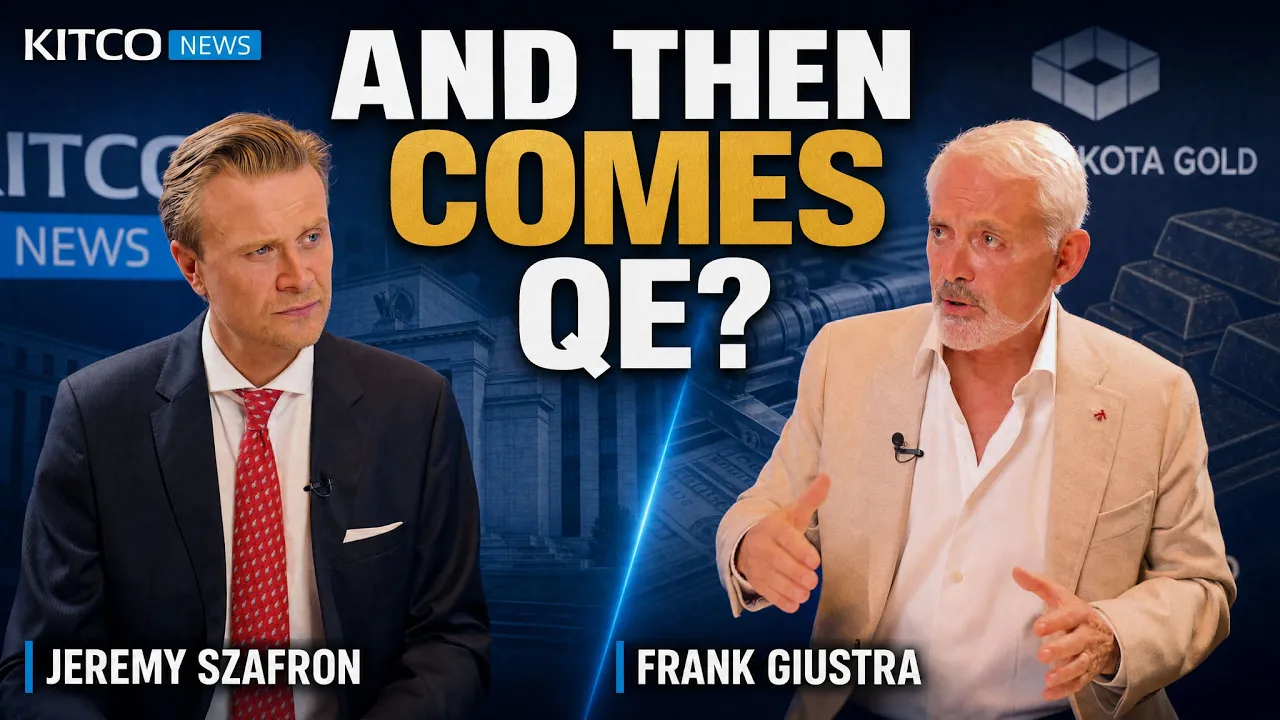
Kitco News [music] on-site coverage of the New Orleans Investment Conference is presented by Dakota Gold. All right, welcome back to the New Orleans Investments Conference. I'm Jeremy Saffer. Now, Brent crude is above $110 a barrel this morning and the war behind it is dragging on. Also, Canada's largest gold miner responded reported about $3.4 billion in net cash just yesterday. But its Arctic Mines, the diesel bill, is running about 45% over budget. And my guest has spent 20 years inside of this industry and of course studying wars with the International Crisis Group. He's also made a fortune in gold in 2001 with gold under $300. He and a few partners took control of a tiny gold company and became Gold Corp, one of the biggest gold miners in the world. He founded Lionsgate and his new memoir is about what money can and can't buy. So what does he see now? Of course, Frank Juster is a CEO of Fior Group. His book, The Money Dilemma is out on November 3rd. Thanks, Frank. >> Two corrections. Y >> I've been in this business over 45 years. Excuse me. Um and um Brent this morning was 114. >> Yeah. Over 110. >> Over 110. >> Over 110. I mean, so it's it's taking it's it's it's stuck and it's taking the margins out of some of these miners, which which I need to kind of know uh what your perspective is. And and I mean, you know, I guess it's the war. Uh you sent me your latest essay. Of course, you publish this on your your website and you wrote the wars drag on lawn after its original reason is gone because the leaders can't bear to be the one who has basically lost. I mean, you can talk and applied that to Iran. You applied it to Ukraine. Forecasters still have oil coming down in 2027. Is is the market pricing piece too early or is are we going to see, you know, next year? >> 100%. I mean, I I think we're far from certainty in terms of any peace agreement between the US and Iran. As a matter of fact, I'm more on in the camp right now that the US is going to attack after the midterms. Um, now if they, you know, there's a lot of diplomacy taking place. You don't read a lot about what's going on behind the scenes, but they are actually communicating with each other and they both are trying to come to arrangement because, you know, the blockade has really hurt Iran. Although it won't make them capitulate. that is a the US is dreaming to think they can get regime change with his blockade, but it's certainly hurting the economy and hurting the people. But um I think there's a very very good chance and especially now with the Israeli elections, Netanyahu is going to stay in power until they sort out whether they sort out a new government could take months and months before they form a government. They might not even be able to form a government. >> So close. and and so so he has a free hand to work with the US to strike uh Iran if they so choose and I think if that happens I think it's the biggest mistake in history because Iran will retaliate equally um and they're going to go after everything in the region including the underwater fiber optic cables that you know provide all the communication I mean you you know and I think oil is going to stay elevated and I think oil could could potentially go a lot higher if there's a second a third strike. This would be the third strike. Um but you know I think the whole strategy of the US on this is been wrong from the start. They shouldn't have done this in the first place. They put the whole now it's a huge game of chicken between Iran and the US and with the fate of the global economy at stake and it's really we could force our the global economy into a deep recession or depression if this gets out of hand. So they're playing a very very dangerous game of chicken and so and but you know you have to also think what's happening in the region the the local Gulf players you know the Saudis the UAE the Bahrain the Kuwaits the the Qatarist are coming to the realization that they have to change their security architecture and now they're talking to Iran about a post-war arrangement where they provide their own security arrangement within the region and essentially see the US leave. That's what certainly Iran wants. And more and more some of the Gulf countries are going now this whole security umbrella that they promised us, it didn't work out so well. This is just causing us more trouble. So cuz they all know Trump won't be in office forever, but the region is going to be there long after Trump is gone. So they're going to have to figure out their own arrangements there. So I think there's going to be a diplomatic solution to this. But the question is, does the US escalate this with another attack? And I think from my perspective, huge, huge mistake. >> Now, I mean, for the audience, obviously, you're inside these rooms, you hear what most people don't. You're not just a gold guy. Um, the diplomacy, has anything surprised you about it? >> Well, it [laughter] how far back do you want to go? I mean, certainly the diplomacy as was being run by Trump's son-in-law and Witco, these folks were not trained in any form of diplomacy. have no there no idea what they're doing in that world. I think uh and now you're seeing some allegations of some serious corruption by Jared Kushner in the background as he's you know out there being a quasi diplomat at the same time profiting and you know all the stuff about bank accounts and money going back and forth. So I I I think that they have certainly handled the whole thing very poorly right from the beginning. I mean they shouldn't have attacked in the first place. That was a They thought there'd be an easy win. Take out the regime, it'd be all be over. And no one in the intelligence services believed that. No one. And Trump did it anyway. >> Now, when you can they learn from Venezuela at all on that? >> Well, Venezuela was a very different thing. They went in, took the guy out, and basically held a gun to the government and said, "Okay, now you're our partners. [laughter] It's But Iran is not Venezuela." What people don't understand Iran is a massive country with very sophisticated technology. It's not some backwater country. You know, people were confusing Iraq with Iran. Iran is not Iraq by any stretch. >> Now, who has benefited? Obviously, the oil producers. Some would argue Russia, you know, getting a little bit of income here. I mean, who's benefited from this? >> The oil companies. And even Trump trying to rally last week. I couldn't believe Trump actually said when he was talking about gas prices because most people in America, the voters are very unhappy. And this is the reason why the I think the Republicans are going to lose both houses now. Gas prices is the number one issue on people's minds. And can you believe Trump stood up there and said, "Ah, people talk about gases. I don't give a damn. We're making a ton of money. We means the oil companies, the people invested in oil companies." And to say that in a campaign rally when 80% of the population is hurting and pissed off, like literally pissed off, I thought was a bad campaign move. [laughter] >> Now, you've seen a lot of things in this industry. What does a longer war mean for gold? >> I think eventually this war like all the other useless wars in the last 50 years and they were all useless. Viet from Vietnam by actually from Korea, Vietnam, everything. Afghanistan, Iraq, all senseless, useless wars that achieve nothing except help destroy America's financial balance sheet. That's all it does. I mean, Afghanistan and Iraq probably cost $8 trillion. $8 trillion for two stupid wars that should have never happened. They were based on lies, both of them. And um and so I I think what it we keep doing these endless wars. It'll be like every other empire of the past. Go right back to the Roman Empire. Anybody, you slowly bankrupt the nation. You have to debase your currency in order to stay in the game. >> Okay. What does that mean for gold? You debase the dollar, gold goes up. It's that simple. They have a that's the relationship. So the more you chip away at the value of the dollar or any fiat currency including the euros, the yen on the more you chip away at the value of those by printing money, increasing money supply, increasing debt, you're destroying the currency. It's that's math. That's not a theory. That's just happens every time throughout history. And so in the long run, the US dollar is going to continue to get destroyed like every other fiat currency and gold will go up relative to those fiat currencies. >> And your argument is because every no one wants to lose. I mean is this an ego play? >> Yeah. So I wrote that article Yeah. yesterday which is you can find on my blog frankjustro.com >> where I basically wrote an article that showed how throughout history leaders that either enter wars or inherit wars don't want to be the leaders that lose even when they actually know they've lost and there's plenty of evidence from guys like Nixon and Lynden Johnson and Napoleon even the stuff that he was saying back you know a few hundred years ago I don't want to be the guy that lost it's all about personal legacy and ego And you can think we're in a world of 8 billion people and we're hostage to one individual's ego that he can't afford to say I lost and therefore millions suffer around the world. Thousands die, the economy gets destroyed and all for one person's ego, you know, because everybody knows this war is a mistake. Everybody except the neocons who are, you know, pushing, you know, they're a very small percentage of the population and but the majority of the population doesn't want this war. Never wanted it and is even wants it even less now. >> So, I mean, midterms, you think it's going back, right? >> Listen, anything can happen. And then you can't trust polls anymore. No, >> but it sure looks like the House is going to be a sweep. And as of this morning, I was even checking the Senate. every day is getting worse and worse for the Republicans. Um there's a good chance that, you know, we're going to get a change there as well. And so, and I think that the Republicans are panicking now. And, you know, and I think it's going to be chaotic. I don't think we're going to have a clean outcome next week when when the midterms happen. I think there'll be a lot of accusations and who knows how Trump will react if he loses badly. He, you know, we know how he's reacted in the past. So, I'm assuming it's a pretty good bet that he'll react equally or even worse this time. >> Bombers kind of thing. >> Yeah. You know, so I think I think it's going to be ugly and messy, but I and I think then what's going to happen if the Democrats actually do win, you're going to see so many investigations. >> Yeah. >> Not just Trump, his family, the entire circle around them, all of this corruption that's taking place right now. There is one of the top. There are two issues that people are voting on. affordability and corruption. Those are the two top issues. People are sick and tired of this just out in the open corruption. I mean, there's always been corruption in politics, but they used to hide it. >> Yeah. >> Now they don't care. They just do it out in the open and they do it large. It's not like a little stealing here and there. It's like, let's hand out a couple billion dollar contract here and there and all the inside cronies are all participating. So, there's going to be investigations which is going to also mean that >> you're not going to be able to govern >> Yeah. properly when you're out there killing each other is in essence what Democrats and Republicans have been doing all along. So I think it's going to be just getting worse and worse and worse and who see we'll see what happens in 2028. You know Trump will be gone from you know unless he wants to stay and uh >> new Venezuela wasn't he going to know I thought he was going to >> Yeah. Anyway, [clears throat] so I I don't see just to summarize I I don't see a pretty outcome to this. Now listen, if I am wrong and Trump does not attack after the elections and if they do find some diplomatic solution and it's not going to be a perfect solution by any, but something that just stops the blockade, stops the sanctions and stops um Iran from um attacking ships in the straight of Horus. So open up the straight. There are a few key issues that both sides want. Obviously, the US is focused on the nuclear issue and I think they can find the solution that that because they had it with the GCPOA already. They had a solution before. Now, Trump wants to tighten out those terms. Who knows how Iran is going to react to that, but Iran will not give up their nuclear u ambitions for for domest for domestic civilian use. Uh they just won't. That's that's a red line for them. Always has been. They're willing to take a lot of pain in order to protect that, right? Um and we'll see. But uh listen, I I hope I'm wrong. I really hope I'm wrong. >> All right. Now, we started talking about the price of fuel. Obviously, it's become a big issue. And I looked this morning. I mean, IO Eagle came up with some numbers. They got $3.4 billion in net cash, but it's all in sustaining costs are up 24% in a year. I mean, you've built gold companies, you've sold gold companies. If you ran a junior right now, would you sell it to a major or would you hold out? >> Well, that's that's a pretty open-ended question. So many I could ask you a million questions in in return before I made that decision. No, but generally speaking, listen, everybody's going to be hit with higher prices. It's just because energy is how you produce mineral products. You need energy to produce. So, you know, unless you have, you know, windmills and lots of solar panels and, you know, you're going to you have to buy diesel. Yeah. >> And we know what's happening with the price of diesel. So, yeah. So, I'm not surprised that they're all in cost went up. >> None of it 45% over budget, but they're still returning 50% plus of free cash flow. >> That's right. So, I would I own Egg Nico and I would still own it because I believe that gold is not going to go down. It might take a little while to work its way back up again, but it I believe it's definitely going up and it's not going to go down. If it goes down, it's not going to be by much because there's a a floor of buying by central banks is not going to go away. That's a structural change that is going to be here for years. They're slowly dilizing and replacing with gold. And that's not something you do overnight without driving the gold price through the roof. So, so I believe that that's just going to continue. So, I I think yeah know I I I I think uh gold price is going to go higher. So, you want to own the really good gold mining stocks and Agniko is one of the best. >> I mean I own Aerys which is in Colombia again huge cash flow. It's one of the highest grade mines in the world. Aerys mining is one of the highest grade Siggoia. They're a mine in Segoia. is the second highest grade of it's 11 grams and um it's just spitting out cash, you know, so eventually those guys that are spitting out cash are going to buy they're going to buy things cuz they can't find they can't replace the reserves from their own inventory. They have to go buy a 5 million ounce deposit somewhere else which a junior owns. So I think you know I think that the buyers are still going to be there. I think from the junior's perspective, yeah, but it's all about valuation. I mean, if I own a share in any company and you bid me a ridiculous price, you're going to own it. Okay. >> But I mean, this volatility, I mean, the haircuts that we've seen on some of these equities over the past 3, four months, >> are they going and grabbing them at a discount or are they just waiting? >> I so far it looks like they're waiting. Yeah, it doesn't seem to me that they're in any rush. I'm saying that ultimately they're not going to not going to have any choice. They don't. They just eventually and that goes for copper as well. It's not just gold, but all these juniors that have these big deposits, you know, you have if you have a multi-million ounce deposit or over billion ton copper deposit, you're going to be looked at by the m the majors and and I know this for a fact cuz I know which companies I own and which majors have expressed interest, which in itself means nothing. You know, they express interest. They want to see your data. They, you know, and some companies give it to them, some companies don't. >> You know, you've been in this a long time. What's the sentiment like in terms of gold juniors and a copper producer? I mean it feels like the copper is getting some money right now. >> Yeah, absolutely. Because it's it's the most soughtafter critical mineral. The world cannot run without copper. I mean it basically electrifies the world and copper has as you know a supply deficit problem facing it which has been widely talked about. I mean I've talked on your show about it before. So is everybody else. I mean it's not it's not my just my secret knowledge here. >> We're going to be seeing a very very large supply deficit in copper in the ensuing years. We know that there's been very little investment in copper development over the last 30 years. So the majors have not developed any much on their own. All they keep doing is expanding their existing mines and mining lower and lower grade and eventually that game has to end. So who has the uh big pferies is the juniors. you know, there's there's a handful of juniors that have over a billion tons, good grade, near surface, you know, good location where it's accessible and it's got all the infrastructure available to it. And you know, I've got one in Colombia called Copper Giant, which is my favorite copper story of all. But and it has all those elements. So, and we know we get approached all the time. So, but what that means, who knows? But certainly there's a lot of interest out there in these things. And I think all of those ones that I just described, those type of deposits will get taken out. All of them. Now you got Aerys as well in Colombia. I I mean you've been in that jurisdiction a long time. Obviously there's a new uh government in leadership there. What's it like been working with them? >> They've been they've made it very clear in their campaign and now that their government they've made it very clear they are aggressively going after foreign investment in both mining and oil and gas. Okay. Whereas the previous government was kind of against all of that. They weren't according the world. They've also signed a deal with the United States as a strategic ally to uh provide critical minerals uh in partnership of some sort with the US. So that's there's an arrangement there and as you know Colombia has always been the trai traditionally the strongest ally America's had in South America. So that's that relationship has always been there. do got a little afraid with the last with the last president but um so I think he is and he he has appointed all his people now for his cabinet and he is like every day we were seeing announcements of we're putting this deposit on the national security list of things that has to get done and Makoa copper giant >> just got put on that list it's going to be as best as possible fasttracked towards a production decision because they want to get that thing online as quickly as possible. Yeah. You know, I was thinking about this because I was watching that news out of Coffford Giants. Obviously, it's big news working with the government. You know, you being on that list, you'd think it would repric it. >> Yeah. >> Weird market we're in. Very strange market. Like, you know, you can put out a lot of good news in this environment, but the sentiment is not there. And I keep saying to the folks that run these companies for me, like I I don't run these companies. I'm just an investor. And I And then they're going, "Oh my god, we're just getting killed out there. What's going on?" I said, "Join the club. [laughter] It's not just you. Look around you. It's everybody's, you know, you put out news and you think it's great news. >> Nada. >> All right. Take me back to 2001. I mean, what? Gold's under 300 bucks. Uh, mining stocks obviously out of favor. >> What did it feel like in those rooms compared to now >> when I do these these pitches, these uh keynote talks, >> you know, it's interesting. Um, I wrote, you know, I wrote I just wrote a book. So, it's the story is in my book what I'm about to tell you. Uh the book's called The Money Dilemma and it's going to be out in a next week. Um but I I talk about what happened in 2001 when I made a personal decision that I liked gold. I published a paper on it >> and there was the first thing I ever wrote in my life. I published an article and had it was put in a US investment newsletter. And and with that article, myself and a fellow by the name of Frank Holmes, I don't know if you remember Frank Holmes, we went around and did presentations to institutional investors in Toronto, New York, London, and Zurich. >> We weren't pitching any deals. We were just I was trying to get a read of how people would react to me saying that the gold market's coming back and now is the time to invest in these things. And it was hilarious. We were almost laughed out of these places. I mean, people were just changing their heads going, "You're delusional." I think one guy in Zurich said to me, "You're just a deal junkie. You want the gold price to go up." I go, "Well, that's partially true, but but but not not entirely true." Anyway, so >> it was a struggle in 2001, but we when uh Weaten River, which became Gold Corp, which you mentioned earlier, when we did our first financing, we had to raise $100 million to buy a basically it was a silver gold mine in Mexico. It's called Lewisman. and we had to come up with $100 million. And that market had been dead for five years since 1996. And so when we went out, it was not easy. It was hard to convince people. We scraped it and put it together. But by the time a year later, we did the second financing to buy Alen Brea in um in Argentina and we were raising 250 million. We had to actually stop the road show by then. We stopped the road show because we were oversold and we're going, "Okay, we it's done. Close the book. has done. It was a lot easier and and it changed in a period of about a year, year and a half. But right now, I would say the sentiment is hopeful, but not by any means estatic. >> And as I said, I was just at the conference in Beaver Creek. I said, I don't see any Lamborghinis parked in the in the driveway. I don't see guys popping champagne bottles and I dancing girls on the stage. No, I don't see any of that yet. that that attitude what you see in bull markets and I've seen quite a few over the last 45 years and where people are behaving like there's a bull market now right now it's like I'm interested I like it why are these stocks not moving you know does anybody really care that know the attitude is very cautionary >> and was the sentiment different back at $5600 gold I mean I I still didn't see the popping of the champagne >> it wasn't it was we're not in the traditional bull market because the public at large has not bought into it yet in any way like the retail investor or even the general institutions are far and few between in terms of being even aware like you talk to American institutions you talk about gold and they kind of look at are you one of those guys you know the gold guys you know but they have no idea why they're they can't explain to you why they feel that way they're just uninformed they just don't know yet and they've so I think that the we have not seen the surge of generalist investors, retail and institutional in this market by any stretch. They you'll know when it happens. You'll know because the volumes will be really high because institutional buying usually creates higher prices, higher volumes, uh a lot more deal making, a lot more financing. You know, you don't see a you're seeing the financings today, but you know, they're not like every day a bot deal. Like I remember between 2003 and 2008, I mean we were just I couldn't keep up. We were doing a deal almost every second day. >> Just nuts. Yeah. >> Uh that brings me to the book actually because at 39 years old, I know that you wrote, you know, you made all the money you ever wanted. What happened next for you? >> Well, I thought I was going to retire. You know, I I I left the investment banking world. Uh I was chairman and CEO of York Securities back then. We were killing it. I mean we're just I left an absolute high >> 3 months after I stepped down. Bex happened and the whole market went dead for 5 years. Gold went down. Interest in mining stocks went down. No one wanted to touch these things. You couldn't finance anything to save your life. Uh and I so I was lucky. I didn't know Briggs. I knew we never we had suspicions about Brix, but we didn't know what was going on. Um anyway, so and then I was retired. Yeah. And I thought that was going to be I was 39. I thought I got lots of money and I have a really great life, you know, I'm single and doing this. Four months later, I'm going, "Oh god, I'm bored." [laughter] >> So that's when I started to scheme about creating Lionsgate. Yeah. And I launched Lionsgate in late 1997. >> Yeah. Uh we will talk about Lionsgate because I'm going to ask you about your pitch being a founder of that. But your father was a nickel miner in Sudbury, Ontario. I mean, he's one he's the one that introduced you, I think, to the stock broker. Correct. >> Um, what did he make of all of it? >> Of my success? Not much. It's in the book again. You got to read it. It's very funny. My father was one of these very hard ass immigrant fathers that worked his butt off his entire life. Was not a warm individual. He provided for the family, but he was not one of he wasn't the hugging type. And he was really tough. Really tough. And he and I during my teenage years did not get along. And it wasn't until we discovered we had a common interest, which was the stock market, that we actually started communicating with each other. But as I became successful over the years, a he didn't believe it. He kept saying, "You don't have that kind of money." Because I said, "You know, dad, mom, I'm gonna buy you guys a vacation home cuz I can afford it, right?" He goes, "Where are you going to get the money for buy me a dad? Don't worry about it. I I got it. Okay, I got >> that Italian immigrant." >> I got it. He just couldn't believe. And then later on when he realized that I did have the the money, he was worried I was going to blow up. He keep going, >> "Son, you are walking in a dangerous world. told you, you know, I was cuz I was in the philanthropic world. I was giving away money. I was doing this. I was very becoming very high-profile on issues around money, you know, and uh and he just thought that was a mistake and that I eventually would blow up. And um and I kept saying, "Dad, you don't understand. I'm actually a very conservative guy. I mean, I'm in the risk business. >> You know, everything we do is risk. So, I know that if I invest in something in my business, there's a chance I could lose my money. But that's a risk I'm willing to take because that's my world. That's the business I'm in. But when I manage my own personal portfolio outside of that business, it's very conservative. >> You know, I mean, the the you called the book money dilemma, right? Uh what's the dilemma? >> The dilemma is what happens when you get when what happens first when you don't have money and you want it badly and and then what happens when you eventually get the money and then realize that something's missing that you know that that's not it. That's not the end goal. It's like you make it and you go, especially when you have a big win and all a sudden you've made a huge amount of money on something, which happens in our business, right? You exit a deal and you make a huge win and you're sitting there going, "Okay, now what?" >> Yeah, I got all this money. You should be happy, right? You should be content. You can you can retire and go play golf. And that's exactly what you don't do. You go, I want to do more. I want to do and then when you do more and more and then you realize, go that's not doing it for me. It's just it's just more money. And you know, even though I'm giving it away to my philanthropic efforts, it's just not >> it's not there. >> It's not there. And it's it's finding to me, >> and this is what the book really talks about is how you find your purpose. >> And purpose is different for for everybody. My purpose is going to be different than yours. And I talk about how different people in my life have a different purpose that they believe is that why they're here. Mine, I eventually figured out was because I was lucky enough to make all this money. I had the contacts to do many many things. Why don't I put all of that money and knowledge and connections to work to help others and I made that decision in 2007 and I and that literally changed my life. I decided that was going to be my life. I was going to be someone that really made a contribution to help pe people in many different ways, whether it's poverty alleviation, refugee resettlement, um, education, mentoring kids, uh, homelessness, all the things that I did over the years, uh, addressing problems that helped other people because I was fortunate enough to have the resources to do it. It was a blessing actually. I felt lucky that I was in a position where I could actually do something that helps people. And that was my purpose. And it gave me peace. Once you have peace, you don't need anything else. You know, happiness comes and goes, but once you have peace, you're set. You know, you live your life. You know that someday you're not going to be here. And you know, you do your best. >> Yeah. You know, good advice for people, too. I mean, we were just talking about this affordability crisis, what's happening in the United States economy, it being a top election issue. How much is enough? I mean, how do you advise people when they have enough? Well, if you look at what's happening in the US today with the, you know, Musk is now practically a trillionaire and these guys are any swing in the market, they're up or down 100 billion or so. And it doesn't, it's like it's such a ridiculous amount of money to be concentrated in such few hands. And anytime throughout history where that happens, cuz this is not the first time, >> it means social unrest and social unraveling. And that's what we're starting to see the beginnings of in Europe now. And I think Europe's going to come first. Places like France and the UK um where discontent is going to come to the streets and people are going to get angry and sometimes violent because they they don't understand why they've been left behind. They don't understand why there's so much wealth being created but they can't afford to pay the rent or buy the groceries or put the kids to school or pay their health insurance. All these things. And so I I think that we're going to see more and more of that unraveling. And it's because partially because it's not the concentration of wealth in very very few hands. And I think it's ridiculous. I wrote an article about 10 years ago was called who wants to be a billionaire? I don't. >> Okay. And I'm not a people call me a I get called billionaire all the time on social media and articles, billionaire franchise. I'm not a billionaire. I gave away most of my money. I you know I'll never be a billionaire because I'll keep giving it away. I mean, sure, I've got enough. I've got I love a great life. I've got everything I need. I have more than what I need. Very comfortable. My, you know, my family's taken care of. But who needs a billion dollars or a hundred billion dollars or$500 billion? But what is the purpose >> when you can use that wealth in a way that better society instead of just taking, which is what these guys are doing? And I find that the most successful high-tech entrepreneurs are the the greediest and the least generous with their money. >> And you say, "What were they, you know, Jeff Bezos Bezos never gave away any money. His wife leaves them, she takes all the money, she gives it away. [laughter] >> She did. She did. She did indeed. Uh, you know, a lot of people watching this have made some serious money in gold or silver over the past couple of years. I mean, some people have if they held that gold even at the prices now, what would your book tell them? >> My book would say, listen, um, and and and again, I wrote an article series of articles 5 years ago called the five secrets to a balanced life. if it's on my blog and you can go back. It's written years ago and I and I laid out my five secrets to a balance to find balance. Okay? Again, having a lot of money on its own, trust me, will not bring you happiness. It won't alone. Yes, it's going to make your life more comfortable, give you more freedom. It's money is wonderful, but it's not going to be the solution to finding peace. So, what I said is I found mine in five different secrets. Uh I find adventure. I love adventure and having, you know, serious adventure doing through racing cars. Anything that gets my heart rate going, I love. Okay. Um uh educating my brain, being curious enough to to keep learning new things to keep the brain sharp. I like I I'm a curious person and I will dive deep into something that interests me >> like films. like films or quantum gravity or you know um olive oil anything that's interest I just I do a deep I go down the rabbit hole on it I get very passionate about uh I passion I think you need to find what your passion in life is you really need to because it's passion is going to save help you find a career that you're going to love and appreciate even during difficult times um and um and uh uh purpose the last one's purpose and everybody has a different purpose mine is philanthropy yours doesn't have to be it can be my I I use the example of my mother my mother spent her entire life and her single and only purpose in her mind was her kids and then her grandkids and all she wanted to be was of service to her kids and then grandkids later on and the minute she was you could tell the minute she lost the ability because of old age that she couldn't you know feed them and you know you could see the light go out you could see the light she she had lost her purpose and you know and I know other people I I do mentoring with young kids um in uh in uh Vancouver in British Columbia. We we do we've been doing this mentoring for 30 years uh with hundreds of thousands of kids throughout British Columbia. And um and you know, I always say to them, you know, it find your passion first and then figure out what you know, find something you love. Go learn that, do that, and then worry about the money later. But keep in mind, you're going to be doing this maybe the rest of your life. You better be happy with it. >> Yeah. Yeah. Good point. Uh, now we talked about Lionsgate here briefly and we're already approaching 33 minutes. I'll keep it brief, but you did sell movies for a living at one point. Yeah. >> Um, pitch me gold at $4,000 like a Lionsgate film. I mean, what do you say in 30 seconds to people? I said, okay, I got to make this up as I go along. Um, so when I started uh uh writing about gold in 2001, okay, I had a thesis and the thesis is has held up pretty well over the years. you know, it's it's it's certainly delivered on what I thought was going to happen. The thesis still holds. Okay? Nothing has changed. The only change is it's getting worse. It's that the environment that causes gold to go up is getting worse by the day. All of the things to convince me that I'm wrong, to convince me that my thesis are wrong, I would say, "Give me world peace, honest politicians, and benevolent bankers." If you can give me all three of those things, I will walk away from gold. But we're not getting that. No world peace. It's actually the the world's fragmenting in a way that's quite dangerous. Um, >> honest politicians. I mean, that's almost laughable right now. They're gaslighting you every day on TV. They're just the worst of the worst. I would never be a politician. And benevolent bankers, come on. It's the bankers that put us in this mess in the first place. Them and the Fed. So, um, you know, we're in a world that's corrupted. It's broken. It's overlevered. There are too many derivatives. there's some financial accident that's going to happen. You know, there's I was saying yesterday in the conference, there are dozens of black swans lurking in the shadows just waiting to come out. Uh and one of them will come out and it'll prick the bubble and then things will start to unravel and then there will be a policy reaction to that unraveling. easy money, which is the only way that they can do it, which could mean lowering the rates, printing QE again, which they I absolutely guarantee you'll see a lot QE in our lifetimes. Um, they're in a a trap they can't get out of. So, so I think that my gold thesis stands and I think that gold is going to go a lot higher over the years and it's going to be very volatile. So you have to appreciate that if you buy physical gold, you buy it to hold it and not to hope you're going to trade it out, you know, 3 months from now because I I can I can't time gold works in mysterious ways. You can't the the short-term stuff in gold is all over the place. But generally, if you look 20 actually 1971 to today, >> that's a hell of a run. That's and and it's a gold preserves generational wealth. That's what it does. always has, always will. >> Now, you're long in this market. We know you have deals in it. Um, who's the next gold corp and and what's it like building it at $4,000 gold? >> Uh, the next gold I can't and I'm not going to say because that's be way too promotional, but listen, uh, the gold corp formula was used time and time again by myself. >> Yeah. Um, and we call it the buy and build strategy, which uses capital markets, M&A expertise, and operational expertise to both build mines and acquire companies that have mines. And you do those these in parallel sim simultaneously. I did it with that. We did it with Endeavor Mining back in 2009. I did it again with Leia Gold, which became part of Equinox. And now we're doing it with Aerys. Um, and I think Aerys has a good chance of it's certainly on the path to it's got two operating mines and two very large long life projects that once we put those other two projects production, it'll get to a million ounces a year. >> And so that's going to then allow them to do acquisitions. I mean, you can grow, you can keep growing these things like we did with Gold Corp over mergers, acquisitions. You keep growing the size and uh, so that's the strategy that we use. you know, I've always got things in the works where I'm trying to build things in different metals, right? And uh yeah, so I, you know, I I'm not going to predict which one's going to be the next Gold Corp. Gold Corp was a moment in time. It will never get repeated. I mean, that was just I don't it came out of nowhere and it just amazed me. We didn't we had no idea when we launched Wheat and River that it was going to get to a $50 billion market cap someday, you know, but it did. >> Yeah. Amen. Okay. Okay. Well, before I let you go, I find it funny because your publisher calls the book warts and all. Um, what was the hardest chapter you had to write? I >> think the one about my relationship with Bill Clinton because that's the one that confuses people the most about who I am and what my motivations are. And I got a lot of political heat because of that relationship. And my relationship with Bill Clinton was all about philanthropy. It was like we were saving lives with our HIV AIDS initiative and then with with the the poverty initiative that I came up with the idea and he he backed it, you know, that was all about, you know, bringing people out of poverty in Latin America and other countries. So, I was just giving away my money. I thought, well, this is great. Someone's going to pat me in the back and say, "What a wonderful guy you are." But didn't work out that way because I got caught in the middle of two election cycles. first when Hillary ran against Obama for the primaries in 2008 and then again when Hillary ran in 2016. The minute those things happened, the right-wing press in the US came after me in a way that was the most brutal thing I've ever had to fight off in my life. I mean, the the things that were being said about me, I was going, "Guys, I was just giving away my money, you know, just because I had a relationship with Bill Clinton." And what what the book talks about is some things that I have never discussed in public before because you know I thought okay you know I took my lumps you know it was my own fault I was naive I didn't understand I appreciate the US political game as it was played as well as I should have and I got caught into this mess of being accused of all sorts of crazy stuff that were just simply debunked later by other publications but you know that that stink stays with you because that's just the way that the media works right so it was a really hard time in my life Because I was I was asking myself, why am I being attacked? I mean, I'm just literally trying to save people's lives. I'm literally giving away my money in big chunks. I'm getting nothing in return. There was no quit protocol. I was I donated to the foundation for the HIV and I then I set up a separate entity to do the poverty stuff. Had nothing to do with anybody's personal interest. It was just my philanthropic work, which I still do even though we've far left the Clinton relationship. you know, 10 years ago, we left and set up our shop, took it out of that that umbrella and put it I'm still writing checks every year. I probably in the poverty stuff, I probably given away $200 million already just for the the one the the one initiative of on poverty. It was nothing to do with making money. It was about giving away money. So, that was hard. Lionsgate was really hard. And that is probably one of the best chapters in the book is how, you know, launching Lionsgate, I thought it was going to be easy and it was anything but. It was the hardest thing I hardest thing I've ever done in my life. >> You learned a little bit about that. >> Oh, I learned a lot about cash flow. >> Cash flow. [laughter] Cash is king. All right. Of course, the book is called The Money Dilemma. It's out November 3rd on Amazon. Uh Frank, always a pleasure. Appreciate your time, >> Jeremy. Always great. [music] Great to see you, man. All right. Here at Kiko News, we're going to be at the show all week long with some fantastic guests. Be sure to subscribe. We'll see you at the next >> KitKo news on-site coverage of the New Orleans Investment Conference [music] is presented by Dakota Gold.

Comentários 0
Entre para participar da discussão.
EntrarAinda não há comentários. Seja o primeiro a compartilhar sua opinião!