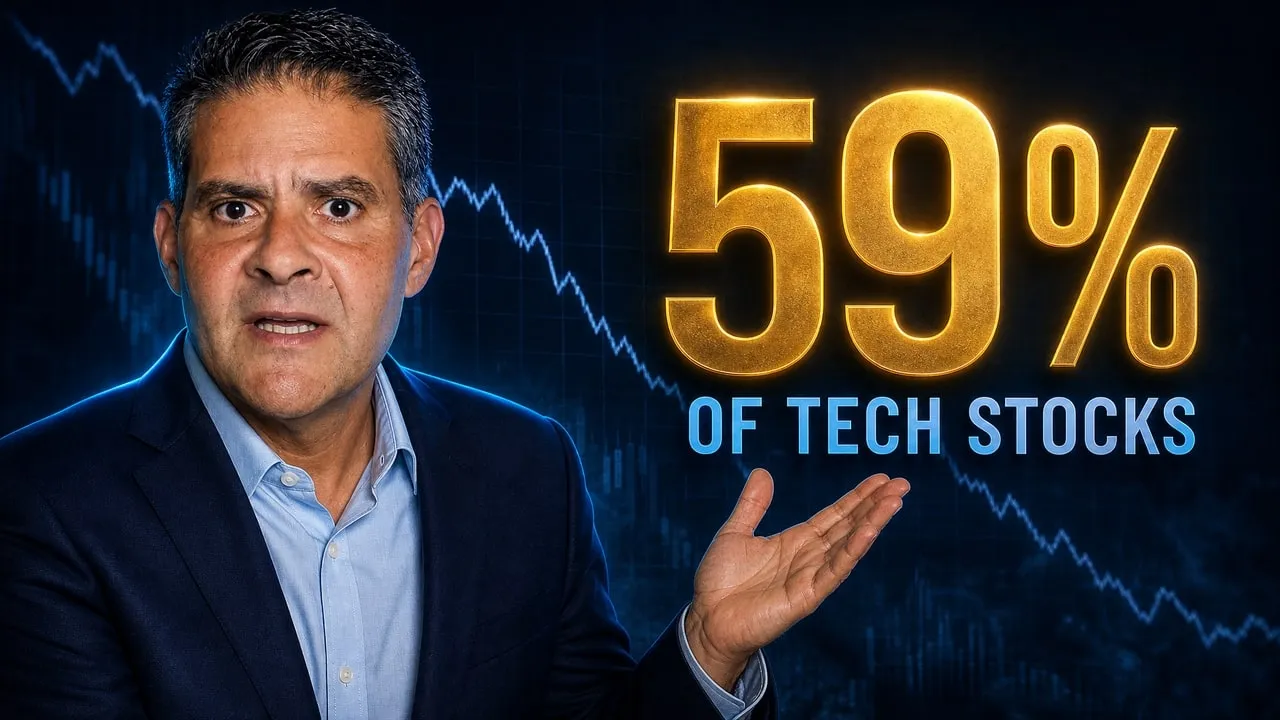
Over Half Of Tech Stocks Are Already in a Bear Market

- Rendement de la vidéo
- +30,05%
- Appels
- 1
- Achat / Vente
- 1 0
- Publié
Recommandations
L'entrée est le cours de clôture de l'actif à la date de publication. Le cours actuel est la dernière clôture enregistrée.
-
Entrée $384,36 09 juil 2026Actuel $502,97 07 août 2026Résultat +$118,61
Look Microsoft. What is it? $380 a share. Microsoft, it's at least worth $500 a share, at the very, very least.
Transcription Complète
Good morning. This is Dylan Jovine with Behind the Markets. Happy Thursday. Today is Thursday, July 9th, and you know something? Read a great little report out from Turning Point Market Research that says, basically, points out over half of all tech stocks are already in a bear market. I didn't know that. That was very interesting. You can feel it, though. We can feel it, though. It said 59% of S&P 500 tech stocks are now trading at least 20% below their 252-day highs, which is very, very interesting. Very, very interesting. Very high share of that, and it matches kind of a similar surge or similar breakdown in market leaders that we saw last year during, gosh, it's been over a year ago, a so-called Liberation Day, the tariffs. It's interesting. Interestingly, the S&P 500 information technology index has dropped 8.4% since June. So you know, look, we see in the tech sector breadth, especially with the chips sell-off, we talked about it a couple of days ago, basically, the chip sector had become 20% chips, 20% of the S&P 500, which as I told you before, in my career, when one sector like that doubles its share of the S&P 500, basically it's a serious warning sign. It's a warning sign. It's a sell signal. And I remember very famously in 2006, 2007, right before the market crash, banks had so many outsized profits from writing all those mortgages that their share of the S&P 500 was around 20%. And you knew that, that was not normal in an economy that grows at 2% to 3% a year. A financial sector really, you know, it became distorted as a percentage of the S&P 500 on a valuation basis. The same thing here with the chips and the memory stocks and all these other things. People forget. They have short memories. They forget Micron has been very cyclical over the years. They forget it's a small competitor compared to Samsung and SK from Korea. They also tend to forget that we're having a lot of companies that are so attracted to the high prices in the US stock market that they are listing shares really, really quickly so they can take advantage of these high prices, this insatiable demand that people have. Think about it. In the past, you know, 60 days, putting aside SpaceX, which certainly took advantage of these high prices, but Elon Musk is a phenomenon all to himself. But, you know, taking aside SpaceX completely, AOL went public. Remember AOL, America Online? The dial-up service? That went public again under the name of another company. So that went public. That's amazing to me. These guys bought this also-ran kind of rump of a business and brought it public. That's how expensive the market is, which is crazy. So you have a lot of companies looking to really take advantage. SK Hynix, which is South Korea, basically the largest, them, Samsung, and Micron are the largest memory companies. Micron's kind of a 7% share company, a runt. But, you know, SK saw what was happening to Micron, South Korean company, they said, "Well, heck, we want to sell stock in America." And they just did an offering to bring their company. They want to get some of this upside. Everybody gets to sell stock and raise money at very, very, very good prices for the company. We call that cheap capital. They're taking advantage of what has become, certainly has bubble-like characteristics. Now, I have said to you that the bear market won't start really until the Mag Seven and these hyperscalers stop spending all this money. And right now, that hasn't happened yet. But the minute that happens, obviously I'll be telling you, these guys start spending. But here's the good news. The good news is that we're starting to see some buys. That things are starting to look cheap. They're not in the super sweet spot, but they're getting there. I'm starting to nibble a little bit. Look Microsoft. What is it? $380 a share. Microsoft, it's at least worth $500 a share, at the very, very least. If you look at their three main business units, cloud, software, personal computing, this should be worth at least $3.5 to $3.8 trillion, which is about $500 a share. Just their, you know, production and business processes unit has 60% operating margins. Intelligent cloud has 40% operating margins. Personal computing has 30% operating margins. This is a crazy good business. This is a business that basically prints money. It's just terrific. You're looking at these things and you see this. So I personally think, the headline for me is, sell off in these big stocks is very, very healthy. As I talked about the other day, this trade is kind of crowded. It's way over. Obviously, that's why we've been selling the past few weeks and really just locking in these profits while they were still buying left in there. That's why we've been taking profits and really just kind of lock in on our gains and, you know, waiting for this. And you know, what will happen is these will sell off and we'll get back into some of them again. And because a lot of them are great companies, right? A lot of them are fabulous companies. But for right now we have some great opportunities in the energy sector, great opportunities in geothermal. We're very, very well-positioned that we're talking about, that we're gonna be bringing to you very, very soon here, and that we have been bringing to you. So I feel like we positioned ourselves mostly for this. We still have a little bit more work to do, but we'll guide you through this. Just like those of you who've been around since we started this company in 2018, and certainly those of you who followed me around this business for twenty some odd years already know that bear market sell-offs get me very excited, because you get to buy things cheap. I think of it like a great thing on sale. And remember something, we know our four steps to profit from a market crash, market sell-off. Number one is sell your most speculative stocks. Number two is push that extra money that you get into money market mutual funds like Vanguard Money Market Mutual Fund. Number three is write up a shopping list of companies that you really love that were always too expensive for you. And number four is get ready to pounce, because, you know, we'll see an opportunity to pounce. Pull out the playbook. This is what the playbook is designed for. Sharpen those knives. It's like getting a sale at your favorite store. If you just found out your favorite store, let's say it's a home goods store, or I wouldn't say supermarket, but a home goods store, something that you like but a little out of price, you found out that everything was going 25% to 50% off, you might get a little excited. So I wouldn't call this quite a July 4th sale, but it's the kind of sale I'm starting to lick my chops for. Anyway, that's all I have for you today. Have a wonderful day. I'll see you tomorrow.
Commentaires 0
Connectez-vous pour rejoindre la discussion.
Se connecterAucun commentaire pour l'instant. Soyez le premier à partager votre avis !