Why The Market’s Not Reacting To The Biggest Earnings

- Rendement de la vidéo
- +8,05%
- Appels
- 3
- Achat / Vente
- 1 2
- Publié
Recommandations
L'entrée est le cours de clôture de l'actif à la date de publication. Le cours actuel est la dernière clôture enregistrée.
-
Entrée $1 815,27 15 juil 2026Actuel $1 704,37 06 août 2026Résultat +$110,90
I've recently done some trims of ASML that I'll touch on a little bit later.
Contexte Now, to go into this, I first want to start off by looking at the reaction... So, this one's a big one. I've recently done some trims of ASML that I'll touch on a little bit later.
-
Entrée $1 815,27 15 juil 2026Actuel $1 704,37 06 août 2026Résultat +$110,90
I did another trim around 1750, so around the price it trades today.
-
Entrée $190,16 15 juil 2026Actuel $209,16 06 août 2026Résultat +$19,00
That trim 30 days ago I put half of the money into DoorDash.
Transcription Complète
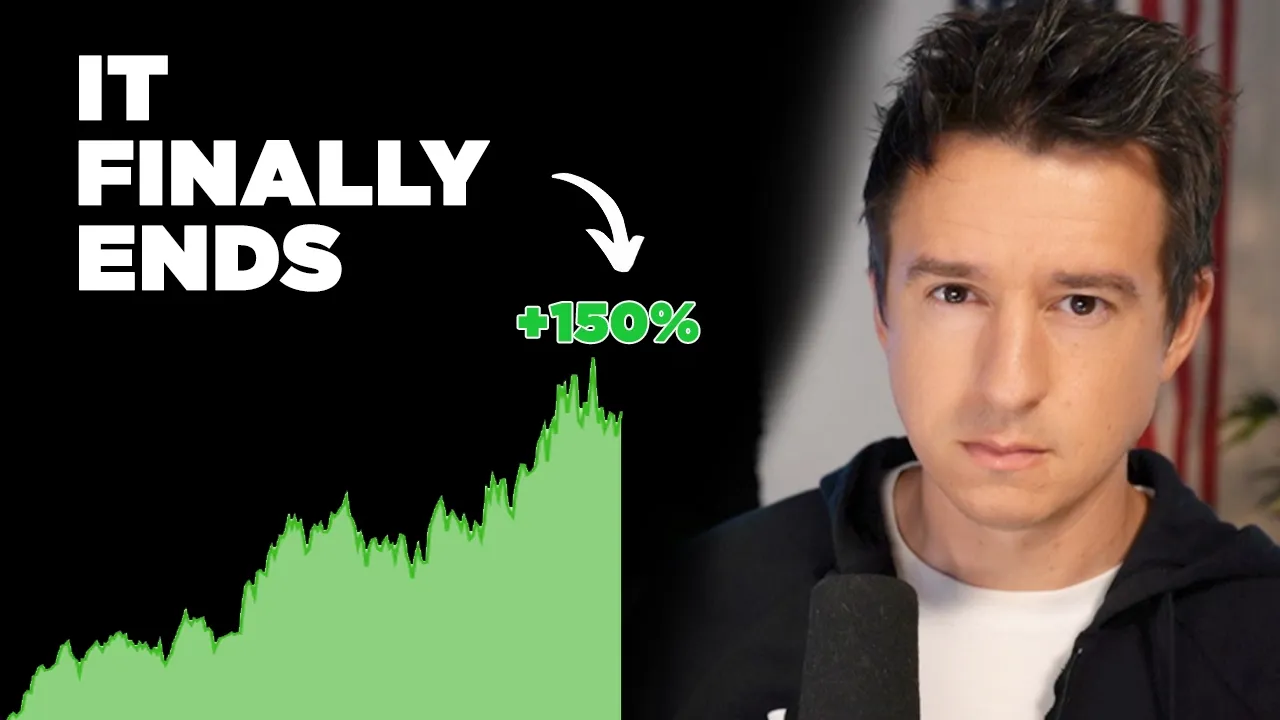
Welcome back everyone. Today on the Joseph Carlson Show, ASML crushes their earnings. This wasn't a typical beat and raise. This was blowout earnings. Numbers that were some of the the best numbers, the best earnings report that I've ever seen. It was far above analyst expectations, and they're making multi-year plans, raising guidance, increasing volume. This was incredible. The stock is flat, and we're going to discuss it. The banks are doing great, and we have other companies that are up to bat. Tomorrow we have Netflix. This one feels a little dicey. Don't you feel a little nervous going into Netflix's earnings report? A little bit of trepidation if you're an investor in this company. After all, Netflix stock has been known to fly up or down 10 to 20% in a single day. We've seen it happen multiple times. I'll give you some final thoughts going into this one. Then we have my portfolio. My portfolio is up to an all-time high today. We're finally back in the green year-to-date. We've had strong momentum over the past month, and we'll be looking at my portfolio, seeing which of these stocks are trading which direction over the past 30 days. Plus, we have some news to get to. For example, Warren Buffett was the one that said he bought Google at Berkshire. It wasn't management. And then in today's episode, we have a two-for-one fail of the week. The first fail of the week is that Kalshi is trying to get it approved to bet on planes being delayed. This is one of the worst ideas that I've ever heard. It should be completely illegal. The government shouldn't entertain this for a second. And then the second fail of the week, which is completely different, is that New York City is excitedly banning data center development. looking at why these are both horrible ideas in the fail of the week. So, we have a ton to get to in this episode, and if you haven't already, check out qualtrim.com. See why 13,000 other people are actively using this. It has charts and graphs, as well as an entire exclusive video library. There's so much additional content here. There's so many long-format shows. We have ask me anythings. We have deep dives in the companies, long-format portfolio updates, and much more. All of this is available risk-free with a free trial at qualtrics.com. Now, we start things off by looking at ASML's earnings report. This is a company that I followed for some time. I have it in the portfolio. It's grown into a rather large position. $126,000 total position, $93,000 in gains. So, this one's a big one. I've recently done some trims of ASML that I'll touch on a little bit later. But, to go into this, I first want to start off by looking at the reaction. When you look at ASML today, it looks like just another day. In fact, it's extremely mundane. There's nothing going on with the stock. It is up half a percent. So, at first glance, it seems misleading. Like nothing just happened. But, in reality, ASML just released one of the best earnings reports that I've ever seen. They crushed on revenue. They crushed on earnings per share. And they didn't just beat and raise guidance, they raised guidance substantially on a multi-year basis. The CEO says, quote, "Our second quarter total net sales were 9.3 billion and gross margins came in at 54% both above guidance primarily by higher than expected install base management sales." ASML has the advantage of having almost every machine that they've ever sold throughout the last 20 years still being used today. So, everything that they sell, it's always being used, but it always needs management. That is the install base management that he's referring to. It's frequent that they want to upgrade these machines, they want to maintain them, they want to put in new features in them to make them a little bit better and more modern. And ASML had an immense amount of install base management. Many updates and upgrades, many things that needed to be fixed this quarter. Many investments in these older machines. So, this install base management is part of the reason I love ASML is you have the big lumpy sales up front, the $400 million when they sell a machine, but then when you have it sold, they still need to be managed, they still need to be updated all the time, which creates this reoccurring revenue stream. It's not quite a subscription, but in some cases it's actually better than a subscription. Subscriptions can be easily canceled. Well, you can't easily cancel an ASML machine. They're a critical piece of infrastructure, so it's like this continual revenue stream that can't be canceled. It's a very attractive situation. Now we get to the most important sentence here. Based on this momentum, we are planning to add 30% to our 2026 low NA EUV capacity of around 65 for 20 27. And we are investigating to increase capacity with another 30% for 2028. Similarly, we plan to add 30% to our 2026 DUV immersive capacity of around 130 for 2027. And we are investigating to increase capacity with another 30% in 2028. In addition, we are continuing to significantly expand and upgrade our portfolio. This isn't like just they beat on the quarter. This is them saying we have so much continued demand. We have so much visibility in the future. We are increasing our supply, our capacity by 30% for multiple machines years into the future. So if you're an ASML shareholder, you can rest assured that you still own one of the best companies in the world, and it's only getting better. The fundamentals are growing like crazy. What may be confusing is if you own the stock, you look at those earnings reports, and then you're expecting the stock to move up meaningfully, but you check it and it's not even up 1%. All of that, everything ASML's doing, couldn't get this stock to budge at all. And I think that that's going to confuse a number of people because again, it's just when you see that good of a report, you think it's going to move up. But to add some context here, this is what I've been saying for some time. I have been saying for weeks now that I believe that the momentum in these semiconductor stocks is getting rather thin. I believe that investors have already priced in a lot of the growth. It smells a situation where that cliche phrase price to perfection probably applies here. The company is practically speaking a perfect company. It has an indisputable moat. It has a monopoly on its product and it's super profitable and it's growing fast. It's harder to find a better company by the numbers. But when you look at this perfect company, it is being priced to a level of perfection. Right here we have it at a 46 or 44 forward PE. Even on next year's estimates it's at a 38. Now, with this big raise, this will come down a little bit. So it'll appear a little bit cheaper. But what we can see here is that ASML is being priced with high expectations. Year-to-date the stock is up 50%. So what are investors expecting here? The stock did just continue rocketing up 50% every couple of months without end? Is that how stocks work? They don't go to the skies. They don't go up forever, especially when it's been priced in so much in advance of these earnings. When I look at a lot of the market behavior today, investors are acting like momentum never ends. Like it just goes up forever for every stock that's doing well. And that's not the case. Investors price these companies based on the fundamentals. And in most cases they try to price ahead of the fundamentals. That's what we've seen with the ASML. Over the past year or so, ASML is up 130% plus. Now, this is something where it's not surprising to me. I said in my last episode that I think ASML will do fantastic fundamentally speaking. I think TSM will do the same. That's already known and most investors are expecting that. But even so, I've been trimming my position. Here's an example of a trim. I did this one at $1,918. So, [snorts] ASML trades at 1785. I did another trim around 1750, so around the price it trades today. That trim 30 days ago I put half of the money into DoorDash. From that point, roughly a month ago, DoorDash is up 15% while ASML is now down 6%. So, this has been a profitable trim so far. The stock that I bought that was at a lower valuation, it's come [snorts] up a bit. ASML has fizzled out a little bit. And what we see overall in my portfolio in the past month is that momentum is shifting. A lot of the semiconductor stocks that have been the big ones to rally this year, the Micron Technologies, the ASML, TSMC, all these companies, they've given up a lot of gains over the past month. Investors seem to be souring on those stocks or at least becoming more skeptical to some degree. And their attention has shifted to other companies. In my portfolio, over the past 30 days, DoorDash is up 15%, Texas Roadhouse is up 15%, we have Meta up 13%, Moody's is up 12%, S&P Global is up 10%, Mastercard is up 10%, Amazon is up 3%, and Duolingo is up 3%. And the reason I mention this is not to focus on short-term time frames. I don't really care about just the past month, but I believe there is something broader going on here. I think that this could be the first indication that investors are starting to look outside of semiconductors, outside of energy companies, outside of whatever goes into a data center. That has been the trade that has dominated for the past year to 2 years, and I believe that investors are starting to expand their horizons. A lot of the companies that have been left behind, the quality durable growth companies with huge distribution, have up until now traded at reasonable valuations. And if we see more of this, where these companies post incredible earnings and the stocks are flat, and in the meantime other companies in the market are meaningfully moving up, that shows a trend shift. When we look throughout this week at other semiconductor companies, primarily TSMC, we already know that the earnings are going to be good. They're going to be extremely good. The question for investors is whether or not that's already represented in the stock price, whether or not momentum has gotten ahead of these earnings. The earnings have to be so good, so wildly above investors maximum expectations that they are better than perfect. It can happen. Nvidia has done that before, so maybe TSM, maybe the memory companies can do it this quarter, but I think it's becoming less likely. In most cases what I see is that these type of companies are starting to be priced in and investors are now looking other directions. One company right now that has a significant amount of bearishness, a lot of skepticism, continues to be Netflix. This one has been beaten down, down 50% from the highs, trading at around [snorts] $70 per share. What I'll be looking for with Netflix is how management addresses the issue that's engagement. First of all, how they interpret the issue. The market likes to put spins on different issues, in some cases they're not really issues at all. For example, [snorts] when Netflix is doing the password crackdown, everybody thought it was going to be a big disaster. YouTubers made videos mocking it. They said it was going to be the downfall of Netflix. There was so much complaint on Twitter and on X. Everybody said they're canceling Netflix because of the password crackdown. In reality, management said, "We've We've tested it. It's working. It's going to work really well." Management was correct. So, a lot of times management has a better understanding of the issues with their company than outside investors, especially ones that are heavily motivated to portray in different ways. So, I'll be looking at how the management themselves view the engagement issue and then also how they plan on addressing it. If their plan makes sense, if they see a real problem with engagement, they will outline it and have a plan to address the issue. And going into Netflix's earnings report, I also have to just mention that this is a volatile stock. It'll be up 7% or down 7%, maybe even more. I've held Netflix through multiple 20% changes in a single day. It's dropped twice, 20% in a day. It made back all of those losses over time. It wasn't nearly as bad as investors had thought, but it was enough to shake out investors like Bill Ackman. He even got out of the stock because it was such a volatile unpredictable stock. So, if you're invested in Netflix, make sure you're wearing a seatbelt. It's going to be a bumpy ride. Overall, I still think it's a fantastic company, very reasonable price today. I look forward to the earnings. The other stock that I'll briefly mention on is the big banks exemplified by JP Morgan, the biggest bank in the world. And the earnings were really good. As expected, when you look at a bank, there's a basic way to do analysis on them. A bank is as good as who they're lending money to. Right now, the US consumer and the US economy, wealth management, the stock market trading, all of that is extremely strong, very versatile, very healthy today. There's no reason that JP Morgan should be struggling as a bank during this time point in the economy. Now, moving on, we get to some big news today. If you're a Google shareholder, which I am, it's my largest position, then it may be meaningful to know that when Berkshire bought Google, most people assumed it was new management because Warren Buffett was retiring or he had retired already. So, they thought, "Wow, new management got to work really fast and they bought Google. They added it to the portfolio." And when it's new management that's not Buffett buying Google, it just has a different ring. It doesn't really feel the same. You don't really have the same validation as Buffett himself buying a big tech company. We know the only real big tech company that Buffett meaningfully bought was Apple. It was a wildly successful investment. So, if Buffett was the one who had bought the $10 billion worth of Google, that would have been far more meaningful. Well, it turns out that he was. In an interview just today, he says that was his decision. >> In fact, just last month, it added $10 billion as part of a private stock purchase of those Alphabet shares. Now, there's been a lot of speculation as to who decided to to purchase those shares with many pointing to the stake as a sign of how Greg Abel will be putting his mark on the Berkshire portfolio. I asked Buffett whose idea it was to buy the tech giant. >> I initiated it. But I mean I I normally wouldn't give you that answer on something like that, but I would >> He said, I initiated it. I initiated the purchase. >> Getting back to um Alphabet or Google, uh it's probably number five or six. >> Well, I thought it was number three if you consider uh the $10 billion private placement that would go along with that because that would put it north of $31 billion. >> Yeah, but we we we've got we've got the Burlington Northern Railroad which is certainly worth far more money than >> Okay, so you're you're counting fully owned companies as well. >> no, I mean >> He says it's holding number five or six depending on whether or not you include their privately owned assets and it makes more sense to include those. It's part of the Berkshire portfolio. But regardless, the reason that this is meaningful is simply because Buffett's the one that did it. I don't think this changes the picture for most investors. Most of us have been in Google for some time. It's a great company. We've owned it for years, but it is cool to see Buffett join along and recognize and validate how good of a company it is and how good of an investment it is looking forward. Now finally we get to the fail of the week which in this case I have two to highlight. So this is a two-for-one and we start things off with Kalshi which makes a frequent appearance on the fail of the week. Now in most cases it's because Kalshi is a gambling app that's turning everything in society. And we have to bet on everything nowadays. You see their ads everywhere and that's generally just not great for society. It's not a great development. But in this case it's very specific. Kalshi today just filed to make it so that an individual can bet on an airport and the number of flights or the percentage of flights that will be delayed. They want to make it so that people can bet on how many flights will be delayed in an airport. Now, just at first glance on this, you can most likely see why this is a terrible idea. See, there's something where you create bad incentives. When you manufacture bad incentives, that's called perverse incentives. It's something that you don't want to do. For example, an insurance company will not let you take out an insurance policy on your neighbor. You can't say, "Hey, I want to insure my neighbor for $5 million." Why would they not allow you to do that? Because it makes an incentive for your neighbor to die. You can't have your neighbor die and then you get paid as a result. That is a bad incentive. You can't even insure a spouse for a ridiculous amount of money. You can never go to State Farm and say, "Hey, I want to insure my spouse for $100 million." Why would they not allow you to do that? Even if you could afford the premium for that insurance, it would create a bad incentive. It would make it so that you get wealthy if this thing happens, if they disappeared. So, there's there's rules about perverse incentives, about creating rules where they create bad incentive structures. And we have that throughout society. But here we have Kalshi making it so people can profit and gamble on the percentage of flights being delayed. This makes it so people could easily manufacture the correct outcome by intentionally delaying flights. This makes it so that employees get could get paid at airports by not doing their job, not correctly making it so that flights come in on time or leave on time. They could bet on not as many flights going out on time, and then they could manufacture the outcome themselves while betting on it. A a lot of people are doing this already in sports where that's very difficult, but now we're expanding this to where they can do it for flights. This is a type of thing where you know if this gets passed, you know if this type of thing gets passed and it becomes law, more flights are going to be delayed. You're going to see that happen. People will bet that a certain percentage will be delayed. They'll know that they have to delay five or six flights in an airport to meet that percentage. To get that money, they're going to do everything they can to delay flights. You can have unruly passengers make it so that the flight is delayed. You can call in anonymous things to try to delay a flight. You can have employees that intentionally make things run slower. There's lots of ways to do it and people are creative when they have a financial motive. So, this is another terrible type of impact that Cal she's having on our lives, on people that even want nothing to do with it. They want nothing to do with Cal she themselves, you're still going to be impacted as well. You're going to have your flight delayed as well, even if you don't use Cal she. And the reason that you don't hear this called out more frequently by podcasters, by news stations, by everyone is because all of them are getting paid by Cal she. Cal she seemingly sponsors everyone everywhere in the United States, therefore making it almost impossible to hear valid criticisms of their product. Everyone has a motive to not criticize the person sponsoring them. Now, moving on to fail of the week, number two in this case, we have New York City, home of scaring away billionaires by calling them out directly and saying you're going to tax all the billionaires more. Home of making your city the most unfriendly business center in the world to the benefit of Miami. Also home of rent freezes and now home of the nation's first statewide temporary ban on new data centers. New York City proudly announced that they're banning data center creation for a full year while they figure things out. Here's their statement on it. >> Which is why as your governor, I don't still want New York to be first. I want New York to be first in the right way. And that's why we're going to take the time to get it right. That is my commitment to the people of the great state of New York. >> And then to add some insult to injury, immediately following a data center ban, she uses the technology from data centers to generate an image of her with red laser eyes. Now, I can't blame all of this on New York City. After all, the biggest promoters of AI like Dario and Sam himself have basically said that AI's terrible when it's not. They said that it's going to kill jobs when it's not, and they've misdescribed the product many times to their own detriment. So, some of this is because of the sentiment that they've created, but regardless, a lot of this comes down to basic misunderstanding. For one, the whole idea that data centers use a ton of water is completely wrong. Maybe old data centers do, but the new more modern ones are fan cooled or they're completely insular with their water, meaning they actually use a very small amount of water proportionate to the land that they take up. In fact, almost every alternative, both residential and especially agricultural, use dramatically more water per acre of land than data centers. Most people still believe this is the complete opposite. So, a lot of this is messaging today. But as New York continues to ban businesses, scare away Amazon, make it so there's no data centers, it's to the benefit of other states. There will be a lot of states that benefit from having data centers in them with enormous amounts of tax revenue and new jobs created. It seems overall what's happening here is good policy being abandoned in favor of whatever is popular on TikTok. It's as though the popular trends on TikTok are literally what's writing laws in certain states, and we see that with New York City. So, those are the fail of the weeks. That's all for this episode. Hope you enjoyed. See you in the next one.
Commentaires 0
Connectez-vous pour rejoindre la discussion.
Se connecterAucun commentaire pour l'instant. Soyez le premier à partager votre avis !