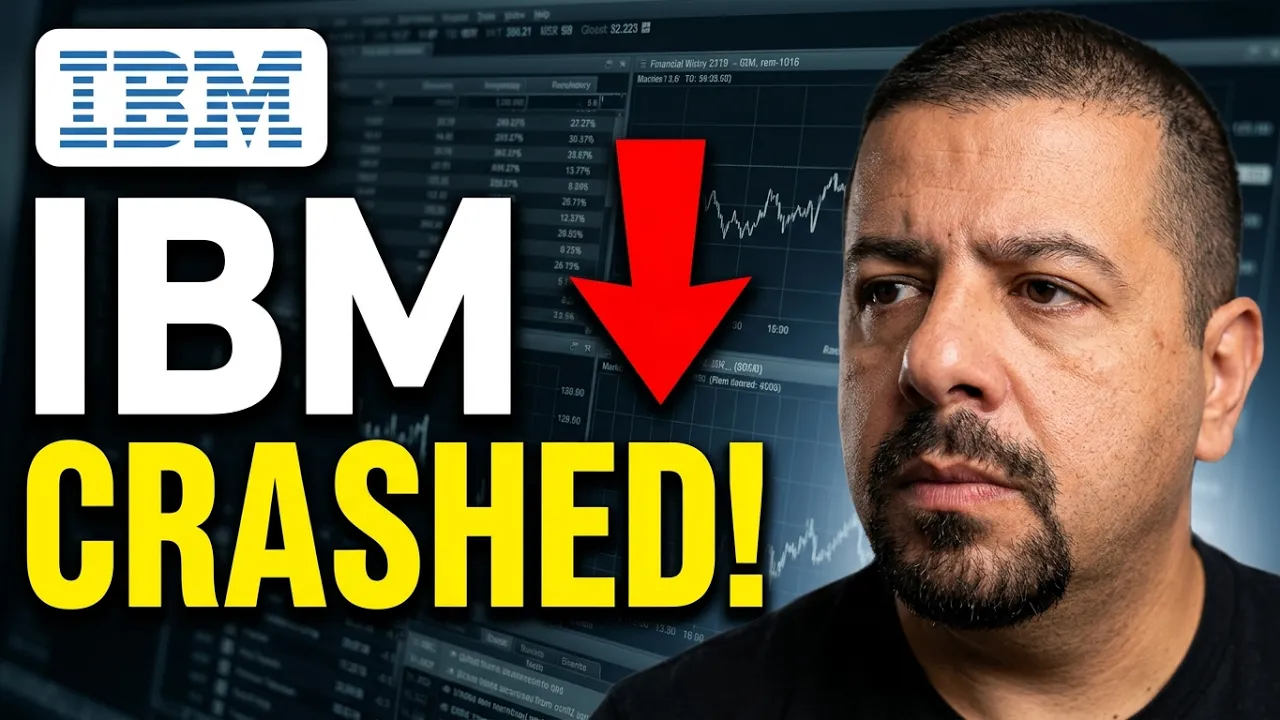
Why is IBM Stock Crashing, and is it a Generational Buying Opportunity?

- Rendement de la vidéo
- +10,58%
- Appels
- 3
- Achat / Vente
- 3 0
- Publié
Recommandations
L'entrée est le cours de clôture de l'actif à la date de publication. Le cours actuel est la dernière clôture enregistrée.
-
Entrée $211,20 15 juil 2026Actuel $234,77 07 août 2026Résultat +$23,57
I've had IBM stock rated as a buy and I last updated that recommendation a couple of months ago.
-
Entrée $211,20 15 juil 2026Actuel $234,77 07 août 2026Résultat +$23,57
I would say right now IBM stock is barely a buying opportunity, just barely a buying opportunity.
-
Entrée $211,20 15 juil 2026Actuel $234,77 07 août 2026Résultat +$23,57
So, even if you're interested in buying IBM stock on the dip, I would be cautious. I would actually wait until the company reports their quarterly financial results and we get more information before jumping in here and buying on the dip
Transcription Complète
We got some massive news for IBM stock investors that are sending the stock price down almost 25% on the day as the company warned investors that growth in the upcoming quarter is going to be much slower than expected. So, let's take a look at the details of this announcement from IBM and I'll answer if I think this is a buying opportunity for investors. I want to thank The Motley Fool for sponsoring this video. Visit fool.com/parkev for the 10 best stocks to buy now. You can see the price action here for IBM stock down over $71 per share to 218. That makes it down over 24% on the day. Of course, I'm disappointed in this news because I've had IBM stock rated as a buy and I last updated that recommendation a couple of months ago. So, here's the news that sent the stock price crashing on July 14th. The company updated their forecast for the second quarter, which they now suggest they're expecting revenue of 17.2 billion, which would represent 1% year-over-year growth. Of course, this figure is lower than what the company had previously forecasted back in April when they reported to investors that they expected a 5% growth for the full year and 5% growth for the upcoming quarter. So, this begs the question when IBM updates their quarterly financial results completely, when they hold their conference call, will they revise their outlook for the full year instead of growing 5%, will they revise that outlook to just 1% growth or even less than that? You can see here the guidance for the full year in 2026. IBM maintains its guidance for constant currency revenue growth of 5% or more and free cash flow growth of approximately $1 billion year-over-year. They also highlighted during that conference call that for the second quarter, they expect constant currency revenue growth is expected to be similar to the full year with approximately 50 basis points of operating pre-tax margin expansion. So, they went from forecasting for at least 5% growth in the upcoming quarter to just 1% growth. Thankfully, they still expect the pre-tax operating margin to expand by roughly 50 basis points. To be more precise, they're forecasting the pre-tax margin to be up 30 basis points. So, they're revising that lower, but that's only a 20 basis points decrease in the margin expansion compared to the revenue expectation, which is revised lower by a much more significant margin. So, these are huge revisions downward, and you can understand why the stock price is down as much as it is. Plus, this comes between quarterly financial results. So, the management team felt that the results were so much worse than expected that they needed to update investors ahead of time before their scheduled quarterly financial update. So, I like that at the very least the management team took the time to explain why and what is causing the shortfall. The CEO saying, "What played out during the quarter was much worse than our expectations driven by a short shortfall in our Z performance and the associated software stack primarily in transaction processing. In the last few weeks of June, we saw clients shift their quarterly CapEx spend towards servers, storage, and memory purchases to secure supply constrained infrastructure ahead of expected price increases. This dynamic impacted client buying patterns. Wow, that's a lot to unpack there. So, let's go through it one at a time. First of all, what makes this situation worse is that it's getting worse in the last month of the quarter. Sometimes companies will have a bad month in the beginning of the quarter and then things will improve. And so, investors can feel more reassured that, "Okay, things are getting better." But in this case, the worsening of expectations, the worsening of results happened in the last few weeks of June, which is the last month in their second quarter. So, you have January, February, March for the first quarter, then you have April, May, June for the second quarter. And their results got much worse in the last few weeks of June, meaning what's happening in July, right? Is the situation still going downward? Those are the questions investors will be asking and they won't be answered until the company officially reports their second quarter results and it holds a conference call with Wall Street analysts. And so, the big stock price sell-off is partly attributed to what they already reported and what investors are expecting is going on right now in the month of July. Another interesting moment here, another interesting comment is their customers are shifting their capital expenditure towards physical AI. They're buying servers, storage, and memory. So, they're building out their own infrastructure, their own capabilities rather than purchasing software from IBM. And I think this has broader implications. Of course, this is good news for companies like Micron and Nvidia and AI providers. Dell Technologies comes to mind, building of and supplying those data centers. But it's bad news for software companies. And I'm sure this is going to fuel some of the concerns and reinvigorate that SaaS apocalypse narrative that investors were so fearful of earlier this year. Of course, IBM is just one company and this is just a few weeks of data and the this in of itself doesn't indicate that this is what the whole industry is doing. But, investors were already hyper sensitive to this narrative and for IBM to come out and basically uh reinvigorate that narrative and and put more fuel on that fire, that's concerning to be sure. So, this dynamic is impacting client buying patterns. So, very interesting to see this and uh the company reporting these results ahead of time. So, let's look at IBM specifically. It's now trading at a forward price to earnings of 17.5. This is the cheapest it's been in a couple of years now. IBM's stock hasn't been this cheap. This is uh the biggest one-day drop in IBM share price, I think ever. I'm reading the news reports. I don't think IBM stock price has fallen by this magnitude in its history. So, this is big news and it does go to highlight the concerns. If this was just a one-quarter miss or if this was just something short-term in nature, the stock price wouldn't be falling by as much as it is. But, this is reinvigorating that fear that IBM's business will be significantly negatively impacted from AI sh- uh permanently. Permanently, not just temporarily. That's what the market is pricing in here with these developments, with this news. So, I revised my discounted cash flow valuation model for IBM. I revised lower by several billion dollars, about 3 billion dollars annually for 2026 and forward because of these developments. And I revised the risk of IBM higher. The beta I adjusted above where it actually is trading at because I see IBM as a greater risk over the next 5 years than it was over the previous 5 years. So, I adjusted the risk profile higher. And after these adjustments, the fair value per share dropped. Previously, I had the fair value calculated at above $320 per share. It dropped to about $243 per share. Uh about 25% drop. Uh along the lines of the price drop here. So, I would say the price drop is justified according to the details, the financial details that IBM reported, and the increasing risk of these developments. But, it's still above the current market price of $218 per share. So, it still looks undervalued based on the figures that I'm noticing here, but the risk is much greater than before. I would say right now IBM stock is barely a buying opportunity, just barely a buying opportunity. I almost downgraded IBM stock to a hold. That's how significantly negative this news was. And I'll be waiting to hear from IBM in their upcoming quarterly financial update. And that could reveal a lot more information. And then I'll feel more comfortable making an update to this buy or hold rating with IBM stock once I have more information to go on. But, it almost warranted an upgrade. So, even if you're interested in buying IBM stock on the dip, I would be cautious. I would actually wait until the company reports their quarterly financial results and we get more information before jumping in here and buying on the dip and I would be okay if I miss out on it if the stock price jumps back up and recovers by the time they report and I miss out. I would be okay with missing out because there's so much concern here, so much that could change for the business in the brief time that they report these preliminary results and when they report their actual results.
Commentaires 0
Connectez-vous pour rejoindre la discussion.
Se connecterAucun commentaire pour l'instant. Soyez le premier à partager votre avis !