you kind of want to stay away from your large super banks that are doing a lot of Wall Street deals right now, specifically around AI.
Contexte
“Goldman Sachs maybe even JP Morgan, Bank of America, City, whatever. ... you kind of want to stay away from your large super banks that are doing a lot of Wall Street deals right now, specifically around AI.”
you kind of want to stay away from your large super banks that are doing a lot of Wall Street deals right now, specifically around AI.
Contexte
“Goldman Sachs maybe even JP Morgan, Bank of America, City, whatever. ... you kind of want to stay away from your large super banks that are doing a lot of Wall Street deals right now, specifically around AI.”
you kind of want to stay away from your large super banks that are doing a lot of Wall Street deals right now, specifically around AI.
Contexte
“Goldman Sachs maybe even JP Morgan, Bank of America, City, whatever. ... you kind of want to stay away from your large super banks that are doing a lot of Wall Street deals right now, specifically around AI.”
a Goldman Sachs is probably not going to do as well as a regional bank over the next year.
Transcription Complète
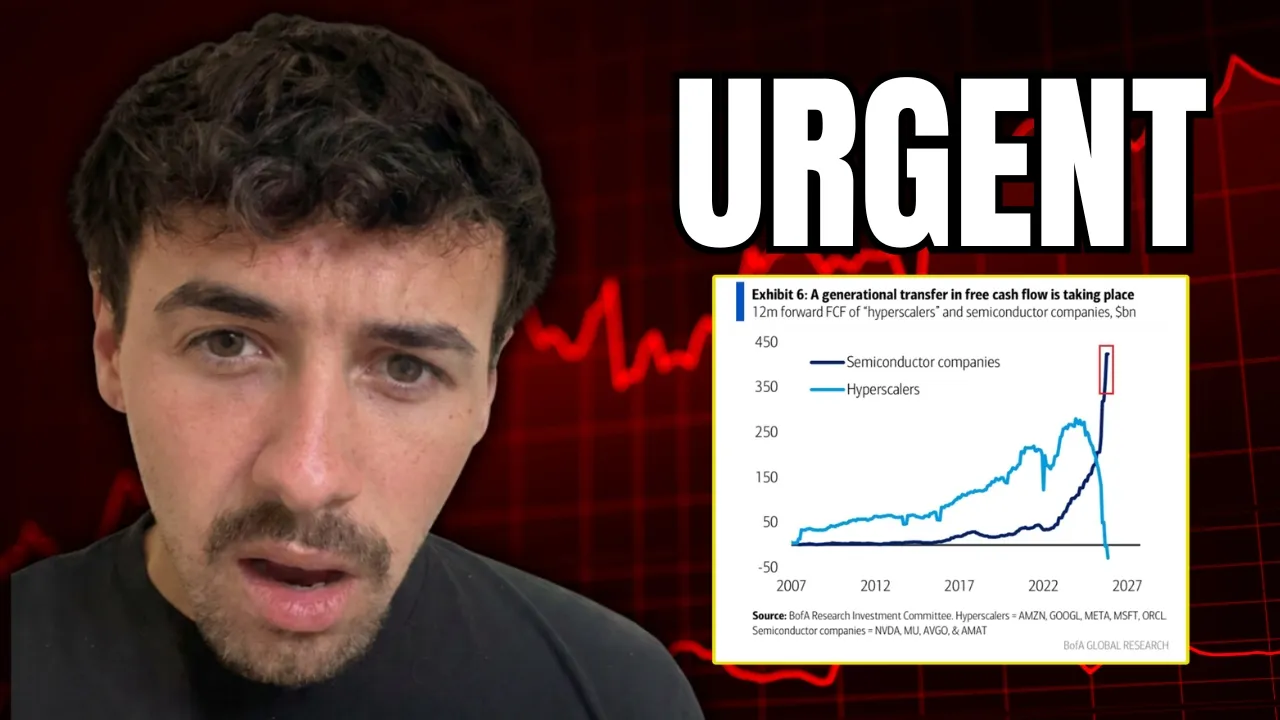
AI stocks basically collapsed today. And we have a huge catalyst for AI stocks tomorrow morning, which is TS earnings. We're going to talk about that in today's episode, but I really want to start off this video with providing you guys some high-level [ __ ] okay? 95% of Wall Street, they don't understand what I'm about to explain to you. And it's the only thing that actually matters when you're investing. Nothing else matters. And look at the age demographics on this channel. Odds are if you're watching this video, you are between 35 and 65 years old. Let me help you accelerate your wealth creation journey. So, let me start here with the only thing that really matters ever in the stock market. This is high-level game that about 95% of Wall Street does not understand or actively implement into their investing journey. And this is how I'm able to find stocks that are, you know, 10x plus winners in a short amount of time. You know, it's because of this. Let me explain this as simply as I possibly can. It gets really in-depth, but just stick with me, okay? The only thing that actually matters are three sentences, if you will. Expectations, what do you think will happen, and what actually happens. So, the only thing that really matters is expectations and what happens. Let me put this into an example for you. If investors are expecting Coca-Cola or any stock for that matter, but let's say Coca-Cola, to give you $2 of EPS next year or this year, it doesn't matter. And Coca-Cola comes in at $10 of EPS, you're going to make a lot of money on that because expectations were low and the company really delivered. Well, if you want to find big winners, you got to look at it from this perspective. You got to say, "Okay, Coca-Cola's expecting $2 of EPS. I think Coca-Cola will do $8 of EPS. There's a big difference between that. If I'm correct and Coca-Cola does $8 of EPS, I'm going to make a lot of money because I am way higher than where Wall Street is, right? And then that's the question. What do you think will happen and then what actually happens? So, that's the recipe to making a [ __ ] ton of money in the stock market. This is the recipe. This is the secret sauce to finding 10x stocks. And you don't always have to look 10 years out to do this. The only thing that matters is what are expectations by Wall Street and what happens. And then ultimately somewhere in the middle hopefully is what you think will happen. Now, I I could also make the analogy here. I could say, "Wall Street's expecting $2 of EPS for Coke for EPS for Coca-Cola next year. I think Coca-Cola will do $12 of EPS, but they actually do $10 of EPS. It doesn't matter even if I'm wrong on my super bullish expectation. As long as Coca-Cola beat expectations by a large degree, I'm still going to make a lot of money. So, really expectations versus what actually happens. Now, let's talk about AI stocks. What's priced in? What are the expectations for AI stocks? Well, it's it's for about 1.3 trillion in capex. I think you're only going to get about 900 billion in capex for next year. So, there's 400 billion dollars of a difference there. It doesn't mean AI stocks are going to zero. It just means that you have to reprice things, right? You have to price in, bring consensus lower because the numbers are going to be lower. And look, that's my expectation. I think about 900 billion in CapEx next year it's, you know, is pretty appropriate. You're expecting about 700 billion in CapEx for this year. That would be a deceleration as far as the growth, but it's for a very good reason. So, number one, first things first, once Wall Street starts or begins to sell hyperscalers for spending more, the clock is ticking towards the ending. Let me explain this. This happened in 1999 and early 2000, but mainly like you had Cisco. That was like the pickaxe and shovels kind of company for the internet. Well, all of the telecoms, the companies that were buying Cisco products, their stocks actually peaked in early 1999. Cisco continued to go higher, but as Wall Street began to punish the companies for spending more and buying more of Cisco's products, their stocks came down. It was the the the the clock was ticking at that point for spending it to stop, right? Executives at companies, they always listen to Wall Street. Every single time. Sometimes, if you're like a Mark Zuckerberg in 2022, you're willing to, you know, watch your stock drop 80%. And that was because of Reality Labs, right? But other companies in 2022, everyone else at the time was was this is the the year that we're going to be lean. We're going to lay people off. We're going to protect shareholder value and capital, right?" Why? Because the markets demanded it. >> [laughter] >> Okay? Well, when the markets start to demand slower CapEx spending, that is what you're going to get. The question is, how mispriced are we? And that's why AI stocks have come under a lot of pressure recently. But really what it comes down to is the CapEx cycle. There are two areas where the compute is going to go. Like all of these hyperscalers building data centers. There's two reasons. One is mass enterprise AI adoption, things like AI agents and tools and things like that. A lot of compute demand is going to come from that area. Number two is robotics. So, if we're thinking about the timeline here, mass enterprise adoption doesn't happen until 2028 through 2030. And robotics are going to be even later than that. So, massive compute demands from enterprises, they're not even coming until a year and a half from now. We can get into the the the reasons for this, but a big one is governance, security, and data problems. So, a lot of sectors have governance and security issues, and they don't really trust AI, and we got to work through some of that. But the biggest problem is 90% of companies' data is in data silos, unstructured, meaning like audio files are sitting next to text files. And AI can't do anything with that because it's unstructured. So, that's why companies like Snowflake and Datadog are seeing a lot of demand right now is because, you know, companies are trying to restructure their data to actually use AI. What we've seen in the past 6 months is a rapid rise of experimenting with AI. So, that's why like Claude Code and Codex and Cursor have seen a lot of demand recently is because it's not because enterprises are actively adopting AI into thousands of different workflows in their company. They are experimenting to see what AI can do. And that experimentation, I think was really good. I think it went well. I think companies realized the opportunity with AI, but they're not at a place where they can adopt AI to handle important tasks. We're just not there from a security, compliance, or data perspective. And I think the data perspective is probably the biggest bottleneck at this point. And you guys can also see this image here of free cash flow generation from the hyperscalers in light blue and semiconductors in dark blue. This is completely flip-flopped. So, it's no wonder why people have been running away from hyperscalers for a long time. It's because their fundamentals have been deteriorating, right? They're spending all of their money, going into debt, issuing stock to pay for free to pay for capex. That's coming to an end. Wall Street is slowly starting to figure this out. That's why AI stocks have been falling recently and hyperscalers have been rising. Especially on a day like today, it was very obvious, you know, Google Amazon Meta Microsoft Apple all of these companies went higher. And your major AI stocks were down a lot. So, in conclusion here, AI stocks need and will be repriced in the next couple of months. And we're already seeing the start of that. And And look, like big money, they Some of them already know what is coming. So, don't be shocked when this happens. We've already seen the stocks begin to do this. Big money already knows exactly what's happening. They just have insider information. They get ahead of the ball before everyone else. I've been talking about this long before Wall Street has. But, if this is your first time hearing this, well, consider subscribing to the channel so you can have a heads-up next time. You know, long long before the [ __ ] hits the fan, I will tell you about it, okay? But, this also comes at a time in which you tend to get seasonal midterm election volatility. So, you do tend to get this volatility that really begins late July and heads till about early October or so. Um which lining up with what's happening with AI stocks and the repricing that we're going to see, you could have a run-of-the-mill correction over the next 8 weeks or so. Don't be shocked if that happens. But, what is actually more important to remember is from, you know, October, whenever we bottomed from this run-of-the-mill correction, potentially, you tend to go on like a 9-month vertical rally. And I see a lot of positive things lining up, as I've said, you know, before on this channel, that could really exacerbate this, right? The war with Iran ending. There was good news out today that maybe Russia wants to make a deal with Ukraine. Maybe that ends. That's going to be really good for oil. That's going to be really good for inflation. By the end of this year, Kevin Warsh's task forces are going to be completed, and you're going to have inflation coming down. You're going to have treasury yields coming down. Again, oil coming down. Inflation's not going to be a problem. I believe the consumer can be stronger if rates come down and all of those things happen, real estate's going to pick up. People are going to have a lot more money in their bank accounts if if they're if they're able to finally sell their home. That's going to boost the economy and spur spending. I will also mention that in the near term here, you have the highest um earnings expectations for a quarter since Q3 of 2021. So, it's been 4 years since we've had earnings expectations this high. You can see that Wall Street is expecting 22% EPS growth year-over-year for for this upcoming quarter. Again, the the the highest you've seen since Q3 of 2021. I do think we're going to smash these numbers, but even if we come in at like 30%, it is a slowdown in the percentage beat, right? Because last quarter we were expecting 12% earnings growth, came in at 27%. That was a more than double. To do something similar this time around, you would need EPS to grow at like 45%. I don't think that's going to happen. So, even at 30% it's going to be a disappointment. And you're probably going to get more sell-the-news reactions this earnings than we've seen in a while. Now, this all sounds like bad news depending on what aisle you're you're sitting on here, right? Especially if you're all in AI stocks. I'm just trying to give you guys a little bit of a heads-up um as I have been on this channel for the last couple of weeks. But now you're actually starting to see what I've been saying over the past couple of weeks coming true, coming to life. But I don't want to just give you guys the bad news. I want to give you guys some of the good news as well. The good news is this is healthy for the AI trade. The good news is the capex trade, AI stocks will come back around late next year and they will be the talk of the town again as capex likely needs to reaccelerate for mass enterprise AI adoption and robotics that's hopefully, you know, getting ramped up next year. We'll see what Tesla, you know, how how Tesla captures that opportunity. But between now and then, uh you're going to see a rotation into other areas of the markets. And if you can identify this first before everyone else, you're going to make a lot of money. So, what's going to happen? As AI stocks reprice lower, again, mhm, this ain't a bubble popping kind of a moment. This is a repricing. This is normal. Whenever people are, you know, having FOMO over a certain group of stocks, it's never a good time to buy them. We should know this, you should know this, everyone should know this. You don't want to chase hype, no matter how good it sounds. Why? Because expectations go way further, most of the time, than what actually happens. But what happens as this rotation out of AI stocks takes place? Number one, hyperscalers catch a bid. So, maybe it's time to own Microsoft. Maybe it's time to own Meta. It depends. Some companies might raise CapEx and come down on earnings. Some are going to cut CapEx and go up on earnings, right? So, you do want to be uh you know, specific in the stocks that you're picking. But number two, software is going to catch a bid. I think software is the bridge to enterprise AI adoption. There's too much risk in partnering directly with a large language model. We've seen them replicate other companies' businesses, like Figma and OpenAI stealing IP from Apple. There's too much of a risk. Companies are going to get their AI, their AI agents and their AI marketing and their AI this and that, workflow management, from existing software companies. So, there's a layer of protection there. Right? Biggest opportunity we've ever seen in our lifetime is in software. Because of, again, as I said at the start of this video, the the the where Wall Street's expecting and what we're actually going to get the the gap there is crazy big. I've really never seen anything like it. Um and number three, cyclicals, non-AI industrials, and non-AI financials. These are going to be big winners. Now, what does What do I mean by that? Well, a Goldman Sachs is probably not going to do as well as a regional bank over the next year. Because Goldman Sachs maybe even JP Morgan, Bank of America, City, whatever. A lot of these banks, they're they've seen this boom from underwriting AI investments, underwriting, you know, AI debt and lending. If that slows down, you know, banks are going to do well. Again, if oil comes down, consumer gets stronger, problems kind of go away in the broader markets, uh because the consumer's getting stronger. These are middle America banks, regional banks, smaller banks. You kind of want to stay away from your large super banks that are doing a lot of Wall Street deals right now, specifically around AI. So, I don't think the markets are are actually going to have a problem. I think the markets are going to go higher as we reprice AI stocks. But some people that are all in on AI stocks, if you're watching this video, you're going to get burned. You're going to get burned. You're going to have to sit on dead positions for a while. Look, don't be mad at the messenger here. I've been talking about this for weeks, and you're finally seeing it happening in the past week or two. It's time to wake up. It's time to see the sunshine on this one. Okay? Expectations are too high, and they are being repriced. It happens every time there's FOMO, and no matter what sector it is. In 2017, it was cannabis. Yeah, can you believe that? Cannabis was the the FOMO hype sector. What happened to those cannabis stocks? Wasn't great. Okay? Um smokeless tobacco, right? There was a bit of a FOMO phase around that as well. Alcohol, look at uh Boston Beer Is it Sam's? Okay, I just want to point this out for you guys. Um Maybe they went. Boston Beer, look at this one. And uh look at the FOMO around this one at one point in time. Yeah. Look at that. Look at that, dude. It was a $1,300 stock back in 2021. It's $171 today. You never want to chase FOMO. Don't fool yourself. It's FOMO. People are chasing it, okay? So, this is normal, this is healthy. You're going to see other areas begin to take the baton and to lead and to do better. That's what you want to be positioning for right now. And I just gave you the secret sauce. Hyperscalers, software, cyclicals, non-AI industrials, and non-AI financials. Let me know your thoughts on this down below in the comments section. Hit the like button as well as subscribe to the channel if you guys have not done so already. If you guys want to see the stocks that we are actively buying right now, how we have been able to outperform the S&P by 4x this year so far. I think it's going to get more dramatic the end of this year and next year. I think it's going to be a crazy good year for us. That link is down below in the description of today's episode. Have a fantastic rest of your day, and I will see you in the next one.

Commentaires 0
Connectez-vous pour rejoindre la discussion.
Se connecterAucun commentaire pour l'instant. Soyez le premier à partager votre avis !