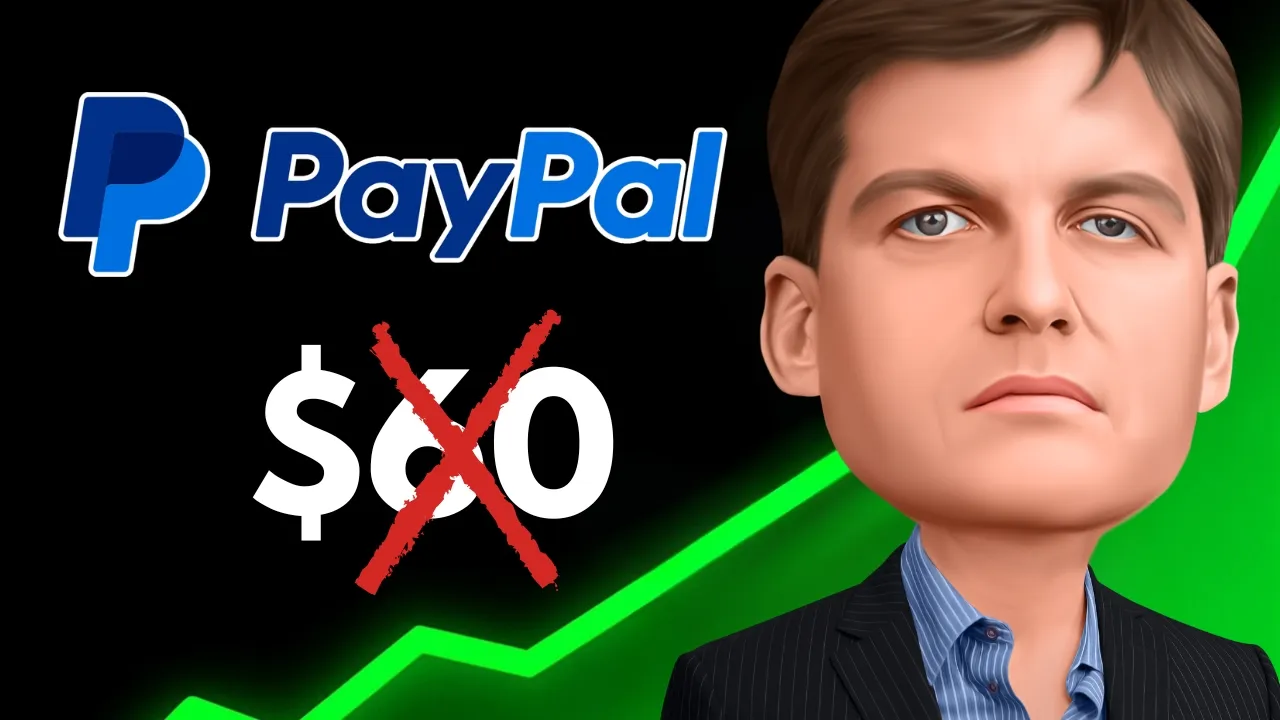
Michael Burry Has NEVER Been This Angry About a Stock. Here's Why

- Rendement de la vidéo
- +5,38%
- Appels
- 1
- Achat / Vente
- 1 0
- Publié
Recommandations
L'entrée est le cours de clôture de l'actif à la date de publication. Le cours actuel est la dernière clôture enregistrée.
-
Entrée $56,73 16 juil 2026Actuel $59,89 07 août 2026Résultat +$3,16
that's why I think this company is a screaming deal at this point from my standpoint.
Contexte “I agree with them because the current return in the next 10 years based on my assumptions above if they play out is about 21 a.5% on my middle assumptions. ... That's why I think this company is a screaming deal at this point from my standpoint.”
Transcription Complète
If you own PayPal, especially if you bought it under $60 a share, you need to hear this. The stock just skyrocketed 14% in a single day because someone wants to buy the whole company. But is the offer a gift or is it a steal? Today, we have three bull cases, three bare cases, and then we're going to run the numbers and find out what PayPal is really worth to determine if someone's just trying to steal the company at a good price. So before we get into the bull case and the bear case, let's talk about the bombshell that dropped last night. Stripe, one of PayPal's biggest competitors, and a private equity firm called Advent International, have reportedly made an offer to buy PayPal for $60.50 a share. That would value the entire company at more than $53 billion. Stripe and Advent each would own 50%. And this isn't just talk. The deal reportedly has about $50 billion in committed bank financing behind it. This is a real offer with real money. Now, the stock popped 14% in the news. Sounds great, right? But let's zoom out a little bit because that pop still leaves PayPal in a rough spot. The stock is down 25% from where it was one year ago and so far from its all-time high of $310 per share set back in 2021 during the pandemic when interest rates were near zero and everything in fintech was flying. That means if you bought PayPal anywhere near those highs, this stock has been absolutely painful. So why has PayPal been beaten down so badly? one word, competition. And not from one direction, from everywhere. Apple Pay is baked into every phone. Block, the company behind Square and Cash App, is taking share. A firm and CLA are gobbling up the buy now pay later space. And here's the ironic part. Stripe, the company that's now trying to buy PayPal, is one of the competitor that's been eating PayPal's business for years. The payment space went from PayPal being the clear king to PayPal being one of many. And the market absolutely punished the stock for it. Now, here's where it gets interesting. Michael Bur, yep, the guy from the big short, one of the most famous investors alive, actually owns PayPal stock. And with this offer came out, he said, "The bid is too low." His exact words were, "I believe the bid will have to rise. the company is well below intrinsic value and any successful bid should be well above intrinsic value to account for the control premium. In plain English, he's saying PayPal is worth far more than $60 a share. And if somebody wants the whole thing to control it all, they should have to pay a premium on top of that. That way, they get full control and not have to answer to other people. So now, every PayPal shareholder has the same question. Is $60.50 50 cents a fair price or is Stripe trying to grab this company on the cheap while it's beaten down? That's exactly what we're here to figure out. So, let's get into the bull cases. If you own the stock, you need to understand exactly what the optimists are seeing. Bull case number one, PayPal is extremely absurdly cheap for what it actually is. This is the simplest bullcase and it might be the most powerful. PayPal's trading at around seven or eight times earnings. Guys, let that sink in. That is a valuation you you usually see on a business that's going nowhere or declining. A company that's shrinking, dying, has no future. But PayPal is none of those. The perception might be that, but the numbers show different. It's highly profitable. It generates a lot of free cash flow. It's still one of the biggest payment networks on the planet. The bulls say that the market is pricing PayPal like it's a broken business, but the numbers say otherwise. And here's where it gets really interesting. That legendary investor, Michael Bur saw exactly this. He built a full position in PayPal at an average cost of about $49 a share. His thesis was simple. PayPal's network is so massive and so deeply embedded in online commerce that it's incredibly hard to displace. And at this valuation, it was only a matter of time before private equity or a strategic buyer came knocking. And guess what? That's exactly what just happened. Stripe and Advent showed up with their $53 billion offer. Bur called it before it happened. But here's the thing. Even though that offer gives him about a 22% gain on his cost basis, he is refusing to sell. He publicly said that $60 is simply way too low. He believes that PayPal's true intrinsic value is somewhere between 75 and $115 a share and that a realistic winning bid should be closer to 100. Now, that's a very wide range, but as you've seen and you will see in our stock analyzer tool, when you make assumptions, low, middle, and high assumptions, it can be a wide range. Bullcase number two, the buybacks and the cost cuts are quietly transforming the business. So, while everyone is focused on the stock going down, PayPal's management has been doing something really smart with all that free cash flow that they generate. They're buying back billions of dollars of their own stock every single year. Remember, when a company buys back its own shares, it decreases the numbers of shares outstanding. So, your slice of the company gets bigger and bigger and bigger without you doing a single thing. PayPal has been aggressively shrinking that share count and it's driving that earnings per share higher and higher even when the revenue growth is modest. On top of that, management has been cutting costs hard, simplifying the organization, streamlining operations, and using AI internally to get far more efficient. They've deployed Chat GPT Enterprise across their 24,000 employees and they're using AI coding tools to help their engineers build much faster. The Bulls say that this is a company that's getting leaner, more profitable, and more shareholder friendly every single quarter, and the price hasn't caught up yet. Bull case number three, the Open AI partnership could open up a whole new way that people pay for things. This one is forward-looking, but it's a big deal. PayPal signed a major strategic partnership with OpenAI to embed its digital wallet directly inside Chat GPT. Think about what that means. Millions of people are already using Chat GPT to research products, compare options, and get recommendations. Now, imagine you're chatting with AI. It finds exactly what you want, and you can buy it right there. Instant checkout powered by PayPal without ever leaving the conversation. PayPal is connecting its tens of millions of small business and retail brand product cataloges straight into chat GPT commerce. The bulls call this agentic commerce. The idea that AI agents will eventually handle shopping for you and PayPal is positioning itself to the be the payment rail that those agents will use. If that future plays out even partially, it gives PayPal a growth engine that nobody is pricing into the stock right now. So that's the bull case. PayPal is dirt cheap for what it actually earns. The buybacks and cost cuts are making the business better every single quarter. And the open AI partnership could give it a whole new growth story. And Michael Bur bet on exactly this setup. It has played out and he's still saying the price is too low. If the bulls are right, this stock has a lot of room to run. And guys, I didn't even mention Venmo. Now, let's flip it. I got to give you the bare cases because if you're going to own PayPal or if you're sitting on shares wondering whether to take this buyout offer, you need to know what could go wrong. You absolutely have to understand both sides of the same coin. So, bare case number one, PayPal's core business, that checkout button, is slowly losing ground. This is the one that keeps the bears up at night. For years, that PayPal button at checkout was the default. You saw it everywhere. It was the easy trusted way to pay online. But that dominance is eroding. Apple Pay has cut into PayPal and is becoming the preferred way to check out online. And it's not hard to see why. You just glance at your phone, Face ID confirms it's you, and you're done. No password, no redirect, no extra steps. Google Pay is doing something similar. Shopify has built its own payment system. And then you've got the buy now pay later wave. Clara and a firm are aggressively pulling younger shoppers away from the traditional checkout flow entirely. This is not a sudden collapse. It's a slow bleed. And slow bleeds are dangerous because by the time most people notice a lot of damage is already done. Barecase number two. PayPal is processing more money but keeping less of it. And that's a problem. This one is sneaky because it hides behind a number that looks good on the surface. PayPal's total payment volume, which is the total amount of money that flows through its system, keeps growing. Sounds great, right? Here's the catch. A big chunk of that growth is coming from a part of the business called Brainree. Braintree is PayPal's unbranded payment processing arm. It's the behindthescenes plumbing that big companies use to accept payments. And the problem is Brainree is a low margin, highly competitive, commoditized business. Think of it this way. The branded PayPal button, the one that you actually see and click, that's the high margin, premium business. That's where PayPal makes the real money every single transaction. But Brainree, it's a price war. Everyone's competing on pennies. So PayPal is processing more dollars, but keeping less profit on each one. The bears say this is like a restaurant that doubles its customers, but only by selling everything at half price. The top line can look impressive, but the bottom line tells a different story. That's exactly why our fifth tenant of principal driven investing is that even a great business and story at the wrong price will become a bad investment. And our third bare case, the revolving door at the top has shaken confidence and delayed the turnaround. This one is about execution risk and it's a big deal. PayPal brought in Alex Chris as CEO to turn the company around. Wall Street gave him a chance, but the board wasn't happy with the pace of progress and they pulled the plug, removed him, and brought in Enrique Lores to start over. Think about what that means. Every time you swap out a CEO, you get a new strategy, a new reorganization, a new set of priorities, and new forward guidance. The clock resets, products get delayed, employees get distracted, and Wall Street loses patience. The bears say that PayPal has been in turnaround mode for years now. And the turnaround keeps getting restarted. That's not a turnaround. That's a company that can't figure out what it wants to be. And when a company is going through that kind of internal upheaval, it makes you wonder, even if the stock is cheap, is it cheap for a reason? The bears worry that a real operational recovery is still years away and that the buyout offer from Stripe might actually be the best outcome shareholders can hope for. So, who's right, the Bulls or the Bears? Now, guys, before we dive in, I want to remind you, do not take the title and thumbnail literally. We are never here to give you a stock tip. We're here to teach a process so that one day you can apply that process to all your investments and you're going to sleep better at night because you know how to value a stock. You know how to make good assumptions about its future and you understand the price you're paying. So, we've heard both sides here. Now, let's run the numbers and that's exactly what we're going to do. Now, the first order of business, this is the price of the company. It's not the stock price, it's the market cap. The stock price just represents the market cap divided by number of shares outstanding. Now free cash flow 5 a.5 billion last year 5.2 billion a year for the last 5 years. So it's marginally higher and I like the fact that their free cash flow is greater than their net income. So they're selling for 9.3 times free cash flow and that's after the 15% increase today. So it was actually below eight at one point. 10 times earnings, high returns on capital and getting better, it seems, which is a great quality metric for a business. Very good quality metric. Now, 10-year profit margin 14.17, 5year, 13.5, one year, 15. So, the question is, are they growing their profit margin just from cutting costs? Maybe that's something to consider here, like the bears say that they're just cutting costs and that's it. Could very well be the case. But I like the fact that their revenue is still growing. 6.3% a year with higher margin over the last three years, 8% for the last five, 13% a year for the last 10. So it's that these numbers show that it's not as bad as people think. I like the fact that revenue still grown in the last 3 years and profit margin has still gone up. That's a positive right here. Okay, let's go check out our eight pillars. All right. So guys, cash flow is down over the last 5 years and so is net income by pretty much equal amounts. The rest is a check mark. So it lends credence to the idea that they're making less money on higher revenue. Get that completely. But remember, if I offered you PayPal for $1, not $1 per share, $1 total, would you take it? Of course you would. You make your money back in a millisecond. Would you pay a trillion dollars for PayPal? Well, of course not. So, what we're trying to do here is realize that somewhere in the middle, it becomes a very good investment. No matter what the story is. Now, guys, I have thrown a lot at you here so far. If it feels overwhelming, trust me when I say this, you're not alone. Every great investor, every good investor at some point felt overwhelmed. I'm asking, how much do you want to understand this? Do you want to barrel through that wall and become somebody knowledgeable? Because guess what? It's not as hard as you think. I am here and I've built this channel for exactly the reason of teaching people that investing isn't as hard to understand the numbers. It's more of the emotional side we have to get to. So, I have made this very easy. I created an absolutely free key metrics PDF that'll explain all these metrics to you. All you have to do click the link in the description below or in the first pin comment and you'll be able to download it in a matter of seconds. And in a few minutes, we're going to go over what the right price to pay for PayPal is. Now guys, I want to remind everybody out there, I'm a PayPal shareholder, but never own a stock because I or anybody else owns it. But I will tell you when we run the stock analyzer tool, you got to stick around because I want to give my opinion on what I think about the company. So analyst estimates, they have 540 per share this year going to 917. That's a lot of growth. Now, it's high d high single digits essentially. and revenue growth, not nothing glamorous, but 35 billion growing to 56 billion over the next seven years. So again, high mid to high single digits, not a grower, but if they can do that profitably, if you pay a cheap enough price, it can be absolutely incredible. So let's go to our stock analyzer tool, and we are pulling up the last time I did PayPal on its stock analyzer. So, first off, I'm doing a 10-year analysis. Next thing we do, revenue growth, guys. I did three, six, and 9% revenue growth for the next 10 years. Nothing huge, nothing small, a nice range. Now, pro free cash flow is higher than profit margin. So, I'm going to focus on free cash flow here. They did 19% a year for the last 10 years, but it's been declining. So, I did 14, 17, and 20. Next, what PE, what price to free cash flow would I assign to this company 10 years from now? Well, guys, the market average over long periods of time is 15 or 16, but you've got to go higher for good companies, lower for bad ones. This one's kind of in between. I could understand going lower for this one. So, that's what I'm going to do here. I'm actually going to make this 14, 16, and 18, which is kind of low. But guys, I look at this saying, yes, they have good returns on capital that seem to get get be getting better, but it's a highly competitive space and I don't think it deserves a premium quite yet, a massive premium quite yet. And then finally, my 9% desired return. Now, you might be wondering why 9%. Well, guys, there's no margin of safety. I'm merely trying to find what I think the intrinsic value, like Michael Bur talked about, on this business is. Now, there's something I have to let you know before we finish stock analyzer in investing. Most people don't fail because they lack information. Information is everywhere. They fail because when the market feels unpredictable and every decision feels like it could be the wrong one, they freeze. And that freezing is anxiety. And it costs you far more than bad trades ever could. And that fear and anxiety that creates costly mistakes. So imagine a world in which you knew the right price to pay for a stock and you're you know that price because it's based on your own assumptions about the future, not someone else's guess. So imagine having eight clear pillars that tell you the story of any business. So you always know the next right question to ask. Imagine a screener that sits quietly in the background and watches the market for you so you can sit back and wait with confidence until the perfect price arrives and the software notifies you so you can take your next step. That's exactly what we've built here at Everything Money. Just like I was demonstrating for you in this video, our community and our software is a place where clarity replaces confusion, where your next step feels far more obvious instead of overwhelming. and where you're never making decisions in isolation. You're going to feel far more confident. You're going to start trusting your instincts because they'll finally be backed by the right tools and the right people inside our community. Guys, growing your money is awesome, but it's not just about growing money. It's about becoming someone who's control of their financial future and able to sleep well knowing they've made good decisions. Here's what I want you to figure out. Is it worth over a dollar a day to you? I assure you it is. So, do yourself a favor. Start a 7-day trial for just $7. Click the link in the description below and get full access today. Run whatever stocks you've been thinking about, even your own assumptions on PayPal, and see what the numbers actually tell you before you spend a single dollar on it. So, I'm going to hit the analyze button here. Boom. I have a low price of 70 or 75, a high price of 160 to 200, a middle price of 106 to 124. Now you see where Bur gets his numbers from. And guys, I agree with them because the current return in the next 10 years based on my assumptions above if they play out is about 21 a.5% on my middle assumptions. So I sit there and say, why would I want a one-year gain of 20% when I can sit there and have it on an annualized basis for the next 10 years? Now, for me, as I showed you guys, I talk about 9% return. I want a 15% return on stocks that I buy, but only because of my personal situation. This does not apply to you. When I hit the analyze button for that, that's why I have a price in 70 to 80 range in the middle. That's why I think this company is a screaming deal at this point from my standpoint. But guys, again, you need to be the kind of person who can go in there and analyze that on your own and determine if your assumptions are correct or not. So guys, I personally agree with Michael Bur. The second I saw this, I I even wrote in our group chat for Everything Money, I said something along the lines of this is garbage. Like this is a terrible deal for PayPal shareholders. But it shows the confidence that Stripe, a competitor that was taking away business, said we want to own PayPal. To me, that validates the business more than people the story has been justifying. But again, I don't think this is a $60 stock. And I'm hoping this bid leads to other bids that come in. And if it doesn't drive the price up further and further, investors will be happy as they see the company play out its thesis in the long run. Remember guys, the deal may not go through. That's why even though the deal is for $60, the stock is still at 54 because there's a chance it doesn't go through. Now, there's one more stock that I want you to see. It's one that investors think could be a bigger opportunity in the market as we speak. So, click this video right here to watch it. Thank you for your time.
Commentaires 0
Connectez-vous pour rejoindre la discussion.
Se connecterAucun commentaire pour l'instant. Soyez le premier à partager votre avis !