
- Rendement de la vidéo
- -1,14%
- Appels
- 2
- Achat / Vente
- 2 0
- Publié
Recommandations
L'entrée est le cours de clôture de l'actif à la date de publication. Le cours actuel est la dernière clôture enregistrée.
-
Entrée $664,54 16 juil 2026Actuel $592,90 07 août 2026Résultat −$71,64
I have chosen to purchase Meta and Amazon in my portfolio instead.
-
Entrée $249,89 16 juil 2026Actuel $276,14 07 août 2026Résultat +$26,25
I have chosen to purchase Meta and Amazon in my portfolio instead.
Transcription Complète
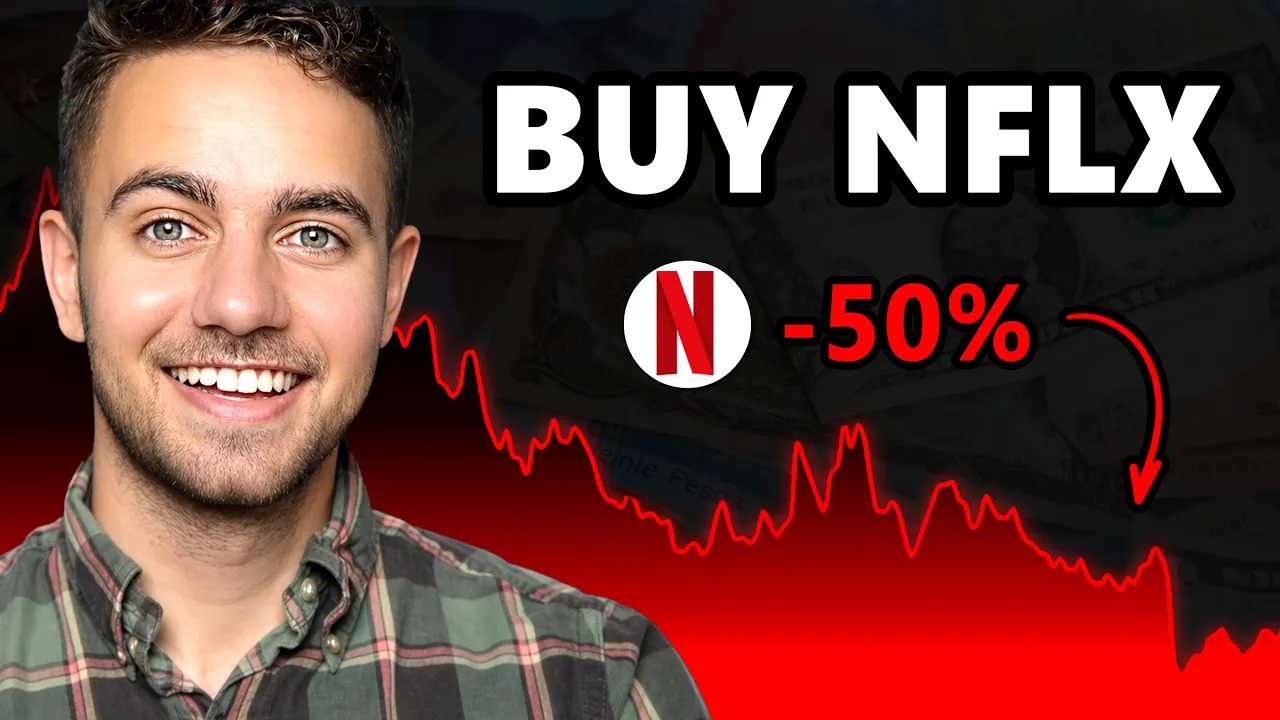
Netflix stock is down roughly 9% in after hours trading after reporting their second quarter earnings results. The stock is also down roughly 50% from its all-time highs that it set in just last year. So, the market does not seem very bullish on Netflix stock right now. And it also seems like investors are not very happy with the earnings report that just came out. In fact, as the conference call has continued on, the stock has also continued to sell off a little bit more. Now, Netflix is not a stock that I own in my portfolio, but a lot of people who watch my channel do own Netflix, and every single quarter, I get asked to cover this stock's earnings. So, in this video, we are going to go through the full Q2 report, and I'm going to show you everything that investors need to know. I'm going to show you the good and the bad as well, as someone who I think is pretty objective, because it really doesn't impact me at all if the stock goes up or down because again, I don't own it. So, with that being said, let's now dive into the Q2 report. And I have a lot of screenshots to show you. All right, so starting from the top here, they said, "Our financial performance remains solid and we're on track to meet our objectives for the year. Q2 revenue grew 13% year-over-year or 12% on an FX neutral basis to 12.6 billion and operating margin was 33%. Both were in line with our guidance. We've narrowed our forecasted revenue range to 51 to 51.4 billion and continue to forecast an operating margin of 31.5%. both consistent with our prior guidance. View hours grew 2% in the first half of 2026 versus 1.5% in 2025 despite the competitive impact of the Winter Olympics and the World Cup this year. Then down at the bottom, they say the entertainment industry remains dynamic and competitive. Now, the next screenshot that I quickly want to show you was Netflix's Q2 forecast from their previous earnings report. And here we can see that they were forecasting revenue growth of 13.5%, an operating margin of 32.6% and earnings per share of 78. Well, now let's take a look at what they actually produced for this quarter. And in this quarter, revenue growth was 13.4% which was basically in line. The operating margin was 33.2% which was actually higher than their previous guidance. and their earnings per share came in at 80 cents, which was 2 cents higher than their guide that they put out. However, free cash flow for this quarter was down roughly $700 million on a year-over-year basis, which is not ideal to see. But overall, just by taking a quick look at the headline numbers, this earnings report honestly looked like it was fine. Again, revenue was right in line with what they were guiding for. the operating margin actually came in higher. Operating income also came in higher and their earnings per share beat their own internal guidance that they put out. So then the question is why is the stock down almost 9% in after hours and what didn't investors and the market like about this earnings report and the answer lies mainly in their guide for the third quarter. So here we can see that for their third quarter forecast they're expecting 11.7% revenue growth, a 33.2% 2% operating margin and 82 cents in earnings per share. Now, why the market does not like this is because you can clearly see that the business is consistently decelerating. Over the past four quarters, revenue growth has decelerated from 17.6% all the way down to 11.7%. And the year-over-year revenue growth rate in the Q3 forecast is down a whole 5.5%. So, it seems like Netflix's business again is starting to decelerate quite a bit. Now, in the last video that I did on Netflix, I was saying that the business is starting to look like a more matured, slower growth company, which is fine. Every business eventually turns into a more slower growth company because companies cannot grow at high double-digit growth rates forever. What investors need to understand though is that when businesses start to decelerate, typically they see multiple compression and their multiples start to come down to reflect the slower growth. And I think that this is really what is starting to happen to Netflix. And I don't think that this company deserves the very high multiples and premiums that it used to trade for. Like even 25 to 30 times earnings for this business now seems like it would be a stretch and potentially overvalued. And I think that again, I just think that's kind of what's happening to this stock now. Now, getting back over to their guidance though, this screenshot shows us that Netflix beat on earnings per share for this quarter, but it actually missed on analyst expectations for revenue, margins, and free cash flow. The guide for next quarter also missed what analysts were expecting across every single metric. And the annual guide is also missing across pretty much every single metric as well. So analysts were expecting a lot more from Netflix for this quarter and especially for their guide for next quarter and the remainder of the year and I do think that this is the main reason why the stock is selling off so much. Netflix also shows us their growth rates across different geographies around the world. And here we can see that every single region that Netflix is in is decelerating and by quite a bit. This obviously is not ideal, especially since the emerging markets are supposed to be the growth engine for the business, and they are now slowing down quite a bit. For example, in Europe, we can see that their year-over-year growth rates are now at 11%, down from about 16% last year. Latin America is at 16% versus 23% last year. And Asia-Pacific is at 18% versus 23% last year. So, their growth rates across the board are down about 5% in every single region. So, this isn't necessarily a United States or North America issue, but it seems like an issue across the entire business. Now, moving back over to their shareholder letter here, they wrote operating income in the second quarter was 4.2 billion, up 11% year-over-year, and the operating margin was 33.4% versus 34.1% in the second quarter of 2025. Q2 operating income and margin were slightly ahead of our forecast due to the timing of expenses and we continue to expect content amortization to grow slower in the second half of the year and to increase roughly 10% for the full year. For Q3, we expect revenue growth of 12% or 11% on an FX neutral basis. We project an operating margin of 33.2% compared to 28.2% a year ago for next quarter. So Netflix is expecting its operating margin to remain high next quarter and to be a whole 5% higher than it was last year. And again, this is because their content amortization expenses are projected to slow down dramatically in the second half of this year, which should expand their margins quite a bit. Then at the bottom, they say, "Our 2026 outlook is consistent with our prior forecast. We are narrowing our forecast to 51 to 51.4 4 billion which represents 12% FX neutral growth and a projected roughly doubling of our ads revenue into approximately $3 billion. Our forecast applies annual operating income growth of 20% plus for 2026. Further on in the shareholder letter they continue to say in Q2 with swapped 137 million views which is loved by our members and on its way to becoming our second most viewed original animated film ever in 2026. We expect live programming to account for just over 5% of our content spend, but only 1% of our view hours. Yet, live event programming accounted for six of the top 10 new member signups over the last 5 years. Our members also watched more than 97 billion hours, up 2% on a year-over-year basis. So, what Netflix is saying in this screenshot is that they launched their second best animated film ever. So, the company seems like it is continuing to put out highquality content. Live programming is also becoming one of the main contributors of overall member signups and payments, which is good to see. However, total member watch time again was only up 2%. I do not think that this is ideal because think about it, if their members grew by 5%, for example, but watch time is only up 2%. Then that would mean that watch time per person is down. But we no longer know about Netflix's membership metrics because they don't report them anymore. So, it's hard to say what's actually going on here. Regardless though, a 2% increase in watch time is not very impressive. I view this as either the memberships are growing slowly or the per person view time is going down. It basically has to be one or the other. And I don't think either is good. Now, this next screenshot from their shareholder letter says, "After today's what we watched report, which covers the first half of 2026, we will shift to publishing this report annually in the first quarter beginning in 2027. The goal of separating the publication of the report from our earnings results is to keep the focus on our primary financial metrics which are revenue and operating profit. So Netflix is going to start reporting this metric once per year instead of twice per year. And this comes after Netflix also stopped reporting its overall members and members growth. In my opinion, the only reason for them to do this is because the numbers are not very impressive. I mean, think about it. Netflix was happy to report subscriber growth for well over a decade, but as soon as it became underwhelming and started to decelerate, then they randomly stopped reporting it. Well, I don't think that was random, and I think that this is just how it works. Now, this next screenshot talks about the cash flows that were down on a year-over-year basis, and Netflix says that this is due to a one-time tax payment from their Warner Bros. deal and the company making a lot of money from the cancellation of that acquisition. They're also repurchasing a lot of shares. In the second quarter, they bought back $4.7 billion worth of stock, which is a good thing to see. But now, let's move on from their earnings report. And I want to share a chart that I have previously shared, which is the different market shares of streaming times of the different major streaming companies. And the ones that I have highlighted in the screenshot are Amazon, Netflix, and YouTube. Now, in January of 2025, Netflix had 8.6% market share, YouTube had 10.8% and Amazon had 3.7%. Then in January of 2026, Netflix gained 0.2% market share to 8.8%. YouTube gained 1.7% market share and Amazon gained 0.4% market share. Now, what this means is that Netflix's streaming market share is growing slightly. However, Amazon and YouTube are actually growing their market shares at an even faster pace. Again, Netflix grew their market share by 0.2%, Amazon was 0.4% and YouTube was a whopping 1 7%. What I'm also noticing from this chart is that YouTube and Amazon held their market share better than Netflix throughout the year as well. And I actually have a chart that I made on Claude showing January 2025 as 0%. And then this shows us how these businesses grew or lost market share throughout the remainder of the year. Again, with January 2025 being set as 0%. And we can see that both Netflix and Amazon saw their respective market shares dip from January to May. And then Amazon started to regain market share and ended the year with a higher percentage of market share gains. Netflix saw the most dips and the lowest amount of market share gains last year in 2025. And YouTube killed it the entire year. They saw their market share continue to grow and they ended the year with the strongest market share growth of 1.7%. So relative to YouTube and Amazon, Netflix saw the weakest amount of market share gains last year and they saw the highest amount of market share losses in certain periods throughout the year. This ultimately suggests to me that this market is becoming very very competitive and Amazon and YouTube are doing a better job getting streaming watchtime in the United States. Now let's quickly head over to Stock Unlock and see what analysts are expecting for some of Netflix's different KPI growth. And here we can see that analysts are expecting revenue to compound their revenue by about 10% all the way out to 2032. However, we can say that the compounded annual growth rate to the revenue is projected to consistently decelerate over the coming years. And I think that this is most likely going to happen because as I said earlier, as businesses continue to grow and expand, it becomes more challenging for them to maintain high growth rates. So now let's take a quick look at Netflix's earnings per share outlook. And here we can see that out to 2032, analysts are expecting them to continue compounding earnings per share by nearly 12%, which is actually pretty dang good. They are expecting the earnings per share growth rates to decelerate consistently over the next 6 years, but still 12% annual earnings per share growth. It is not bad by any means. So now let's run some quick DCFs on Netflix stock to see if it is looking under or overvalued today. So, in this DCF, I'm going to project out over the next 5 years using analyst estimates of about 12.76% annual earnings growth out to 2030 and a 20 price to earnings ratio. This 20 price to earnings ratio, I think, is on the lower end for Netflix's business, but it also does reflect in the business's earnings growth to continue decelerating down to approaching about 11 to 12% by 2030 to 2031. And in this DCF, if Netflix can continue to grow its earnings by 12.76% per year and trade for a 20p, then the stock's fair value would be about $75 per share and it would compound by about 10% annually relative to 75 bucks. Now, I believe it's around $68 in after hours trading right now, which means that the stock could be trading below fair value based on this DCF right here. However, in my opinion, I do think that a 23 to price to earnings ratio would be a lot more fair for Netflix's business. And with a 23p, if they can actually hit annalyst estimates of roughly 13% earnings growth over the next 5 years, then the stock could compound by about 13% annually, and its fair value would be about 85 bucks per share. So, with that being said, I do think that there is a pretty strong argument that Netflix's stock is beginning to look undervalued in the market today. But for myself, I don't think that Netflix stock is the most attractive stock in the market right now, especially when both Meta and Microsoft are still trading for under 20 times forward earnings. Those businesses are both growing faster. They're much more diversified. They have higher growth. And I think that their modes are much, much better. So, while Meta, Microsoft, and even Amazon are, in my opinion, very cheap in the market right now, I don't see any reason why I would own Netflix over those businesses when I think they're much higher quality, growing faster, and offering better prices. For example, if we quickly go load my Meta DCF right here, then we can see that over the next 3 years, if Meta can grow its operating cash flows by at least 15% annually and trade for a 14 price to operating cash flow, which is below how the stock has historically traded, and this growth rate is below what analysts are currently expecting, then the stock could produce a 16.4% compounded annual growth rate, which is significantly higher than Netflix today. And again, I think that these are with some pretty conservative metrics. Now, if we also load my Microsoft DCF right here, well, over the next 3 years in this DCF, I say that they will grow their operating cash flow by about 13% annually, entry trade for 20 times operating cash flow, which again is below their historical averages. And this is well below what analysts are currently guiding for. And even with these metrics, we get a 19% compounded annual growth rate. And again, I believe that both Microsoft and Meta are much higher quality businesses than Netflix. they're growing much more rapidly and their multiples are actually lower right now which means that the future returns could be significantly higher. So when I am comparing Netflix against the available options in the market right now I think that there are a lot better stocks that are higher quality growing faster and offering more future return potential and that's really what it comes down to for myself with Netflix stock. So to wrap up this video let's go through a quick summary of what we discussed and my final thoughts. So, in my opinion, the main issue with Netflix is that the business is consistently decelerating. This is causing the stock to rerate down and to sell for lower multiples. And again, I do not think that Netflix deserves to trade for multiples above 25 or into the 30s anymore. I think that this is a 20p or low 20p business. Now, if its growth rates are going to continue decelerating and the business is going to grow at roughly 10 to 12% per year, that being said, I do believe that the business can still grow by 10% plus for the foreseeable future through slow member growth and annual price increases. This is still a solid business. It's just not one that I think should command super high multiples or a premium anymore. The ads business is growing strong, which is good to see and could provide an additional tailwind for growth over the longer term and potentially even expand the margins even further. Netflix is also holding and gaining slight market share in the US streaming market, which is good to see. But competitors are outperforming and taking more share, which I do not necessarily like to see. This just tells me that Netflix does operate in a fairly competitive market, and its competitors are arguably doing a better job than Netflix is. Overall though, I do think that Netflix is looking fairly too undervalued. Now, if it can continue to grow at double digits and trade for a 20 to 23 price to earnings ratio, which I do think is fair for the company. However, as I said, I do not think that it is more attractive than Meta, Microsoft, and Amazon right now. And I have chosen to purchase Meta and Amazon in my portfolio instead. Meta and Microsoft in specific though are trading for similar forward price to earnings ratios. They're growing faster, they are more diversified, and they have much stronger modes in my opinion. This is why I don't own Netflix relative to what else is available in the market to me today. So, those are my final thoughts and summary of what we discussed in this video. If you did enjoy this video, then please remember to leave a like on it. And if you're new to my channel and you want to see more earnings analysis like this, then please consider subscribing and turning on notifications because I will be covering a lot more stocks and earnings through this earning season. As always, thank you so much for tuning in.
Commentaires 0
Connectez-vous pour rejoindre la discussion.
Se connecterAucun commentaire pour l'instant. Soyez le premier à partager votre avis !