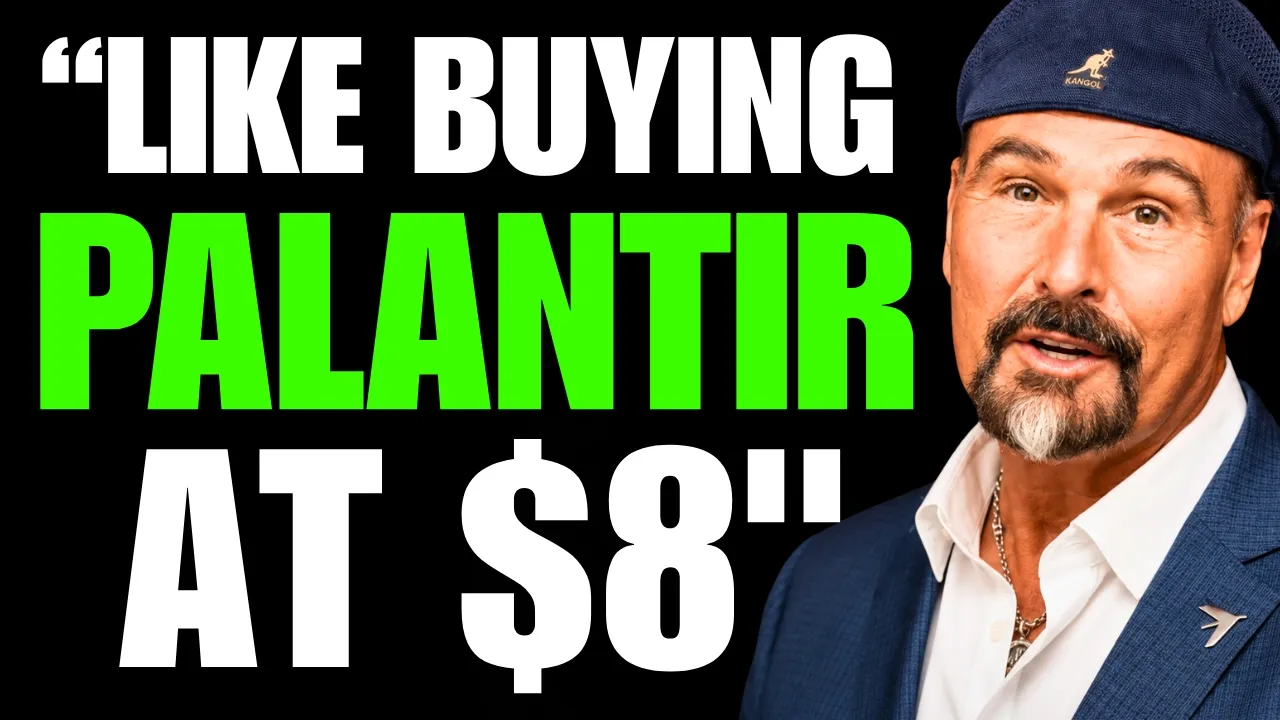
Will This Stock Solve The AI Energy Crisis? (20X Gains?)

- Rendement de la vidéo
- -16,46%
- Appels
- 1
- Achat / Vente
- 0 1
- Publié
Recommandations
L'entrée est le cours de clôture de l'actif à la date de publication. Le cours actuel est la dernière clôture enregistrée.
-
Entrée $67,62 17 juil 2026Actuel $82,19 07 août 2026Résultat −$14,57
I also wouldn't want to bet heavily on a smaller company like Rocket Lab at its current valuation.
Transcription Complète
AI has an energy problem. And Jon Najarian claims in his latest presentation he found the stock that will solve this and that this stock could have a Palantir-like run. He won't reveal the stock unless you pay him, but after watching his hour-long presentation, I was able to figure out that the company is Rocket Lab, ticker RKLB. In this video, I'm going to break down the company, explain why investors are excited about the stock, cover the hidden risks Najarian won't tell you about, and most importantly, tell you whether I think the stock is a buy. But before we do any of that, I'll show you exactly how I figured out the stock. The headline of Najarian's presentation reads, "Beyond SpaceX, Elon's next millionaire maker. The smart money is already positioning for his next $40 trillion wealth wave." The theme of this presentation is one that other stock pickers have discussed. It's the idea that AI is stressing the energy grid too much and that eventually the cheapest and most environmentally friendly way to run data centers will be to put them in space. The idea is that satellites could theoretically use constant solar power while avoiding many of the grid and permitting problems affecting traditional data centers. To support his claim that Elon Musk is planning to build this, Najarian points to an FCC filing outlining plans for a massive constellation of AI-powered satellites. But Najarian is not pitching SpaceX. Instead, he is pitching a smaller company that could supply the rockets, spacecraft, and power systems needed for this buildout. The first clue is the founder. Najarian says the CEO had absolutely no formal aerospace education and started by building rocket engines in his garage. The garage description is dramatized, but the underlying story matches Rocket Lab founder Peter Beck. Beck skipped university and told via satellite, "This is how I started off building engines. I worked on rocket bikes and rocket packs and rocket scooters." So the self-taught founder experimenting with homemade rocket technology is clearly Peter Beck. Najarian then says the company launched 10 rockets in 2023, 16 in 2024, and 21 in 2025. Rocket Lab's own announcements confirm exactly 10 launches in 2023, 16 in 2024, and 21 in 2025 with a 100% mission success rate during the final 2 years. Next, Najarian says the company won a contract worth more than $800 million to build missile tracking satellites. Rocket Lab announced an $816 million Space Development Agency contract to manufacture 18 satellites carrying missile warning and tracking sensors. He also says the company built two spacecraft for NASA and UC Berkeley's Escapade Mars mission. Rocket Lab publicly describes them as the Rocket Lab built twin spacecraft. So, that clue is a direct match. But, the biggest clue connects Rocket Lab directly to the presentation's space data center theme. Najarrian says the company is building rockets, satellites, solar arrays, the full stack. Then, on February 26th, 2026, Rocket Lab announced advanced silicon solar arrays designed specifically to power gigawatt scale space-based data centers. Peter Beck even said, "Space-based data centers are the next frontier in computing infrastructure." So, as you can see, Rocket Lab is clearly the stock being pitched here. We'll get into whether this stock is worth it in 15 seconds. But, before that, I want to remind you to click the link in the description to get my free report on the top 10 stocks to buy and hold forever after you're done watching. This report lists 10 stocks that offer good growth and value and are stocks I believe every investor should buy. All right. So, the stock is Rocket Lab. Here's what they do. Rocket Lab is one of the few publicly traded companies building almost every major part of the space economy. The company is best known for Electron, its 59-ft small launch rocket. Electron can carry up to roughly 300 kg into low Earth orbit and is designed primarily for small satellites. Unlike large rockets that often carry many customers at once, Electron gives satellite operators more control over their launch date and exact destination. Rocket Lab also uses Electron for responsive government missions and is working to recover and reuse parts of the rocket. But, Rocket Lab's future growth could depend heavily on Neutron. Neutron is a much larger reusable rocket designed to carry as much as 13,000 kg into low Earth orbit. That would allow Rocket Lab to launch entire satellite constellations, heavy national security payloads, cargo missions, and spacecraft headed beyond Earth. Its first stage and protective payload fairing are designed to return together for refurbishment and future flights, which could lower costs and support more frequent launches. Rocket Lab also builds satellites, spacecraft, solar cells, and other components through its space systems division. Here's the bull case. First, the full-stack space company. Rocket Lab is more than a rocket launcher. It builds rockets satellites spacecraft solar cells, and critical components, allowing it to earn revenue across multiple parts of the space economy. Second is Electron is already proven. Electron has become one of the world's most frequently launched small rockets. It's dedicated launch model gives customers greater control over timing and orbit, while also positioning Rocket Lab for responsive military missions. Third is Neutron could change everything. Neutron moves Rocket Lab into a much larger market. It could launch satellite constellations, heavy defense payloads, cargo, and deep space missions, putting Rocket Lab in direct competition for contracts that Electron simply cannot serve. Fourth, defense dollars are flowing. Rocket Lab has already won major satellite contracts from the US government. As missile defense and national security spending move deeper into space, the company could become a critical military supplier. And last, a new space infrastructure boom. If orbital communications, defense systems, and even space-based data centers grow as expected, Rocket Lab could sell the launch, build the spacecraft, and provide the power systems, giving it several ways to win from the same trend. Here are the hidden risks that Najarian will never tell you. First is Neutron still has to fly. Neutron is the biggest part of Rocket Lab's future, but it remains an unproven rocket. A first stage tank failed during qualification testing, pushing the targeted debut to late 2026. And Rocket Lab admits further delays are possible. Second is growth is still losing money. Rocket Lab's revenue is growing quickly, but the business is not profitable. It lost about $45 million and burned roughly $50 million from operations in the first quarter of 2026, while research and development spending climbed above $80 million. Third is shareholders are funding the drain. The balance sheet is strong partly because Rocket Lab continues selling stock. It raised approximately $446 million through an at-the-market offering during the quarter, which strengthens the company but dilutes existing investors. Next, a few customers carry big weight. Rocket Lab acknowledges that a substantial portion of its revenue comes from a limited number of customers. Government budgets, contract delays, or the loss of one major customer could therefore have an outsized effect. And lastly, the expectations are already in orbit. Investors are pricing in successful Neutron launches, major defense wins, and years of rapid growth. If Neutron slips again or growth disappoints, the stock could fall even if the underlying company continues improving. Okay, so what do I think about everything? First off, I'm not completely buying the data centers in space narrative. Every time I watch one of these presentations, the stock picker makes the same case. Space will solve the energy, real estate, and cooling problems facing data centers. But it's not as simple as they make it sound. Cooling is actually very difficult in space because space is a vacuum. These satellite data centers would require massive radiator panels to release heat. And think about how difficult it would be to repair or upgrade a data center in space. On Earth, a technician can easily replace a malfunctioning server. In space, that wouldn't be possible unless robots could perform the repairs. Despite what Elon Musk says about data centers in space, I think the technology is still a long way off. Elon also has a history of poorly forecasting when his technology will be ready. In 2015, he said Tesla's cars would be able to drive themselves by 2017. Nearly a decade later, Tesla's still aren't fully autonomous. So I would take his predictions with a grain of salt. Another problem I have with this investment thesis is that Rocket Lab, and the space industry more broadly, is constantly running into setbacks. Just look at Rocket Lab's timeline for its Neutron rocket, which the company is essentially betting its future on. Neutron was originally expected to launch in 2024, but the project has repeatedly run into delays. The first launch has now been pushed back to the end of 2026, and there is always a chance of further setbacks. That doesn't mean the rocket will never launch, but it could mean Rocket Lab spends significantly more money before seeing any return on that investment. And for Rocket Lab to justify its current market cap of around $40 billion, it likely needs to capture a very large share of the commercial launch market, possibly 25% or more. It is competing against SpaceX, Blue Origin, Firefly Aerospace, European launch providers, and Chinese competitors. Rocket Lab does benefit from being a full-stack aerospace and defense company, though. It can generate revenue from Neutron and Electron launches, complete satellites, and satellite constellations, solar cells and power systems, spacecraft components, optical communications, national security programs, hypersonic testing. At a valuation of roughly $40.5 billion, the market appears to be pricing in most of the following. Neutron launches successfully and becomes commercially competitive. Rocket Lab wins a major position in the medium-lift launch market. Space systems grows into a multi-billion-dollar operation. Defense contracts continue expanding. Revenue compounds rapidly for many years. The company eventually produces strong profit margins. If Rocket Lab becomes a dominant full-stack space company, the valuation could eventually make sense. But if it remains primarily an electron launcher with a decent components business, the current market cap is extremely difficult to justify. When it's difficult to determine who will become the biggest winner in a developing sector like space, it can be smarter to invest in a picks and shovels company. Think about the AI boom. It was difficult to predict which software companies and platforms would ultimately win the AI race. But almost everyone knew AI itself would take off. The picks and shovels companies have turned out to be some of the best investments. Companies like Nvidia, Micron, Vertov, and others. These businesses allow investors to bet on the broader trend without having to pick the eventual winner. That's how I feel about the space economy. SpaceX will probably remain the industry leader, but I wouldn't buy the stock at any price. I also wouldn't want to bet heavily on a smaller company like Rocket Lab at its current valuation. Instead, I would rather own a picks and shovels company like MDA Space. MDA supplies complete satellites and satellite systems, antennas and communications technology, space robotics, including the Canadarm franchise, Earth observation and geo intelligence services, hardware for commercial and government satellite constellations. This isn't necessarily a buy rating for MDA Space either. I simply believe it is a smarter way to invest in the growth of the space economy. Before you go, don't forget to grab my free report. The 10 stocks I believe you can buy today and hold forever. It's packed with solid long-term picks you won't hear hyped up anywhere else. Just click the link in the description, enter your email, and I'll send it straight to you.
Commentaires 0
Connectez-vous pour rejoindre la discussion.
Se connecterAucun commentaire pour l'instant. Soyez le premier à partager votre avis !