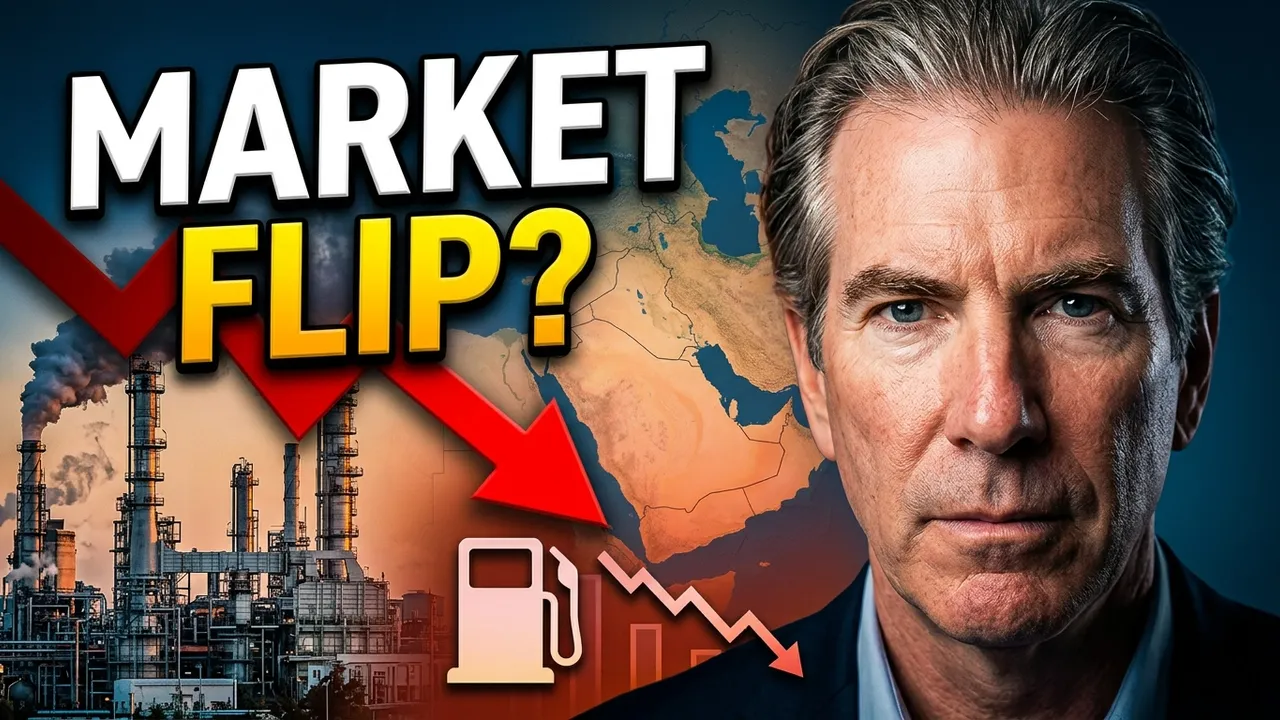
Iran Ceasefire Could Flip Oil Markets Upside Down

- Rendement de la vidéo
- +10,22%
- Appels
- 1
- Achat / Vente
- 1 0
- Publié
Recommandations
L'entrée est le cours de clôture de l'actif à la date de publication. Le cours actuel est la dernière clôture enregistrée.
-
Entrée $77,81 19 juil 2026Actuel $85,76 06 août 2026Résultat +$7,95
I like the hard asset local operations, HALO, as a in you know, this being the theme.
Transcription Complète
Easy Jeff for us in our defense to throw up the price of oil and say well here's a barrel of crude it's up or down a little harder to track some of these other markets. You say though they may be more important right now. Why and what are you watching? >> Well well ultimately the consumer does not buy oil. The consumer buys gasoline and diesel and when we look at gasoline diesel prices you do not see the ceasefire that occurred on June 17th. They just keep migrating higher and higher and if you look at the spread between refined product and crude oil. That spread we call it the crack spread. It is nearly the same level as the price of crude in some places and it's at an all-time high. Obviously you know I like to think about what happened with with the straights as being like a pimple being popped. You push a lot of oil out that hit the crude price but what's really going on is we have huge losses of refining capacity all over the world. Let's start with Russia as being the big one that that you pointed out. They are the Ukrainians are going 1300 kilometers inside of Russia doing precision strikes on the CDU units the crude distillation units in these these refiners and taking them out. We estimate 60% of Russian refining capacity is taken out. That's 3 million barrels per day. You know to give you an idea there's lines you know gas station lines in Russia but more importantly the Russians are importing product from India right now. They're supposed to be the big exporter. So this I think is really serious and then one thing that's important is we do not have strategic reserves on refined products in anywhere in the world. Before we could solve the problem with with crude oil you know with the disruptions in the Gulf but let's take the what's happening in in Russia. It's on top of refineries not operating in China. Refineries not operating in the Middle East. You had a you know earthquakes disruption to the large refineries in Venezuela. We have a lot of refining capacity online and I think the market needs to pay attention to this because it's not just what happened in the Straits of Hormuz, but it's what's happening as you pointed out geopolitically on a global basis. >> Jeff, it's Kelly here and just to double down on that point. We spoke with Robin Brooks last hour who has been saying a blockade of Russian oil should be a move considered if if we're serious about ending the war. Yes, it would be a huge deal, but that's kind of the point. Um and he thinks the oil market has proven flexibility in response to these shocks. I'm just curious, he said look, in even in the case of Iran, if you double down on the blockade, maybe prices go to 125 a barrel. Again, he thinks not catastrophic. So, I'm just curious for your reaction from the point of view of trying to achieve those goals, do you think that the oil market and with the product situation you described that it can still take that in stride? >> By the way, these refineries are built in the old Soviet system. There are refineries sitting in the city with a pipe with a crude pipe going into them. There's no way to get the redirect the crude. At most, maybe a third, 30 to 33% of that crude could be redirected and most of that's already been redirected. This is lost supply and it's really difficult to to redirect because the system was built around that these refineries would be operating, you'd be able to move the product out. So, this is not the blockade is there. The Ukrainians are hitting them and creating the blockade that you're that you're referring to. So, it's not like a large amount of crude can be redirected and that's something that's very different about the old Soviet system. It was built to AB export crude here, re-export products and these refineries are built in the middle of nowhere with pipes going straight. That's my point. >> That one that we're showing by the way is in Omsk. Okay, I don't have I'm not super great on Russian geography, but that's like a thousand miles away from Ukraine. This is not Bless you. This is not on the border of Russia and Ukraine. This is in the middle of Russia. This shows that Ukraine is able, pretty much at will, to hit Vladimir Putin where it hurts, and not on the border, deep inside the country. It'd be no different than some foreign adversary striking something in Nebraska for us. This is a big deal. How does this factor in and layer on top of the Iran stuff, which by the way is not fixed, because the number of ships going in to the Arabian Gulf is way less than the number of ships going out? >> Yeah. I mean, these problems it's just you have one bottleneck shifting to the other bottleneck. You know, the core of our super cycle thesis in commodities is decades of underinvestment in physical capacity of the global economy, particularly in the West. And so, the ability to adjust to these things becomes increasingly more difficult. The more times they happen, the more depleted the inventories become, the bigger the price spike. Everyone goes, "Oh, the thing spikes, and then it comes down. Oh, it's over." No. The a super cycle or underinvestment, and I I like the hard asset local operations, HALO, as a in you know, this being the theme. We've underinvested in these hard assets. It is not like the prices trend up. They spike. They come down. The way I like to do it is you have, you know, supply drop below demand, prices spike, bring demand down in line with supply, then the prices drop, and then demand goes back up, and boom, you just go over and over and over. It's not going to be an upward trend. And even when you look at investment vehicles like the USO, which is a rolling front month on the the crude curve, it's up 33% since the beginning of the war, despite the oil price having been lower. Why? Because you're banking those spikes every time one of those spikes happen. And that's really the key theme here is this underinvestment. You know, you look at Targa and Williams, you know, they're trading at record highs right now, because midstream
Commentaires 0
Connectez-vous pour rejoindre la discussion.
Se connecterAucun commentaire pour l'instant. Soyez le premier à partager votre avis !