
- Rendement de la vidéo
- +8,91%
- Appels
- 1
- Achat / Vente
- 1 0
- Publié
Recommandations
L'entrée est le cours de clôture de l'actif à la date de publication. Le cours actuel est la dernière clôture enregistrée.
-
Entrée $249,99 20 juil 2026Actuel $276,14 07 août 2026Résultat +$26,15
My my pick, Amazon, still related to AI but mostly diversified.
Transcription Complète
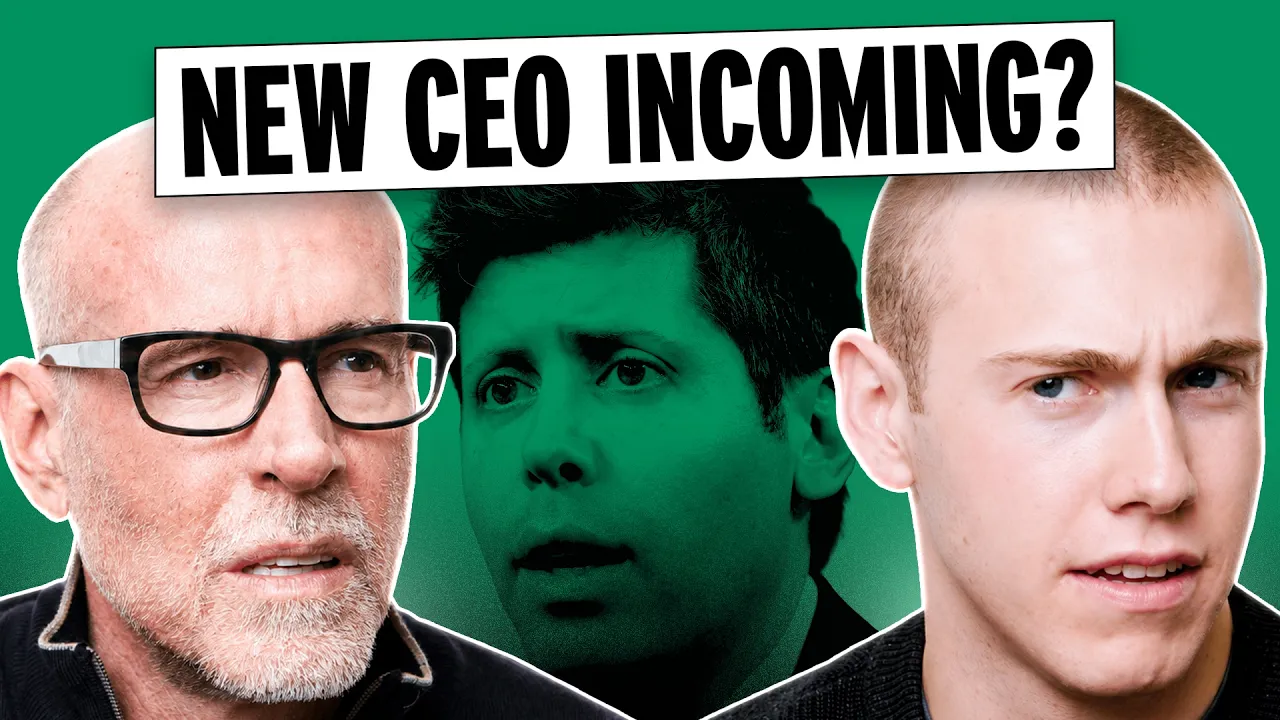
Sam Alman is on the green mile. He's an innovator, not an operator. They need an operator. They need an adult in the room right now. He just clearly doesn't know how to handle employees who want to leave. [music] He's made a fool of himself with certain statements that are just immature. Quite frankly, he has not made the right moves in terms of relationships with other organizations. This is all going to lead, and I'm teasing my [music] prediction here, we're going to have a new CEO at OpenAI within the next 6 months. Today's number 60. That's the percentage of Gen Z people who say they would find someone extremely attractive if they never used AI to make personal [music] decisions. I'll tell you, Ed, I am just sick of Gen Z's arrogance. They walk around and act as if they rent everything. Have you heard from Michael Symbolist? I may or may not have heard from him, but I love the direction that we're heading in, and I don't want to change a thing. >> That's cuz you're some Princeton prude with like [laughter] wants a pimp's cup, does doesn't know how to drink beer, tell a good joke. >> You've had better dad jokes. I'll say this one was this one was okay, maybe six out of 10. You've had some bangers last week. I forget what it was, but it really it really hit the spot. So, we're we're trending in the right direction. So, I'm not going to tell you what my correspondence with Michael Sebast has or hasn't been. All I know is that he's been a blessing to the show. >> I'm not going to say anything. Um, [laughter] >> how are you, Ed? It's not coming home. [snorts] [laughter] >> Yeah, I agree. >> I'm not going to lie. I'm >> I hear you. >> I I'm struggling to find any silver linings or any positives uh out of that World Cup. Well, it's not like you flew to the US with your entire family thinking you were going to go see England in the World Cup final. [laughter] Now I'm going to see Yamal and Messi, which granted it's great soccer, but do you think it's bad form? I'm going to wear my Team England jersey. Do you think that's bad form to wear that to the final or do I show my loyalty? >> We'll take any support we can get. I mean, you might get heckled and people might call you a wanker, but that's okay. >> Well, that's called social media. That's called me. That's called [laughter] That's called a weekday for me, Ed. Have you read my comments? You're [snorts] used to it. >> I'm used to it. >> Yeah, it is. It I got to I mean, it's hard to describe that feeling of just pure disappointment, but something I've been thinking about. >> That's cuz you're young. Trust me, you'll get used to it. [laughter] >> Yeah. Have I told you about my divorce, my companies, my general my general like every time I look in the mirror now, just the horror and disappointment? just to [laughter] uh give you my sort of takeaways on just being an England fan and also just being a football fan in general. Something I've been thinking about is it's so annoying how much worse it feels to lose >> and joy is to win. >> Yes. Losing the the intensity of the feeling of losing is so much greater than than the feeling of winning. I mean, you know, we went to the to the England game and saw Norway. We had a great experience. I had an amazing time. don't get me wrong, but we got the win and then I'm kind of like, okay, like on to the next one. Great. That semifinal loss, I couldn't dig myself out of the hole. And you never feel that way when you win. And what is that about human psychology? >> That's alcohol. So, [laughter] no, I'm serious. When I was young, when I was your age and I drank, it'd be like 6 hours of euphoria with a 10-minute hangover, a couple Advil Diet Coke, and boom, I was ready to drink again. And as I've gotten older, the euphoria shrunk and the hangover is is increased. So just so you know, you're going to have more of that diminishment of upside with an dramatic expansion. There's I I get excited about very little anymore, but I'm worried about [ __ ] everything, >> right? >> Who are you rooting for? I don't even know who to root for. Well, I know who I'm rooting for in the final, but it feels like it literally feels like getting a hand job from my cousin at Thanksgiving. It's just not nearly what I was hoping for. >> Yeah. Well, >> I don't know where that came from. [laughter] >> I don't know where that came from. [panting] [gasps] >> I like how I just kind of didn't really acknowledge just move on because it's kind of normal at this point. >> Who are you rooting for in the final? >> I look to be honest, I I don't like either of these teams. I I I don't I I think >> you don't like Yamal. >> I used to like Yamal, but something I've been thinking about. It's my problem with Argentina. My problem with Spain now is both of these teams are filled with very very arrogant people and the celebrations. I don't know if you saw the celebrations of the Argentina players after the England game, but they put up this sign saying the Faulland Islands are ours and the way that they celebrated after the game like there's just a sense of arrogance. I think Messi is an exception, but the rest of the team and the rest of the players, the way they carry themselves, they're just not very humble. The same is true of the Spanish team. I used to love Lamin because he was this kind of cute kid with braces who sort of no one knew why he was so good, but he just happened to be this incredible phenomenon. Now he's kind of bought into his own hype and you can sort of see him getting that sense of arrogance. I can feel someone saying the same thing about me. But regardless, I wanted quiet English humble people to go all the way and to do it do it for us. I wanted the Dan Burns and the Anthony Gordons to win. And instead, it's the superstars. It's It's the same old same old. And I wanted to see I wanted to see someone else. I wanted to see someone else rewarded for being humble. And that's not what we're going to see. So, I I I'm not going to support either of these teams. Messi is the greatest player in history. He's the GOAT. If he wins this, then it'll be kind of nice that we'll have like just a a conclusion to that debate, the undisputed goat. But I really I really can't get excited about either of them. >> I didn't like the way the game ended either. I I didn't the world the the vibes at the end of that game were distinctly different from the vibes at the end of other games. I was kind of disappointed. >> It's I mean at this stage there's so much wrapped into it. Emotion, politics, patriotism. I mean it's very it's very intense. Plus that's such a historic game with the hand of God and Maradon in 1986. I mean there was a lot in that. How much joy did we get from team England though? I'm actually at that stage where I'm I really am appreciative of the players, the coaches, and the fans because I got so much joy 100%. >> The game I went to with you, the games I watched with my boys, I just thought I thought that team was just And in typical British fashion, they're just going to be secondguessing everybody and [ __ ] posting the coach. They had an amazing I think they had an amazing tournament. >> I agree. And everyone's saying that he made the wrong decision by putting on the defenders. It's the same decision he made against Mexico. >> Take it to your fantasy football. >> Let's give the guy a break is my view. We'll [music] get [ __ ] posted in the comments. That's okay. We'll get over it. We have a lot to get into here, so I'm going to launch us into our first story. [music] It was another brutal week for Open AI. We've discussed the company's hell weeks before. This one might have been one of the worst yet. The headlines kept piling up. Apple first sued OpenAI, alleging that it stole intellectual property. The startup announced it is shutting down its Atlas browser less than a year after its launch. Its president of applications, Fiji Simo, said she is stepping down. Its first AI device leaked and a movable speaker wasn't exactly the reveal that many people were hoping for. The company was also reportedly caught selling advanced AI models to Chinese firms blacklisted by the Pentagon. And then there were the financial and the competitive pressures. According to Earketer, OpenAI's ad business is on track to miss its own forecast by 90%. S&P also recently downgraded Oracle's debt to tripleB minus, just one notch above junk status, citing OpenAI as a key credit risk. End quote. At the same time, Anthropic is reportedly gearing up for investor meetings ahead of a potential IPO as soon as October. So, it appears Anthropic will win the IPO race. Plus, Deepseek, the Chinese competitor, is preparing for its own IPO and it could file as early as this year. A successful public debut could make it even harder for OpenAI to attract capital. So, Scott, so much went wrong for OpenAI at this point last week. Um, and you can feel the Shaen Freud on all sides of the spectrum here because in a lot of ways they've alienated the left from a political perspective because of [snorts] cozying up with Trump after there was the falling out with anthropic. At the same time, they're also kind of alienating the right. We've seen that Elon Musk has been [ __ ] posting Sam Alman. They're alien alienating everyone. Then we get this Apple lawsuit where Apple accuses OpenAI of being quote rotten to its core. They said that their behavior of stealing hardware secrets was quote normalized and exemplified by leadership and was quote the tip of the iceberg. So that wasn't very good. We have the Atlas browser shutting down. We have Fijiimo stepping down. We have the Oracle downgrade. We have OpenAI selling its models to these blacklisted Chinese companies which doesn't put it in good books for the government. And that was of course kind of one of the only edges that it had over anthropic. A lot to get into. A lot went wrong. your reactions >> more than just the headlines. What I'm thinking about is the pattern here and that every bubble seems to kind of pop in the same order. First, the applications disappoint, then the infrastructure gets overbuilt and finally capital markets catch up and close. At the turn of the millennium, you know, pets.com failed before WorldCom and today the cracks are showing at OpenAI and the next is the infrastructure. Open ads reportedly worth over a half a trillion dollars. Yet almost every major narrative has flipped just in the last 60 days. Consumer products are struggling. Management turnover is accelerating. Monetization is proving harder than people expected. And competitors aren't dying. They're lining up to go public. So it's becoming sort of we used to think they were spending as if this market's going to be huge and it's going to be win or take all with justifying this drunken intoxicated spending. But it's become capital intensive, brutally competitive, and increasingly commoditized. And the real risk isn't that open AI loses. It's that nobody wins enough to justify these valuations. And we see an unfurling of the collapse from B TOC to B2B to infrastructure similar to 99. And you know, again, his history doesn't repeat itself, but venture capital sure as hell does. and that is it is massively overspent here and these valuations are going to come down uh dramatically. But I've you know I've always said oh it feels like 90 you know you want to say it's 99 it's probably more like 97. This does feel like Q4 uh 99 and then March of 2000 is is now in you know in in plain sight. you were saying when we were talking about this offline that you think that we're going to have to see a management shakeup here uh just based on everything that Sam Alman's gotten wrong and I think I mean there is the AI bubble question which is like does the AI business model actually make sense if you are in the front-end AI business and [snorts] that's something that has been kind of an open debate um I mean if we look at the financials of open AI and anthropic these companies that are losing a lot of money you would think it it doesn't really work right now. Maybe it'll be kind of the Uber uh or the Amazon where they spend all of this money and then eventually they figure out how to make more money than they spend and eventually it turns into a viable business. But that's kind of an open debate and I don't blame Sam Alman or his execution um on that reality. I mean the reality is that compute is very expensive. Building the data center is very expensive and so far it's been very hard to market a viable product which is commensurate with the with the costs. But there are some executional mistakes that we've seen from Sam Alman. One would be he's trying to launch this hardware business and apparently he's been stealing from a company that he had previously formed a partnership with. Like that's something you kind of have to remember about OpenAI is they used to be partners with Apple. It the plan was that OpenAI was going to power Siri and then Apple turns around and announces actually no we have a new partner. It's Google. And now we learn why that is. It's because Apple thinks that OpenAI is quote rotten to its core and that they have been stealing trade secrets and poaching their employees. So just from like a relationship management perspective like clearly that is a huge mistake. There was the issue with we're launching all of these side projects and now we're saying that none of these side projects are actually panning out like the Atlas browser and like Sora the image generator which they shut down as well. Um, I mean it just in a remarkable way Sam Elman is getting the entire world to hate him. And it's almost like nothing he says or does can go right. And I've never really seen that from a CEO. A CEO who has become so unlikable, not to one faction of the country or one faction of the market, but literally to everyone. I can't find really anyone who is supportive of this company who doesn't have a financial interest in this company and that's wild from a CEO perspective. I mean there's just so many things here. AI has been the most poorly managed brand over the last 12 months and I feel like the cudigra of head up your ass brand management was deciding that Kevin Oly should be the spokesperson for data centers. [laughter] >> I think he made himself the spokesperson but I agree. They should have shut him down quick. He should have said, "Boss, if you want this thing built, just shut the [ __ ] up." [laughter] But look, the I think the thing that really hurts here in terms of credibility and provides legitimacy to what is often perceived as just competitive wrangling is the lawsuit from Apple. And they're claiming that OpenAI stole trade secrets by poaching over 400 Apple employees. And OpenAI had recruits bring Apple prototypes, which by the way isn't illegal on its own, recruiting employees. There's been laws passing. You can't have Steve Jobs and I forget who it was. Bill Gates had a kind of a gentleman's agreement that later surfaced in emails that they wouldn't poach each other employees and that's not competitive. All that is is a transfer of power from employees who want multiple vids on their labor and that that's illegal. You're allowed to recruit other employees unless that employee is an executive and assigned a garden, you know, garden leave or not a non-compete which you have to compensate them for. But anyways, the strange thing or the irony of the suit is that Apple has a reputation in the industry for stealing other companies ideas and they're one of the most frequently sued tech companies for patent infringement. And the and the reality this goes to a larger and I'm not saying they are they aren't guilty but the reality is the majority of companies that have outside shareholder gains and this is true of an economy that's growing faster than 5% a year they're essentially thieves or probably more accurately a strip miner in that is in the 19th century the US stole manufacturing technology or tech for textiles and littered the eastern seabboard with with with manufacturing techn technology and capabilities and even actually kidnapped artisans from Europe. China has been has built an entire economic model on IP theft. And so most of these guys are suing each other. But when Apple comes for you in this case, their communications are very good. It's not an individual. They're not getting into a pissing match with this ego versus this ego. They're just saying, "Look, they're laying out an illegal kind of a droid adult format. This company is guilty of, you know, kind of mass theft, if you will." But I it is really incredible how the momentum is flipped on OpenAI. >> And now we know that Anthropic is scheduling its IPO talk. Supposedly that listing is going to come in October which is very soon. That's only 3 months away. Um and you know there was a debate of like who's going to win that race between anthropic and open AI. Who's going to sort of capture all of the energy uh and the capital in the room? It's clear that Anthropic is going to win that race. In fact, if we look on Cali, the odds that they will announce an IPO before 2027 are up to 74%. So, this Anthropic IPO is happening. OpenAI is tableabling theirs. But then the fact that in the same week we also learned that Deepseek is planning its IPO. And to be clear, we don't really know anything about it. It's very confidential. We don't really know anything about their financials. Um, but they're out there and they're planning this and it seems like the debate used to be, you know, who's going to get out first? Is it going to be anthropic or open AI? That's not a question. Now the question is, will DeepSeek get out before OpenAI? And that poses a whole other slew uh of questions and risks for the company. I mean, what do you make of what do you make of that? Well, I think the biggest story that has that it's got almost no no coverage is that is what I think is I would refer to affectionately as is AI dumping from China. And that is free Chinese models went from less than a third of all traffic in late 2025 to about 2/3 recently. And it's much less expensive. I mean essentially what's happened in the air market has condensed what's happened to industrial economies in Europe but instead of it taking two decades it's taken two months and that is they steal the IP on a cell phone tower from Seammens and then they manufacture it with cheaper labor and they sell it back to Telos for 40 cents on the dollar and there are a lot of regional LLMs in China and they have access to cheaper power cheaper chips less power consumptive and they're also subsidized by their own local governments. And I believe, and I said this before, that she has a vested interest that the ultimate Ohio class submarine to be flipped against us is to engage in AI dumping. And I think it's happening. And you hear stories of VCs encouraging the portfolio companies to use these open way Chinese models. But you're seeing the best business model in history is IP theft. a close second in terms of a pricing mechanism is 80% of the market leader for half the price and Deep Seek and these Chinese openweight models claim they're 90% of the market leader for a third of the price. I I think this is going to be the next geopolitical pawn once Trump actually if Trump actually figures out what's going on here quickly enough. But the entire economy right now is a giant bet on AI. And China has come in with a with a a product that is near near frontier for a lot less money. And that is going to start to and Mia, our our head of research, put together this graph that just blew my mind, one of those mountain graphs. And you see the frontier models at like 80 90% share in China you know five or 10% these Chinese models and the mountain of Chinese of of consumption of Chinese open way tokens has exploded and yet it's not getting that much coverage. It's as if I mean the the US auto industry was hollowed out over call it 20 30 years and it started with the Honda Civic and then they had an Accord and then oh wait but that's just one company. You know, it's Toyota, which became the largest auto company in the world in terms of production volume. What the Chinese automobile industry did to Detroit in about three decades. It feels like Beijing is doing to us a AI frontier models in about 3 months. We'll be right back after the break. And by the way, we will be going live on Substack with Noah Smith tomorrow [music] at 1:30 Eastern. Don't miss it. Subscribe now. Support for the show comes from Delete Me. The internet makes it easy for scammers, stalkers, and hackers to do their thing. That's just a fact. But it's important to remember that there are ways to protect yourself. That starts with protecting your data. And [music] Delete Me can help you do just that. Delete Me does all the hard work to wipe your personal information from data broker websites. It was named the top pick for data removal services by Wire Cutter. And our producer, Jennifer Sanchez, has tried Delete Me. She was surprised to find out how much [music] personal information was actually already out there. But Delete Me made it very easy for her to clean it up. Take control of your data and keep your private life private by signing [music] up for Delete Me now at a special discount for our listeners. Get 20% off your delete me plan when you go to joindeme.com/profg and use promo code profg at checkout. The only way to get 20% off is to go to joinddeleteme.com/profg and enter code profg at checkout. That's jointdeme.com/profg code profg. [music] Support for the show comes from quint. This season is full of opportunities to relax, and your wardrobe should reflect that. [music] You can reach for simple, highquality pieces to get you through the warmer weather comfortably [music] and in style. Quint has all the well-made summer essentials you need. They're 100% European linen pants and shirts are breathable and a perfect upgrade to your warm weather wardrobe. Those start at just $34. Quinc's teas are soft enough to live in all day, [music] and their lightweight cotton sweaters are just enough coverage for those cooler summer nights. Plus, [music] it's not just clothing. Quint offers everything from home to travel to everyday essentials. I love my Quint wear. I love the linen shirts. Everyone needs to have a linen shirt, especially in the summer. And the best part, in my view, it's all incredibly affordable. Make your summer wardrobe easier. Go to quint.com/markets for free shipping on your order and 365day returns. Now available in Canada, too. [music] That's quinc.com/markets for free shipping and 365day returns. quint.com/markets. [music] We're back with Profy Markets. I mean, when we just sort of map out like what are the threats to open AI right now, I think you've got you've got this sort of lack of goodwill in the marketplace. Um, and we saw there was this viral clip of Alex Cop on CNBC basically saying that he's done with OpenAI and Anthropic because their tokens are so expensive and the value is not there and it so feels sort of like corporate America is turning on this company which I think could be a problem in terms of these B2B contracts which are pretty important both for OpenAI and Anthropic. You've got this Apple lawsuit and all of the other lawsuits, by the way, that Open Air is going to have to fend off, but the Apple being probably the most well capitalized, which could legitimately shut down their hardware business. You've got just competition in general, as you pointed out, the market share statistics. A year ago, Chad GBT was at 76%. Today, it's at 50, and that's because there are two major insurgents. One is Claude, which has gone from 1.6% market share to 10%. Gemini has gone from 9 to 28. So Gemini is exploding as well. And then I think the most significant and the most important is the price war that appears to be breaking out right now. And that is the pricing of these AI models is clearly becoming front of mind for enterprises and it is very quickly becoming a race to the bottom because you have Meta that is coming out with their model which is dramatically cheaper and they [snorts] have literally stated that it is their mission to initiate a price war because they know that they can play that game. They have the cash. Open AI and Anthropic can only play that game for so long because where are they getting their money from? And they're not getting it from profits. They're getting it from venture capital. And so at some point, if the investor spiggot turns off, they can no longer play that game. Gemini is also pricing their models lower. But the elephant in the room, and I'm 100% in agreement with you on this, is clearly the Chinese models. It is clearly deepseek, Kimmy. all of these Chinese models which are so dramatically cheaper than the US models that it's hard to actually fathom just to go through the data here. The price per million output tokens for OpenAI's model GPT 5.6 is $45. For Claude Fable 5 it's $50. The equivalent price for Deepseek's model is 87. So it is 99% lower than the American alternatives and obviously now we're seeing that China is stealing market share. I don't I don't know. I mean we see all these benchmarks of like which model is the best and there's all these debates like you know people kind of generally assume that open AI and anthropic have the best best-in-class worldclass models. I'm not going to chime in on that. But what I do know is that people are using the Chinese models because the Chinese models can get the job done fast enough, well enough, and they are so much cheaper that it would be ridiculous not to turn to them. Which is why you're seeing the increase in market share. It's also why you're seeing a lot of these blue chip American companies that are making that switch. I mean, we've gone through some of them before. Coinbase Shopify Airbnb Uber they're all starting to switch over to use these Chinese models. And it seems to me that this is clearly the elephant in the room for not just OpenAI, but for all of American AI at this point. And how could Xiinping, how could the CCP, how could China not be trying to target this? Because if we are as dependent on AI as we are, it is clear that this is the fastest way to bring the industry to its knees. Initiate the price war, get everyone back on the side of China, take up that market share, and then the question for us becomes, what happens if this keeps happening? What happens if they continue to eat into that market share? And I wonder if I mean, this is a question I'll pose to you. I wonder if that is going to be the tipping point for an open AI or an anthropic. The fact that they cannot compete with China. What do you think? >> I think they can compete. I I do think that they're so there's a market for Emirates and and Delta. There's a market for the LVMH and the high-end. The frontier models with better IP will be great businesses. The problem here, Ed, is that When I raised money for red envelope at 120 million thinking that I was a genius getting that kind of valuation, the problem was it was really difficult and stressful to try and raise money for the next two years after the market collapsed because the people who came in at 120 were pissed off and didn't want to raise money at a lower valuation and you end up with all sorts of expectations and repricing options and to a certain extent the one of the one of the real anchors around the necks of open AI and anthropic right now is 8 or 900 And that is 800 or $900 billion, which is what all their last round investors are anchoring off of. Because I believe OpenAI and Enthropic will still be amazing companies. If they decline by 80% in value, that means they're worth as much as Starbucks. They're worth as much as Disney. They're amazing companies, but the expectations and the valuations have just gotten so far out over their skis that the narrative will naturally be really negative. But I do think there's a market for the premium frontier model. people want US companies. In addition, and this was, I thought, the most puncturing statement from Alex Karp. It was brilliant. He's talking his own book, but it doesn't mean it's true. He said, "People turn to Palunteer because what they want is a thick layer of innovation and protection on top of LLMs." Because if you're, and he didn't say this, but I'll project. If you're Apple, you don't want to upload your board decks and project plans and product road maps into any LLM and have them incorporate it again, strip mine it, and incorporate it into future answers for Samsung and Microsoft who are posing the same queries, especially after you've literally found evidence of them stealing your hardware products. I mean, if you're already anxious and then you see the lawsuit, I mean, no way you're starting that enterprise contract. >> I mean, this is the narrative that's emerging that is really powerful. These are companies that have ingested all intellectual property without consent or compensation. They strip mine it and then sell it back to the people who are losing their jobs because they've strip mined their initial IP. like that's not a good I that's a business model that should get people angry and so there needs to be I mean this lawsuit's going to be interesting. I still go back to an original or an idea I've had for a long time and that was do with the recording artist do and have have an organization that's on top of them like the record association I forget what it's called player and basically they have means of assessing every time private Idaho is played by the B-52's awesome song on every radio station across America and then they say okay radio stations approximately 20 basis points of or half A half a percent of total play time was B-52 songs. We license, we do a blanket license for X dollars. It char we charge you, you know, we charge KQ 106.7 Rock of the 80s in Los Angeles, the greatest radio station ever. We charge you two or$2.5 million a year for a site license, an omnibus license to have access to all of our music to play. And then you run ads against it. And then we take 2% of that and we send it to Warner Brothers or whoever represents the B-52s. None of that goes on. Again, bringing this back to me, if I type in in the Voice of Scott Galloway, I will see literal sentences from chapter 7 of one of my books, but I'm not getting any compensation. So the strip mining I think an an adult will come in and say Adobe did this and it didn't seem to pay off but Adobe's visual LLM Firefly or whatever it was called they actually only had licensed imagery because they wanted to say look we've we are holding up to our standards of IP but that is yet an privacy IP theft actual theft uh of intellectual property not only IP theft from indiv individual consumers but IP theft from other organizations. Uh this is all going to lead and I'm teasing my prediction here. We're going to have a new CEO at OpenAI within the next 6 months. >> Could you expand on that prediction while we're here? >> I'll do what Rachel Matto does. I used to love watching Rachel Matto and I got so sick of her saying, "What if I told you that I knew the name and the identity of the person who killed JFK? [snorts and laughter] Stick around." And then you have to watch four minutes of commercials convincing you had opioid induced constipation and restless legs. And then you come back and she's like, "There is a man. He has a name. Another man is showing up and has a solid thesis and why it was this man. Stay with us." And then we'd cut to another commercial break. I'm like, I have had it. Rachel Matto is the biggest biggest I won't use a word tease of some kind. [laughter] And I like gave up. I'm like, I am not willing to endure more commercials showing me how much it sucks to get old to find out who who killed JFK. [laughter] Uh, anyways, uh, should I do it now or should I wait for predictions? >> I would like to hear it now because I myself uh am impatient, so I'm going to assume that the listener is too. >> We're about to see OpenAI acquire a company called Sierra. And that is the best companies don't stop at the platform. They develop their own applications. Microsoft didn't stop at Windows. it it built or bought and built Office. Uh Apple didn't start with iOS, it built the App Store. Open AAI is worth about half a trillion dollars, 500 billion. Sierra, which is essentially uh Sierra has one of the best enterprise AI products and uh they're going to I believe they would check so many boxes acquiring Sierra and installing Brett Taylor as the CEO because OpenAI has one of the best frontier models and Sierra has one of the best enterprise AI products and Brett Taylor may be the best enterprise software operator of his generation. So as foundation models get cheaper, the intelligence will be commoditized and it'll be the scarce asset won't be IQ. It'll be customer relationships, workflow integration, and enterprise trust. That's Sierra. And at $5 billion, which is what it's worth in the market, say you pay 10, that's a 2% dilution. And you not only get uh real progress in your application layer, you get something that'll increase the value of Open AI by hundred billion dollars by calming the waters with someone who is seen as not only someone who understands the technology, but has a very elegant, smooth hand around retention of employees and smoothing over. Keep in mind, this is the guy that shoplifted $44 billion from Elon Musk and forced him to close and didn't get into a pissing match with Elon Musk. Elon Musk does not [ __ ] post Brett Taylor. Think about it. He had to pay $44 billion for a company that's now worth three billion. And he's not out calling Brett Taylor a crook. So this this solves the Altman problem, the insecurity in the market problem. Brett Taylor will get cloud cover to make massive reductions in capex. They can pay Brett five or 10 billion of that incremental hundred in increase in valuation they get they get the day they announce this acquisition. This is just makes so much industrial logic. Anyways, OpenAI acquires Sierra and installs uh Brett Taylor as their CEO and kicks Alman up to chairman. >> Wow. Okay. Sam Alman out as what was the time frame? >> I would say it's six months. You know, it might be it might be 12, but Sam Alman is on the green mile. He's an innovator, not an operator. They need an operator. They need an adult in the room right now. He just clearly doesn't know how to handle employees who want to leave. He's made a fool of himself with certain statements that are just immature. Quite frankly, he has not made the right moves in terms of relationships with other organizations. Um, so they need an adult and and Brett Taylor kind of just reeks of confidence. the entire every investor at OpenAI would have about a 7-day exhale if they announced that Brett Taylor was the new CEO. >> That's a very bold prediction, but the more you think about it, the more it actually isn't that unreasonable given how much of a shitow it seems to be at OpenAI right now. I think it it's just helpful to play out how these kind of situations might unfold for OpenAI's business. like you know and we think about this Apple lawsuit. I mean what could go wrong here? What could go wrong is that the hardware business just shuts down and that seems to be very much on the table for OpenAI right now. The other thing that we saw were those e-arketer estimates of chatbot ad revenue. So, I mean, it's worth thinking like what what would chat GBT and OpenAI's advertising revenue actually look like if they were as low as e-arketer is predicting for the chatbot ad revenue market at large. The other thing to think about is these price wars like what would happen if open air had to reduce their model pricing and you know pick a number. We picked a number. We said what would happen if they had to reduce their prices by 80%. kind of like worst case scenario. If you put all those things together, if you eliminate the hardware business, if you dramatically reduce the ad business, if you dramatically reduce the pricing power that OpenAI currently has and seems to be seeding with every passing day, and then you project all of this out, they have said that they're going to be profitable by 2030. But when we put all these estimates together, what we find is that actually no, they won't be cash flow positive. they will be losing about $165 billion a year. That's when you put this all together. And so, in other words, if these things go wrong, this business just flat out won't work at all. At which point, you have to start asking questions as to what actually happens to open AI. Someone say it just goes bankrupt. It just implodes. I don't really think that's going to happen. I think the more likely scenario is that there will have to be some sort of massive restructuring, some sort of M&A event. Probably it gets sold to a larger AI company. [snorts] The point being all of these very very speculative investments and very speculative bets, they kind of all have to go right for Open AI to make it to make it out of this alive. unless something massive happens, unless you shake things up in a in a massive way. But it is really getting to that point. And I think the question for investors is which thing do you decide to worry about? I think if there's anything that I would be worried about if I were an investor in OpenAI, it would be the China problem. It would just be the pricing just just flat out because at this point they're losing control of the narrative. The enterprises are turning against them with every passing day. They're telling them these tokens are too expensive. There is a lot of incentive to switch over to a Chinese model. Maybe the government bails them out. Maybe they see some regulation that makes none of that even regulation wise even possible. [music] But that does seem to be where things are trending at this point. [music] We'll be right back. And for even more markets content, sign up for our newsletter at profarkets.com. [music] Support for the show comes from Vanta. Every new tool your team signs up for, every vendor that turns on AI features, every new integration has a chance for something to go wrong. And most security programs weren't built for AI's pace of growth. Enter Vanta. Vanta is the number one agent [music] trust platform used by over 16,000 fast-moving companies, including RAM, Cursor, and Harvey to ensure they're always audit ready. And now Vant is helping companies like yours watch for the risks that show up between audits [music] across your vendors, your AI tools, and your entire environment. How the Vant agent network works like a 24/7 GRC [music] engineer in the background, finding issues, drafting fixes for you, and cutting vendor assessment time by up to 50%. Whether you're a fast growing startup or a global enterprise, Vanta is here to help you automate your security and compliance and earn and prove trust. Get started today at vanta.com/markets. That's venta.com/markets. Support for the show comes from BCX, the public ticker for private tech. For generations, American companies have moved the world forward through their ingenuity and determination. And for generations, everyday Americans could be a part of that journey through perhaps the greatest innovation of all, the US stock market. It didn't matter whether you were a factory worker in Detroit or a farmer in Omaha. Anyone can own a piece of the great American companies. [music] But now that's changed. Today, our most innovative companies are staying private rather than going public. The result is that everyday Americans are excluded from investing and getting left further behind while a select few reap all the benefits until [music] now. Introducing VCX, the public ticker for private tech now available wherever you buy stocks. VCX by Fundrise gives everyone the opportunity to invest in the next generation of innovation, including the companies leading the AI revolution, space exploration, defense tech, and [music] more. Visit getvcx.com for more info. That's getvcx.com. Carefully consider the investment material before [music] investing, including objectives, risk, charges, and expenses. This and other information can be found in the funds perspectus at getvcx.com. This is [music] a paid sponsorship. We're back with Profy Markets. People keep saying that the market is diversifying, but the deeper you look, the harder that argument is to make. It seems like every part of the market is becoming increasingly dependent on AI. Take small caps. Some of the best performing stocks in the Russell 2000 this year are AI beneficiaries. Max Linear, a semiconductor company, is up 424% year to date, while cloud computing company Rackspace Technology, has gained 567%. In total, roughly 24% of the Russell 2000 now has some exposure to the AI trade. The same pattern shows up in emerging markets. The Msei Emerging Markets XChina ETF is up 34% year to date, but much of that performance is driven by its heavy exposure to Taiwan and South Korea, two markets whose largest companies are deeply tied to the semiconductor supply chain. So Scott, I just want to simplify this. One of our biggest concerns about this market has been overconentration. The fact that, you know, the top 10 stocks make up 40% of the whole S&P. It's up from 20% just 30 years ago. Um there's this over reliance on AI that we've been worried about, but this year I'm just we're hearing a lot from investors that that is changing, that big tech has been underperforming and that we've seen this diversification or this broadening of the markets. And let's just play a clip of what some investors have been saying. >> Broadening of the market. We're seeing more participants to the upside. Look, I think the broadening of the market, we've argued for some time that it would be extraordinarily healthy if the market broadened and that's really been going on since the end of October. >> It's been an incredibly broad uh broadening out. >> I think that broadening out theme, which was one of our themes as we entered the year, I think that broadening out theme is going to be quite relevant. Yeah, >> the trouble is that when you actually look at all of these quote unquote broadened segments, the stocks that are doing all of the broadening are AI stocks. And you look at the S&P, big tech isn't carrying this market. True. But AI still is the best performing stocks have been Intel, Seagate, Western Digital, Micron, Dell, SanDisk, all of the sexy AI names that we keep on hearing about. And the same is true of every other sector. and we can go through them in a moment. Before I do that, I'll just start with your reactions. >> The CNBC pundits who will always find a reason like real estate agents will always find a reason why you need to buy now if you're a buyer and why you need to sell now if you're a seller. These folks own stocks and so they're always going to come up with a reason why you should buy more. Um the market is not broadening. It's just finding new ways to buy Nvidia. people put your analysis these pundits are pointing to small caps, emerging markets, industrials, utilities, even real estate. And if you scratch the surface, the same story emerges. Semiconductors, power demand, uh like even cooling systems or fiber, data centers, AI software, that's not diversification. It's second order concentration. In 1999, everything eventually became an internet stock. Today, everything's becoming an AI stock. And that's not necessarily bearish. It just means investors are kidding themselves when they use words like broadening as some sort of code for diversifying away from AI. That's just not happening. If the AI trade sneezes, we're not catching a cold. We're getting we're getting pneumonia. And buying quote unquote AI adjacent stocks and calling it broadening is like ordering a Diet Coke with your double double from In-N-Out. Be clear folks, you you still bought a [ __ ] cheeseburger. That's what you've done here. You've bought a cheeseburger. >> Just looking at some of these sectors like you mentioned utilities which a lot of people you would think of that as diversification away from technology away from tech away from big tech but if you look at what the I mean it's up that sector is up 7% year to date. If you look at the companies that have been driving that it has been the companies that are quote unquote AI compute providers or AI power providers. with companies like Dominion and Bloom Energy, which is up 143% this year. The same is true. You mentioned real estate. Who are the winners in real estate right now? It's not REITs that are building houses. It's REITs that are building data centers. It's digital reality trust, Iron Mountain. It's these companies that are basically going out and being AI landlords. Similar to what we saw uh in our conversation with Mike Novagrats. Same is true of industrials. Caterpillar is now an AI stock. Vertive is an AI stock. They are carrying that sector. And now, you know, we can talk about the size of companies, large caps versus small caps. A lot of people would say, "Oh, we're broadening because the Russell 2000, which are the small cap companies that they are outperforming this year." Well, actually, if you look at the returns, more than half of them have come from AI related stocks. The same is true by region. A lot of people say, "Oh, we're broadening. We're we're getting into international markets. Emerging markets are outperforming." Well, no, because South Korea and Taiwan have accounted for 75% of those returns because most of those gains are coming from three companies, TSMC, Samsung, and SKH Highex. So, we're starting to see this this this problem in the way that we talk about markets where there's this idea that we're diversifying, that we're kind of getting away from AI, but we should be very clear like AI is literally touching everything in this market. It's even touching fixed income. And this is something that Torston Slock over at Apollo has talked about. AI now accounts for nearly half of all investment grade bond issuance. So you could think like, oh, the equity markets are being kind of overlevered to AI, but the same is now true of the bond markets. And I want to play you this clip. Um, this was again, this was Torston Sllock who was uh uh one of the one of the heads over at Apollo and he's talking about like the 60/40 portfolio, which is sort of the the classic balancing of your portfolio where you're 60% equities, 40% bonds. He reframes it in a very interesting way. This is what he said. >> This AI thing better work out. >> It better work out >> because if that doesn't work out your portfolio will be in trouble. That's why ironically the best investment recommendation today is the new 6040 is really to do 60 maybe AI and 40 non AAI. So in other words, the best recommendation for investors is to invest in nonAI things that are not correlated with this one factor. Because if there's one thing we have learned in finance since the financial crisis is factor investing. You don't want to be exposed just to one factor and at the moment there's one factor staring all of us right in our eyes and that is AI is literally everywhere. >> I think he kind of sums up exactly what's happening here. [laughter] Right. >> Well, of the big tech companies we talk about, who's the least concentrated or dependent upon AI? >> Apple. >> That's exactly right. And what's Apple what's Apple? Uh Apple stock uh one-year performance it's up 60%. Year to date it's up 23%. all the other guys. My my pick, Amazon, still related to AI but mostly diversified. It's up 13% this year. And then look at the guys who are ground zero for it. You know, Microsoft, right? Um you know, Microsoft's down. So, uh look out below. I I if as a general theme, if I could go long a basket of stocks, it would be GLP1. And if I could go short a basket, it's um it's AI. But be clever, folks. I mean, the reality is I I don't I'm not suggesting you invest in gold bars or assets or cash. I think you're always in the market. I'm always in the market because you don't know when these, you know, you don't know how fast and how irrational the markets are going to run. I'm always in the market. But you absolutely need to be diversified and you need to really understand what the term diversification is because if you're in the S&P or even in what you think are small cap stocks, I think at this point you really want to think about how do I try to mostly diversify away from AI and that is not easy right now because everything seems to be somewhat correlated to AI. But I will say that I think if the market goes into a pretty serious recession, I still think people are going to find the budget for their WGO. Um, I still think they're going to pay their rent. I think the builders and the and the REITs are going to do okay here. Uh, consumer products, defensive stocks, but this feels wow. It feels frothy right now. And it feels like there are cracks, you know, the the size of the Grand Canyon beginning to emerge. >> We talk a lot about diversification and it's what we're learning more about this market is it is increasingly difficult to diversify because of how much AI has kind of penetrated everything. Um whether it's emerging markets, whether it's small caps, whether it's bonds versus equities, like AI literally touches everything. What do you think the right move is for investors at this point? Like how do you handle that problem? Brief history of diversification. In the 80s, people people some finance professors uncovered research or published research saying you get riskfree return when you diversify. And Ray Dalio says that the entire objective of the most successful hedge fund ever, Bridgewwater arguably, was to find 15 uncorrelated distinct cash flows that if you could get to that point, you'd always beat the market with lower or higher sharp ratios or whatever it is. And investors listened in the 80s and these enormous hedge funds started buying Australian stocks and Japanese bonds. But because people listened and diversified, everything became more correlated, which meant that the biggest hedge funds when US stocks went down began selling their Japanese bonds when they needed money. [snorts] So now almost it's almost impossible to be to be uncorrelated with AI and the S&P and American tech. You just don't want to be a ground zero. And just a personal learning here, and I've said this a lot, I've been rich three times. Why? Because I've lost it all twice. Lost it all and more twice in 200 2008 because I never understood the power and the importance of diversification once you have an asset base. What am I doing? [clears throat] I'm selling down my big tech. And some of this also might be FOMO of having missed out because I have not made a lot. I have not made I guess in an adjacent way I've made money from AI but I was offered anthropic at I think 20 billion and I'm got to be honest I'm angry I didn't do it and I haven't I haven't been big in AI so some of this might be just sour grapes but what I'm doing is my big themes are the following GLP1 now not first and foremost but unfortunately I think the biggest trend in society right now that is going to run unabated is income inequality because of court decisions that let people throw as much money as they want at an election. So, we're going to continue to see a leakage of capital and power and rents from workers and consumers to shareholders, which will disproportionately affect the top 1% who own a disproportionate amount of shares. So, what am I doing? I have a disproportionate amount of my net worth in high-end real estate because I think that I mean, this is where my biggest investment is. I think anyone worth over $50 million is going to have at least one home in one of five places. Dubai, London, Palm Beach, New York, or Aspen. And I have invested about half my net worth in buying really high-end homes in four of those five. And the secondary benefit or the psychic income because I'm at a point in my life where I'm not all just about financial return. I'm about psychic return is a I enjoy these houses and I'm hoping it'll force my sons to to visit me more. Um, which based on my orientation weekend, that strategy isn't working. Did I tell you that he literally didn't text me for two days? I'm in [ __ ] Charlottesville with nothing to do, wearing orange sunglasses, and he didn't text me once, Ed. He didn't text me once. Literally, >> you told me that he physically blockaded the door with his body. I didn't hear about the texting problem. >> I walked in as soon as I put his bag down, it's like, "Okay, thanks, Dad. I love you." And literally me out of the room. [laughter] I mean, it was like, God, am I that bad? Anyway, but I don't know where I was going with that. That took me off. I'm getting emotional. But look, what I'm doing, and then this is I'm to a certain extent violating my own thing about diversification, but I think you're going to see inflation. And I think you're going to see massive increases unfortunately in income inequality. And the thing I love about real estate for my own mental health, talking about psychic returns, I want a lower percentage of my assets and publicly traded stocks because I'm checking this [ __ ] thing 10 times a day. And the thing I love about private markets and real estate is I don't get a scorecard every day. And so psych uh it taps into this really unfortunate overwhelming trend of regulatory capture and income inequality which is going to continue to run unfettered for a while. and believing that we're going to swing to the left and bring in a democratic socialist or whatever they're calling whatever, however they're trying to wallpaper over head up your ass economic policy and anti-semitism masquerading as some sort of youthful energy. Fine, have at it. But it's not going to get in the way of the regulatory capture of the wealthiest. Those people are going to use Representative Shiovalia as an example of how [ __ ] up this whole democratic socialist movement is. in the middle of America is going to continue to put up with a regressive tax structure that results in a ridiculous amount of accretion of wealth to people in the top 0.1% who pay less and less taxes. And hopefully they'll all buy my home. >> I don't know [laughter] how we get here. I don't know how you I'm also not even sure what about the democratic socialist is getting you so riled up >> because we're about to snatch defeat from the jaws of victory. Socialism doesn't work. Capitalism works as long as you it rests on a bed of empathy and you keep reinvesting in the middle class with redistribution of income. >> I agree. But I look I look at what Mani's done so far and it it hasn't been socialism. Everything he's done so far has been like surprisingly very reasonable. The rent control is the only thing I disagree with and also what he's done with the with the Whimo stuff. I >> I want to be clear. I'm not talking about mom Donnie. I I I've said I mean I didn't mean to get political. Well, I always get political. I think you have to rally around people when they're elected and give them the benefit of the doubt. I think he is done. There's some things that upset me about him. Specifically, the new litmus test for the people he seems to uh elect seem to be in my opinion. >> There was that one woman who said she was a little crazy, but >> a little crazy. >> So, >> banned the police, no borders, murderers should not be in prison, showed up to an anti-Israel rally on October the 8th. Yeah. She is about to become the poster child for the Republican party to convince middle America that, okay, we keep making rich people too rich, but they're [ __ ] crazy. Anyways, I worry we're about to snatch defeat from the jaws of victory by swinging way too far, way too far to the left. >> I think you're letting this one woman taint your your views of everything. >> That is entirely true and accurate. And let me also acknowledge [laughter] the other side that boomers like myself don't get to pick their flavor of disruption. And what I will say about Mandani and these new candidates is they're bringing >> he's been surprisingly he himself has been surprisingly measured for >> great politician. >> Yeah, >> he's great. More power to him. I want to be supportive of him. I want to be supportive of youth. And people my age don't get to pick their flavor of disruption. I've been calling for disruption. Democracy needs a turnover and a shedding of skin. >> Yeah, I don't disagree with the with directionally what you're saying, which is this is only going to get worse. I mean, what's going to happen? >> Believing that electing people who think we shouldn't have prisons or we should or demonize billionaires. One of the attributes that middle America loves, the people who decide elections, is that where Europe [ __ ] up is the following. They would rather be worse off as a whole if they're more equal. America says we don't mind being unequal. As long as a whole we're all doing better. Billionaires are fine as long as the average wage growth goes up and prosperity goes up. It has gotten so out of control that it's now coming at the cost of the middle class and the average person who can't afford to send their kid to school or buy groceries. But America, generally speaking, one of our core attributes is we don't demonize success. We celebrate it. And we're okay with inequality to a certain point. As long as it doesn't, as long as as a whole, we're doing better. We've had huge inequality since 1945. That's a key component of capitalism for incentives, it has gone way too far. And rather than swing back to something reasonable like a progressive tax structure, alternative minimum tax, reduction in reduction in transfers of wealth from young to old, we're going to the Democrats are going to elect, I worry, a group of people that have economic policies that feel like North Korea light or or East Germany like in the middle of America is going to go no [ __ ] way and we're going to end up with JD Vance and continue to demonize transgender people, continue to have corruption, continue to have stupid crypto scams, continue to overturn and roll back the rights of women. Where am I going, Ed? Get me out of this. Save me here. Bring me back. We were talking about diversification. This is all part of your real estate thesis. >> Diversify. >> I think this is part of the problem is that traditionally the index fund, the whole point of it was diversification. Like that was what they have been for. The S&P the idea like you just put it in, you cover your eyes, you're all good, you're set, you're diversified, it's all of corporate America, no worries. But increasingly what we're seeing is like you can't really depend on that as much as you could in the past. The same would be true of like the NASDAQ 100, which to be clear, like I don't think that's actually like a has ever been a true diversification device. But if they're now just figuring out ways to figure out these loopholes such that SpaceX can get stuffed into the index, like you're increasingly realizing that these index funds, these passive investment vehicles, they're not what they used to be marketed as, which is just pure safety in the market. Everything's diversified. That is a problem because one of my views is like I'm a big fan of index funds. Like I'm a big fan of of passive investing, putting it in the market, being broad broadened and diversified and letting the market do the work. But I think we're now starting to have to ask questions as to what true diversification is. By putting your money in the S&P, you're not really doing the job of diversification, which means that you now have to start doing some homework if you're super interested in getting yourself diversified. It means that you do need to go and explore different sectors and different markets that have less exposure to AI. That's homework that you'd ideally not have to do if you're just investing in your 401k, in your Roth IRA, in your retirement account. But now we're realizing maybe you do have to do that. And so I think the question for us and for listeners and for all investors now is can you go out and find sectors and investments that are not levered to the hilt on AI? Some people would say, "Oh, maybe like financials, maybe the banks, uh, not really." If we look at the bank earnings that we just saw this week, they're getting all of the returns juiced from AI because of the debt issuance to build the data centers because of the equity trading, which is because of the AI stock explosion. Those aren't really covered. I think you have to work really hard, dig deep, and find companies and and investments that are not exposed. one I'll give you one sector that I think isn't exposed, hasn't been getting love. It was one of my picks at the beginning of the year. I'm going to stick to it. It's the healthcare sector. I think that is a that is a sector that has not infused AI at all yet. And perhaps maybe they will at which point you will start to see some some real returns. Um but I do think that's the question and it's a very hard one for investors to tackle. Look when the.com collapse happened, I took a bullet to the chest and then again in '08, another bullet to the chest and financially killed. Since then, as I've gotten fortunate enough with the benefit of a bull market win in my sales to aggregate some wealth, Kevlar diversification is your Kevlar. And I like to think, and I might be wrong, I don't think there's any hiding. When this collapse, which is coming, it's probably not a collapse, a draw down of AI happens. There's nowhere to hide, but you can at least be in a place with some food and water. I'm trying to set myself up for a 20 to 30% decline, not 120% decline, which is what I experienced in the dot. Uh, no leverage, diversifying into other assets. Um, and making sure I'm I try to have no more than 5 or 10% in any one asset. And you say, "Well, Scott, you just said 50% is in real estate, but I do think there are submarkets in real estate where that are somewhat uncorrelated uh to each other." But I I would just what I I ask my friends now that I know have some money. I'm like, "What do you invested in?" They're like, "Oh, I believe in index funds." Index funds as a construct are great, but start looking at like Australian index funds, you know, like diversify because because as as Jon Snow said, winter is coming. All right, let's take a look at the week ahead. There are no major economic data releases in store, but we will see earnings from Google Tesla IBM Intel Comcast and American Express. Scott, any predictions? >> Well, I made it. Um, Open Eye is going to acquire Sierra and install Brett Taylor CEO. [laughter] >> I lost that prediction. It's very bold. I admittedly don't have one today because I didn't do my homework, but I'm just going to sort of reup on a previous prediction that I made. I predicted that SpaceX would get a 25% pop on the first day of trading. That happened. And then I said it would get cut in half. We're down to 40% down from its highs. So, I'm just going to hold to the prediction. It's going to get cut in half. Um, and I could easily seeing it trading below $100 a share. We haven't seen any of the lockups expire. [music] We're about to see a ton of supply come online. More pain for SpaceX. Thank you for listening to Profit Markets from Profit Media. If you liked what you heard, give us a follow and tune in tomorrow for a fresh take on the markets. [music] >> [music]
Commentaires 0
Connectez-vous pour rejoindre la discussion.
Se connecterAucun commentaire pour l'instant. Soyez le premier à partager votre avis !